← Everything Everywhere Daily: History, Science, Geography & More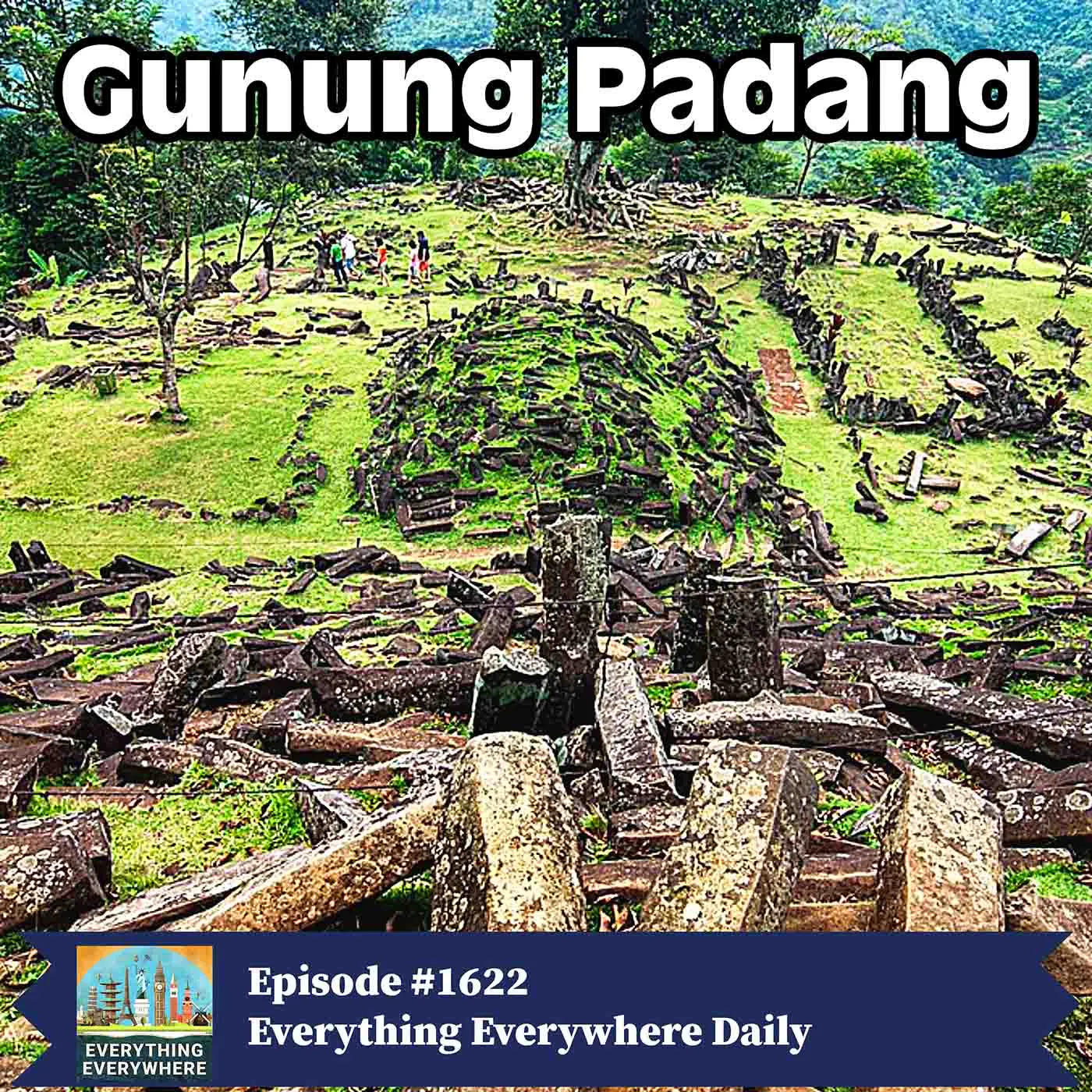
Everything Everywhere Daily: History, Science, Geography & More
Gunung Padang (Encore)
00:12:47
Learn more about one of the forgotten wonders of the world
Loading summary
Transcript1 lines
- [00:01]
Gary Arndt
The following is an encore presentation of Everything Everywhere Daily. Located on the island of Java in Indonesia, just about 100 kilometers from the capital of Jakarta lies what might be one of the most important archaeological sites in the world. While it's been known to locals for centuries and to professional archaeologists for over 100 years, it's only been seriously studied in the last several decades. Some of the estimates of the age of the site, if true, would radically transform what we know about early human civilization. Learn more about Gunung Padang, perhaps the oldest and largest pyramid in the world, on this episode of Everything Everywhere Daily. This episode is sponsored by Masterclass. If you're listening to this podcast, then you are someone who is curious about the world and loves to learn. And if you want to give the gift of learning and knowledge this Christmas, you can't do better than Masterclass. Masterclass offers online classes from some of the most successful instructors in the world in their fields. You can learn cooking from Gordon ramsay, conservation from Dr. Jane Goodall, disruptive entrepreneurship from Sir Richard Branson, mathematical thinking from Fields Medal winner Terence Tao, and diplomacy from former Secretaries of State Madeleine Albright and Condoleezza Rice. You can access over 200 classes across 11 different categories. Masterclass always has great offers during the holidays, sometimes up to as much as 50% off. Head over to masterclass.com everywhere for the current offer that's up to 50% off@masterclass.com everywhere. Once again, that's masterclass.com everywhere. This episode is sponsored by Quince. Finding the perfect gift can be pretty overwhelming. This year I found the perfect spot for timeless gifts made from premium materials. So you gotta check out Quince. Quince lets you treat your loved ones and yourself to true quality at an affordable price. I got a cotton fisherman throw blanket from Quince and I literally use it when I am writing many of the episodes for this podcast. I also have some Turkish cotton bath towels from Quince that I absolutely love. By partnering directly with top factories and cutting out the cost of the middleman, Quince passes the savings on to you. Quince is also on the nice list. They only work with factories that use safe, ethical and responsible manufacturing practices and they use premium fabrics and finishes for that luxury feel in every piece. Gift Luxury this holiday season without the luxury price tag. Go to quince.com daily for 365 day returns plus free shipping on your order. That's Q U I n c e.com daily to get free shipping and 365 day returns. Quince.com daily oftentimes when I do an episode about a famous location around the world, I'm able to throw in some sort of personal anecdote about my travels there. In the case of Gunung Padang, I don't have any. And it isn't because I haven't been to Indonesia. I have. I've been to Jakarta. And I could have easily visited Gunung Padang on a day trip if I had so desired. The problem is that I had no clue that Gunung Padam existed until several years after my trip to Jakarta. I'm guessing that many of you are probably in the same boat. Either your awareness of Gunung Padang came recently or you've never heard of it at all until now. So, unlike other noteworthy archaeological sites around the world, it's probably worth giving a brief explanation of what Gunung Padang exactly is. Is. Gunung Padang is a structure situated on a hill that consists of five different terraces built on top of each other. Each terrace has retaining walls which are made out of stones of long columns of volcanic rock. These terraces give the structure an appearance closer to that of a ziggurat, like those found in Mesopotamia. On top of everything are littered thousands of hexagonal stone columns similar to those that make up the retaining walls. Many of these are laid out in the shape of a rectangle or a square at the top, indicating that they form the outline of a building or a structure of of some sort. The entire structure is 110 meters or 360ft tall. It's sloped at an approximately 45 degree angle and there are 370 steps that will take you all the way to the top. The name Gunung Padang means mountain meadow, or alternatively mountain field in Sundanese. For everything I just said, I have to qualify it with. Maybe the reason for the qualification is that there just may be a whole lot more to the site than what we currently know. More on that in a bit. One of the reasons why Gunung Penang hasn't captured the attention of the world is because, unlike other famous megalithic structures, Gunung Penang is situated in the middle of a thick forest. Trees cover most of the structure, which from a distance makes it look like a naturally occurring hill. It's been dubbed Indonesia's Macu Picchu. Gunung Padang has been known to the people who live in the area for centuries, but it wasn't a site that was regularly visited. Given its location, many locals probably didn't even know exactly where it was located, as it wasn't a place that was high in their priority list. According to Sundanese tradition, the Sundanese being the native people who live in western Java, the structure was built by King Silawangi in a single evening. King Siliwangi was a legendary Hindu king who ruled prior to the arrival of Islam in Indonesia. He had a status similar to that of King Arthur in England. It's doubtful he actually existed, but he may have been modeled after one or more actual rulers. The earliest written reference to it occurred back in 1891, when Indonesia was still a Dutch colony. It was referenced in a history book of Java and mentions a single visit made by a man the year prior, known only as Mr. De Court. Despite the fact that the site was known, almost nothing was actually known about it. It was subsequently forgotten until 1979, when some local farmers rediscovered it. With its rediscovery, it immediately came to the attention of antiquities and archaeology authorities in Indonesia. Initial research was conducted in the 1980s, and in some very limited digs they managed to find evidence of pottery and other small artifacts. The initial dating of the pottery found at the site put it somewhere between 45 BC and the year 22, or about 2000 years old. However, the pottery discovered at the site only puts a ceiling on the age of the site, not a floor. Someone could have been occupying the site 2,000 years ago and left the pottery, but it doesn't mean that they built the site. Subsequent estimates have pushed the date back to about 500 to 800 BC. One of the largest and certainly most controversial studies of Gunung Padang began in 2010 by an Indonesian geologist by the name of Danny Natawadjaya. Natawadjaya and his team deployed tools which had not previously been used at Gunung Padang before. In particular, ground penetrating radar and seismic tomography. Here I should note that Nadewadjaya is an accomplished geologist. He's one of the best seismologists studying the Indonesian archipelago and a graduate of Caltech. However, he is not an archaeologist. As part of his research, he conducted an excavation of the site using a backhoe. Archaeology has advanced a lot over the last century. Many of the archaeological digs conducted in the 19th century were extremely destructive. Since then, standard archaeology techniques involve taking a very slow and methodological approach to digging up artifacts. If you've ever been witness to an actual dig, you'll notice how archaeologists will painstakingly use brushes and dental picks to carefully remove objects so they aren't damaged. And they also don't want to miss something which, even though small, could be Extremely important. The only thing worse than using a backhoe in the world of archaeology would probably be dynamite. The excavation immediately caused an uproar around the world and the archaeological community. The excavation ended soon after it began, in 2014. However, as bad as the dig was in terms of archaeological best practices, it did discover many things. Coins were found that were claimed to have been dated back about 5,000 years. They eventually stopped digging when they hit a layer made of sand. The biggest controversy occurred when Ngajawea and his team released their findings. They didn't actually release them in a formal academic paper, which is how almost all research is made public. Nadejaweda released his data in a report to the government and then in a poster which was displayed at the 2018 meeting of the American Geophysical Union. The conclusions that they reached were startling and have the potential to upend everything we know about early human civilization. Just a few minutes ago, when I was describing Gunung Padang, I used the word. Maybe that's because this giant complex built on a hill may in fact not be built on a hill, or at least not built on a hill as large as we think it is. According to Nadejaweda, what we can see is simply the top layer of a multilayer structure. The various layers were built on top of each other over an extended period of time. The top layer, he believes, is about 3,500 years old. Below that is another layer which is built of similar basalt columns which can be seen on the surface. These basalt columns, the researcher claims, are held together with a mortar made of clay, iron, and silica. The second layer is about 8,000 years old. The third and bottom layer may have caverns or other hollow spaces. And this layer may be between 9,500 to 28,000 years old. These last two claims about the age of the second and third layers would shatter our notions of early human civilization. If true, for the longest time, archaeologists thought that civilizations and megalithic structures only began about 6,000 years ago. If you remember back to my episode on Golbeki Tempe in Turkey that has been dated back 11,000 years, the discovering and dating of Golbeki Tempe completely rewrote what we knew about ancient people. And it even took a while for everyone to accept it. What's being claimed about Gunung Padang would be even more revolutionary if it was true. Needless to say, there has been a great deal of skepticism about this claim. For starters, the research team still hasn't published anything or made all of their findings public. Second, if you're going to make extraordinary claims like human civilization is twice as old as we think it is. You need extraordinary evidence. Right now, there isn't anything which can prove this theory beyond a reasonable doubt. Third, there isn't any sort of corroborating evidence anywhere else. No archaeological digs in the area have found anything which would indicate a culture that was capable of creating such structures so early. Finally, politics might be coming into play. The funding for the project was from the Indonesian government and the results of the research were first given to the government. If the findings are true, then it means that Gunung Padang would be both the oldest and largest pyramid in the world, bigger than the Great Pyramid of Giza in Egypt. It would be a huge coup for Indonesia both in terms of international prestige and tourism revenue. The vast majority of mainstream archaeologists have been very skeptical of the claims made by Ngtjawea. Other alternative and pseudoarchaeologists have embraced the theory as it supports many of their preconceived notions for when civilization began. What we can say for certain right now is that there has been very little research conducted at Gunung Padang since its rediscovery in 1979. If the claims of Daniel Ngadawijaya are true, then proving them will require a lot more evidence than what we currently have, and it will require excavations using much better techniques than what they used. What pretty much everyone can agree on is that Gunung Padang is a very special place that is deserving of more study. As it currently stands, Gunung Padang is pretty much still a giant mystery. We don't know who built it, we don't know when it was built, and we really don't even know how big it truly is. Hopefully more funding and attention will be spent at the site over the next several decades to help answer many of the outstanding questions which surround Gunung Padang. The executive producer of Everything Everywhere Daily is Charles Daniel. The associate producers are Benji Long and Cameron Keever. I want to give a big shout out to everyone who supports the show over on Patreon, including the show's producers. Your support helps me put out a show every single day and also Patreon is currently the only place where Everything Everywhere Daily merchandise is available to the top tier of supporters. If you'd like to talk to other listeners of the show and members of the Completionist Club, you can join the Everything Everywhere Daily Facebook group or Discord server. Links to everything are in the show Notes.