← Everything Everywhere Daily: History, Science, Geography & More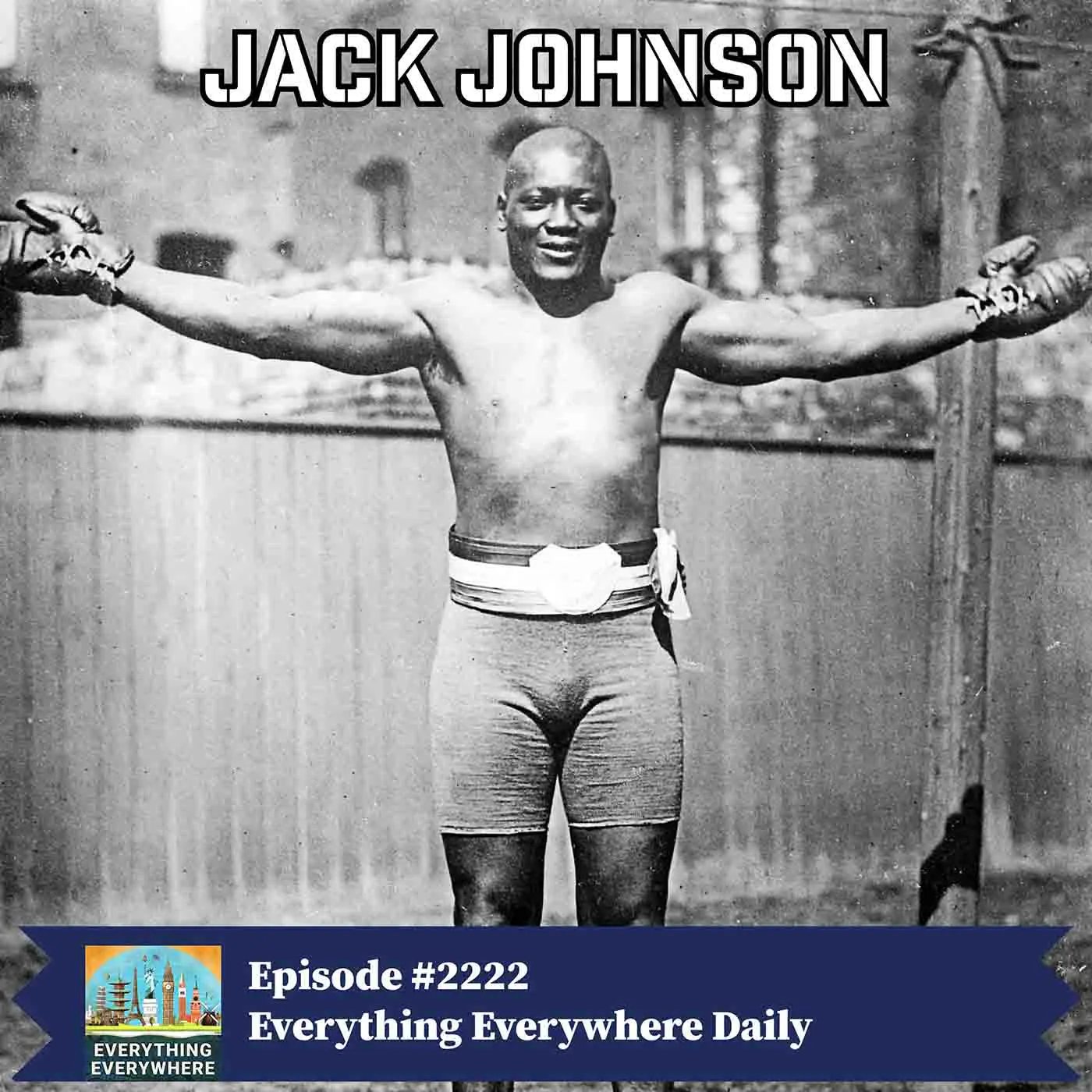
Everything Everywhere Daily: History, Science, Geography & More
Heavyweight Champion Jack Johnson
00:15:40
Loading summary
Transcript1 lines
- [00:00]
A
In the early 20th century, one title in sport stood above all others. The Boxing Heavyweight champion of the world. It was the epitome of athletic prowess and at that point every champion had been white. In 1908, however, one man shattered the color barrier and sent seismic shockwaves through society that would be felt for decades. Learn more about Jack Johnson and his historic championship reign on this episode of Everything Everywhere Daily. This episode is sponsored by Quint's. For a while I've been telling you about Quints. I have sweaters, T shirts, blankets and towels that I've all gotten from Quince. That's because Quince is at the sweet spot of high quality and low prices. They provide some of the same products that you'll find from other luxury brands for a fraction of the price. Go to their website and they will show you exactly who the brands are and the prices and the savings are astonishing. Everything at Quint's is priced 50 to 80% less than similar brands. They work directly with ethical factories and cut out the middleman. So you're paying for high quality, not brand markup. Upgrade your everyday Download the Quints app for app exclusive offers or go to quints.com daily for free shipping on your order and 3, 365 day returns. Now available in Canada and the UK too. That's quince.com daily for free shipping and 365 day returns. Quince.com daily. This episode is sponsored by Square. There's a local cafe I visit where paying is almost effortless. They use Square and whether I'm tapping a card or leaving a tip, the whole process takes just a few seconds. That smooth checkout means the staff can spend less time wrestling with technology and more time dealing with customers. That's what Square does for businesses. It brings payments, point of sale, inventory, staffing and online sales together in one system. Its AI powered tools can handle routine tasks, while real insights help owners make smarter decisions. Square can work for someone opening their first location or a business expanding into several. With Free plus and premium plans, transparent pricing and no long term contracts, Square helps you run your business more smoothly, bringing payments, operations and insights together in one place so you're ready for whatever next. Right now, listeners can get up to $200 off square hardware when you sign up at square.com godaily that's sq U-A-R-E.com godaily get started with Square and build a setup that works the way you do. The incredible story of Jack Johnson began in 1878 when he was Born into poverty in Galveston, Texas, the child of former slaves, Johnson quit school in the fifth grade to take manual labor jobs to help support his family. His entry into the world of boxing was through the Jim Crow era battle royales. In a battle royale, white spectators watched and threw coins as promoters forced a group of black men into a ring to beat each other until only one man remained standing. Johnson had talent and began training as a boxer, soon finding himself fighting in private clubs in the Galveston area in the late 19th century. The proper fighting style was aggressive with an emphasis on brawling. Johnson's style was based on a high handed defense, quick feet and counter punching. He also employed clinching tactics to frustrate his opponents. Johnson was not known for quick knockouts. He let his opponents tire themselves out and often defeated them in late 20 round fights. However, it was taunting and psychological intimidation that were perhaps Johnson's greatest skills. Well before Muhammad Ali was known for his quick tongue, there was Jack Johnson. Johnson was almost always talking during his fights. His defense was so strong that he often sat back and mocked his opponents, their corner and even people in the crowd who offended him. Johnson's style was not one designed to win over fans, but it did win fights. In 1903, Johnson defeated Denver Ed Martin to capture the colored heavyweight championship of the world. Johnson had reached the top of the mountain for a black fighter in Jim Crow America. Like many aspects of American public life, boxing was strictly segregated and white sports writers only acknowledged the white title holder as the legitimate champion of the world. Jim Jeffries, the reigning world champion, had drawn the color line and refused to fight Johnson or any other black contender. Social expectations of the era demanded that a black athlete be quiet, humble and know his place. But Jack Johnson had no intention of doing any of that. Rather than maintaining a silent humility, Johnson took his prize money and trailed Jim Jefferies from city to city. Across the country he sat front row at Jeffries fights, openly mocking him from ringside and relentlessly calling him out for refusing to step in the ring with a black man. With pressure mounting, Jeffries maintained his resolve not to fight Johnson and chose to retire to his alfalfa farm in 1905. Bypassing Johnson, Jeffery set up a match between the top two white contenders to take the belt and he even refereed the fight. Marvin Hart assumed the title in 1905, but he wouldn't hold it for long as he was beaten in 1906 by Canadian champion Tommy Burns. Burns adopted Jeffrey's aversion to fighting Johnson again. Johnson was undeterred he he trailed Burns all over the world and taunted him in the press. Jack London, the famed author of books such as White Fang and Call the Wild at the time was a writer for the New York Herald and the San Francisco Call. He took notice of Johnson's pursuit. Reflecting both the prevailing racial biases of his era and his own personal prejudices. London directed shockingly disturbing language towards the black heavyweight champion. After years of being goaded, Tommy Burns finally relented and said he would fight Johnson. But he named a price so high he was sure that nobody would ever rise to pay it. He apparently was not familiar with hugh huge deal McIntosh, a flamboyant promoter who met Byrnes asking price of $30,000 and set December 26, 1908 as the date for a fight in Sydney, Australia. The fight created a global sensation with massive social implications on both sides. Held in a hastily built stadium in Rushcutters Bay, a suburb of Sydney, the fight was set for 23 minute rounds. Boxing historian Bert Sugar noted that Johnson didn't see a black face in the crowd and bore an incredible onslaught of racial insults. However, it had no impact on him. The fight was an embarrassment for Tommy Burns. For 14 agonizing rounds, Jack Johnson dinges beat Tommy Burns. He systematically dismantled him. Every time that Burns crumpled on the edge of defeat, Johnson reached down, propped the champion back up on his feet and continued the beating. All the while, Johnson mocked Byrnes, smiling into the ringside cameras and at the filmmakers. The racial epithets that bore down on Johnson in the early rounds turned into a desperate collective cry of Stop the fight. The crowd could not bear to see the white champion lose. As Johnson was poised to put Burns on the mat in the 14th round, the police rushed in and stopped the fight, ordering the cameras to stop rolling. The authorities couldn't stop Johnson from winning, but they could censor the moment, sparing Burns and those who couldn't stomach the idea of a black champion. The the indignity of having to see it. Even Jack London was impressed, calling Johnson a colossus and Burns a child. Characterizing the fight as a massacre, Johnson mused about Burns after the fight in his usual bravado. Burns was a strong fellow with a good right hand punch, but I had forgotten more about boxing than Burns ever knew. By framing it as an intellectual defeat as well as a physical beating, Johnson sought to undermine one other core element of the racial attitudes of the era. Era the myth of intellectual superiority. Johnson became a foundational figure in the new Negro movement permeating black America. Amid the great Migration in northern cities, ultimately leading to the Harlem Renaissance, which I covered in a previous episode. Johnson embodied this new attitude by using his platform to command respect and social freedom. He was not going to sit idly by and be the humble champion that his opponents demanded. In fact, he wore tailored suits, spent frivolously, drove high powered European sports cars, opened his own luxury night spots and publicly dated white women, all while staring down a nation that lynched black men for far less. He didn't just break the rules of Jim Crow America, he ignored their existence entirely. For white America, this was an incomprehensible provocation. From the moment he won the title from Tommy Burns, Johnson was a target of vicious public criticism, particularly in the nation's newspapers. They rose quickly to challenge the legitimacy of Johnson's title, claiming that Jim Jeffries had retired as the true champion and until Johnson defeated him, he wasn't legitimate. Johnson responded by announcing that he would fight Jim Jeffries or any other man who challenged for his title. Johnson's willingness to fight all comers inspired a movement called the Great White Hope era, which prompted white Americans to find someone to beat Jack Johnson. Led by Jack London's calls for Jeffries to return to the ring, the nation's newspapers issued calls for anyone to rise and defeat Johnson. And while Jeffries ignored the call, the nation's promoters scoured the country for a worthy challenger. Johnson quickly defeated inexperienced fighters such as Victor McLachlan, Philadelphia Jack O', Brien, Tony Ross, Big Al Kaufman, and the middleweight champion Stanley Ketchel, whose teeth actually ended up embedded in Johnson's gloves. After a ferocious knockout, the energy against Johnson was growing, and Johnson only fueled the outrage with his very public romantic relationships with a series of white women. To Johnson, he he had the freedom to do whatever he wanted, and he didn't owe anyone an explanation. Black leaders like Booker T. Washington urged him to tone down his behavior, warning that his defiance was stroking an already dangerous racial backlash across the country. The black press and religious leaders joined the crusade, praising his otherworldly boxing abilities while also challenging his persistent disregard of social norms. Johnson, however, refused to listen. White America finally got its wish. When Jim Jefferies had seen enough in 1910, he agreed to come out of retirement and fight Jack Johnson on the fourth of July in Reno, Nevada. The fight aroused nationwide attention with telegraphed updates to crowds across the country and plans in place for a massive film release provided Jeffries won as expected. Jack Johnson, however, had other ideas. The fight illustrated two truths. One, Johnson was one of the greatest fighters in history. And two Jeffries had been retired too long. Johnson pounded Jeffries for 15 rounds until Jeffries corner could take no more and called the fight. The nation was on a knife edge after the victory as riots broke out all across the country. The fight triggered the first massive nationwide race riots in American history, killing dozens, injuring hundreds, and standing as the largest racial unrest the country would see until the aftermath of Martin Luther King Jr. S assassination 58 years later. In wake of the victory, Johnson maintained a profound and divisive confidence. As he noted, I won from Mr. Jeffries because I outclassed him in every department of the fighting game. Before I entered the ring, I was certain I would be the victor. I never changed my mind at any time. It was now clear that they were not going to defeat Johnson in the ring. So his enemies plotted to defeat him outside the ring. They intended to use the mann act of 1910 to take him down. The Mann act was passed amid increasing hysteria surrounding the perception that there was a growing practice of trafficking white women for use in prostitution. Jack Johnson was targeted under the act simply for traveling across state lines with his white female companions, turning a law meant for sex trafficking into a weapon against interracial relationships. He was tried in 1912 when the Justice Department brought charges against him for violating the Mann act arising from an unsuccessful relationship with a woman named Lucille Cameron and a successful relationship with a woman named Belle Schreiber. He was convicted and sentenced to a year in prison when an all white jury found him guilty of buying Schreiber a train ticket and and transporting her across state lines. But instead of going to prison, Johnson fled to Canada and lived abroad as a fugitive for seven years. This was not the only act of Congress that seemed targeted at Johnson. They also passed a law banning the transport of fight films across state lines. Fearing the impact of people watching him defeat white fighters during his exile, he agreed to fight another white hope, a giant man from Kansas named Jess Willard. The fight was scheduled for Havana in April of 1915. Johnson was 37 at the time of the fight and he hadn't trained properly while living as a fugitive and on the run. And he had been drinking far too heavily. The fight was set up as a 45 round match in the heat of the Havana sun. The much younger Willard had far fewer problems with the heat. And as the fight Wore into the 26th round, the Johnson ran out of steam and was knocked out for the first time in nearly 15 years. While Black Americans mourned the defeat, white America celebrated it as a return to normalcy, Johnson had finally lost and was growing weary of life as a fugitive. In 1920, he arranged to surrender to authorities in California. After serving less than a year for his violations of the Mann Act, Johnson returned to public life. While he only boxed in exhibitions, he acted in vaudeville plays, played in a jazz ensemble, patented a new type of wrench, and opened Club Deluxe in Manhattan, which would later be purchased and renamed the Cotton Club, spawning the careers of Duke Ellington, Louis Armstrong and many others. On June 10, 1946, at the age of 68, Jack Johnson died in a high speed car crash just outside of Raleigh, North Carolina. Moments earlier, he and a white traveling companion had been refused service at a local lunch counter. Told to eat out of sight, behind the building, or not at all, Johnson angrily protested and walked out. Jack Johnson's life was defined by extraordinary talent, fierce independence, and a refusal to accept the limits imposed on him by a deeply racist society. His victories in the ring made him a world champion, but his confidence and personal freedom made him a target outside of it. Although he paid a heavy price for defying the conventions of his era, Johnson permanently changed boxing and became a symbol of resistance whose importance extended far beyond sports. The executive producer of Everything Everywhere Daily is Charles Daniel. The associate producers are Austin Otkin and Cameron Kiefer. Research and writing for this episode was provided by Joel Hermanson. My big thanks go to everyone who supports the show over on Patreon. Your support helps make this podcast possible. I also want to remind everyone about the community groups on Facebook and Discord, as this is where everything happens outside of the podcast. As always, if you leave a review on any of the major podcast apps, you too can have it running the show.