Loading summary
Transcript7 lines
- [00:01]
A
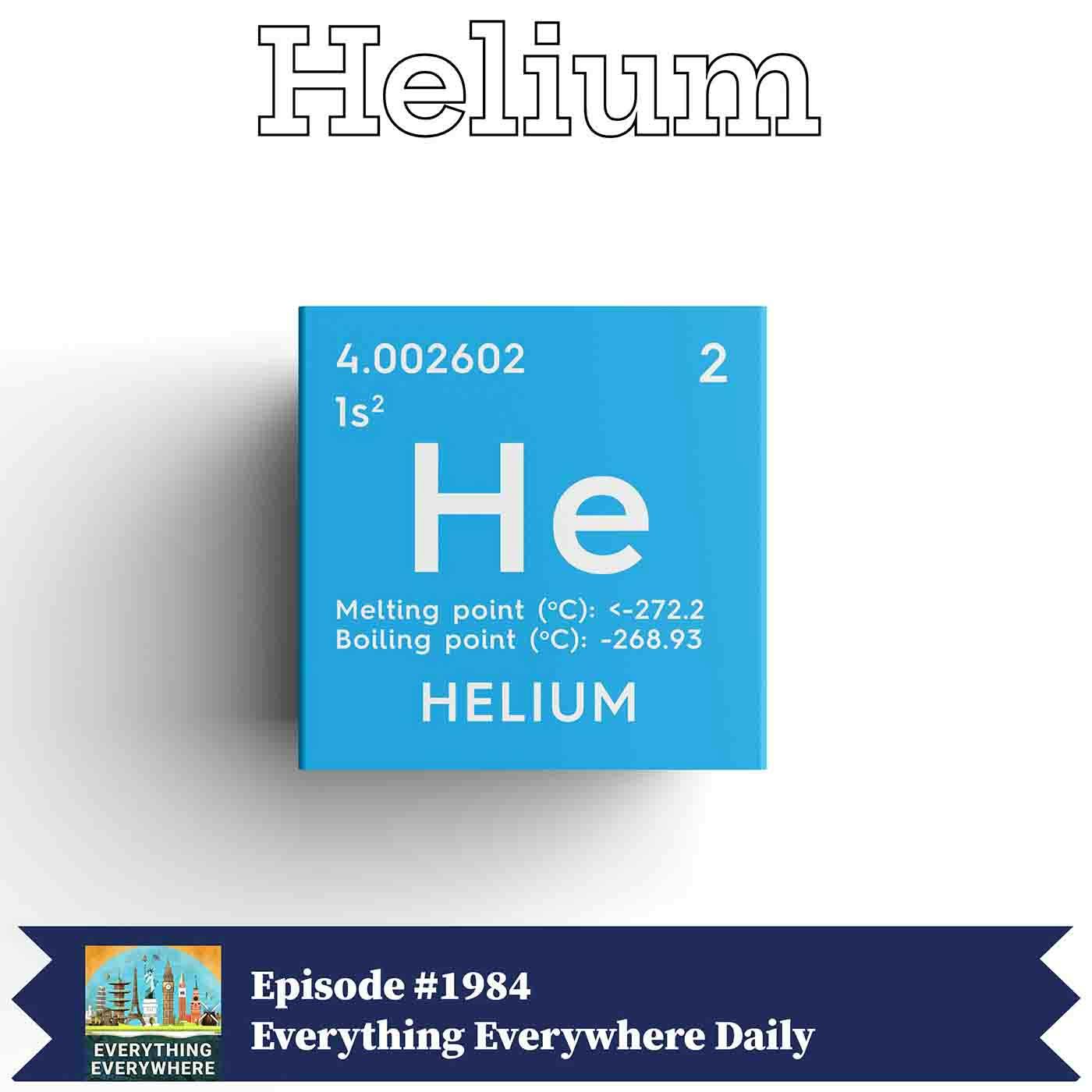
Sitting at the far top right of the periodic table is the element Helium. Helium is the second lightest and second most abundant element in the universe. It's also an inert gas that doesn't form molecules with anything. It has extremely few uses and despite its cosmic abundance, is very hard to find on Earth. Yet in the future, it might become one of the most valuable substances in the entire world. Learn more about Helium, its discovery, its uses, and its potential future on this episode of Everything Everywhere Daily.
- [00:45]
This episode is sponsored by Aura Frames. If you're looking for a gift for someone close to you, I highly recommend checking out Aura Frames with auraframes. You can set it up in about two minutes and share memories all year long. You can upload directly from the Aura app on your smartphone and share your images more securely than email or social media. It can also display short videos up to 30 seconds long with audio. Auraframes have meticulously calibrated high resolution displays. Unless you look really closely or see a photo transition, you'd never even know it was a screen. I have an auraframe in my house and I love it as it's a great and simple way for me to display the many thousands of photos I've taken on my travels. For a limited time, save on the perfect gift by visiting auraframes.com to get $35 off Aura's best selling Carver mat frames, named one by Wirecutter by using promo code daily at checkout. That's auraframes.com promo code daily. The deal is exclusive to podcast listeners and frames sell out fast, so order yours now to get it in time for the holidays. Support the show by mentioning it at checkout. Terms and conditions apply. This episode is sponsored by Uncommon Goods. The holidays are almost here and if you still have names on your list, don't panic. Uncommon Goods makes holiday shopping stress free and joyful with thousands of one of a kind gifts you can't find anywhere else, you'll discover presents that feel meaningful and personal. Never rushed or last minute. Uncommon Goods looks for high quality, unique products, often handmade or made in the United States. Independent artists and small business craft many, so every gift feels special and thoughtfully chosen. Uncommon Goods has tons of custom made gifts, including everything from sweaters with a picture of your dog to cribbage boards with your family's name. Uncommon Goods has something for everyone from sports fans to grandparents to kids and hobbyists. They're also an excellent source for Christmas decorations and ornaments, so don't wait. Make this holiday the year you give something truly unforgettable. To get 15% off your next gift, go to UncommonGoods.com daily. That's UncommonGoods.com daily for 15% off. Don't miss out on this limited time. Offer uncommon goods we're all out of the Ordinary.
- [03:03]
Helium is in many respects the oddest element on the periodic table. It has an atomic number of two with two protons in its nucleus. That makes it an inert gas with both electrons in its first shell filled helium has two stable isotopes. The most common isotope is by far helium 4, which has two neutrons in the nucleus. Helium 4 constitutes 99.99998% of all helium. The other isotope is helium 3, which has only one neutron. It constitutes 0.0002% of all helium. Despite the incredibly small amount of helium 3, it is extremely important. As we'll see in a bit. Helium is created via the fusion of hydrogen, which is the primary form of fusion in stars. As such, helium is the second most abundant element in the universe, with 24% of all the elemental mass in the universe. There is 12 times more helium by mass than all the other heavier elements in the universe combined. Helium has the lowest boiling point of any element at 4.2 degrees Kelvin, or minus 268.9 degrees Celsius, or minus 452.07 degrees Fahrenheit. @ normal pressures, helium cannot freeze. However, when pressures are increased to about 25 times atmospheric pressure and temperatures are close to absolute zero, then it can become a solid liquid. Helium exists in a bizarre quantum state known as superfluidity, allowing it to flow without friction, climb walls, and escape containers through microscopic gaps. Despite the abundance of helium in the cosmos, there is shockingly little of it on Earth. Because it's inert, there's no helium chemically bound in rocks, any helium that reaches the atmosphere will rise and escape into space. The story of helium's discovery is one of the strangest in the history of chemistry because it was first found not on Earth but in the Sun. Helium's history begins during the solar eclipse of August 18, 1868, when French astronomer Pierre Jules Cesair Janssen traveled to India to study the Sun's chromosphere using a spectroscope. By observing sunlight passing through a prism, he expected to see known spectral lines produced by elements such as hydrogen. Instead, he found a bright yellow line that didn't match any earthly element. He reported the anomaly immediately. Unbeknownst to him, English astronomer Norman Lockyer independently observed the exact same unexplained line. Because spectroscopic lines were reliable signatures of chemical identity, and this line matched nothing cataloged, Lockyer concluded that it must represent an unknown element on Earth. He coined it helium, derived from the Greek helios, meaning sun, and proposed the remarkable idea that the sun contained an element humanity had never encountered. Although helium was discovered in the sky, no one really knew whether it truly existed on Earth. The race to find it took nearly 30 years. In 1881, Italian physicist Luigi Palmieri detected unusual spectral features in gases emitted by Mount Vesuvius. But the evidence remained inconclusive. Terrestrial confirmation finally came in 1895, when Scottish chemist Sir William Ramsay treated the uranium mineral clevite with acid to isolate the gases that it released. Among them, he found a light gas that produced the exact same yellow spectral line as seen in the solar observations. Ramsay had effectively captured helium in a test tube. Around the same time, Swedish chemists Per Clave and Nils Langlett also extracted helium from clevite, confirming Ramsay's findings independently. While most of the helium in the universe is produced via the fusion of hydrogen, there is another method by which it could be radioactive decay. When a radioactive isotope undergoes alpha decay, it ejects two protons and two neutrons from its nucleus. In other words, a helium atom. The decay of uranium and thorium is how most of the helium on Earth was created. As almost all radioactive decay occurs below the surface of the Earth, helium can slowly migrate upwards over time and accumulate in pockets of natural gas. This is why nearly all helium extracted today comes from natural gas fields. Some of the richest deposits, like those in the United States, Great Plains, contain concentrations high enough to justify separating helium from methane and other components through cryogenic processing. Helium's uses are far broader and more strategically important than most people realize. Because it's inert, non toxic, non flammable, extremely light, and capable of reaching the lowest boiling point of any element. It fills a set of industrial and commercial niches that almost no other substance can. One major application is in cryogenics, where liquid helium's ultra low temperature is essential for cooling superconducting magnets. This makes it indispensable for MRI machines, many types of particle accelerators, magnetic resonance research, and some quantum computing systems. Its unique properties also make it a critical coolant in certain nuclear reactors and low temperature physics experiments that study phenomena near absolute zero. Helium plays an important role in manufacturing and materials science because it is inert and doesn't react chemically. It is used as a shielding gas in arc welding, particularly for aluminum and other metals that oxidize easily. Semiconductor fabrication also relies on helium to create controlled atmospheres, cool components, and purge systems. Fiber optic cable production requires helium to prevent imperfections in the glass structure. In aerospace and rocketry, helium is used to pressurize fuel and oxidizer tanks, purge lines, and provide stable, non reactive environments. Its reliability under extreme conditions has led to its use in virtually every major space program since the early days of rocketry. Helium also has a role in deep sea diving where mixtures such as Heliox allow divers to breathe safely. At depths where nitrogen becomes narcotic, there are numerous commercial uses as well. It aids in the production of specialized scientific instruments in gas chromatography and in controlled atmosphere environments for preserving sensitive materials. Even in medical treatments. Helium oxygen mixtures can support patients with respiratory issues. Because helium's low density reduces airway resistance, it's used in leak detection systems because helium's tiny atoms can escape even the smallest gaps and are detected at extremely low concentrations. Most people are familiar with helium's filling balloons and blimps. Because it's far safer than hydrogen, it is the preferred lifting gas. And of course, most of you have probably experienced the effect of helium. When you inhale it, it will temporarily make your voice sound like a cartoon character. The reason why this happens is pretty straightforward. People speak in a high pitched voice after inhaling helium because the gas dramatically changes how sound travels through the vocal tract. The physics is simple. Helium is much less dense than air and and sound waves move through it much faster. That change in the speed of sound alters the resonant frequencies of the cavities in your mouth, throat, and nasal passages. Helium is safe to inhale insofar as it isn't toxic and can't interact with anything in your body. But if you inhale too much, it can displace oxygen in your lungs. Because demand for helium has increased with the rise of high tech uses such as semiconductor manufacturing and MRIs, and because the supply of helium is very finite, There have been growing concerns about a helium shortage. Unlike oil or natural gas, the supply of helium can't just be ramped up if the price increases. Only a few natural gas fields have enough helium to extract it economically. When these fields decline, or when natural gas markets shift for unrelated reasons, helium supply tightens. The industry also struggles with the long lead times required to build extraction, purification, and storage infrastructure, combined with the occasional geopolitical disruptions and maintenance shutdowns at major processing plants. The global market has experienced repeated helium crises over the last two decades, leading to price spikes and shortages that hit hospitals and research labs the hardest. The United States Strategic Helium Reserve was created to buffer exactly this kind of volatility. Established in 1925, it had nothing to do originally with semiconductors or medical imaging. The federal government wanted a secure supply of helium for military airships. Over time, Congress expanded the reserve, leading to the creation of the vast Bush Dome storage facility near Amarillo, Texas. This facility became a global price stabilizer because it allowed the US to stockpile enormous amounts of crude helium and then release it into the market during shortages. For decades, it was the world's largest single source of helium and effectively the backbone of the global helium supply. However, the reserve also created distortions. Under the 1996 Helium Privatization Act, Congress ordered the government to sell off the reserve to recoup its debts, forcing helium into the market at artificially low prices. Cheap helium discouraged investment in new extraction and encouraged wasteful uses, while also making the industry dependent on a resource that was being intentionally depleted. As the reserve was gradually depleted and privatized, the market lost its stabilizer. There is one other thing about helium that I alluded to at the start of this episode, and it might be the most critical use of helium in history and has the potential to reshape society. Nuclear fusion and quantum computing both require helium. The problem is it requires helium 3, that isotope of helium, which represents only 0.0002% of all helium. Many of the most promising quantum computing platforms, including superconducting qubits, topological qubits, and some spin based systems, must be operated at temperatures where thermal noise is essentially eliminated when mixed with helium 4. Helium 3 allows the creation of dilution refrigerators, the only practical devices capable of reliably reaching temperatures in the millikelvin range, just thousandths of 1 degree above absolute zero. Helium 3 is attractive in fusion because when it fuses with deuterium, it produces almost no neutrons, releasing its energy mainly as charged particles. That means, in principle, a helium 3 fusion reactor could create power with far less radioactive damage and simpler shielding and the possibility of directly converting particle energy into electricity.
- [14:40]
However, as you may have guessed, the problem is Helium 3 is really, really rare. Outside of exotic particles like antimatter, which can only be created a few atoms at a time, Helium 3 is the most valuable elemental substance on Earth. A kilogram of it can sell for as much as $20 million.
- [15:05]
So if we're going to need more helium 3 and helium 3 is just a tiny, tiny fraction of all the helium produced. And if helium is already in short supply. Where in the world are we going to get Helium 3 from one place we're not going to get it is from Earth. There just isn't enough. Nor can we make any One place that does have a lot of helium is the sun, and the sun throws off a lot of helium in the solar wind. However, the Earth's magnetic field causes most of that to be deflected off into space. So the best bet for finding Helium 3 would be the moon. Over the course of billions of years, Helium 3 has been ejected from the sun and has lodged into the lunar regolith on the surface. Lunar mining of helium 3 would involve collecting and processing the thin layer of regolith in which the isotope has been implanted over billions of years by the solar wind. Because helium 3 only exists in trace amounts, mining would resemble large scale surface strip mining processing rather than deep excavations. Robots or bulldozer like vehicles would scoop up vast quantities of lunar soil and deliver it to a processing plant where the regolith would be heated to several hundred degrees Celsius to release the trapped gases. Those gases would then be captured, cooled and separated so that the tiny fraction of helium 3 can be isolated from far more abundant helium 4 and other volatile gases. At $20 million per kilogram, helium 3 mining might make a lunar base cost effective.
- [16:47]
Helium is a lot more than party balloons. Its inertness, its lightness and its low boiling point make it uniquely suited for many tasks. And it's entirely possible that helium will become even more important in the future as new technologies exploit the properties of the helium 3 isotope.
- [17:10]
The executive producer of Everything Everywhere Daily is Charles Daniel. He the associate producers are Austin Otkin and Cameron Keefer. My big thanks go to everyone who supports the show over on Patreon. Your support helps make this podcast possible, and I also want to remind everyone about the community groups on Facebook and Discord. That's where everything happens that's outside the podcast, and links to those are available in the show Notes. As always, if you leave a review on any major podcast app or in the above community groups, you too can have it read in the show.