← Everything Everywhere Daily: History, Science, Geography & More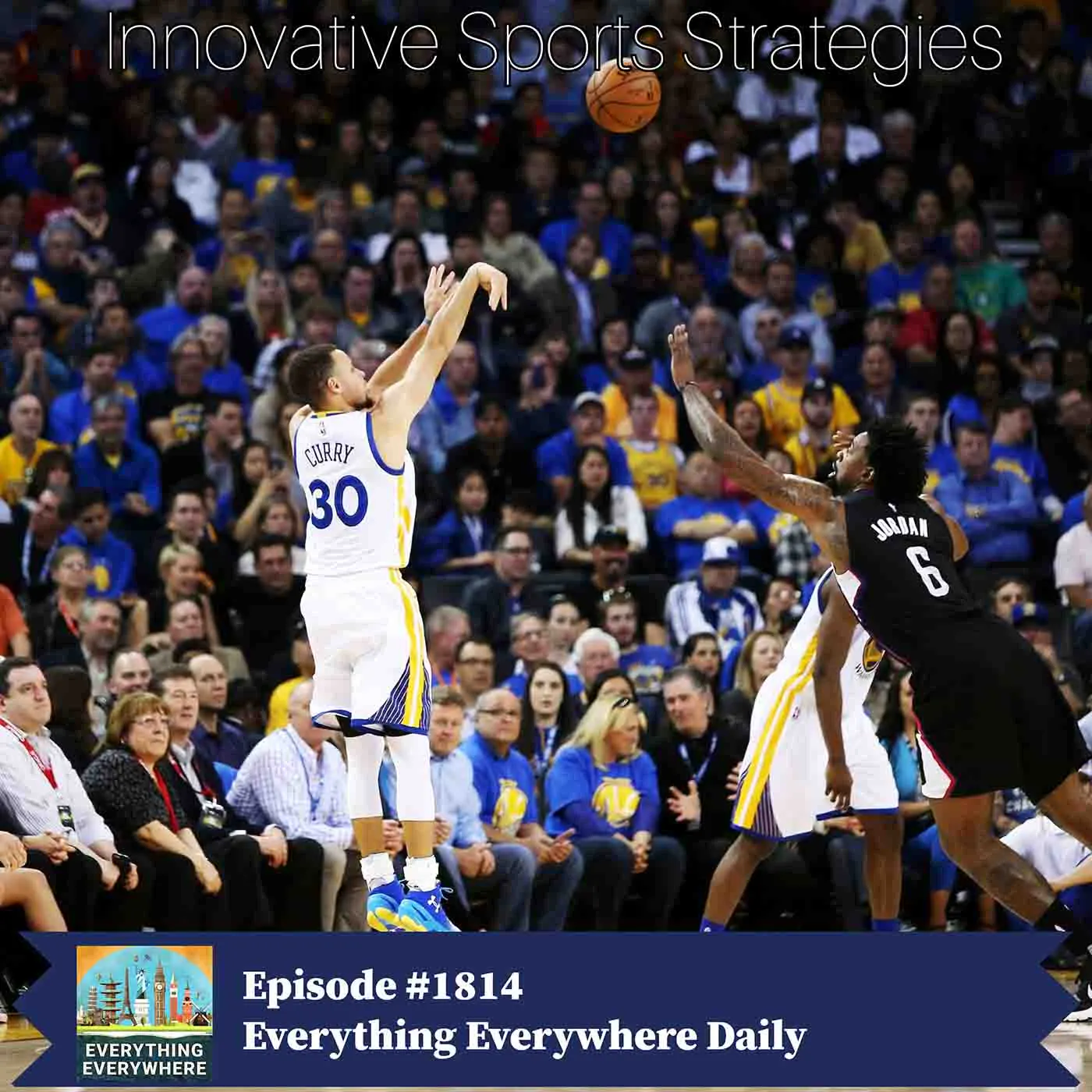
Loading summary
Transcript3 lines
- [00:01]
Host
All sports are governed by a body of rules. Within those rules, there's usually a set of norms for how the game should be played. Most coaches will instruct their players to use similar techniques. However, every so often, someone comes along who totally rethinks how a game can be played using the same set of rules. They come up with a totally different approach to the game, which sometimes can be revolutionary and other times it's simply evolutionary. Learn more about innovative sports strategies and how taking a different approach to a game can lead to positive results on this episode of Everything Everywhere Daily this episode is sponsored by Quint's. It's summertime and that means it's time to bring out the summer clothes. If you're looking to update your wardrobe this summer, I suggest you check out Quints. Quints has all the things you actually want to wear this summer, like organic cotton silk polos, European linen beach shorts, and comfortable pants that work for everything from hanging out in the backyard to nice dinners. And the best part? Everything with Quint's is half the cost of similar brands. By working directly with top artisans and cutting out the middleman, Quint's gives you luxury pieces without the markups. I recently needed a new duvet and I went to Quint's and picked up a great one that looked much better than what I had before, and all at a fraction of the price I'd pay elsewhere. Stick to the staples that last with elevated essentials from quince. Go to quince.com daily for free shipping on your order and 365 day returns. That's Q-U-N-C-E.com daily to get free shipping and 365 day returns. Quints.com daily.
- [01:54]
Quinton
Location the lab Quinton only has 24 hours to sell his car. Is that even possible? He goes to Carvana.com what is this, a movie trailer? He ignores the doubters, enters his license plate. Wow, that's a great offer. The car is sold, but will Carvana pick it up in time for it? They'll literally pick it up tomorrow morning. Done with the dramatics? Car selling in record time? Save your time. Go to Carvana.com and sell your car today. Pickup fees may apply.
- [02:26]
Host
In previous episodes, I covered several innovations in individual sports. These included the Fosberry Flop, developed by Dick Fosberry. Fosberry developed a new technique that revolutionized the high jump. His new technique won him the gold medal in the high jump at the 1968 Olympics, and eventually every high jumper adopted the Fosbury Flop Some techniques were effective, but perhaps they were a bit too effective. New Zealand long jumper Tuariki Delamere realized the biomechanics of the long jump would work better if you did a front flip in mid air to preserve your forward momentum. He used it at the 1974 Pacific 8 Championship and did a jump that would have been a world record if it had not been for Bob Beamon's insane jump at the 1968 Olympics. The powers that be banned this technique, citing it as being too dangerous, even though gymnasts seemed to have no problem doing flips in midair. Likewise, Spanish javelin throwers found that they could crush the world record by throwing the javelin like a discus, and this too was banned, although this had more to do with the dangers of impaling spectators. In this episode I want to examine similar innovations that have developed in team sports. These usually aren't as dramatic as a single technique, but the results can often be the same. And I want to start with one of the most innovative but not necessarily successful approaches to playing association football, AKA Soccer. Total Football Total Football is one of the most influential and revolutionary tactical philosophies in the history of soccer. It was developed in the Netherlands in the 1960s and 70s, reaching its peak with Amsterdam, Ajax and the Dutch national team during the 1974 World Cup. Its key premise is that any player other than the goalie can take over the role of any other player, creating a highly dynamic and fluid system where the positions and responsibilities are totally interchangeable. The philosophy of Total Football took shape under the visionary leadership of Renus Mickels, who began his managerial career at ajax in the mid-1960s. Mickles emphasized tactical intelligence, fitness and positional flexibility. He built a team where defenders could surge forward into attack, forwards could drop into defense, and midfielders covered all spaces as needed. Players were expected to read the game intuitively and constantly adapt. This system relied on a highly technical and disciplined squad, most notably exemplified by Johan Kruff, who became its on field orchestrator. Krif's exceptional footballing intelligence allowed him to influence the game from virtually any position, making him the epitome of of a total football player. Total football was not easy to pull off, which is why so few teams bothered to try it. It required fluidity in positioning where players switch roles seamlessly, high fitness levels because of the continuous movement required during the game, and positional awareness such that every player understands the entire team's shape and tactical plan. Ajax had an academy where they taught total football to young players so they could be accustomed to it should they ever make the top team? Total football did see limited Success. Ajax won three consecutive European Cups from 1971 to 1973. Playing in a total football style. In the 1974 World cup, the Dutch national team, with most of its core being drawn from Ajax and led by Kruf, found success. Despite losing to West Germany in the final, they introduced a thrilling, fast paced style of game that forever changed the tactics of soccer. Given the Netherlands size compared to other countries, it performed well. However, despite their success, total football never quite gained widespread adoption. That being said, many of its core concepts, such as pressing as a unit, positional play and encouraging technical skill in all the players are now standards at the highest level of soccer today. The chief insight of total football was that players and positions weren't set in stone. There's another sport that adopted a similar strategy with the repositioning of players, baseball. While baseball has set positions, there was nothing in the rule books that explicitly said where a given player had to play, it was just natural that the first baseman covered first base, etc. Etc. Normally there is no reason to radically move players around in the field. However, in the 1940s, one manager realized that moving players out of position might be a way to neutralize one of the game's best hitters. Lubo Drew was the player manager of the Cleveland Indians from 1942 to 1950. One of the biggest threats that the team faced was the Boston Red Sox and the great Ted Williams, one of the greatest hitters in history. Williams was a devastating hitter, but he had one thing that was highly predictable. He was a pole hitter. Williams as a left handed hitter, almost always hit the ball to the right side of the field. On July 14, 1946, the Indians and the Red Sox were playing a Sunday doubleheader in Boston. In the first game, Williams hit three home runs in a single, driving in eight runs. Between the two games. Boudreaux, frustrated with Williams performance, finally decided to do something that he had been thinking about doing for weeks. In Williams first at bat in the second game, he hit a double. In his second at bat, Boudreau yelled to the players in the field yo. And all the players moved to the right side of the field save for the left fielder who was just playing in a deep shortstop position. Boudreaux later said in his autobiography, quote, my plan was predicated on the belief that Williams, who made no secret of the fact that he wanted to be known as the greatest hitter of all time, which I think he was, would be too proud to adjust his style to counteract my strategy that it would be beneath his dignity to change. Known as the Boudreaux Shift, it became a historical curiosity. However, fast forward to the 2000s. Baseball became awash with advanced statistics, including spray charts which told defenses exactly where a hitter was most likely to hit a ball. The data told a very simple story. Put your players where the ball was likely to be hit. The Tampa Bay Rays and the Houston Astros pioneered the widespread use of the shift. Later, data driven front offices like those of the Dodgers and Yankees adopted it, leading to a Major League Baseball wide boom. By 2019, most teams shifted in some capacity on nearly a third of all plate appearances. By the early 2000s, widespread shifting resulted in lower batting averages, especially for left handed power hitters, more strikeouts and fewer balls in play, making the games feel less dynamic and much more boring. In response, Major League Baseball introduced new shift restrictions. Starting with the 2023 season, two infielders must be positioned on either side of second base at pitch release, and all infielders must have both feet in the infield dirt before the pitch. Like the forward somersault long jump, the infield shift simply proved to be too good. American football has seen its share of innovative strategies. Perhaps the best known and most successful has been dubbed the West Coast Offense. The West Coast Offense was developed and refined by Bill WALSH in the 1970s and 80s, fundamentally changing the way teams thought about passing and offensive strategy. Its origins trace back to Walsh's time as an assistant coach with the Cincinnati Bengals under Paul Brown. Walsh was looking for a way to work around an offensive line that couldn't hold blocks for very long and a quarterback who didn't have a very, very strong arm. To do this, he constructed an offense built around short, quick passes that would serve as an extension of the running game. Instead of relying on long throws, Walsh designed timing routes that allowed the quarterback to take three and five step drops, get the ball out quickly and hit receivers in stride. The idea was to control the ball, stretch the defense horizontally and force them to defend every blade of grass. When Walsh became the head coach of the San Francisco 49ers in 1979, he had the perfect quarterback to execute this vision in Joe Montana, which is why it's called the west coast offense. The 49ers offense relied on precision and ball control, utilizing short passes to backs, tight ends, and a new breed of athletic receivers who could gain yards after the catch. It was an offensive philosophy that de emphasized verticality and in favor of rhythm, spacing and consistency. The west coast offense quickly proved successful as the 49ers won four Super Bowls under Walsh and his successor George Seifert, and the concepts that they perfected reshaped modern offensive football. The philosophy has been adopted and adapted by almost every team and coach across the NFL ever since. Even today, elements of the west coast offense are still evident as teams continue to emphasize completion percentages, quick decision making, creating yards after the catch and spreading the ball to multiple targets, making Walsh's revolutionary concepts an enduring part of football strategy the last innovative strategy I want to cover comes from basketball. Unlike the previous strategies I've mentioned, which were created within the rules of the game, this strategy was a reaction to a rule change. The three Point Field Goal the three pointer was introduced to the NBA at the beginning of the 1979-1980 season. It was a direct import from the American Basketball association, which had adopted the shot in 1967 to add excitement and spacing to the game. At the time, most NBA coaches and players weren't sure what to do with the new scoring option. Early on, three pointers were considered a novelty, a long distance, low percentage shot that most teams rarely bothered to attempt. In the first season of the three pointer, teams averaged fewer than three attempts per game, often relegating the shot to end of quarter heaves or situations of desperation. For the next two decades, the three pointer remained a secondary weapon. Teams built their offenses around post play, mid range jumpers and driving to the rim. Players who specialized in long distance shooting like Larry Bird and Reggie Miller were respected for their accuracy. However, most coaches still believe the most efficient scoring happened closer to the basketball. What the coaches failed to realize was that the three point shot wasn't just one extra point, it was 50% more points. Taking a step back to the three point line for some shots might decrease your shooting percentage, but the increase in points would more than compensate for it. The real revolution happened in the 2010s with the emergence of Steph Curry and the Golden State Warriors. Curry's shooting range was almost unlimited. The warriors built their entire offensive system around ball movement and an avalanche of three point attempts. Other teams took note and the entire league started to follow suit. By 2020, most teams were taking 30 to 43 point attempts per game. The average number of three point attempts per game per team in the most recent NBA season was a record 3.37.6. In comparison, in the 1980-81 season the number was just 2. As 3 point attempts have gone up, 3 point shooting percentages have gone up as well and the team that attempts the most three pointers on average has a 55% chance of winning. The increased importance of the three point shot in the NBA wasn't a single aha moment by a single coach. Rather, it was an evolutionary change in strategy as teams recognized the simple fact that it worked. These examples I've covered in this episode are far from the only ones that exist in the world of sports, and if I know my audience, I'm sure many of you will notify me of other examples that I didn't cover. Sports, like war, are a constant battle of adaptation and innovation, which means that for every innovation and strategy, eventually something else will come along to counter it. The Executive producer of Everything Everywhere Daily is Charles Daniel. The associate producers are Austin Oakton and Cameron Kieffer. I want to thank everyone who supports the show over on Patreon. Your support helps make this podcast possible. I'd also like to thank all the members of the Everything Everywhere community who are active on the Facebook group and the Discord server. If you'd like to join in the discussion, there are links to both in the show notes and as always, if you leave a review or send me a boostogram, you too can have it read on the show.