← Everything Everywhere Daily: History, Science, Geography & More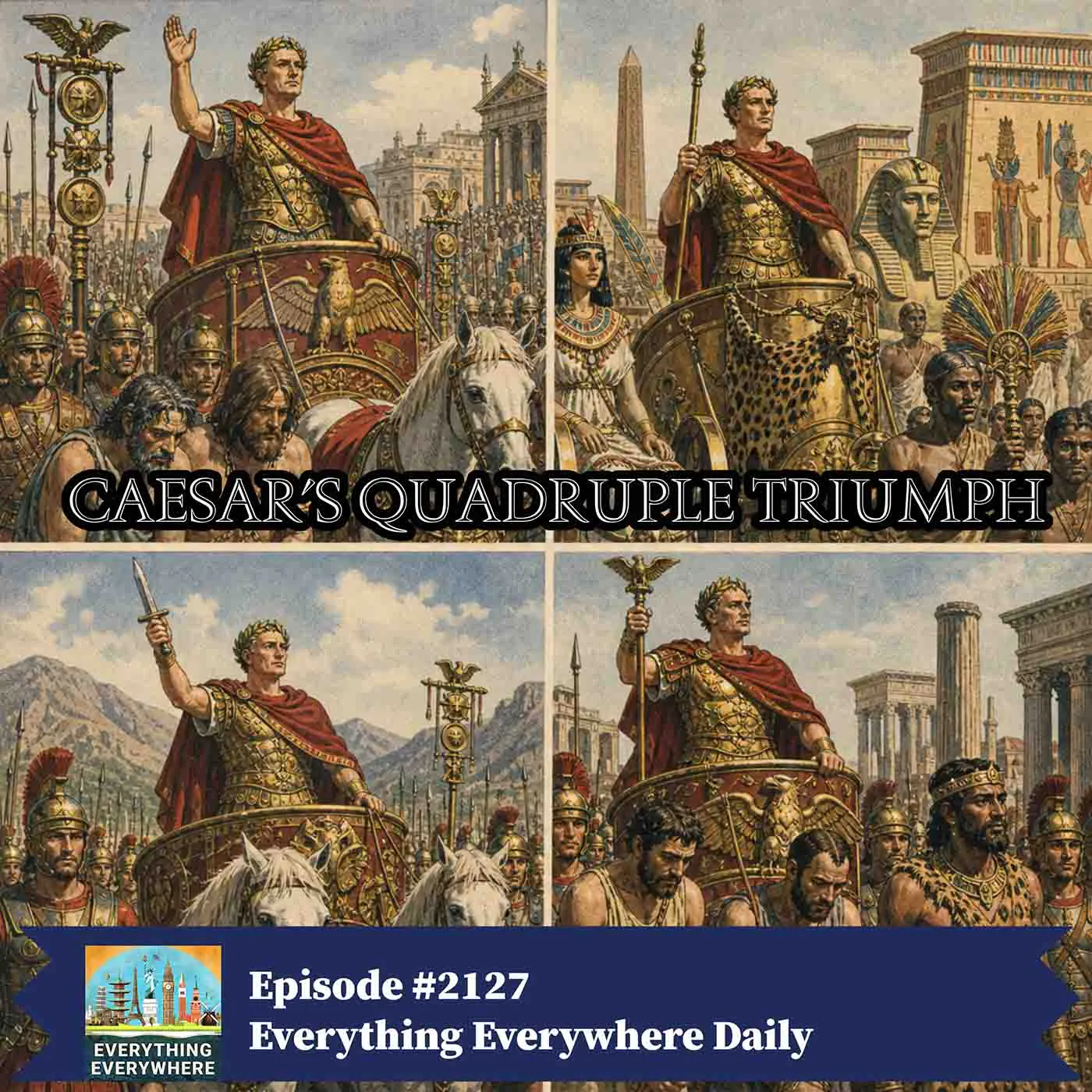
Everything Everywhere Daily: History, Science, Geography & More
Julius Caesar's Quadruple Triumph
00:14:07
Loading summary
Transcript1 lines
- [00:00]
A
In 46 BC, after 12 years away, Julius Caesar finally returned home to Rome, and a lot had changed since he was last there. The entire Roman system had been upended, and now he was the man on top. To celebrate his homecoming, he did something that had never been done before or since. He didn't just hold a triumph in his honor, he held four. For some in Rome, it was the greatest thing that they had ever seen, and for others, it confirmed their worst fears. Learn more about Julius Caesar's quadruple triumph and the controversy surrounding it on this episode of Everything Everywhere Daily. This episode is sponsored by Mint Mobile. Most of you might have something that you're saving up for. Maybe it's the trip of a lifetime, your children, your retirement, or maybe even something nice for yourself. And if you're looking for some extra money, the easiest thing you can do is to cancel your current mobile plan and switch to Mint Mobile. With Mint Mobile you can get high speed data and unlimited talk and text delivered on the nation's largest 5G network starting at only 15 bucks a month. Use your own phone and number, activate with ESIM in minutes and start saving immediately. No long term contracts and no hassle. That's why I recommend Mint Mobile. If you like your money, Mint Mobile is for you. Shop plans@mintmobile.com eed that's mintmobile.com eed upfront payment of $45 for 3 month 5GB plan required equivalent to $15 a month new customer offer for first 3 months only, then full price plan options available, taxes and fees extra. See Mint Mobile for details. This episode is sponsored by Quints. I recently moved into a new, larger place and I faced the challenge of decorating it. I of course am turning to Quince to help get the job done. In addition to clothes, Quince offers stylish home furnishings that makes my place look great at affordable prices. And I've also recently picked up a second cashmere sweater that I've talked about before just because I like it so much. The great thing about Quince is that their prices are 50 to 60% lower than those of similar brands. How Quint's works directly with ethical factories and cuts out the middleman so you're paying for quality, not brand markup. Everything is designed to last and makes getting dressed and decorating your home easy. Refresh your everyday with luxury you'll actually use. Head to quince.com daily for free shipping on your order and 365 day returns now available in Canada too. That's Q U I-n c e.com daily for free shipping and 365 day returns. Quince.com daily. One of the biggest and most spectacular events in the ancient world took place in Rome in the year 46 BC. Over a period of 10 to 14 days, the returning general, former consul and former legal dictator Julius Caesar held not one, not two, not, not three, but four triumphs to celebrate his victories over the previous decade. I've done several previous episodes covering the Roman triumph and several of Caesar's deeds, including the Battle of Alesia. Suffice it to say, receiving the honor of a triumph was a really, really big deal in the Roman world. It was in some respects the ultimate achievement for someone in the Roman Republic. In a culture that hated and feared the idea of kings, Rome would for one day ar honor a victorious general by treating him like a king. It was a state sponsored ceremonial procession through Rome in which a victorious general publicly displayed his spoils, captives and achievements, all while being honored by the Senate and the people. Triumphs weren't common. On average, there might be one every year or two. In rare cases, someone might earn a second triumph. And there were rules that had to be followed. The victorious general had to ask the Senate for a triumph and they were not allowed to enter Rome until the triumph took place. Now let me briefly cover what happened to Caesar in the years leading up to his triumph. In 59 BC, he served a year as consul while a member of the informal alliance known as the First Triumvirate, along with Pompey and Crassus, a topic I covered in a previous episode. After his consulship, he was appointed the proconsul of Cisalpine Gaul and Illyricum, and shortly afterwards, his command was extended to include Transalpine Gaul. He used this opportunity and the legal immunity that came with it to conquer Gaul, which is modern day France. None of this was approved by the Senate, yet it was very popular with the common people in Rome and made some members of the elite very nervous. Members of the Senate wanted to prosecute Caesar for his crimes in Gaul. Caesar was immune so long as he was proconsul. But his term was nearing its end. He wanted to run for consul again, which would give him immunity. But to do that, he would have to return to Rome and give up his proconsulship. This resulted in him crossing the Rubicon river with a legion in 49 BC, marking the start of a civil war that ended at the Battle of Pharsalus in 48 BC. However, after winning the war, he didn't return to Rome Immediately he went to Egypt and then to Pontus in what is today northern Turkey, and then to what is today Tunisia to address outstanding problems. And by the time he returned to Rome in 46 BC, he was its undisputed ruler. With his enemies vanquished, Caesar now wanted his rewards. A triumph was usually awarded to honor an accomplishment in a single campaign. However, because Caesar had fought all over the Mediterranean, and because he had been gone for so long, he demanded four triumphs. Now, you might be wondering, why couldn't he have just had one big triumph? It almost certainly had to do with the fact that his biggest rival and former son in law, Pompey Magnus, had received three triumphs in his career. Other notable Romans, such as Marcus Claudius Marcellus and Gaius Marius, had received three triumphs, as well as Lucius Cornelius Sulla, Scipio Africanus and Quintus Fabius Maximus. Some of the greatest generals in the history of the Republic only received two. And anybody who knows Roman numbers knows that IV is greater than iii. While there's much we do know about Caesar's triumphs, there's much we also don't know. We don't know the exact dates they took place. Most estimates place them between July and September of 46 BC. We don't also know how many days they occupied. But everything probably happened over a span of 10 to 14 days, with many games and banquets also taking place. 46 BC was also called the Year of Confusion, because that was the year Caesar moved Rome to the Julian calendar and added a month to the Roman calendar to fix the fact that the seasons had gone out of sync. The first triumph was for his conquest of Gaul and his defeat of the Gallic leader Vercingetorix. Of the four triumphs, this was the least controversial. This triumph was the most elaborate of the four, filled with immense quantities of loot, detailed displays of battles and territories, and long processions of captives from across Gaul. The centerpiece was the defeated Gallic leader Vercingetorix, who had been held in captivity for years and was paraded through Rome before being executed. At the end of the ceremony, Caesar rode in a chariot through cheering crowds while soldiers marched behind him singing traditional, often mocking songs. The reason this triumph wasn't particularly controversial is that everybody knew the story by this point. For years, Caesar had been sending dispatches from Gaul to Rome which were intended for the Roman people. These became Caesar's commentaries, which are still studied today. Also, defeating foreign enemies was the whole point of a triumph. And. And despite the many issues surrounding how he conquered Gaul. That is in fact what he did. The second triumph commemorated Caesar's victory in the Alexandrian war in Egypt, but it had a very different tone from the Gallic celebration. The procession emphasized the exotic wealth and imagery of Egypt, with elaborate displays meant to evoke the Nile, royal splendor and the drama of a distant kingdom brought under Roman influence. Influence. The most striking figure in the parade was Arsinoe iv, the sister and rival of Queen Cleopatra, who had opposed Caesar and was led in chains as a captive. Her presence reportedly drew sympathy from the crowd, and unlike most other high profile captives, she was spared execution afterward. Cleopatra herself was in Rome at the time, but did not take part in the triumph because her having a son with Caesar was an extremely sensitive topic in Rome. The reason why this was controversial was that Rome didn't really gain anything. Caesar didn't conquer Egypt. He just inserted himself in the middle of a dynastic feud and personally selected the new monarch. While the triumph did technically celebrate a Roman victory, it also revealed something more unsettling to many observers. Caesar acting as kingmaker in a foreign monarchy and projecting a kind of personal, almost royal power that went beyond traditional republican norms. Furthermore, the only reason he was in Egypt was to hunt down Pompey during the civil war, and the Romans would never grant a triumph for killing a Roman. Under normal circumstances, this probably would not have warranted a triumph. The third triumph celebrated his victory at the Battle of Zela over Pharnaces ii. The Battle of Zela is something that most of you might not be familiar with. The Battle of Zela was fought in 47 BC in Pontus in the north of modern Turkey, and saw Julius Caesar confront Pharnaces ii, who had taken advantage of Rome's civil war to reclaim territory. Caesar went there after he was in Egypt. Pharnaces attacked Caesar's forces as they were still entrenching on high ground. But the Roman legions quickly rallied, counter attacked downhill, and routed his army in a single decisive engagement. While the battle itself has been largely forgotten, one thing came from it that is known by almost everyone. One of the most famous quotes in world history, as it's pronounced in classical Latin, veni witty wicci, which means I came, I saw, I conquered. The triumph reflected the speed of the battle, with fewer prolonged scenes of conquest and greater emphasis on the campaign's decisiveness, including displays of captured arms and standards, as well as representations of the battlefield of Zela. Its most famous feature was a placard bearing the words Weni witty wiki announcing how Quickly the war had been won and turning the triumph into a statement about Caesar's personal efficiency and brilliance. Caesar's quote was the most controversial part of the triumph as it emphasized himself rather than Rome or his legions. As with other triumphs, he roden chariot through Rome with troops following behind. But the tone was almost brisk compared to the other triumphs, reinforcing the idea that victory had been achieved with remarkable speed. The fourth and final triumph celebrated his victory in North Africa, culminating in the Battle of Thapsus against the forces of Metellus Scipio and King Juba I. Caesar sailed here after the Battle of Zela, where he defeated the remaining senatorial forces who survived the Battle of Pharsalus. The procession displayed spoils and imagery from the African campaign, including depictions of the battle and exotic elements meant to evoke the region, such as animals and Numidian symbols. One of the most notable figures in the parade was Juba's young son, Juba ii, who was led as a captive and later raised in Rome. This was extremely controversial. While Caesar took pains not to mention the deaths of Romans, it was unavoidable. King Juba was only an ally of the Romans opposed to Caesar. It was here that Cato the Younger killed himself rather than submit to Caesar. The link to a foreign army was tenuous at best. To complement the four triumphs, Caesar organized a massive series of public events designed to dazzle the Roman citizenry with his generosity and sheer scale of the spectacle. A primary feature of these celebrations was the hosting of immense public banquets. Thousands of Romans were fed simultaneously as dining couches were arranged across numerous city districts. During these feasts, the public received food, wine and occasionally even gifts of cash. At the same time, he put on lavish games that included gladiatorial fights, theatrical performances and even a staged naval battle fought by thousands of participants in a specially constructed basin. There were also hunts featuring exotic animals and elaborate displays meant to showcase the wealth of his conquests. The scale of all this was absolutely unprecedented, turning the triumphs into a city wide festival that reinforced Caesar's image not just as a conqueror, but as a provider for the Roman people. Not surprisingly, if the common people of Rome didn't love Caesar before, they certainly did now. Members of the senatorial class, however, saw something very different. The triumphs of Caesar did not directly cause his assassination, but they played a critical role in convincing many Romans that he had become dangerously powerful. By staging four triumphs back to back to back to back, Caesar compressed what would normally have been a lifetime of honors into a single overwhelming display signaling that he stood above all other Romans in history. More troubling was what those triumphs represented. The triumphs blurred the distinction between Roman magistrates and monarchs. Exotic imagery from Egypt, the association with Cleopatra, and Caesar's growing list of honors afterwards, including a long term and eventually lifelong dictatorship, made many senators fear that he intended to become a king in all but name. In less than two years, all the grievances would build up and Caesar would be stabbed to death on the floor of the Senate. While no one knew it at the time, Caesar's quadruple triumph and the surrounding celebrations were almost sort of a goodbye party for the Roman Republic. The executive producer of Everything Everywhere Daily is Charles Daniel. The associate producers are Austin Otkin and Cameron Kiefer. My big thanks go to everyone who supports the show over on Patreon. Your support helps make this podcast possible, and I also want to remind everyone about the community groups on Facebook and Discord. That's where everything happens that's outside the podcast, and links to those are available in the show Notes. As always, if you leave a review on any major podcast app or in the above community groups, you too can have it read on the show.