Loading summary
Transcript1 lines
- [00:01]
A
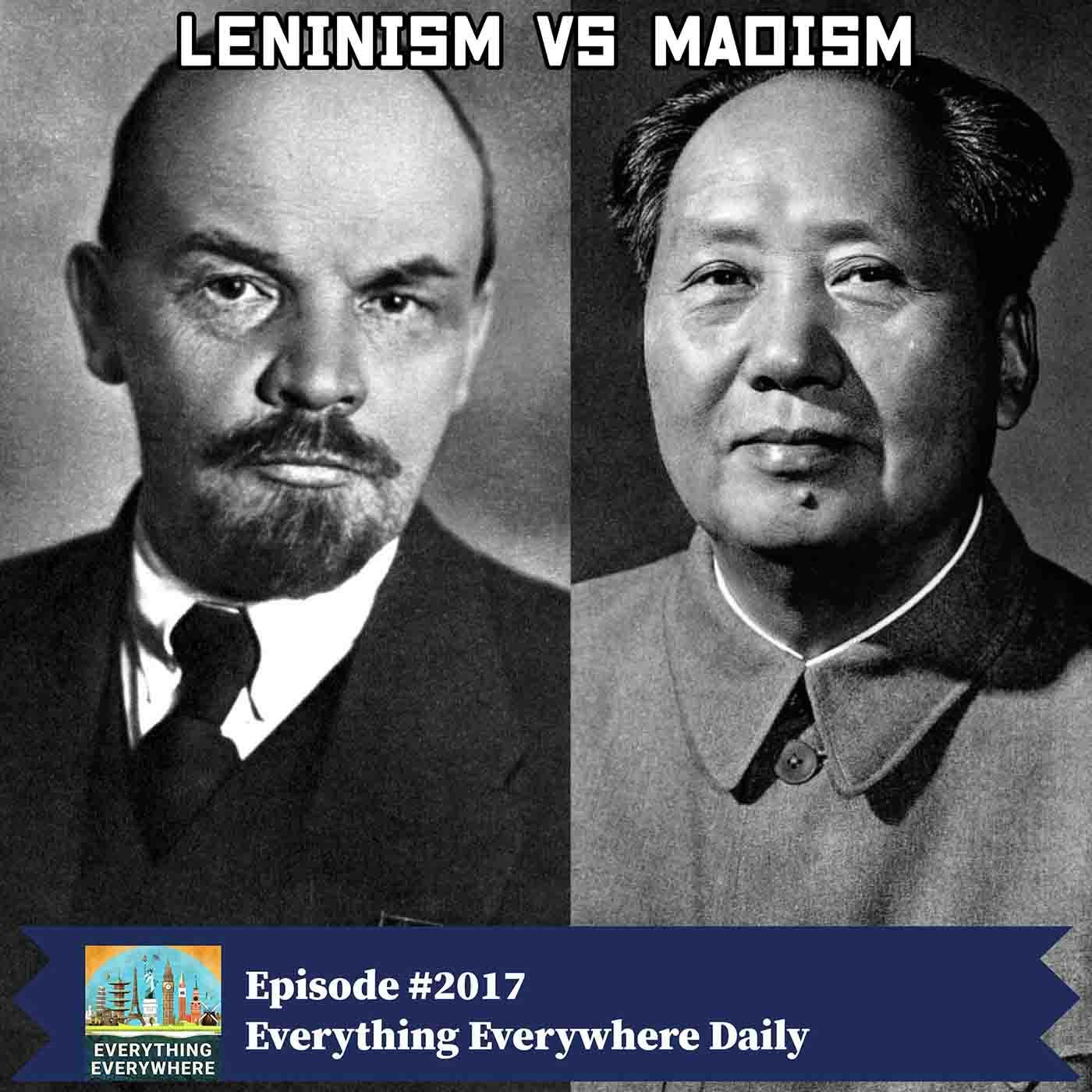
Communism was an ideology that millions of people had to live under during the 20th century. Despite the communist label many nations adhered to, there were often vast differences in how they practiced communism or even what they considered communism to be. In fact, Karl Marx would have probably been shocked to see where communist governments were actually established. Learn more about the differences between Maoism and Leninism on this episode of Everything Everywhere Daily. This episode is sponsored by Quints. A new year is upon us, and that means new resolutions, new goals, and maybe a new wardrobe. If you're craving a winter reset, start with pieces truly made to last season after season. Quince brings together premium materials, thoughtful design and enduring quality so you stay warm, look sharp and feel your best all season long. One of the sweaters I recently got from Quince is something that I have been wearing almost every single day and I love it. By partnering directly with ethical factories and top artisans, Quince cuts out the middleman to deliver premium quality at half the cost of similar brands and often even bigger discounts. Moreover, those competitor prices are often listed right on the Quince website. Refresh your winter wardrobe with quince. Go to quince.com daily for free shipping on your order and 365 day returns. Now available in Canada too. That's Q U-I-N-E.com daily free shipping and 365 day returns. Quince.com daily this episode is sponsored by Mint Mobile. Now that the holidays are over, you might be feeling like you got a big spending hangover. The drinks, the holiday food, the gifts, it all adds up. Luckily, MIN Mobile is here to help you cut back on wireless spending this January. With 50% off Unlimited Premium Wireless, you can get 3, 6 or 12 months of Unlimited Premium Wireless for just $15 a month. All plans come with high speed data and unlimited talk and text delivered on the nation's largest 5G network. That's why I recommend Mint Mobile. You can get the same mobile experience you have now, but for less money. This January, quit overspending on Wireless with 50% off unlimited premium wireless plans start at $15 a month at mintmobile.comeed that's mintmobile.comeed limited time offer upfront payment of $45 for three months, $90 for six month or $180 for 12 month plan required $15 a month equivalent taxes and fees extra initial plan term only greater than 50 gigabytes may slow when network is busy. Capable device required availability, speed and coverage varies. See mintmobile.com. In a previous episode I discussed the differences between Italian and German fascism. In this episode I want to turn the lens on the other great ism of the 20th, communism at a very high level. The biggest difference between fascism and communism is that fascism wasn't a developed political theory created before it was implemented. Communism, on the other hand, was an established political ideology with a following before it was ever put into practice. In this episode I want to focus on the two largest countries to have had communist revolutions, Russia and China, and the two guiding philosophies that governed each country, Leninism and Maoism. The theory of communism was developed by the German philosopher Karl Marx. Marx viewed society as a class based system. This was first outlined in the now infamous book the Communist manifesto published in 1848. Within it, he and his co author Friedrich Engels described their idea of class conflict theory and revolution. The ideas explored in the Communist Manifesto were further developed in Das Kapital, published in 1867. In this work, Marx critiqued capitalism through a Marxist economic lens, providing the technical arguments to support his earlier theories. Regardless, a central theme of both works is that capitalism was an economic system that was flawed and would inevitably fail. According to Marx, and I know this is a vast oversimplification. Within capitalism there are two primary the proletariat, AKA the workers, and the capitalists. The capitalists own the means of production, whereas the workers only engaged in labor for wages and shared none of the profits. This dynamic presents a problem. According to Marx, workers are typically paid less than the value of their labor to the owner. Such a relationship creates an ongoing class struggle between the owners and the workers, or between capital and labor. Marx, like other classical economists, was a strong believer in the labor theory of value. This theory was used to explain differences in market prices across goods. The theory basically says that the longer a product takes to make it and the more labor that is put into it, the more value it should have. Taking this idea a step further, Marx argued that the value of the labor required to produce these products exemplified the exploitation of workers. Additionally, Marx saw a key aspect of capitalism as the drive for efficiency, extracting the maximum wealth from the workers. This emphasis led to changes in the work process to streamline and make it more cost effective, eliminating positions that would no longer be profitable or viable. The exploitation of workers and the eventual surplus of labor within the market were two major problems Marx found with capitalism. He believed that these two issues would eventually compound ultimately destroying the capitalist system. This destruction would result from rising inequality between workers from the capitalists no longer making a profit, and the contradiction would naturally lead to a workers revolution where production would be handed over to the working class. Marx wasn't necessarily calling for the immediate overthrow of capitalism, but rather was describing capitalism as a natural and necessary step in the evolution of economic systems. According to Marx, and this is key for the purpose of this episode, to reach communism, it was necessary to pass through all the stages of capitalism which create the inherent conflicts that he believed capitalism contained. It's through this that capitalism destroys itself and becomes socialist and eventually a communist society. In Marx's perspective, communist society was a utopia, a place where class conflict could no longer exist. And he believed that this was the final step in human social development. And Marx assumed that the only way a communist revolution could occur was in a fully industrialized capitalist economy. While Marx's theories gained many adherents in the early 20th century, they didn't necessarily want to wait around for a communist revolution in a country that they probably didn't even live in. They wanted a communist revolution. Now. Which brings me to Russia. Russia was the first country to undergo a communist revolution and it began in 1917. While Vladimir Lenin and the Bolsheviks were influenced by Marx's economic and social theories, their interpretation, which later became known as Leninism, diverge from strict Marxism by emphasizing the need for a vanguard. Lenin argued that the working class on its own would develop only a limited revolutionary consciousness. So a disciplined, educated and elite vanguard party was needed to lead, organize and guide the proletariat, seize state power and direct society through the transition to communism. Lenin basically thought that it was possible to completely bypass many of the stages that that Marx had outlined. The development of Leninism had to do with the experiences and background of Lenin himself. Lenin became invested in revolutionary politics following his brother's execution in 1887. To Lenin, this made Russian politics personal and he began to read more radical political literature during his stint in law school. And shockingly, Marx's work was the most influential. After officially proclaiming himself a Marxist in 1889, he moved to St. Petersburg, which was then the Russian capital, and began working with other Marxists to build a revolutionary movement. His interest in communism was intrinsically tied to his desire to overthrow tsarist Russia. When the revolution finally happened, Lenin and his Bolsheviks took over the government. Lenin was the leader of the country for the next seven years and he implemented many of his ideas. Under Lenin's leadership, Russia began to usher in communist ideology into Russian society. They began to form soviets, which were councils of peasants that were supposed to govern themselves. In theory, this should have been similar to other democracies, but these Soviets never operated as intended. The reality was that instead of the Soviets holding real power, it was the loyal Bolsheviks within Lenin's party who held all the power, AKA the vanguard. Karl Marx expected socialist revolution to arise in highly industrialized capitalist societies with large politically conscious working classes such as Britain or Germany. Late Imperial Russia was largely agrarian, economically underdeveloped, and dominated by peasants rather than industrial workers, which is why Marx himself viewed it as an unlikely candidate for a proletarian revolution. The Soviet Union was officially formed in 1922, and Lenin served as its leader for two years. Following his death, Joseph Stalin took power and fully transformed the country into a totalitarian state. Stalin was actually the first person to coin the term Leninism, and this ideology governed Soviet society until its fall in 1991. The theoretical justification for the totalitarian nature of Soviet Communism rested on Lenin's theory of a vanguard to accelerate the path to a true communist society. Of course, the vanguard never gave up its power, and the entire notion of an elite to usher in communism was never anything that Marx advocated. And if Karl Marx would have been surprised by a communist revolution in Russia, he would have been downright flabbergasted by the idea of one in China. Maoism, like Leninism, was a derivative of communist ideology. However, instead of adopting Marx's focus on an industrial proletariat, Mao Zedong prioritized the revolutionary role of the rural peasant class. Maoism dominated China from the end of the Chinese Civil War in 1949 until his death in 1976. Mao had grown up a peasant in rural China. His upbringing in the peasant class played a fundamental role in his developing his later political beliefs. Mao first became aware of Marxism while working as a library assistant at Peking University. After learning about communist ideology, he dedicated himself to his beliefs and quickly founded the Chinese Communist Party in 1921. His past as a peasant led Mao to believe that a communist uprising was achievable only if it had an elite revolutionary unit of peasants, not industrial workers. During the Chinese Civil War, the communist forces led by Mao drew most of their support, recruits and legitimacy from rural peasants, with only a small proportion coming from urban industrial workers, reflecting China's overwhelmingly agrarian society. In contrast to Leninism's emphasis on the urban working class, Mao frequently prioritized poor agricultural laborers over industrial workers. Two of Mao's most controversial policies were centered on rural areas, the Cultural Revolution and the Great Leap Forward. The Great Leap Forward, which I covered in a previous episode, was focused on agricultural productivity and small scale iron production. The Cultural Revolution, which was also A previous episode saw the large scale transfer of millions of people to rural areas for re education. Both of these policies led to massive amounts of death. The Great Leap Forward saw millions of people starve to death through inept agricultural policies. And the Cultural Revolution saw the country descend into chaos with anyone not deemed Maoist enough being targeted. Chinese society and the Chinese economy were not even remotely close to what Marx envisioned. They were even more agricultural than Russia and had just a tiny industrial base. Maoist and Leninist ideologies do share some similarities. Both systems accepted the need for a Communist party acting as a vanguard to lead society. They rejected the idea that socialism would emerge automatically from capitalism and endorsed a revolutionary state that would suppress counter revolution while transforming society. Each emphasized strict party discipline, ideological conformity and the legitimacy of violence in achieving and defending revolutionary goals. They differed primarily in their social base and strategy. Leninism was oriented towards the urban industrial working class and envisioned a revolution as a rapid seizure of state power centered in cities, followed by centralized control from above. Maoism adapted Marxist Leninism to a predominantly agrarian society, placing peasants at the center of the revolution and relying on prolonged guerrilla warfare, rural base areas and gradual encirclement of cities. Ideologically, Maoism also stressed continued class struggle after the revolution and mass mobilization campaigns to prevent bureaucratic stagnation, whereas Leninism emphasized consolidation of power and administrative control once the state was captured. In both Maoism and Leninism, the theories can be thought of as being created to justify the seizure and retention of power under the name of communism. While China and Russia were the most prominent examples of this, almost every communist country put its own spin on things which deviated from Karl Marx's theories. In Yugoslavia, communism under Joseph Braz Tito diverged from Soviet Leninism by rejecting strict central planning, introducing worker self management and giving enterprises and local councils greater autonomy and pursuing an independent, non aligned foreign policy. In North Korea, communism evolved into Juche under Kim Il Sung, an ideology centered on national self reliance, extreme centralization and a personality cult, with Marxism largely subordinated to nationalism, militarization and dynastic rule. All of these countries claim to be Marxist and communist, even though they all deviated significantly from what Marx had outlined and what he thought Communism would be. Of the highly industrialized countries that Marx thought would be ripe for revolution, none ever had one because his theories never played out as he predicted. The one thing that Communist and fascist countries have in common is that their political theories were largely developed to justify their government's power and existence. The executive producer of everything everywhere daily is Charles Daniel the associate producers are Austin Otkin and Cameron Kieffer. Research and writing for this episode was provided by Olivia Ashe. My big thanks go to everyone who supports the show over on Patreon. Your support helps make this podcast possible. And I also want to remind everyone about the community groups on Facebook and Discord. This is where everything happens that's outside of the show. As always, if you leave a review on any major podcast app or in the above community groups, you too can have it read on the show.