Loading summary
Transcript1 lines
- [00:00]
Host of Everything Everywhere Daily
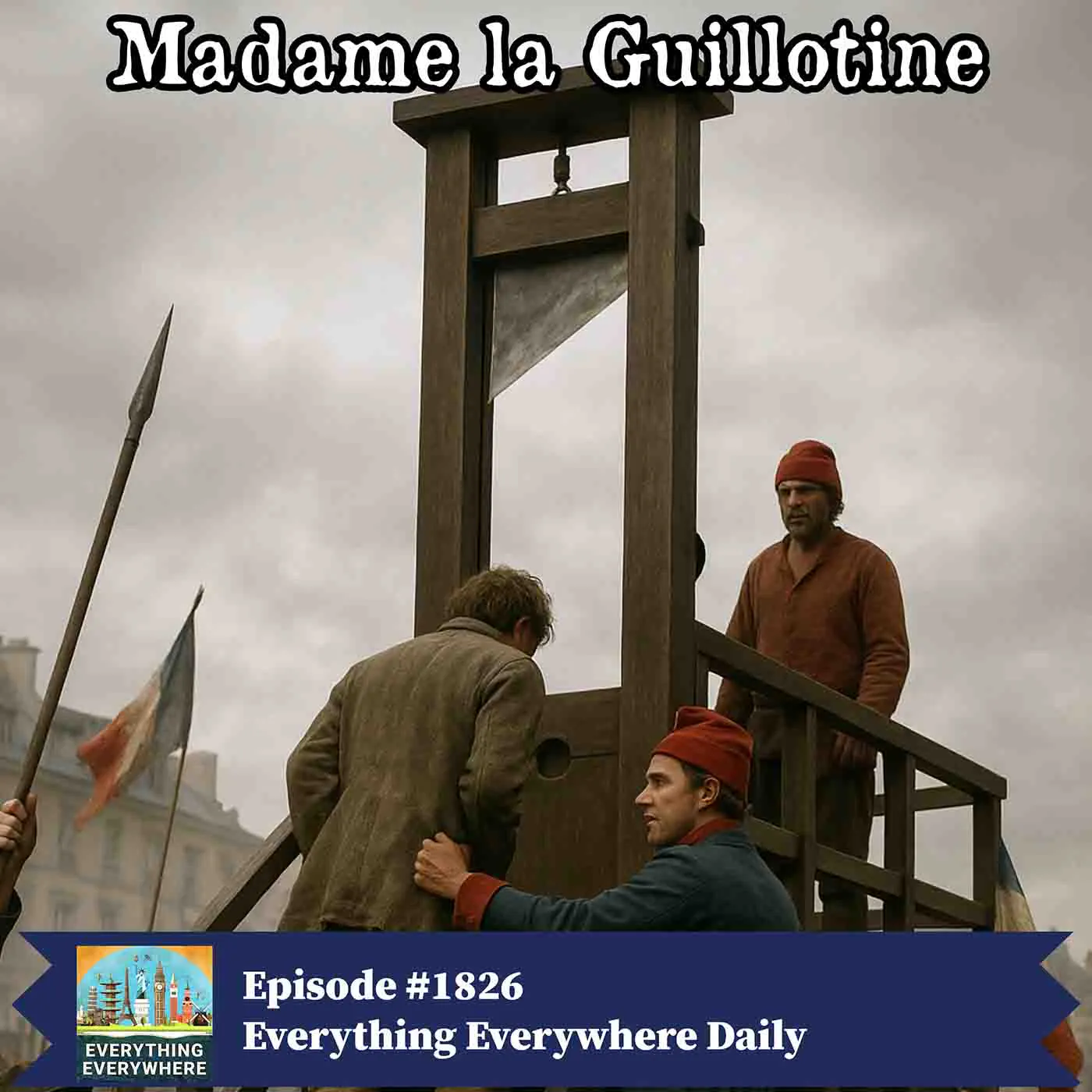
The guillotine has become infamous for being a symbol of the French Revolution and the Reign of Terror. It's been responsible for the deaths of tens of thousands of people since it was first used in 1792. But of all the ways to execute people, why did they create an elaborate contraption when simpler methods were available? Learn more about the guillotine, why it was invented, and its impact on this episode of Everything Everywhere Daily this episode is sponsored by Fiji Water. You've probably heard of Fiji Water and have seen it in stores. Well, Fiji Water really is from the islands of Fiji. Drop by drop, Fiji Water is filtered through volcanic rock 1600 miles away from the nearest continent. In all its pollution, protected and preserved naturally from external elements. In this process, it collects a unique profile of electrolytes and minerals, resulting in more than double the electrolytes as the other top two premium bottled water brands, giving Fiji Water its smooth taste. Fiji Water's electrolytes are 100% natural and this water even has a perfectly balanced pH of 7.7. I've recently been trying to reduce my consumption of diet soda and I've found Fiji Water to be a great alternative. Visit your local retailer to pick up some Fiji Water today for your next backyard party, beach day hike, or even your home office. Fiji Water is Earth's finest water. This episode is sponsored by Quints. No one is ever going to confuse me with someone fashionable or trendy. That being said, if I'm going to buy something, I want it to look good, be of high quality and ideally be affordable. That is where Quince comes in. Quince is the kind of stuff you'll actually wear, like breathable flowknit polos, crisp cotton shirts and comfortable lightweight pants. In addition to clothing, they also offer a range of great items for the home and travel. Everything with Quince is half the cost of similar brands. By working directly with top artisans and eliminating the middleman, Quince offers luxury pieces without the markup. And I've told you all about the great items that I've purchased from Quince. From towels to blankets to a duvet, Quince has become my go to source. Stick to the staples that last with elevated essentials from Quince. Go to Quince.com daily for free shipping on your order and 365 day returns. That's Q-U-I-N-E.com daily to get free shipping and 365 day returns. Quince.com daily before the development of the guillotine, beheadings in France were rather rare. Beheadings required a skilled executioner, so more efficient forms of execution were used, including such classics as being burned at the stake or being hanged. The other reason why there were few beheadings is that beheading was considered to be more humane. In ancient times, Greeks and Romans believed that beheadings were quicker and more painless than almost any other form of execution, and hence less Dishonorable. For example, St. Paul was beheaded because he was a Roman citizen and Roman law forbade crucifixion for citizens, allowing them a more honorable execution method. Other early Christians, particularly Non citizens like St. Peter, were often crucified, burned or thrown to wild animals because they lacked this legal protection. This was later adapted into British culture where it was a nobleman's privilege to be beheaded. Charles I, Anne Boleyn, Thomas More, Mary Queen of Scots, Thomas Cromwell and Lady Jane Grey were all members of the nobility who who were beheaded. There were a few early proto guillotines. The Halifax gibbet was an early beheading device used in the town of Halifax, England from at least the 13th century until the mid 17th century. It consisted of a tall wooden frame with a heavy axe blade mounted in a groove which was raised and then released to fall on the neck of the condemned. It's considered a precursor to the guillotine and may have influenced its later design. The gibbet was primarily used to execute thieves, particularly those who stole goods worth more than 13 pence. The invention of the guillotine is often incorrectly attributed to Joseph Guillotin. Guillotin was a physician and freemason in France and happened to be an opponent of the death penalty. He hated the forms of execution being partaken by the French government, finding them gruesome, and believed that capital punishment should be more humane. It was because of these moral qualms that he proposed a new, less painful form of punishment be implemented. The guillotine was actually invented by Antoine Louis, a French surgeon, and Tobias Schmidt, a German engineer. The device was originally named the Louisite or Louisson after Antoine Louis. The reason Guillotin receives credit is that he suggested to King Louis XVI that decapitation should be the standard form of capital punishment. This led to the King forming a committee, including Louis Schmidt and Guillotin to create the beheading machine that we know today as the guillotine. Guillotin has his name associated with one of the most infamous forms of execution because of his advocacy for a more humane form of punishment. Despite actually being against capital punishment, as Alanis Morissette might say, isn't it ironic? So how does the guillotine work? It's actually remarkably simple. It consists of a tall frame standing upright with an angled, in theory, razor sharp blade suspended over a pillory. A pillory is similar to a stock where a person's head and hands are placed inside wooden boards and locked together. The difference for the pillory is that only the head is placed inside. For the guillotine, the pillory is placed directly below the weighted blade, right above the person's neck. When the almost 90 pound or 41 kilogram blade is released, it drops from a height of about 14ft or 4.2 meters. The actual decapitation takes approximately 1/10 of a second. After the blade hits, the head of the victim is separated from the body and rolled into a basket, placed below the machine before the guillotine, beheadings typically took more than two blows to cut off the person's head with an axe or a sword. Members of the nobility would often pay for the executioners to sharpen their blades before the execution took place. As for peasants, the typical punishment of hangings would often take minutes. And as you can imagine, these prolonged, painful deaths were not popular amongst the French populace. Though the guillotine's method of execution is certainly violent, its methods fell into the ideals of the Enlightenment. The guillotine was quick and and it was standardized by class. It was painless, easy and dignified. Death was now considered democratic, which I'm sure was great comfort to those who lost their head. After the French Revolution, it was required that all death sentences be carried out by means of machine. Unfortunately, its ease of use would make the tool the perfect weapon to enact the Reign of Terror. During the French Revolution, the person who had the unfortunate distinction of being the first person executed by guillotine was a French royalist named Louis, Colonel d'. Angoumante. He was a secretary for the National Guard and was executed for conspiring against the new revolutionary government. The execution took place on August 21, 1792, three years after the French Revolution had begun. Before I go into detail about how the guillotine was used by the Revolution and the Reign of Terror, let me recap the events surrounding the Revolution. The French revolution began on May 5, 1789 and lasted for about 10 years. The rigid structure of the traditional Asian regime divided society into three the clergy, the nobility and the commoners. And the vast majority of the population fell into what was known as the Third Estate, bearing the burden of taxation. While having almost no political power, France was also mired in debt from years of war and privileged elites blocked attempts at reform. Widespread food shortages and rising bread prices intensified public anger. The Enlightenment disseminated new ideas about liberty, equality and popular sovereignty, inspiring many to challenge the legitimacy of absolute monarchy. In 1789, the Advisory Board known as the Estates General was convened and the Third Estate broke away to form the national assembly, setting the Revolution in motion. And this set in motion a change of events that led to widespread political chaos across France, including events like the storming of the Bastille and methodically stripping the monarchy of power. After King Louis XVI was fully stripped of his power, he was arrested, leading to the declaration of the First Republic. Which brings us to the Reign of Terror, which was the subject of a previous episode. Over a period of Roughly a year, 17,000 people are estimated to have been killed by the guillotine, most notably King Louis XVI himself and his wife, Marie Antoinette. As I stated before, the guillotine was considered to be more humane, classless and standardized. These ideas were crucial in the French Revolution because the main idea was to achieve equality. Enemies of the state, regardless of class or standing, would all be equal in death. In other words, the guillotine was the physical embodiment of what the Revolution was meant to achieve. The Great Terror was brutal and perceived enemies of the State, such as the Jacobins, were often sent to prison or the guillotine without a trial. Unfortunately for some victims of the guillotine, the method of execution was not necessarily as painless and swift as promised, creating some controversy about the weapon. Onlookers to executions were unsure if it was immediate, as some claimed to see awareness and sensations after the person had been decapitated. Additionally, sometimes the guillotine would not cut completely through the neck. The machine was soon nicknamed the Widow due to the number of lives that it took. It was also dubbed the National Razor, as well as Madame la Guillotine. The Reign of Terror ended with the execution of its primary instigator, Maximilien Robespierre, who himself met his fate at the hands of Madame la Guillotine. Throughout the Revolution, most of the executions in Paris took place at the Place de la Revolution. These executions were considered to be a public spectacle, with programs of the day's executions often being handed out in the crowds. A bit less relevant, but a fun fact nonetheless, was that the guillotine also inspired women's fashion. During the Revolution, many women began wearing a red choker around their neck, representing where the blade would cut the neck of someone they knew or loved. Another trend was a red shawl that would often be worn over thin dresses. The thin dress was inspired by prisoner shirts, and the shawl is attributed to Charlotte Corday. She was executed by guillotine after she assassinated the revolutionary leader, Jean Paul Marat. Another fashion trend was the guillotine haircut, A hairstyle that gained immense popularity during the Revolution. The style was short and showcased a woman's neck, A radical new look for the time. And it was meant to model the prisoners whose hair would be cut before being taken to the guillotine so that it wouldn't block their necks during the execution. The guillotine has been used outside of France, but not nearly to the same extent. The Caribbean, which was heavily colonized by the French, had the guillotine used, but it was much rarer than it was back in the homeland. The two islands that had used the guillotine were Guadeloupe and Martinique. Its use in the region was ended in 1965. In North America, only one execution by guillotine has ever been recorded. A guillotine had to be brought to the island of St. Pierre, off the coast of Newfoundland, from Martinique and was used to kill a convicted murderer, Joseph Neill. In 1889, St. Pierre was under French legal jurisdiction and the law said that the guillotine needed to be used as the method of execution and that the execution needed to be done near the scene of the crime. And that led to the guillotine being brought up and used because St. Pierre didn't have one of their own. And that execution was actually the subject of the 2000 film the Widow of St. Pierre. In South America, the guillotine was used. In French Guiana, almost everyone executed was a convict who had previously been exiled from France and had been sent to penal colonies such as devil's island. Approximately 150 people were recorded as being executed by guillotine In French Guiana in the Southern hemisphere. It was only officially used in two New Caledonia, which also had a penal colony, and Tahiti, which only executed two people ever with the device. Vietnam, which was a former French colony, used the guillotine as well, Although not in an official capacity. They used it as a fear tactic on the rural populations of the country. In Europe, the guillotine was commonly used outside of France. Germany was the other most notable user of the guillotine, which in German was known as the fallbeil, or falling axe. The method was popular in Germany after the Napoleonic era and remained legal in Germany until the 1960s, when East Germany discontinued its use. In 1967, the German variant of the guillotine differed slightly from the French model, being more sturdy and effective with heavier blades and a slightly shorter design, and this made the method of execution faster. Other countries in Europe have used the guillotine as a legal method of capital punishment, including Belgium, the Netherlands, Switzerland, Greece and Sweden. After the French Revolution, the guillotine continued to be the standard method of execution in France until 1981. Public executions via the guillotine were still used in France until 1939 when Eugene Weidman, a man convicted of six murders, was executed in Versailles. State security crimes or military court sentences were carried out by firing squad, but civilian death sentences were always carried out by guillotine. The final use of the guillotine by any government in the world occurred in September of 1977. The final victim of the guillotine was a convicted murderer by the name of hamida Janbubi. In 1981, the French abolished capital punishment altogether, making it illegal to use, but up until that point, a guillotine was always kept in the Paris city center ready for use. Since 1977, the guillotine has not been used in any official capacity by any government in the world for a legal execution. The guillotine was a bit of a paradox. On the one hand, it was designed to be an egalitarian and humane method of execution. However, it quickly became a symbol of terror and fear, and that is a good reason why it has been completely eliminated from use all over the world. The executive producer of Everything Everywhere Daily is Charles Daniel. The associate producers are Austin Okun and Cameron Kiefer. Research and writing for this episode was provided by Olivia Ash. Today's one star review comes from listener End On Time over on Apple Podcasts in the United States. They write you also have USA listeners. Apparently the reader has never heard of miles, yards nor feet. Well, thanks End On Time. I actually shared this review with a few people I know who listen to the show, and they all had the exact same reaction I did. I almost always use both metric and imperial units. In fact, I make it a point to do so unless the topic warrants just using one or the other. And anyone who has listened to this podcast for any period of time probably knows that now. That being said, I think it behooves any American to at least have a cursory understanding of the rough equivalence between metric and imperial units in your head. It's a good skill to have considering that pretty much everywhere else in the world and all of science uses the metric system. Remember, if you leave a review or send me a boostogram you too can have it read on the show.