Loading summary
Transcript1 lines
- [00:01]
Charles Daniel
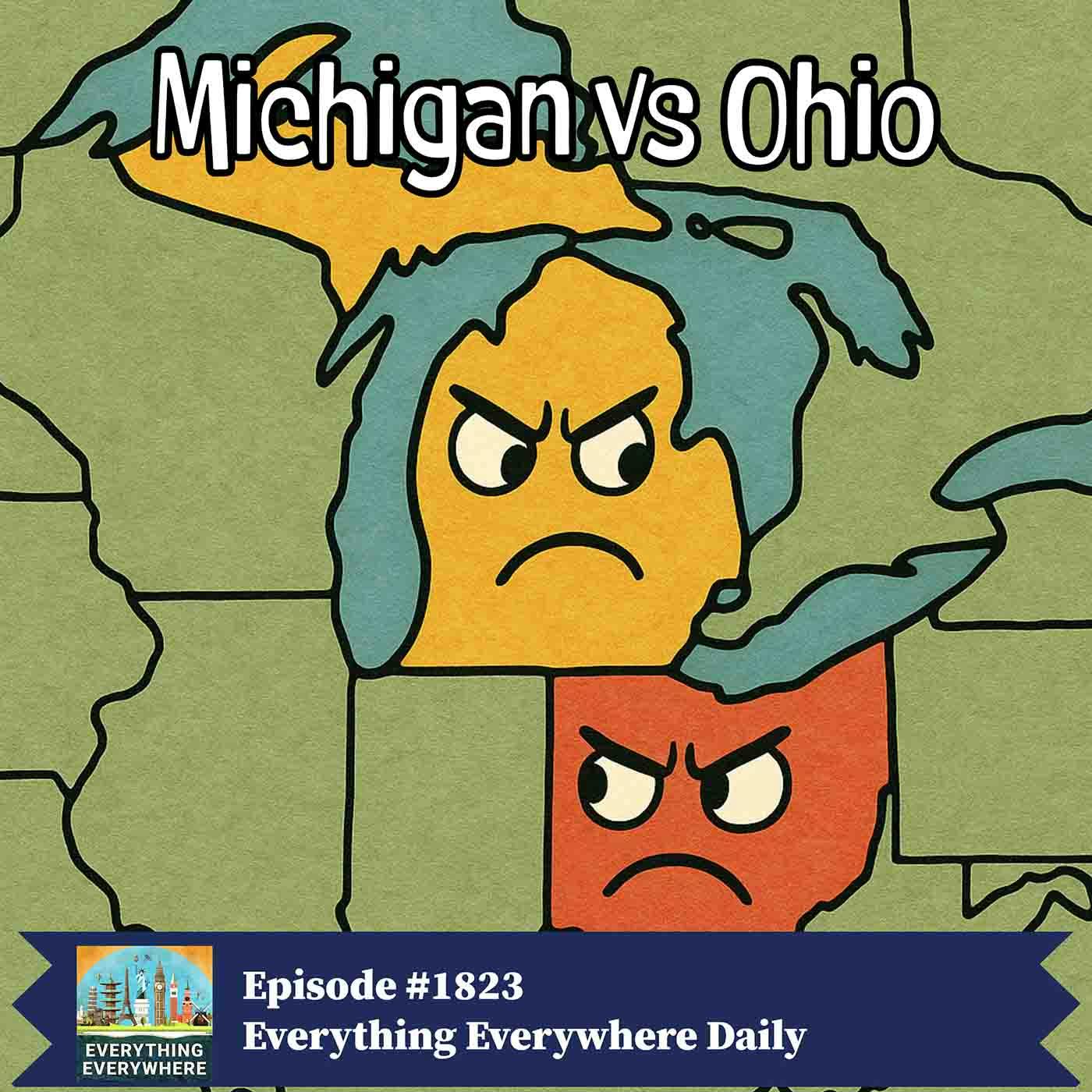
Michigan and Ohio are two states renowned for their intense rivalry. When you think of the rivalry between the two states, you probably think of the rivalry between the University of Michigan and Ohio State. On the football field, however, their rivalry extends well beyond that. In 1835 and 1836, the two states came close to going to war over a border dispute, and the results of that dispute can still be seen on the map today. Learn more about the Toledo War on this episode of Everything Everywhere Daily. This episode is sponsored by Quints. No one is ever going to confuse me with someone fashionable or trendy. That being said, if I'm going to buy something, I want it to look good, be of high quality, and ideally be affordable. That is where Quint's comes in. Quint's is the kind of stuff you'll actually wear, like breathable Flit Polos, crisp cotton shirts and comfortable, lightweight pants. In addition to clothing, they also offer a range of great items for the home and travel. Everything with Quince is half the cost of similar brands. By working directly with top artisans and eliminating the middleman, Quint's offers luxury pieces without the markup. And I've told you all about the great items that I've purchased from Quince. From towels to blankets to a duvet, Quince has become my go to source. Stick to the staples that last with elevated essentials from quince. Go to quince.com daily for free shipping on your order and 365 day returns. That's quince.com daily to get free shipping and 365 day returns quince.com daily. This episode is sponsored by Fiji Water. You've probably heard of Fiji Water and have seen it in stores. Well, Fiji Water really is from the islands of Fiji. Drop by drop. Fiji Water is filtered through volcanic rock 1,600 miles away from the nearest continent and all its pollution protected and preserved naturally from external elements. In this process, it collects a unique profile of electrolytes and minerals, resulting in more than double the electrolytes as the other top two premium bottled water brands and giving Fiji Water its smooth taste. Fiji Water's electrolytes are 100% natural and this water even has a perfectly balanced ph of 7.7. I've recently been trying to reduce my consumption of diet soda and I've found Fiji Water to be a great alternative. Visit your local retailer to pick up some Fiji Water today for your next backyard party, beach day hike, or even your home office. Fiji Water is Earth's finest water. Before delving into the rivalry between Michigan And Ohio. It's necessary to explain what was happening in the region in the early 19th century. And for those of you unfamiliar with the geography of the United States, because you might not live here. Michigan and Ohio are both located in the Midwest region bordering the Great Lakes. The two states had very different paths to joining the Union. Ohio was separated from the original 13 colonies by the Appalachian Mountains. In the early days of the Republic, Ohio was considered to be the frontier and the Wild West. Following the American Revolution, settlement was permitted through the Northwest Ordinance of 1787, which established the Northwest Territory. The Northwest Territory consisted of what is today Ohio, Michigan, Indiana, Illinois, Wisconsin, and parts of northern Minnesota. Ohio couldn't become a state until it met the population requirement of 60,000 people. However, it actually entered the Union slightly earlier as its population was growing rapidly, becoming the 17th state on March 1, 1803. The Michigan Territory wasn't officially organized until 1805, after which it began to grow slowly. The Michigan Territory, which was part of the larger Northwest Territory, was a major theater in the War of 1812, which I've covered in a previous episode. It was a strategic location for both the British and Americans in their attempts to control the Great Lakes. That's because the Michigan Territory had shores on four of the five Great Lakes. The initial boundary of the Michigan Territory was the entire lower peninsula of Michigan and about half of the Upper Peninsula. There was a line drawn through the middle of Lake Michigan, which extended up through the Upper Peninsula, which basically cut it in half. In 1835, the people of Michigan, in the desire to become a state, approved their state constitution and formed their state government in October. And this brings us to the rivalry. As Michigan was organizing and working on becoming a state, a dispute arose. Right along the border of Michigan and Ohio is a small piece of territory known as the Toledo Strip. The Toledo Strip was a thin trapezoidal strip of land measuring 468 square miles, or 1210 square kilometers, and it varied in width between 5 to 8 miles. It was valuable because both the state of Ohio and the territory of Michigan wanted to control the mouth of the Maumee river, which empties into Lake Erie. By controlling this strip, the governments of each state would secure more inland shipping opportunities and better farmland, thereby enhancing the state's economy. The Maumee river provided a connection to both the Great Lakes and and to major eastern cities through the newly developed Erie Canal. The city of Toledo, situated on the north and west banks of the Maumee river, was considered a key port of entry into the Midwest and it was also the shortest access point to eastern cities for both Indiana and Illinois. The big question then is why did both Ohio and Michigan believe that they held jurisdiction over the Toledo Strip? The boundaries of the State of Ohio and the Michigan Territory were, in theory, already set. Well, it was due to the surveying of the region, especially in the late 18th and early 19th century, before Ohio statehood, which was very, very poor. Also, the laws that defined the territories were unclear, leading to both sides interpreting the land as their own and claiming that they held jurisdiction. When Michigan filed for statehood, the territorial dispute suddenly became a major issue as they attempted to gain federal recognition for the Toledo Strip as part of Michigan. This led to Ohio also passing legislation claiming control of the Strip and the Michigan Territory, then doing the same. In return, both legislatures attempted to compel the other to acknowledge that they own the Toledo Strip. Oddly enough, both Ohio and Michigan used the legislation that created the Northwest Territory as their just for their laws. The original ordinance said that the Northwest Territory land would be separated into not less than three nor more than five new states. The Ohio Territory's northern border was specified as an east west line drawn through the southerly bend or extreme of Lake Michigan. The problem was that this boundary was not clearly marked when Ohio became a State in 1803. And when it became a state, the new border specification said that it would run east until it shall intersect Lake Erie. All of this confusion stemmed from a map that was used at the time, known as the Mitchell Map, which was published around the year 1757. The map showed that the southernmost part of Lake Michigan ended before the Detroit river, and therefore the Maumee river would be a part of Ohio. However, later surveys showed that Lake Michigan actually ended further south than what the Mitchell map had showed. And that would be detrimental to Ohio because the new southernmost point of the lake would cause Ohio to lose Toledo. Furthermore, the line that extended east from this point potentially didn't intersect with Lake Erie at all, which would result in the complete loss of all of Ohio's Lake Erie shoreline. In an attempt to protect the territory, Ohio placed a provision in its state constitution that regardless of the boundary, the border would be angled to end north of the mouth of the Maumee River. Ohio then sent their state constitutional change to the US Congress to confirm the border. However, Congress decided that resolving the border wasn't something that needed to be taken care of at the moment. Well, that moment arrived when the Michigan Territory was first created just two years later in 1805. When Michigan defined its southern border, it completely ignored Ohio's state constitution, thus leading to a simmering conflict for the next 30 years. And during that time, tensions slowly grew over the Toledo Strip. One notable moment occurred in 1812 when Ohio's request for Congress to conduct a survey of the line was granted. However, this survey was delayed until 1816 and the conclusion of the War of 1812. Indiana's admission to the United States in 1816 made this survey more complicated. When Indiana was added to the United States, Michigan's border with Indiana was shifted 10 miles north, a change that deviated from the original Northwest Ordinance line. The surveyor for the territory, General Edward Tiffin, was a former Ohio governor and was asked not to survey the border between Michigan and Ohio because that border was defined in the Ohio State constitution. And this obviously favored Ohio in the border dispute as it secured the coveted mouth of the river. Michigan Territorial Governor Lewis Cass then challenged the survey and commissioned a second one based on the original line as established in the Northwest Ordinance of 1787. This result, not surprisingly, came out in Michigan's favor. With the Maumee River's mouth lying in Michigan's territory, the difference between the two geographic surveys created the region that became known as the Toledo Strip. The strip was only five to eight miles wide, but both sides refused to cede land to the other. Michigan went so far as to occupy the territory by creating local governments, building roads, and taxing the region. The conflict continued into the 1830s, with Michigan not being able to join the Union due to its territorial dispute. And despite reaching the population threshold, Ohio remained firm that the border was enshrined in their state constitution and that any Michigander living there was an intruder. Ohio's congressional delegation rejected Michigan's bid to join the Union and actively campaigned for other state delegations to do the same. Ohio continued to cause tension when it established its own government within the toledo strip in 1835, while simultaneously pushing for Congress to pass a boundary bill to settle the territorial dispute once and for all. This led to retaliation by Michigan's territorial governor, Stevens T. Mason. He passed the Pains and Penalties act, criminalizing Ohio governmental actions within the territory. He then sent in Brigadier General Joseph W. Brown to head the state militia. He was under orders to be ready to retaliate against the Ohio trespassers. And this marked the beginning of what became known as the Toledo war. Ohio sent 600 militiamen to the border of the Toledo Strip, While Michigan sent 1,000 men to occupy the city of Toledo. To resolve the political crisis, President Andrew Jackson sought legal opinions on the border dispute. Ohio was more powerful at the time, whereas Michigan wasn't even part of the Union yet and had no voting power in Congress. Additionally, Ohio was considered a swing state in the next presidential election, prompting President Jackson to support Ohio's Toledo claim. However, this wasn't initially acted upon because Congress had decided to not take any action and as a result, the land technically still belonged to Michigan. President Jackson sent two representatives to Toledo to help facilitate conversations between Michigan and Ohio and to resurvey the lines. However, Michigan Governor Mason refused to leave the land and continued to prepare for conflict. During this time, Ohio held an election in the Toledo strip. Michigan authorities then arrested two Ohioans for voting in the elections using the Pains and Penalties act as justification. Ohio Governor Robert Lucas felt that these actions were making the situation worse and sent out surveyors to mark the line. The group of surveyors was later attacked by the Michigan Militia in an armed conflict, the only armed conflict in the war. Although no one died in this battle, nine of the surveyors were taken prisoner. Governor Lucas of Ohio was infuriated by the shots fired and began to pass more acts in retaliation. He established a county seat in Toledo, established multiple laws to protect Ohioans living in the area and sent the modern equivalent of $9.4 million to enforce these laws. Michigan responded in turn by increasing funding for for its militia. Meanwhile, Michigan was still not allowed to become a state despite drafting a constitution and having the requisite population due to the outstanding border dispute. Tensions continued to rise with multiple skirmishes and arrests as Congress urged President Jackson to solve the crisis. Interestingly, there was only one casualty during this war and it occurred outside of conflict. An Ohio man stabbed a Michigan sheriff during a brawl. There were no deaths in battles despite increasing number of militiamen on both sides entering the Toledo Strip. Eventually, Michigan's desire for statehood overwhelmed its desire for Toledo. In 1835, Michigan approved its state constitution and elected a non voting representative to both the House and the Senate. President Jackson signed a bill stating that Michigan would not become a state until it relinquished the Toledo Strip, but in exchange they would be given the Upper Peninsula. However, Michiganders viewed this land as worthless due to its remote wilderness at the time and rejected the offer. Eventually, however, Michigan's financial struggles forced their hand. Michigan was nearly bankrupt due to militia spending and realized that it wouldn't be receiving the same funds as other states so long as it remained a territory. This prompted Michigan to accept the deal offered by President Jackson on December 14, 1836, thus ending the Toledo War. Michigan joined the United States on January 26, 1837 Border disputes between Michigan and Ohio actually persisted throughout the 20th century. They were finally resolved in 1973 when the United States Supreme Court officially ruled in favor of the border as established in the Ohio Constitution. Over time, Michigan did find value in the Upper Peninsula via the fur trade, and eventually the copper found there was far more valuable than what they would have received with the Toledo Strip. The ramifications of the Toledo War are still felt today. The current borders of Michigan, Ohio, Indiana and Wisconsin are all a result of the decisions made at that time. Today, the rivalry between Michigan and Ohio has taken on a different form in sports. While the University of Michigan and Ohio State football rivalry dates back to 1897, it pales in comparison to the greater rivalry between the two states, which has roots going back almost 225 years. The executive producer of Everything Everywhere Daily is Charles Daniel. The associate producers are Austin Okun and Cameron Kiefer. Research and writing for this episode was provided by Olivia Ashe. Today's review comes from listener tothemax111 over on Apple Podcasts in the United States. Amazing podcast. I love it so much. Could you please add more episodes about sports and famous scandals? Anyways, Amazing podcast and I love to listen to it every day. Well, thanks to the Max, there certainly will be both sports and Scandal episodes in the future. I can't say exactly when they will appear, but both of them are well represented in the list of future show ideas. Remember, if you leave a review or send me a boostogram, you too can have it read on the show.