← Everything Everywhere Daily: History, Science, Geography & More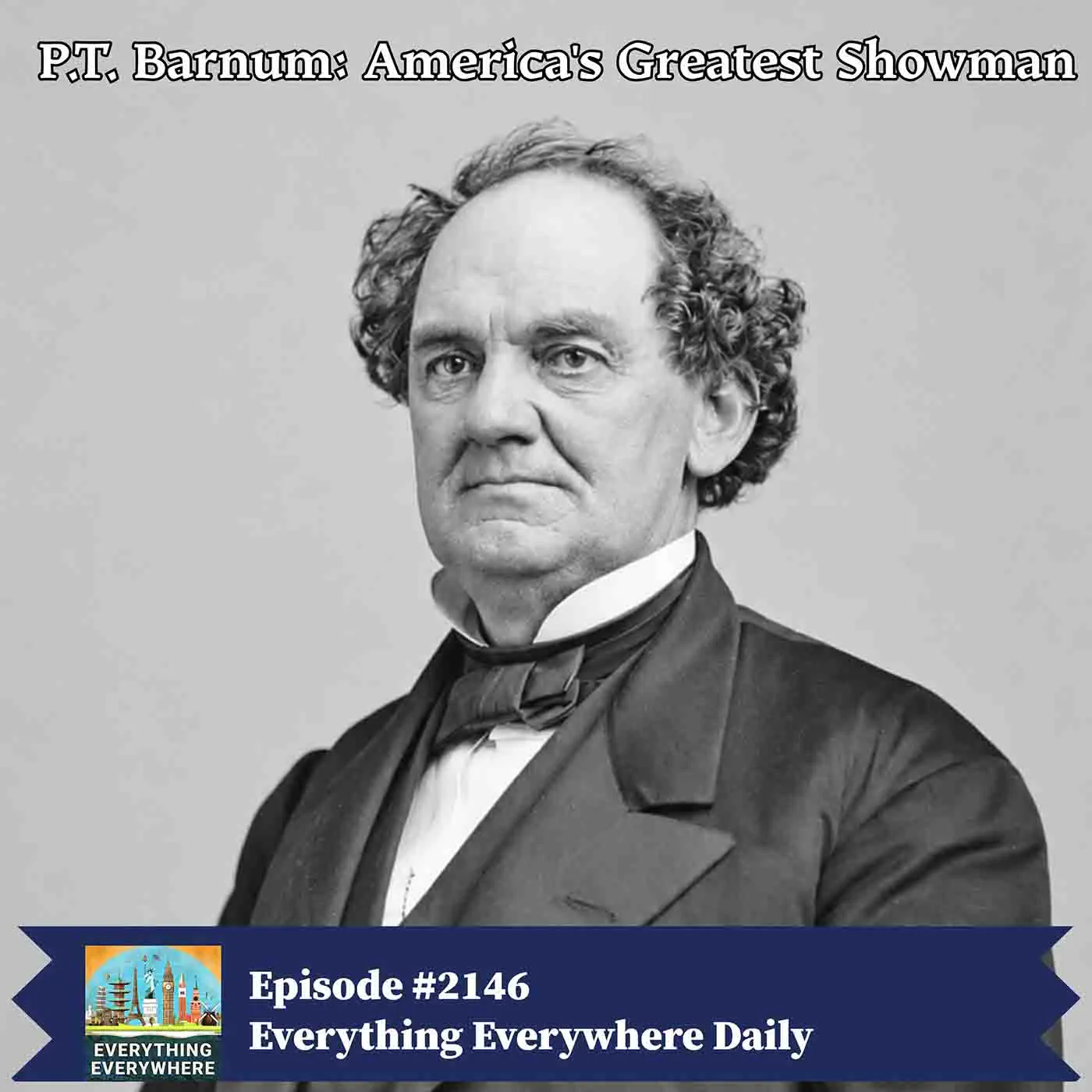
Everything Everywhere Daily: History, Science, Geography & More
P.T. Barnum: The Greatest American Showman
00:14:47
Loading summary
Transcript1 lines
- [00:01]
A
PT Barnum was one of the most famous entertainers of the 19th century, a man who turned curiosity, spectacle and promotion into an art form and money. He built museums, launched tours, entered politics, created legends and helped define the modern circus. His life was filled with ambition, controversy, genius and a fair amount of exaggeration. Learn more about P.T. barnum, the self proclaimed Prince of Humbugs on this episode of Everything Everywhere Daily. This episode is sponsored by Dripdrop. I've started walking every day and going to the gym because you gotta do something to counteract having a podcaster bod. Whenever I'm done, I'll drink a glass of water with Drip Drop's zero sugar plus it has six key electrolytes, 15 essential vitamins and nutrients and no sugar or artificial sweeteners and it also comes in multiple flavors. After you workout or exert yourself, you need to replenish electrolytes. Electrolytes are minerals like sodium, potassium and magnesium that carry electrical charges in your body, helping regulate hydration, nerve signals and muscle function. Drip Drop uses science based formulas for rapid hydration so you feel results fast while getting three times the electrolytes of leading sports drinks. That's why 90% of top college and pro sports teams use Dripdrop. Right now, Dripdrop is offering my podcast listeners 20% off their first order. Go to dripdrop.com and use promo code everything that's dripdrop.com promo code everything for 20% off. Stock up now@dripdrop.com and use promo code everything. This episode is sponsored by Newspapers.com as a history buff, you know that while textbooks record the dates of our nation's conflicts, they often lose the voices of the individuals who served this Memorial Day. As we honor those who made the ultimate sacrifice, Newspapers.com invites you to go beyond the monument and discover the personal stories of the people we remember. Think of it as a bridge to the past, giving you access to over a billion pages of primary source history. This is your chance to move past the generalities of war and find the specific local heartbeat of that era. Newspapers.com provides a vibrant, unfiltered view of the past, letting you see the nuance, the sacrifice and the everyday lives that shape the world that we live in today. It's more than an archive, it's a way to ensure these stories are never forgotten. This Memorial Day. Give a voice to the names in your family tree. Visit newspapers.com today and use promo code everything everywhere at checkout for 20% off your subscription. Newspapers.com honor the past by uncovering its stories. Pt Barnum was born Phineas Taylor Barnum on July 5, 1810 in Bethel, Connecticut, to Philo and Irene Barnum. Phineas was his father's sixth child and had 10 siblings, including older half siblings from his father's first marriage. Phineas grew up in a conservative area where most values were set by the local Congregational Church. To entertain himself, Phineas often engaged in practical jokes, a hobby that he shared with his grandfather. In school, Phineas was perceived as a good student, although he did have some flaws. Many people who knew him at the time commended on his hatred of physical labor. In his youth, Phineas worked for his family, including on his father's farm and at their general store, which he reportedly disliked due to his aversion to working. Following his father's death in 1825, Phineas made the choice to liquidate his family's assets. After the liquidation, he got a position at a general store in the nearby town of Grassy Plains. While working there, he met his future wife, Charity Hallett, to whom he would be married for the next 44 years. With the funds from his liquidated assets, Barnum went on to finance a variety of entrepreneurial projects in Connecticut. However, while working on these projects, he became increasingly concerned about the Congregational Church's influence in political matters. In 1831, Barnum started a weekly newspaper titled the Herald of Freedom, which was published over the next three years. His paper prompted the church to sue Barnum for defamation, resulting in his imprisonment for two months. After the publication of his paper ended, Barnum moved to New York City and took up a new being a showman. In 1835, Barnum was working at a grocery store when a Kentucky based promoter named Coley Bartram entered. Bartram had known of Barnum's interest in speculative investments and intended to take advantage of him. Bartrand had owned a slave named Joyce Heth. The woman was almost completely paralyzed and blind, but Bartrand marketed her as being 161 years old and a former nurse of President George Washington. Though slavery was illegal in New York in 1835, Barnum was able to attain her through a loophole. He first leased her and then completed the purchase. Immediately after, Barnum initiated an intensive marketing campaign. He distributed numerous posters announcing Heth as the greatest curiosity in the world. As public interest in New York started to wane, Barnum showcased her throughout New England. Seeking to maximize his earnings, Heth worked a grueling 1012 hours a day and was presented to audiences as a spectacle. Despite the circumstances, Barnum's approach proved profitable, if highly unethical. As many people paid to witness her speak and sing. When heth died in 1836, Barnum showed neither reverence nor regret for her. Instead, he saw another opportunity to make money. He sent out word of a live public autopsy where her true age would be revealed. Numerous people showed up to see and Hear the reveal. Paying 50 cents to watch. The autopsy found that she was at most 80 years old. Following the financial success of Joyce Heth, Barnum attempted to open up Barnum's Grand Scientific and musical theater in 1836. This act traveled producing shows in the south and along the Mississippi River. The act did not fare well due to a financial crisis that occurred in the country at the time. After facing ups and down in his early ventures, Barnum finally set his sights on his next major pursuit, purchasing a museum in Manhattan. To bring attention to the museum, Barnum sought out any odd attraction that he could find. He also decorated the top of the building in banners and floodlights to draw the crowd's eyes. And to get people into the museum, he hired the worst musicians he could find to perform on his rooftop, hoping that those seeking to escape the noise would would go inside. The attractions inside the museum included dog shows, people labeled by Barnum as exotic Native Americans, albinos, giants, little people, a replica of Niagara Falls, jugglers and magicians. Barnum also offered daily hot air balloon rides and regularly changed the attractions. In the first three years under Barnum's ownership, the museum more than doubled its previous gross earnings. However, this was not enough for Barnum. Wanting to make even more money, Barnum created hoaxes to attract more people to the museum. The first of these hoaxes was a monkey torso and a fish tail joined together to create what he called a Fiji Mermaid. His next big attraction was a child named Charles Stratton, who he found in Bridgeport, Connecticut. Stratton is better known to the world by his stage name and as General Tom Thumb. Stratton was only four years old when he met Barnum, but was marketed as an 11 year old English dwarf. Stratton's size made him a prized attraction to Barnum, who saw not a child but a ticket to fame and fortune. Between 1844 and 1845, Barnum paraded Stratton through Europe, dazzling audiences. On the tour, Barnum and Stratton were introduced to Queen Victoria, who was greatly amused by the actress and her enjoyment led Barnum to meet other monarchs, including the King of France and the Russian Tsar. By touring Europe, Barnum acquired new attractions, mainly automations and other mechanical wonders. The money Brought in during this period also allowed him to open other museums in Philadelphia and Baltimore. During his tour of Europe, Barnum was introduced to a popular singer named Jenny Lind, known in Europe as the Swedish Nightingale. Linda Lind was at the height of her career in Europe. Despite never having heard her voice, Barnum offered Lind the chance to perform in the United states in a 150 tour show where she would be paid $1,000 a night and have all her expenses paid. Lind agreed to do the tour, but required payment in advance, which Barnum agreed to do. This was a big risk for Barnum as he was going on his reputation alone. To pay Lind, he had to put up his home and his museums. Lynd took her money and opened a charity in Sweden to supply schools for poor children. Barnum's risky bet paid off spectacularly. In 1850, crowds surged at the docks when she arrived at the US and at her hotel, swept up in anticipation. Now sensing her power, Lind renegotiated her deal, ensuring that there would be surplus funds left over after Barnum's fee went to her charities. The tour was a smash hit, with the public's enthusiasm around the performances being known as Lyndmania. While on the tour, Lynd and Barnum didn't really see eye to eye. Lind was uncomfortable with Barnum's intense marketing and commercialism, and she eventually severed her contractual ties to Barnum. In 1851, both Lind and Barnum made substantial amounts of money from their tour. Lind earned around $350,000 and Barnum earned approximately $500,000. Adjusted for inflation, Barnum's earnings would be about $19.3 million today. Following the tour with Jenny Lind, Barnum began the first of several retirements. He returned to his mansion, known as Iranistan in Bridgeport, Connecticut, where he spent time with his three children and his wife. While at home, Barnum wrote a biography in which he graphically described how he conned audiences to make money. And unsurprisingly, the publication of this biography sparked significant backlash as the public felt misled by his admissions of having engaged in trickery. The retirement didn't last long. Around this time, Barnum also opened a variety of other entertainment venues, including a theater and America's first aquarium, and as well, brought new attractions to his museum. During this period, he also made a disastrous financial decision in investing in the Jerome Clock Company in 1850. By 1856, the company went bankrupt, taking Barnum's fortune with it. Being completely broke, Barnum was Forced to go back on the road. Fortunately for Barnum, Stratton, AKA General Tom Thumb, was touring on his own and offered to bring Barnum in. The duo did a second European tour. This, combined with Barnum's lectures, allowed him to pull himself out of debt. With entertainment success behind him, the Barnum now transitioned to politics in Connecticut. In 1865, Barnum was successful in this venture as well, which led to his election to the state legislature. In 1875, Barnum ran for mayor of Bridgeport, Connecticut, and won. And as mayor, by all accounts, he improved the city. Barnum described his charitable efforts as profitable philanthropy. Believing that improving the community would increase local wealth and consequently benefit his business, he invested heavily in Bridgeport's development. Based on this principle, Barnum also contributed to Tufts University, serving as a board trustee before the institution was founded. However, this period was also marked by tragedy as his wife, Charity, passed away in 1873. The following year, he remarried Nancy Fish, with whom he would spend the rest of his life. The attraction that Barnum is best known for, the circus, didn't actually start until 1874. Barnum opened PT Barnum's Great Roman Hippodrome in April of that year in New York City. This later became known as Madison Square Garden. He filled the location with new attractions and live animals. His goal was to use all the knowledge and connections from his previous endeavors and open what he called the Greatest show on Earth. Despite being confident in his show, Barnum had a major competitor, a rival circus called International Allied Shows. Barnum decided the best course of action was to merge the two circuses. He contacted the Allied Show's biller, James A. Bailey, and the duo began working on a deal. The two later opened the Barnum and London Circus, later the Barnum and Bailey Circus. In March of 1881, the circus became a smash hit, and one of the most popular attractions was an elephant named Jumbo. Jumbo was considered by Barnum to be one of his greatest triumphs. The creature was 11 and a half feet tall and weighed six and a half tons. He became a beloved figure in the United States, with children everywhere talking about Jumbo. In his first six weeks with the circus, the elephant grossed $336,000, which equates to roughly $10 million today. Jumbo was the featured act of the circus until he was hit by a train and killed in 1885. Barnum was prepared to relinquish a portion of his authority over the circus by 1887. He granted Bailey equal managerial power, and together they continued to elevate the show through the introduction of groundbreaking acts and extraordinary creatures that transformed Circus Entertainment. In 1891, Barnum died at home from a stroke. Much of what people know about P.T. barnum comes from the popular musical the Greatest Showman, and while the film portrays Barnum and his family's lives, it's important to note that the movie takes significant creative liberties and is highly fictionalized. Many of the characters and events in the film are exaggerated or outright fabricated to present Barnum in a favorable light. In reality, Barnum abused members of his circus, where he took advantage of disabled people and often put them in human zoos. The movie creates a feel good story by glossing over many of Barnum's less palatable actions. PT Barnum understood how to get the public's attention better than almost anyone of his era, and he turned that understanding into museums, tours, circuses, political campaigns, and a personal legend that often blurred the line between truth and promotion. His legacy isn't just the circus that bore his name, but the modern world of publicity, celebrity and spectacle that can all be traced back to him. The executive producer of Everything Everywhere Daily is Charles Daniel. The associate producers are Austin Otkin and Cameron Kiefer. Research and writing for this episode was provided by Olivia Ashe. My big thanks go to everyone who supports the show over on Patreon. Your support helps make this podcast possible, and I also want to remind everyone about the community groups on Facebook and Discord. This is where everything happens that's outside of the show. As always, if you leave a review on any major podcast app or in the above community groups, you too can have it read on the show.