Loading summary
Transcript6 lines
- [00:01]
A
Almost a billion people in the world today speak a language that originated from Latin, AKA a Romance language. Despite sharing the same origin, the Romance languages have evolved differently, and in some cases very differently. And while you are almost certainly aware of the largest Romance languages, there's a good chance that you have never even heard of some of the smaller ones that have only a few thousand speakers. Learn more about Romance languages and how they developed on this episode of Everything Everywhere Daily.
- [00:44]
This episode is sponsored by Quints. Temperatures are dropping and the holidays will soon be upon us. This is when you want your wardrobe to just work. Stuff that looks sharp, feels good, and you'll actually reach for that's why I go with Quince. I recently purchased a Mongolian cashmere sweater at Quint's. You can pick one up for $50 when you normally drop $200 or more for the same thing. They also have great denim pants and chinos, as well as fantastic down jackets as well as wool and leather coats. By partnering directly with ethical factories and top artisans, Quinn's cuts out the middleman to deliver premium quality at half the cost of similar brands and often even bigger discounts. Get your wardrobe sorted out and your gift list handled with Quince. Don't wait. Go to quince.com daily for free shipping on your order and 365 day returns. Now available in Canada too. That's Q-U-I-N-C-E.com daily free shipping and 365 day returns. Quince.com daily.
- [01:49]
This episode is sponsored by the Tourist Office of Spain. If you've been listening to this podcast long enough, you might think you know Spain well. Think again. There is so much more to Spain than what most people think. In fact, every part of Spain is packed with history and culture. Extremadura in the west is home to fantastic Moorish architecture and Hamonibirico, the world's greatest pork product. In the north, Galicia, Asturias and the Basque country have stunning coastlines, amazing food and unique cultures. The island of Lanzarote in the Canary Islands has a volcanic landscape, and the Tabernacle Desert has been a filming location for many Western films. The city of Merida has some of the greatest Roman ruins you'll find, and in Valencia, the home of Paella, you can even find the Holy Grail. Plan your next trip and learn about all the lesser known gems in Spain@spain.info Once again, that's spain.info.
- [02:47]
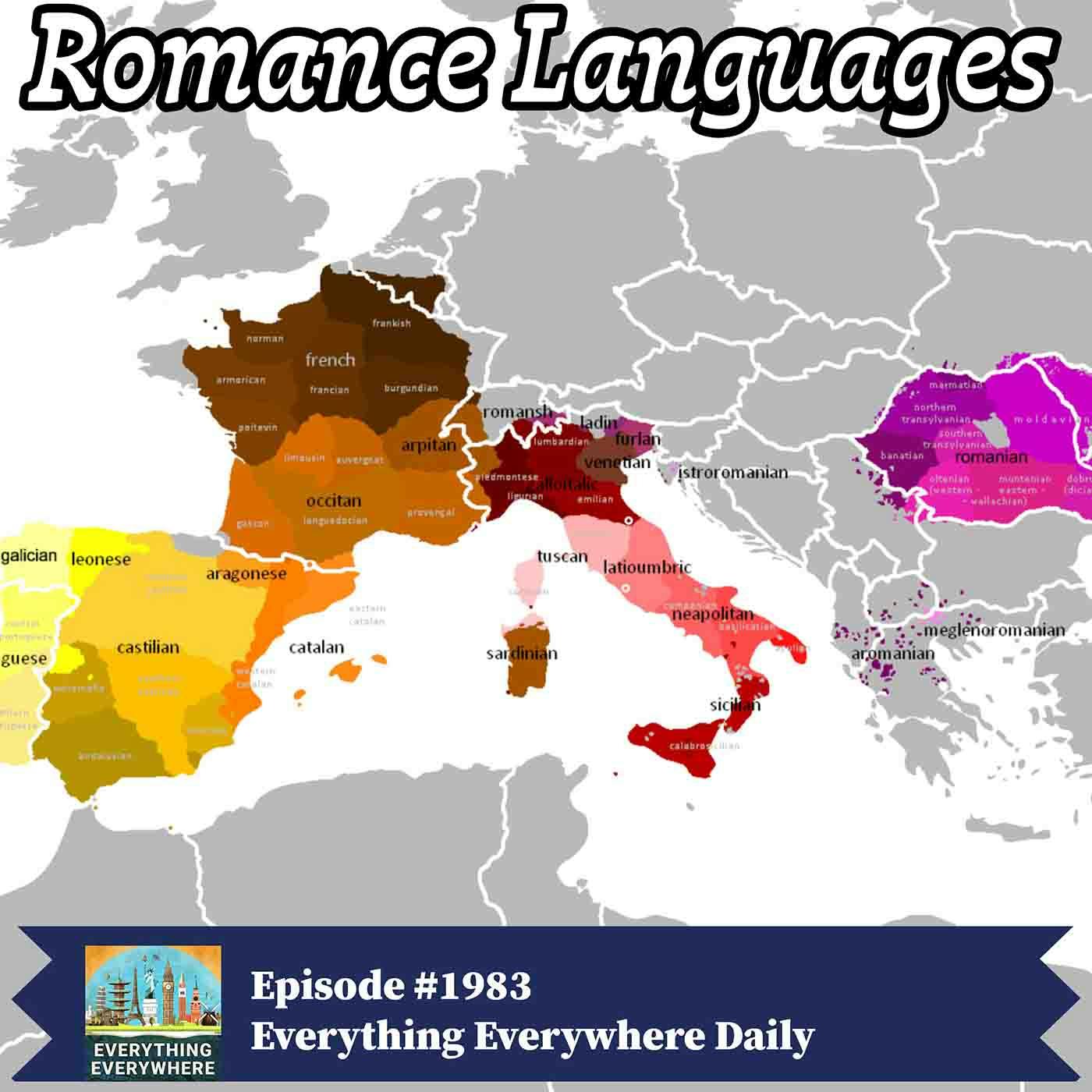
Romance languages are languages that descended from Latin. They're called Romance because they descended from the language of the Romans, and not because of anything related to love or romantic expression. There are currently five major Romance languages with more than 20 million native speakers. In order of popularity, they are Spanish, Portuguese, French, French, Italian, and Romanian. While you're probably aware of these languages, there are actually many other Romance languages that have much smaller populations of speakers, but more on that in a bit. So the first question is, how did all of these different languages develop? The Romance languages descended directly from Vulgar Latin, the colloquial form of Latin spoken by common people throughout the Roman Empire. Vulgar Latin differs importantly from Classical Latin, the formal literary language preserved in the writings of Cicero, Virgil, and other Roman authors. While Classical Latin remained relatively stable and was used for official documents, literature, and scholarly work, Vulgar Latin was dynamic and varied considerably across the empire's regions. As Roman legions conquered vast territories around the Mediterranean and into Western Europe from roughly the third century B.C. through the fifth century, they brought Latin with them. In most conquered regions, Latin gradually supplanted, or at least heavily influenced local languages. Though the degree of this linguistic replacement varied, the Romanization process was most successful in areas such as Hispania, Gaul, and the Italian peninsula, while proving less transformative in regions such as Britain or Germania, where Roman control was less stable or shorter lived. The fall of the Roman empire in the 5th century marked a crucial turning point. With the collapse of centralized Roman authority, the Latin spoken across different regions began to diverge more rapidly. Geographic isolation, limited literacy, and the influence of pre Roman languages spoken in each area, and languages brought by Germanic and other invaders accelerated this process. The Visigoths in Spain, the Franks in Gaul, and the Lombards in Italy all left linguistic imprints on the evolving local forms of Latin. Between roughly the years 500 and 1000, these regional varieties of Latin transformed so substantially that they became mutually unintelligible, giving rise to what we now recognize as distinct Romance languages. Early written evidence of these emerging languages appears in documents such as the Oaths of Strasbourg in 842, which were recorded in both Old French and Old High German, and the Veronese riddle from the 8th and 9th centuries in Italy, which were written in an early form of Italian rather than classic Classical Latin. Oddly enough, the splintering of languages across the former empire preserved the use of Latin for liturgical and scholarly purposes. Almost all official and formal writing during the Middle Ages was in Latin, precisely because it was the one language that everyone had in common. The global reach of Romance languages expanded dramatically during the age of Exploration. Beginning in the 15th century, Spanish and Portuguese colonization of the Americas created vast new territories where these languages became Dominan, while French colonial expansion spread that to parts of Africa, Southeast Asia, and the Caribbean. Today, Spanish stands as the second most spoken native language in the world, with approximately 475 to 500 million native speakers spread across Spain, Mexico, Central and South America, and significant communities in the United States. Portuguese claims about 230 to 260 million native speakers, with Brazil accounting for the vast majority. Although significant populations exist in Portugal, Angola, Mozambique, and other former Portuguese colonies. French is spoken natively by roughly 75 to 80 million people, primarily in France, Belgium, Switzerland, and Canada, with perhaps another 200 million additional speakers who use it as a second language throughout Francophone Africa and other places. Italian has approximately 65 to 70 million native speakers, predominantly in Italy and Switzerland, with diaspora communities around the world. Romanian, the major Eastern Romance language, has about 24 to 26 million speakers, mostly in Romania and Moldova. Even if you don't know a single word in any of these languages, I just listed you at least know that they exist and that they're a thing. What most people assume is that within the borders of a country, everyone, or at least most people, speak the language of that country. For example, Italians speak Italian. That is for the most part true, but again, to paraphrase Mitch Hedberg, there's more to it than that. It turns out there are a whole lot more than five Romance languages. Some have substantial populations of speakers, and some are extremely small. For example, Switzerland has four official German, French, Italian, and Romansh. Romansh is spoken primarily in the canton of Graubrunden in southeastern Switzerland, where it developed from the vulgar Latin brought by Roman soldiers and settlers who occupied the Alpine region beginning in the first century B.C. its evolution was shaped by the area's deep valleys and isolated communities, which preserved archaic Latin features while also incorporating elements from contact with German and, to a lesser extent, Italian. Romansh is not a single uniform language, but a cluster of closely related dialects. Italy has multiple Romance languages that are not Italian. In fact, over half of all Italians do not speak Italian at home. What we call Italian today actually comes from the Tuscan language, in particular the Florentine dialect. The works of the Florentine writer Dante Alighieri were largely responsible for the development of modern Italian. Italy's political fragmentation until the 19th century meant regional dialects remained extremely strong, with some varieties arguably constituting separate languages rather than mere dialects. When Italy unified in 1861, only an estimated 2.5 to 10% of all Italians and actually spoke Italian. So then what did they speak? And Here I should note that there's a lot of disagreement among linguists as to what constitutes a language versus a dialect. The joke is that a language is just a dialect with a flag. For the purpose of this episode, I'm going to call all of these things languages, even though some people might consider them simply to be dialects of the same language. Sardinian is spoken on the island of Sardinia and it's often considered to be the closest to early Latin. It has approximately a million speakers, most of whom live on the island. Friulian and Ladin are languages spoken in the northeast part of Italy. They're descended from the Alpine Romance continuum of languages and reveal centuries of interaction with Germanic and Slavic neighbors. Franco Provencal, also known as Arpitan, is spoken in the extreme northwest corner of Italy as well as parts of western Switzerland and a part of eastern France. Sicilian is a Romance language of southern Italy and Sicily, whose roots lie in the island's complex history of Greek, Latin, Arabic, Norman and Spanish influence, giving it a distinctive vocabulary and sound system that sets it apart from standard Italian. Many of the Italian immigrants in early America were from Sicily and spoke Sicilian, not Italian. Neapolitan, which is spoken in Naples and across much of southern continental Italy, became a major literary and theatrical language, famous for its expressiveness and rich musical tradition. Venetian is native to the Veneto region and was once the lingua franca of the maritime Republic of Venice. It developed as a separate Romance language with strong ties to commerce, producing a lexicon and syntax clearly distinct from Tuscan based Italian, leaving a legacy across the Adriatic world. Lombard, which is spoken in Milan and surrounding regions, belongs to the Gallo Italic group and shares features with Occitan and French resulting from early medieval interactions with Celtic and Germanic populations and geographic proximity to transalpine Europe. Emilian Romanal covers the broad area from Emilia to Romagna, which comprises two closely related yet separate Romance varieties whose consonant patterns, vowel shifts, and vocabulary reflect the region's position between the northern and central Italian linguistic zones.
- [11:43]
These are just the larger minor Romanic languages in Italy. Depending on where you want to draw the dialect language line, there are even more. And I should note that just because these languages are spoken regionally, it doesn't mean that Italian isn't spoken. It just means that another regional language is often spoken as well and sometimes gets priority. Spain similarly has other Romance languages spoken in its country. What we call Spanish is actually within the country, often called Castilian, it originated in the Kingdom of Castile in north central Spain and gradually became dominant on the Iberian Peninsula through political consolidation and the Reconquista. It has an extensive vocabulary borrowed from Arabic during centuries of Moorish presence in Iberia, giving it distinctive characteristics among Romance languages. The most widely spoken Romance language outside of the Big Five is Catalan. Catalan is a Romance language that originated in the Eastern Pyrenees and developed from the variety of Vulgar Latin spoken in what is now Catalonia, Valencia and the Balearic Islands, and adjacent parts of southern France. There are approximately 9.2 million speakers of Catalan in its various dialects. I've actually spent several months in Catalonia and I can say from first hand experience that it is a horrible place to try to learn Spanish. To me, it always sounded like a mix of Spanish and French. In the northwestern corner of the country, Galician is spoken. It's spoken primarily in the province of Galicia and descends from the medieval Galician Portuguese, which emerged from the Latin introduced to the region during Roman rule in the Middle Ages. This shared language became one of the most prestigious literary languages of the Iberian kingdoms, renowned especially for its poetry. Over time, political separation between Galicia and Portugal led to divergent linguistic developments, with Portuguese expanding southward and becoming a major global language, while Galician remained regionally rooted and increasingly influenced by Spanish. Of special note is the small region of the Val d' Aran in northwestern Catalonia. The Val d' Aran is the only part of Catalonia that's on the north slope of the Pyrenees, so the valley actually flows into France. There they speak Aranese, which is a dialect of Occitan. While it's only spoken by about 2,500 people, it has official status in Catalonia. And that brings me to Occitan. Occitan is native to southern France, parts of Italy and Spain. It's descended from the varieties of Vulgar Latin that once formed a broad linguistic continuum across the region known historically as Occitania. There are about 200,000 native speakers of Occitan, but some estimates place that number higher. In the north of France and parts of Belgium, you'll find the Picard language. Picard is spoken by several hundred thousand people, most of whom are elderly, and it's considered a threatened language. The languages that I've outlined so far in this episode are by no means comprehensive, and if you get into dialects, there are many, many more than what I've already outlined. And there's something else to noteportugal Spain, France and Italy are all contiguous with each other. Yet the fifth major Romance language, Romanian, is just kind of floating out there by itself in the East. Moreover, the Roman Empire was much larger than the countries that speak Romance languages. So what happened in the other areas? Well, the answer is the Southern Slavic migration. If you remember back to my episode on Yugoslavia, sometime about 1500 years ago there began a migration of Slavic speaking peoples into the Balkans. The Balkans were once a core part of the Roman Empire, and Romance languages gradually went extinct after the Slavic migration and the rise of southern Slavic cultures. Among the earliest to disappear was Dalmatian. Once spoken along the Adriatic coast from modern Croatia to Montenegro, it actually survived into the late 19th century when its last known speaker, Tuone oudina, died in 1898. Dalmatian showed features midway between Italian and Romanian. Another important extinct Romance language is Mozarabic, the collective term for the Romance dialect spoken by Christian communities living under Muslim rule in medieval Iberia. Mozarabic preserved many archaic Latin traits, was heavily influenced by Arabic, and gradually faded as Castillae, Castilian and Portuguese expanded during the Reconquista. Over the course of centuries, fewer and fewer Romance languages have survived, which has been the general trend for languages all over the world. What used to be a spectrum of languages which spread across Europe has now consolidated into a few major languages and a collection of minor ones. Even though they're not well known and many people have never heard of them, these minor Romance languages are collectively still a part of the daily lives for millions of people.
- [16:57]
The executive producer of Everything Everywhere Daily is Charles Daniel. The associate producers are Austin Otkin and Cameron Kiefer. My big thanks go to everyone who supports the show over on Patreon. Your support helps make this podcast possible, and I also want to remind everyone about the community groups on Facebook and Discord. That's where everything happens that's outside the podcast, and links to those are available in the show notes. As always, if you leave a review on any major podcast app or in the above community groups, you too can have it read on the show.