← Everything Everywhere Daily: History, Science, Geography & More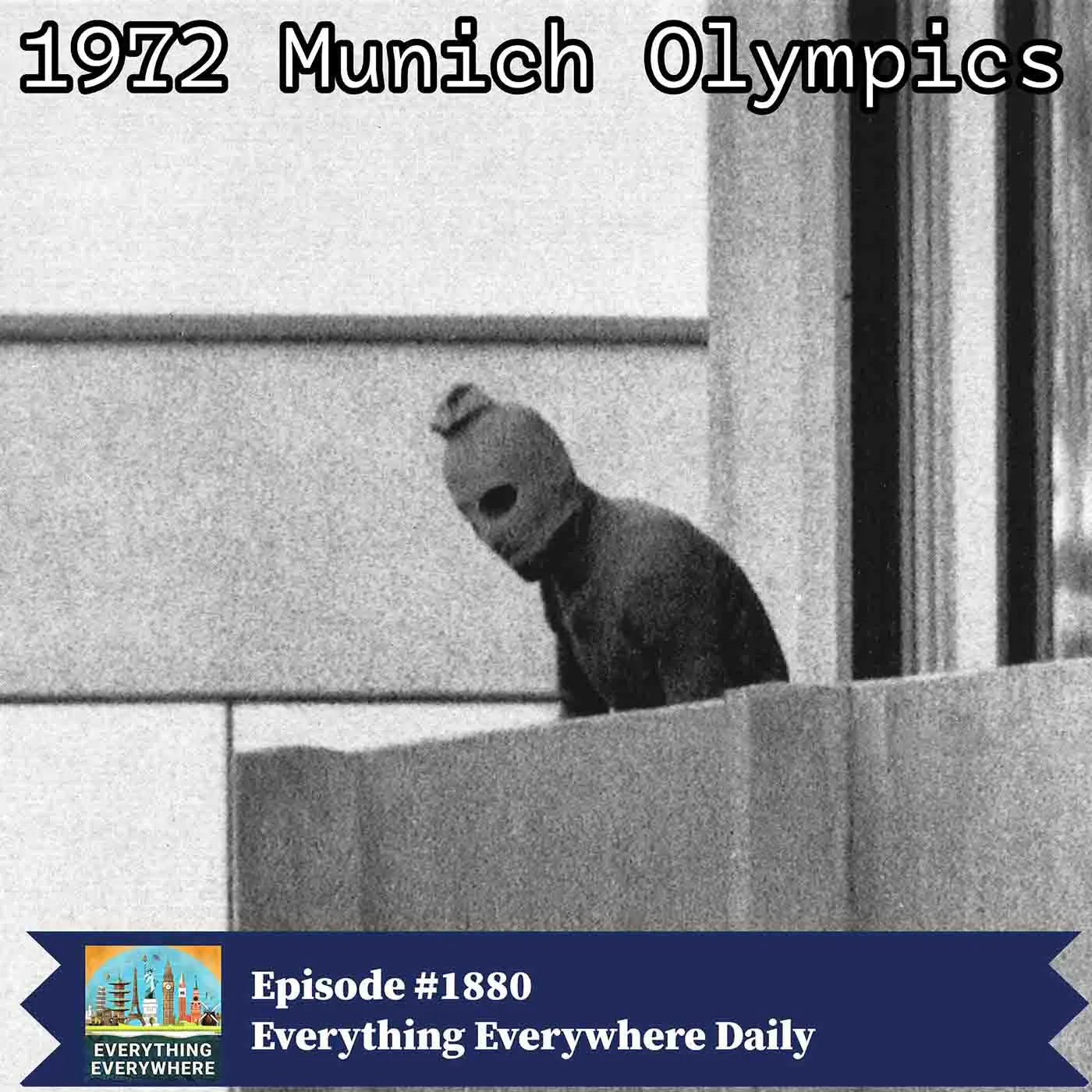
Everything Everywhere Daily: History, Science, Geography & More
The 1972 Munich Olympics Massacre
00:15:49
Loading summary
Transcript1 lines
- [00:00]
A
In 1972, the Olympics returned to Germany for the first time since being hosted in Berlin in 1936. The games were intended to present a new image of West Germany, one that would reject the image portrayed by the previous Nazi hosted Games and showcase a modern, peaceful nation. That didn't happen. Instead, it became known for a terrorist attack on the Israeli Olympic team which led to the death of 11 athletes and coaches and one German police officer. Learn more about the 1972 Olympics and the Munich massacre on this episode of Everything Everywhere Daily. This podcast is brought to you in part by Stash. Here's a secret the best time to start building your financial future is always now. With Stash, you can grow with confidence no matter the market. Stash isn't just another investing app. It's a registered investment advisor that combines automated investing with expert guidance so you don't have to worry about figuring it out on your own. You can choose from personalized investments or let Stash's award winning smart portfolio do the work for you. With Stash, investing doesn't feel like gambling. It's simple, smart and stress free so your money can finally start working as hard as you do. Get access to world class financial advice with personalized guidance for just a $3 monthly subscription. Stash has already helped millions of Americans reach their financial goals. Don't let your money sit around. Put it to work with stash. Go to get.stash.com everything to see how you can receive $25 towards your first stock purchase and to view important disclosures. That's git.stash.com everything paid non client endorsement, not representative of all clients and not a guarantee. Investment Advisory Service is offered by Stash Investments LLC and SEC Registered Investment Advisor. Investing involves risk offers subject to T's and C's. This episode is sponsored by Fiji Water. You've probably heard of Fiji Water and have seen it in stores. Well, Fiji Water really is from the islands of Fiji. Drop by drop, Fiji Water is filtered through volcanic rock 1,600 miles away from the nearest continent and all its pollution protected and preserved naturally from external elements. In this process, it collects a unique profile of electrolytes and minerals, resulting in more than double the electrolytes as the other top two premium bottled water brands, giving Fiji Water its smooth taste. Fiji Water's electrolytes are 100% natural and this water even has a perfectly balanced pH of 7.7. I've recently been trying to reduce my consumption of diet soda and I found Fiji Water to be a great alternative. Visit your local retailer to pick up some Fiji Water today for your next backyard party, beach day hike, or even your home office. Fiji water is earth's finest water. To understand the events that unfolded in Munich in 1972, it's important to understand why West Germany was selected to host the Games in the first place. West Germany was determined to host the Games as it sought to present a more positive image of Germany following the events of World War II. Before 1972, Germany had hosted the Games twice for both the Summer and Winter Olympics in 1936. The previous Games were hosted when the Nazis were in power and they were plagued with propaganda for the Party. By hosting new Games, the government had hoped to change the country's image on the world stage. The Olympic Committee eventually sided with the munich bid in 1966, with West Germany being chosen over Spain, Canada and the United States. After winning the bid, West Germany went to work adopting a positive brand to help showcase the new peaceful country. The game's official motto was the Cheerful Games and the logo was a bright blue solar figure known as the Bright Sun. Additionally, the hostesses were dressed in bright blue and the Games introduced a mascot, a of a dachshund named Valdi, all of which was used to help symbolize the newfound peace within West Germany. However, this peaceful image would come at a cost. Security during the Games was minimal as they wanted to avoid any military imagery. They were also more prepared to deal with drunkenness and ticket fraud instead of a real emergency. Athletes during the Games easily bypassed security measures and would often sneak into other countries areas of the Olympic Village without problem by just climbing over fences. The Israeli Olympic Committee expressed its concern to Munich Olympic officials before the Games began. The team was placed in an isolated region of the village on the ground floor of a smaller building located by the easily climbable gate. Additionally, a very similar scenario to that of the Munich massacre was predicted when planning security for the event. Although this fear was not reported to West German authorities, I say this to illustrate how this lack of security contributed to the events that unfolded. Because they were prioritizing the image of a carefree, safe Olympic Games, they were left unprepared for what eventually happened. The first week of the Olympics went as normal athletes competed and won medals and everything was going fine until the tragedy struck. In the early morning of September 5, eight members of a Palestinian organization known as Black September snuck into the Olympic Village. The terrorists had been working in the Olympic Village for a few weeks, scoping out the area of the attack. During the night of September 4, the Israeli athletes returned to the village after watching a performance of Fiddler on the roof. At 4am the next day, the terrorists scaled the fence with the help of unaware Canadian athletes. Each of the terrorists carried a duffel bag. Within the bags there were assault rifles, pistols and hand grenades. They made their way into the building holding the Israeli, Uruguayan and Hong Kong Olympic delegations. The front door to the building was completely unlocked. The attackers were first noticed by Israeli wrestling referee Yosef Gutt Freund, who had heard a scratching noise. He saw the mass terrorists and weapons and shouted to warn the others in the apartment while throwing a 300 pound weight against the door. As his roommate escaped. Another member of the wrestling team, Moshe Weinberg, a coach, fought the intruders. He was eventually overpowered and shot in the cheek before being forced to lead the terrorists to more potential victims. The Israeli delegation was split into multiple apartment buildings. Weinberg lied to the terrorists about the location of some of the Israeli athletes, directing them to a different building. That building housed the weightlifters and wrestlers whom Weinberg had hoped would be more equipped to overpower the terrorists. Unfortunately, that didn't work as they were all asleep. The terrorists were able to take six hostages from the apartment building back to where the initial attack occurred. When they returned to the first building, Weinberg attempted to attack the terrorists once again. As a result, one wrestler managed to escape by using a parking garage. Weinberg was shot and killed for this attempt, but he did manage to knock one intruder unconscious and slash another with a knife. Then another athlete weightlifter Josef Romano, attempted to attack the terrorists and managed to wound one before being shot and killed. This left the terrorists with nine hostages. Almost all of the delegation was placed into lines across two beds. They were bound and beaten with the corpse of Romano placed on their feet. The final hostage was significantly larger than the other eight. Gut. Freund, who had been the initial person to notice the attackers, was still alive and bound to a chair in such a way that one of the hostages described him as looking like a mummy. At this point, members of the delegation in the second apartment building had been woken and warned. They then left the building and ran to the American building. All those residing in the second building survived as they were able to flee before any potential future attacks could occur. The terrorists then revealed their motivations for the attack. They offered to release the hostages in exchange for the release of Palestinian and non Arab prisoners who were being held by Israel. The list consisted of 328 names. Although the terrorists had made their threat clear by throwing Weinberg's body out of the building. The Israeli government had a policy to never negotiate with terrorists, so there was no deal to be had. The hostage situation placed West Germany in a tough position. Germany, of course, was responsible for the Holocaust, which resulted in the deaths of millions of Jews. So, to put it mildly, the optics of this were really bad. The German government initially considered an unlimited ransom to get the hostages back. This was rejected as the hostage takers claimed that they didn't care for money or even their own lives. To make matters worse for the Germans, the International Olympic Committee refused to suspend the Games, making the situation even more dire. The Germans were not the only group trying to negotiate with the terrorists. Egyptian advisors to the Arab League and members of the International Olympic Committee worked to try to make deals with the terrorists, but those two failed. However, the attempts at negotiation did buy time for the hostages, as it convinced the militia members that their demands were at least being considered. As the hostage situation continued, most athletes from other countries appeared to be completely unaware of what was happening. The Games continued for another 12 hours after the first murder, when pressure on the Olympic Committee eventually became too much. The terrorists had given Israel a deadline of 9am to meet their demands by releasing their prisoners. They also requested a plane for safe passage back to some Arab capital. A crisis team was set up on site to resolve the situation and was told by the German federal government to do whatever was necessary to rescue the hostages. They were unable to reach an agreement by the 9am deadline, but did manage to get an extension. Interestingly, the press had exploded, but not about the hostage situation at this point. Rather, it was about American swimmer Mark Spitz, who had won his seventh gold medal the day before, setting a record for the most gold medals during a single Olympic Games. This record wouldn't be beaten until 2008 by Michael Phelps. Spitz himself was unaware of the hostage situation until he was told about it by the press. He was expected to make a comment on it as he was Jewish, but he ended up just leaving Munich that day as he was concerned that given the publicity surrounding him, he could become a target. With the ultimatum extended until 3pm, German officials attempted to offer themselves as replacements for the hostages, but that proposal was turned down. Later that day, the Israeli ambassador to Germany, Eliza Sheev Ben Horan, publicly stated to the world that Israel would not cooperate with terrorists. At this point. The press was now on the scene at the Olympic Village and began to capture imagery of the hostages and terrorists and broadcast it across the world. The ultimatum was then extended Once more to 5pm the terrorists worked to confuse the police by changing their appearances and clothes to make it look like there were more of them. At this point, there was no one in Germany with training to handle a hostage situation. Additionally, after World War II, the new German constitution did not allow for internal military operations during times of peace, meaning the armed forces were not allowed to help in this crisis. At 4:30pm 13 police officers attempted to rescue the hostages. Disguised in Olympic tracksuits. Over bulletproof vests and machine guns, the group attempted to scale the building, but the Germans had never cut off the electricity to the building, so the terrorists were able to hear about the incoming rescue operations before it ever happened. The terrorists used this to advantage and threatened to kill the hostages if the police were not called back. The police then had to end the operation and the press were removed from the premises. Just before the 5pm deadline, the terrorists changed their demands by asking for passage to Cairo with the hostages so they could continue negotiations. This was agreed to after a German minister and the mayor of the Olympic village went inside the apartment to confirm the hostages were still alive. When they came back, they reported five terrorists, despite the fact that there were actually eight. The second rescue attempt was to take place at the airbase where the terrorists were supposed to board the plane to Cairo. The Germans wanted to have the terrorists and the hostages walk to the helicopters that would take them to the airfield through a basement garage in the Olympic village and then ambush them there. This ended up not happening when the terrorists became suspicious that their route would not be secure and demanded to be transported to the helicopters by bus. The Germans were forced to give in to this concession and attempted to buy more time, claiming that there were no planes available to fly to Cairo. This actually worked and the terrorists pushed back the timeline once more. The terrorists and the hostages were then flown to Furstenfeldbrook Air Base by helicopter. Five sharpshooters were placed around the airstrip. Although none of them were actually trained, they were also improperly positioned, lacked the right weapons and didn't have radios and there were too few of them. Around 10.30pm, the helicopters landed and the terrorists, with their captives tied and bound inside, approached the jet. When two of the terrorists went to inspect the aircraft and found it deserted, they realized that they had been tricked. Almost immediately, the rescue attempt began. German snipers opened fire, killing two of the terrorists, but failing to neutralize the rest. The shooting quickly descended into chaos as the surviving terrorists fired back with automatic weapons. As more police arrived, they mistook one of the snipers and a helicopter pilot for terrorists and shot them, injuring them both. The gun battle raged for over an hour, complicated by poor visibility and confusion about how many terrorists there actually were. Eventually, the the cornered gunmen turned on their hostages. They tossed grenades into one of the helicopters, igniting it and killing the Israelis trapped inside. In the other helicopter, the terrorists sprayed the bound athletes with automatic gunfire, killing all of them as well. The rescue operation was a complete failure. The total number of deaths at both the airfield and the Olympic village included six Israeli coaches, five Israeli athletes and one West German police officer, as well as five of the eight terrorists. In retaliation for the murders, Israel began campaigns against those suspected to be involved in what became known as Operation Wrath of God. The impact of the Munich massacre on Germany can't be understated. The country faced significant criticism for its handling of the situation. A counter terrorist unit of the German Border Guard was formed. In just under two weeks after the incident, the Games were suspended for just 34 hours. On September 6, the memorial was held in the stadium with IOC President Avery Brundage giving a speech. The speech was controversial in that he had actually few references to the massacre and used the time to compare the murders to recent arguments about professionalism and Rhodesia's participation in the Games. There was controversy over the decision to continue the Games, but the Israeli government supported Brundage and the IOC in their decision to continue with the Games. Restarting All Jewish athletes were given protection. Many teams and individual athletes, like Mark Spitz, simply left Munich. In 2012, an investigative report from the German magazine Der Spiegel was released. They claimed that authorities in West Germany had been given a tip from an informant three weeks before the massacre about a potential incident that a Palestinian group was planning. According to the report, the Federal Foreign Office allegedly instructed the State Secret Service to implement security measures that were never taken and this information had been concealed for 40 years. The 1972 Munich massacre remains the darkest moment in the history of the modern Olympic Games. It resulted not just in Germany, but many other European countries creating anti terrorism units to respond to such situations. The Olympics were designed to be an event where the nations of the world could compete and come together, at least briefly, in peace. In 1972, the Olympic Games lost their innocence and it has shaped every Olympic since. The executive producer of Everything Everywhere Daily is Charles Daniel. The associate producers are Austin Otkin and Cameron Kieffer. Research and writing for this episode was provided by Olivia Ashe. My big thanks go to everyone who supports the show over on Patreon. Your support helps make this podcast possible. And I also want to remind everyone about the community groups on Facebook and Discord. This is where everything happens that's outside of the show. As always, if you leave a review on any major podcast app or in the above community groups, you too can have it read on the show.