← Everything Everywhere Daily: History, Science, Geography & More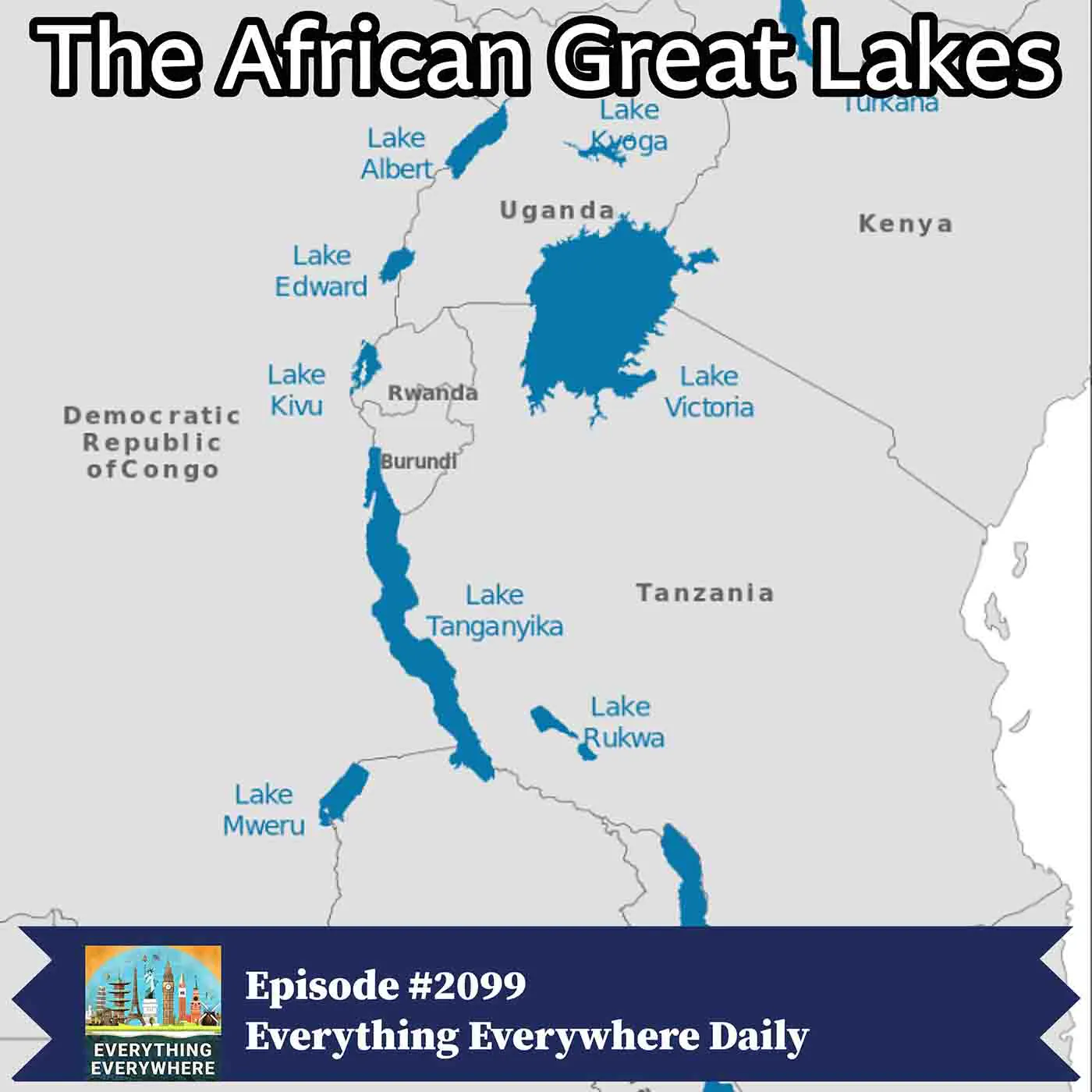
Everything Everywhere Daily: History, Science, Geography & More
The African Great Lakes: Ancient Waters That Shape Modern Africa
00:15:02
Loading summary
Transcript1 lines
- [00:01]
A
The African Great Lakes are some of the largest bodies of fresh water on the planet. Yet they weren't carved by ice, but by a continent literally tearing itself apart. These lakes are older, deeper, and more biologically diverse than almost any others on the planet. They're home to thousands of unique species and tens of millions of people who depend on them every day. But their story isn't just geological or ecological. It's human, evolutionary, and ongoing. Learn more about the African Great Lakes and why they are unlike any other place on Earth on this episode of Everything Everywhere Daily. This episode is sponsored by Audible. It's time to believe in the Hail Mary, one of the most talked about science fiction adventures of the decade. Project Hail Mary by Andy Weir is now on the big screen, and there's never been a better moment to experience the audiobook that started it all. Ryland Grace is humanity's last hope. Alone in space with no memory of how he got there, he must solve an impossible scientific mystery before the Earth is wiped out forever. What follows is a smart, thrilling and surprisingly emotional journey that blends hard science with non stop suspense. Fan favorite narrator Ray Porter delivers an unforgettable performance, balancing humor, heart and escalating tension as the stakes grow higher with every chapter. Part scientific puzzle, part interstellar adventure, Project Hail Mary is a story about curiosity, ingenuity and survival against impossible odds. Now that the blockbuster movie has finally arrived in theaters, there's never been a better time to start listening to the universally acclaimed audiobook Project Hail Mary. Listen. Watch. Save the world. Start listening today@audible.com Hailmary this episode is sponsored by Quince. Steve Jobs is famous for having multiple versions of the same outfit that he wore every day. And I'm not saying I'm Steve Jobs, but I do have a rather simple wardrobe, a habit I developed through years on the road living out of a bag. My Quince cashmere sweater is something I've mentioned before, and I've come to wear it almost every single day. Not only does it look good, but it's incredibly durable. And the best part is that Quince's prices are 50 to 60% lower than those of similar brands. Quint works directly with ethical factories and cuts out the middleman, so you're paying for quality, not brand markup. Everything is designed to last and make getting dressed easy, two things that I really care about. Refresh your wardrobe with quints. Go to Quince.com daily for free shipping and 365 day returns. Now available in Canada too. Go to Quince.com Daily for free shipping and 365 day returns. Quince.com Daily. The African Great Lakes are one of the most extraordinary freshwater systems on Earth. A chain of massive lakes stretching across east and Central Africa along the tectonic scar of the East African Rift. These lakes span 10 countries and collectively hold roughly a quarter of the world's unfrozen freshwater. Unlike the North American Great Lakes, of which there are unquestionably only five, the number of African Great Lakes varies from list to list. The core lakes, which are usually always included, are Victoria, Tanganyika, Malawi, Turkana, Elbert, Edward and Kivu. All of these lakes, save for one, which I'll get to in a bit, have a similar origin and were created through the same process. These lakes, while superficially similar to the North American Great Lakes, are very different. For starters, the North American Great Lakes are very young. They were created about 10, 12,000 years ago, at the end of the last ice age. As the glaciers retreated, they left enormous depressions which were subsequently filled with meltwater. By contrast, the African Great Lakes are tectonic in origin and vastly older. They were created when the African continent split millions of years ago. In a previous episode, I explained how the East African Rift is slowly splitting Africa, and tens of millions of years from now, the eastern part of Africa will become its own new continent. As the crust stretches, it fractures and drops down in long troughs called grabens. Over millions of years, rainfall, rivers and groundwater filled these basins form, forming deep rift lakes. The lakes can be found in Africa across a region in the shape of the letter Y, with two branches, the Eastern Rift Valley and the Western Rift Valley. All of the lakes, again save for one major exception, are created by this process. That is why the lakes tend to be long, narrow and extremely deep. Lake Tanganyika, for example, is the second deepest lake in the world with a maximum depth of 1470 meters, or 4823ft. Now, the exception I keep referring to is Lake Victoria, the largest of the Great Lakes. Lake Victoria is the largest of the African Great Lakes by surface area and the world's largest tropical lake. Formed quite recently, it occupies a shallow depression between the two arms of the Rift rather than sitting along the Rift itself. It's thought to have dried up almost completely around 17,000 years ago during an arid period, and then refilled as wetter conditions returned. The difference between the North American and African Great Lakes extends beyond their creation. In terms of climate, the North American Great Lakes lie in a temperate zone with distinct seasons, winter ice cover and Seasonal temperature stratification. Most of the African Great Lakes lie near the equator in tropical or subtropical climates. Lake Tanganyika in Malawi, for example, are permanently stratified. That means warm surface waters and cold deep waters almost never mix, with major consequences for oxygen levels and nutrient cycling. The deep waters of Lake Tanganyika are largely anoxic or devoid of oxygen and essentially dead zones beyond a certain depth. Whereas the North American Great Lakes mix and oxygenate more fully. Lake Tanganyika is extraordinary not just for its depth, but for what that depth means in terms of time. The water in its deepest layers has been isolated from the surface for potentially tens of thousands of years, and sediment cores drilled from its floor contain uninterrupted climate and environmental records stretching back millions of years. Lake Kivu, which is shared between the Democratic Republic of Congo and Rwanda, sits atop enormous reserves of dissolved methane and carbon dioxide in its deep waters. In a previous episode, I covered the rare natural disaster called limnic eruption. It occurs when a massive eruption of CO2, which is heavier than air, comes out of a lake and spreads in the countryside. It is silent, completely invisible, and incredibly deadly. In 1986, a limnic eruption in Cameroon killed over 1700 people. If such an eruption occurred in Lake Kivu, it could affect over 2 million people. Lake Malawi is so deep and clear that visibility can extend 20 meters, making it one of the finest freshwater diving destinations in the entire world. Its water is remarkably clean by African standards, although agricultural runoff and population pressure is threatening this clarity. If there's one aspect of the African Great Lakes that genuinely astonishes scientists, it has to be their biology. The lakes, particularly Tanganyika, Malawi, and Victoria, are considered among the world's most important laboratories for understanding how species multiply. The best known example of adaptive radiation in the African Great Lakes is the cichlidfish. This family of freshwater fish began with a single ancestral species that colonized a new environment and then rapidly diversified into numerous descendant species, sometimes hundreds or even thousands. Each new species occupies a unique ecological niche, a process biologists call adaptive radiation. Lake Malawi alone is estimated to host between 500 to 1,000 cichlid species, the vast majority of which are found nowhere else on Earth. Lake Victoria is thought to have generated several hundred species from a single ancestor as little as 15,000 years ago. One of the fastest known instances of vertebrate specialization, Lake Tanganyika, the oldest and deepest, hosts around 250 cichlid species and is considered the ancestral source of cichlid diversity across the entire region. These cichlids display a spectacular range of feeding strategies, body shapes, colors and behaviors. Some are algae scrapers, some are specialized mollusk crushers, some are open water plankton feeders, and fascinatingly, some are scale eaters that sneak up on other fish and bite off their scales. There are even mouth brooding species in which parents incubate eggs in their mouths for weeks. The lakes are enormously important to the global aquarium industry because of their cichlid fish. African cichlids are prized for their vivid color, territorial behavior, and relative hardiness. And they dominate large segments of the freshwater aquarium trade, supporting both local export economies in Africa and a worldwide network of breeders and enthusiasts. Beyond cichlids, the lakes host an enormous array of other life. Lake Tanganyika contains unique invertebrates, including jellyfish, snails and crabs that superficially resemble marine species, a legacy of the lake's ancient stable chemistry. Hippos and crocodiles are abundant in and around nearly all the lakes. The surrounding wetlands and shoreline are critical habitat for enormous populations of birds, including African fish eagles, herons, storks, and millions of other migratory birds. Papyrus swamps fringing Lake Victoria provide breeding and nursery habitat for dozens of other species of fish. Tragically, the introduction of the Nile perch into Lake Victoria in the 1950s and 60s caused one of the most severe ecological disasters in freshwater history. The Nile perch is a large predatory fish that was introduced deliberately to boost fisheries production. It devastated the lake's native cichlid population, driving an estimated 200 species to extinction, the largest mass extinction of vertebrates in recorded human history. In contrast to all of this, the North American Great Lakes have almost no endemic species whatsoever that live only in the Great Lakes. The African Great Lakes are not just about geology and biology. For the approximately 50 million people living in the immediate vicinity of the African Great Lakes and the many millions more who depend on their water watersheds, these bodies of water are not merely scenic features. They are the foundations of daily life. Fishing is the most direct economic link. Lake Victoria alone supports one of the world's largest freshwater fisheries, employing an estimated 200,000 or more fishermen directly and millions more in processing, transportation, and trade. The Nile perch fishery, despite its ecological cost, generates hundreds of millions of dollars in export revenue annually, with much of the catch being shipped to Europe and Asia. Kapenta and kariba fish are a critical source of cheap animal protein for landlocked populations in Zambia, Tanzania, and the DRC In Malawi. A sardine like fish called the Usipa is central to both nutrition and culture. The lakes are vital freshwater sources for drinking, irrigation and industrial use across the region. In a continent where water scarcity is a growing crisis, the lakes represent irreplaceable reserves. Several major cities, including Kampala, Uganda, Bujumbura, Burundi, and Mirwanza, Tanzania, sit directly on lakeshores and depend on them for municipal water supplies. Tourism, while underdeveloped relative to the lake's potential, contribute meaningfully to local economies. Lake Malawi national park was designated a UNESCO World heritage site in 1984, recognized for its extraordinary cichlid diversity. The lake's clear, warm waters and sandy beaches draw international visitors for snorkeling, diving, and sailing. Lake Tanganyika similarly attracts divers and researchers, and its shores include Gombe Stream national park in Tanzania, where Jane Goodall conducted her groundbreaking chimpanzee research beginning in 1960. The lakes also play an important role in regional transportation. In areas with poor or non existent roads, lake ferries serve as lifelines connecting communities on Lake Victoria. Ferries link Uganda, Tanzania, and Kenya in journeys that would otherwise require long, difficult overland routes. The sinking of the MV Bukoba on Lake Victoria in 1996, with a loss of over 800 lives, illustrates both the scale of this lake traffic and the dangers posed by overloaded, poorly maintained vessels. With 10 different nations in the region, it should come as no surprise that the lakes have been a source of friction. In fact, multiple issues have arisen, becoming international sources of tension. First, there are the disputes over borders and control. Many lakes, such as Malawi and Lake Victoria, are shared, and disagreements over where boundaries lie can lead to diplomatic tensions and occasional confrontations, especially when fishermen cross into contested waters. Second, competition over fisheries is a major source of friction. Fish stocks move freely but national regulations do not, leading to overfishing, enforcement, conflicts, and arrests where fishermen operate across borders. Third, control of water flow and hydropower creates downstream disputes. For example, decisions affecting Lake Victoria influence the Nile river, which can then impact countries far beyond the immediate lake region. Fourth, environmental damage creates shared problems, but uneven responsibility, pollution, invasive species, and deforestation in one country can harm the entire lake, leading to blame and disagreements over who is responsible. And fifth, natural resources beneath the lakes, such as oil in Lake Albert or methane in Lake Kivu, introduce economic competition and territorial disputes. Despite all of these tensions, there are also significant efforts to collaboratively manage the lakes. Organizations like the Lake Victoria Fisheries Organization and the Nile Basin Initiative aim to coordinate policies, share data, and reduce conflict. These frameworks recognize a basic none of the countries can manage these lakes effectively on their own. When most people think of Africa, they might think of vast savannas, dense rainforests, or maybe even the Sahara Desert. However, Africa is also made up of water, in fact, an enormous amount of fresh water. The African Great Lakes have ancient origins, making them among the most biologically diverse freshwater ecosystems on the planet. But despite having been formed millions of years ago, they are still highly relevant and important to the people who live near their shores today. The executive producer of Everything Everywhere Daily is Charles Daniel. The associate producers are Austin Otkin and Cameron Kiefer. My big thanks go to everyone who supports the show over on Patreon. Your support helps make this podcast possible, and I also want to remind everyone about the community groups on Facebook and Discord. That's where everything happens that's outside the podcast, and links to those are available in the show Notes. As always, if you leave a review on any major podcast app or in the above community groups, you too can have it read on the show.