Loading summary
Transcript1 lines
- [00:00]
Host
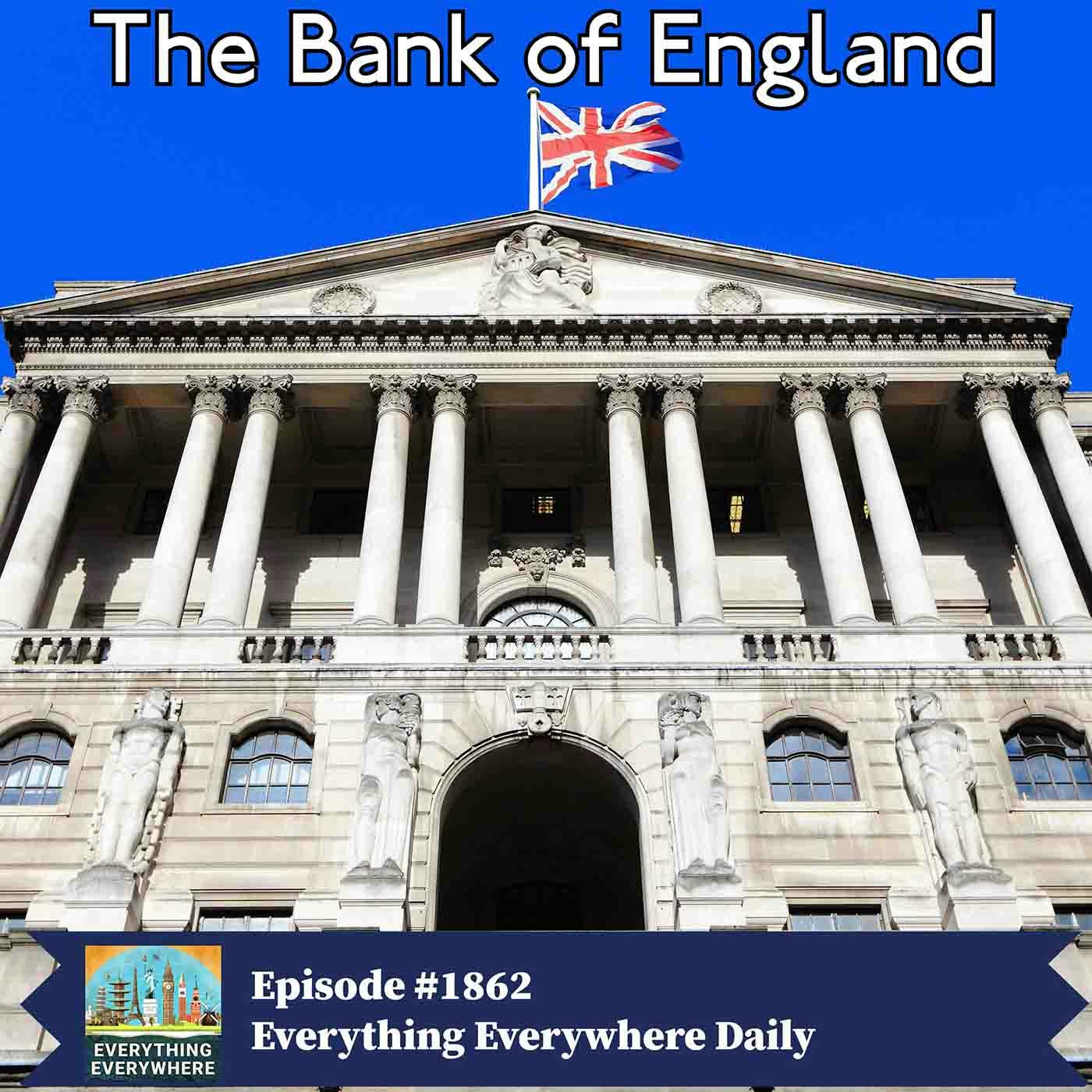
In the late 17th century, King William III of England was facing a problem. He was in the middle of a prolonged war with France, was in desperate need of money, and had exhausted most of the traditional sources for funding a war. A proposal came forward for a new bank that could lend the Crown money at favorable interest rates and also solve several problems for the merchants in England. Learn more about the bank of England, one of the most important banks in world history of on this episode of Everything Everywhere Daily. This episode is sponsored by Fiji Water. You've probably heard of Fiji Water and have seen it in stores. Well, Fiji Water really is from the islands of Fiji. Drop by drop, Fiji Water is filtered through volcanic rock 1600 miles away from the nearest continent and all its pollution protected and preserved naturally from external elements. In this process, it collects a unique profile of electrolytes and minerals, resulting in more than double the electrolyte as the other top two premium bottled water brands, giving Fiji Water its smooth taste. Fiji Water's electrolytes are 100% natural and this water even has a perfectly balanced pH of 7.7. I've recently been trying to reduce my consumption of diet soda and I've found Fiji Water to be a great alternative. Visit your local retailer to pick up some Fiji Water today for your next backyard party, beach day hike, or even your home office. Fiji Water is Earth's finest water. This episode is sponsored by Quint's. I recently purchased a new sweatshirt on Quince. It was a black long sleeve cashmere sweatshirt and if that sounds fancy, it's it sort of is. But I only paid a fraction of what I would have paid if I purchased the same thing from a name brand designer. The Quint's website literally showed me how much an equivalent sweatshirt of the same color and same material would have cost from other fashion designers and my savings were between 78 to 94%. I've been telling you for months now about how Quints brings you quality items at a fraction of the price and it's not just a marketing slogan. You can go to their website and see the savings for yourself by working directly with top artisans and cutting out the middleman. Quints gives you luxury pieces without the markup and they pass the savings on to you. Keep it classic and cool with long lasting staples from Quince. Go to Quince.com daily for free shipping on your order and 365 day returns. That's Q-U-I-N-E.com daily to get free shipping and 365 day returns. Quince.com daily. Something that most leaders quickly realize is that wars are not really fought with weapons and men. They're ultimately fought with money. In the early 1690s, King William III's government was facing spiraling war costs in his conflict with Louis XIV of France. During the nine years, traditional methods of fundraising, such as short term loans from goldsmith bankers, taxes and customs revenues were insufficient and unreliable. England's creditworthiness was weak and lenders demanded high interest rates due to repeated defaults from earlier in the century. At the same time, London's financial world was evolving. Goldsmith bankers had pioneered deposit taking and lending, but there was no institution able to mobilize large amounts of capital on a long term basis for the state, nor to issue widely trusted standard paper currency. The solution to both of these problems was proposed by William Patterson, a Scottish merchant and financier with experience in Amsterdam's sophisticated financial markets. Patterson had a clear model in mind. The Amsterdam Visselbank and the Swedish Riksbank, which demonstrated how a state backed bank could finance government and simultaneously stabilize the currency. In 1691, Patterson proposed a public corporation that would lend a substantial sum to the Crown at fixed interest rates in return for the right to issue banknotes and conduct banking business. His original plan failed to gain traction, but wartime desperation revived the idea. In 1694 the government was seeking £1.2 million, which was an enormous sum of money at that time to fund their war effort. Parliament agreed to raise the money via a public subscription which investors would lend the sum to the government at 8% interest plus annual £4,000. To manage the fee. Subscribers would be incorporated as the Governor and company of the bank of England, with privileges including the right to issue banknotes backed by government debt, to deal in bills of exchange and to accept deposits. The arrangement effectively linked the new bank's fortunes to those of the English state. The bank was created under the tonnage act of 1694, which was formally titled and wait for the whole thing, an act for granting to their Majesties several rates and duties upon tonnage of ships and vessels and upon beer, ale and other liquors for securing such recompenses and advantages in the said act mentioned to such persons as voluntarily advance a sum of 1500,000 pounds towards carrying on the war against France, end quote. It was a marriage of convenience. The government got the money it desperately needed, while the Bank's investors received 8% annual interest plus the exclusive right to issue banknotes. In England. The subscription of the 1.2 million pound loan opened up in July of 1694 and was fully taken up within 12 days, a sign of strong investor interest in the combination of high interest rates and royal backing. The bank began operations and rented premises in the Mercer's hall before moving to Grocer's hall before eventually establishing its own headquarters in threadneedle street in 1734. Initially, the bank's main assets were the government debt it had purchased and its liabilities were the notes it issued against this debt. These notes began to circulate as a trusted paper currency, though at first it was mainly amongst merchants and financiers. And if you remember back to my episode on the gold standard, these paper notes were redeemable for gold upon demand. The bank faced early opposition from the Tory Party, which saw it as an instrument of the Whig party, and also from goldsmith bankers who lost influence, and from the Land bank scheme, which was a rival project backed by landed interests. It also had to weather a 1696 currency crisis caused by the Great Recoinage, which strained its reserve when holders of notes demanded silver in exchange. Nevertheless, its survival and its ability to roll over government loans cemented its position. Over the following decades, it became the indispensable fiscal arm of the British state, financing wars and underpinning public credit. At its founding, the bank was a regular commercial bank that just happened to have a large privileged client in the Crown. It took deposits, discounted bills of exchange and issued banknotes. But its biggest role was holding and managing the government's accounts. Its notes were backed partially by the 1.2 million pounds loan to the Crown and partially by precious metal reserves. However, its special relationship with the Crown meant its fortunes rose and fell with government credit. The Nine Years War and the War of Spanish Succession in 1701 saw repeated calls for loans and the bank frequently rolled over and expanded its holdings of public debt. Its ability to raise funds for the state began to crowd out other competitors. A key turning point came in 1708 when Parliament renewed the Bank's charter and granted it an exclusive privilege. No other bank with more than six partners could be formed in England. This effectively prevented the creation of another large scale joint stock bank, leaving only small private banks alongside the bank of England. The period also saw the rise of long term public debt instruments like Consols, which are perpetual government bonds that were first issued in 1751. With the bank acting as registrar and transfer agent for these bonds. Its role as a fiscal agent deepened, but it was still primarily a profit seeking company owned by private shareholders. By the mid 18th century, London's money market increasingly revolved around the Bank. Its notes had wider circulation and merchants held deposits there as a matter of convenience and prestige. During the American Revolutionary War and with the wars with Revolutionary France, government borrowing surged. The Bank's advances to the treasury became so large that its reserves of gold and silver were strained, foreshadowing the next major change in its operations. In 1797, amid fears of French invasion and a drain on gold, the government suspended the Bank's obligation to convert its notes into gold via the Bank Restrictions Act. This restriction period lasted until 1821. Freed from convertibility, the bank could issue more notes than its gold reserves would otherwise allow, effectively creating money to finance war. This marked the first time its note issuing powers were used as a deliberate macroeconomic tool. Even if contemporary understanding of monetary policy at that time was still rudimentary. It was the first time they suspended convertibility, but it would not be the last. The bank restriction period also sparked intense debates about banking theory. Two schools of thought. The banking school, which believed that banks should have flexibility in note issuance, and the currency school, which wanted strict controls. The intellectual battle would shape central banking theories for generations. Also, as an aside, if you remember back to a previous episode, it was the start of the 19th century when the United States established the first bank of the United States, which was explicitly modeled on the bank of England. After returning to gold convertibility in 1821, the bank faced criticism for its role in credit cycles and financial crises such as the panic of 1825. Economists like David Ricardo argued that note issuance should be strictly tied to gold reserves to prevent inflation. The 1830s and 40s brought increasing calls for a legal framework to control the Bank's powers, particularly due to the influence of the currency school of economists who wanted a rules based system linking note issuance to gold holdings. The currency school won a decisive victory with the bank charter Act of 1844, one of the most important pieces of financial legislation in history. The act essentially created the template for modern central banking by separating the Bank's functions into two departments. The issuance department of the bank could only issue banknotes backed by gold, with a small exception for government debt, while the banking department conducted normal commercial operations. This act also gave the bank of England a monopoly on note issuance in England and Wales, gradually phasing out other banks ability to print money. Scotland and Northern Ireland retain some note issuing banks which continues today as a historical remnant. It was with this 1844 act that the bank of England began to look and behave more like a modern central bank. The Mid to late Victorian era saw the bank of England mature into its role as the world's premier central bank. The gold standard provided a stable monetary anchor and London became the undisputed center of global finance. Walter Bagehot, editor of the Economist, wrote the influential book Lombard street in 1873, which articulated principles that still guide central banking today. Bajet argued that during financial crises, central banks should lend freely at a high rate against good collateral. The outbreak of World War I in 1914 marked the end of the classical gold standard and the beginning of more active government intervention in monetary policy. The bank once again helped finance the war effort and managed complex exchange rate arrangements with other countries. The interwar period was turbulent, featuring deflation, the return to gold in 1925 at an overvalued rate that hurt British exports, and then the abandonment of gold once again in 1931 during the Great Depression. World War II brought even greater government control over finance. The bank became essentially an arm of the treasury at this point, managing war finance, exchange controls and rationing of credit. By the war's end, the stage was set for a fundamental change in the bank of England status. The bank of England act of 1946 formally nationalized the bank, transferring its stock into public ownership and placing it firmly under ministerial control. The post war period coincided with the Bretton woods system, which saw the US Dollar take over from the British pound as the world's reserve currency. When President Nixon ended dollar gold convertibility in 1971, the world entered an era of floating exchange rates that continues today. The bank now had to learn new skills in managing a floating currency while dealing with the inflation pressures of the 1970s. The biggest post war event for the bank of England probably took place on September 16, 1992, a day known as Black Wednesday. The European Exchange rate mechanism, or ERM, was created in 1979 as part of the European Monetary System. It was intended to keep participating European currencies stable within narrow margins ahead of an eventual monetary union which eventually became the euro. Britain joined the ERM relatively late in October of 1990. The pound sterling entered at a central rate of 2.95 Deutsche marks with a permitted fluctuation band of + or -6%. By the early 1990s, the United Kingdom was in recession. Unemployment was rising, housing prices had collapsed and interest rates were above 10% to defend the ERM parity and fight inflation. Meanwhile, the Bundesbank in Germany had raised interest rates to combat inflation pressures from their reunification boom. Because ERM members had to keep their exchange rates in line with the Deutsche mark, the UK was forced to maintain high interest rates despite its weak economy. Currency traders, most famously George Soros as Quantum Fund, concluded that the pound ERM rate was unsustainable. And their logic was very simple and straightforward. If the UK kept high interest rates to defend the pound, it would deepen its recession. And if it cut rates to support the economy, the pound would fall below its ERM band. Speculators began selling pounds for Deutsche marks in huge volumes, betting that the UK would devalue or drop out of the erm. The bank of England spent billions of pounds from its reserves buying sterling in the foreign exchange markets to prop up the rate. On Black Wednesday, the Bank of England began the day intervening heavily in the market. The government announced an emergency hike in interest rates from 10 to 12% and later said that they would go to 15% the next day, measures meant to attract capital back into the sterling. But despite these moves, selling pressures continued unabated, overwhelming the bank's interventions. By the evening, Chancellor Norman Lamont announced the UK was suspending its membership in the ERM and returning to a floating exchange rate. The pound fell sharply on currency markets from around 2.78 marks to 2.6 marks in a single day. The UK treasury reportedly lost between 3.3 billion and 5 billion pounds in the failed defense of the pound. The Quantum Fund reportedly made over a billion pounds in profit from shorting the pound, cementing George Soros public reputation as the man who broke the bank of England. Over three centuries, the bank of England has changed dramatically from a joint stock company designed to help a king fight a war with France, to becoming the bank behind the world's most preeminent currency during the gold standard, to becoming the United Kingdom's central bank in the modern world of floating exchange rates. But perhaps most importantly, it served as a template for almost every other central bank in the world today. The executive producer of Everything Everywhere Daily is Charles Daniel. The associate producers are Austin Otkin and Cameron Kiefer. My big thanks go to everyone who supports the show over on Patreon. Your support helps make this podcast possible. And I also want to remind everyone about the community groups on Facebook and Discord. That's where everything happens. That's outside the podcast and links to those are available in the show notes. As always, if you leave a review on any major podcast app or in the above community groups, you too can have it read on the show.