← Everything Everywhere Daily: History, Science, Geography & More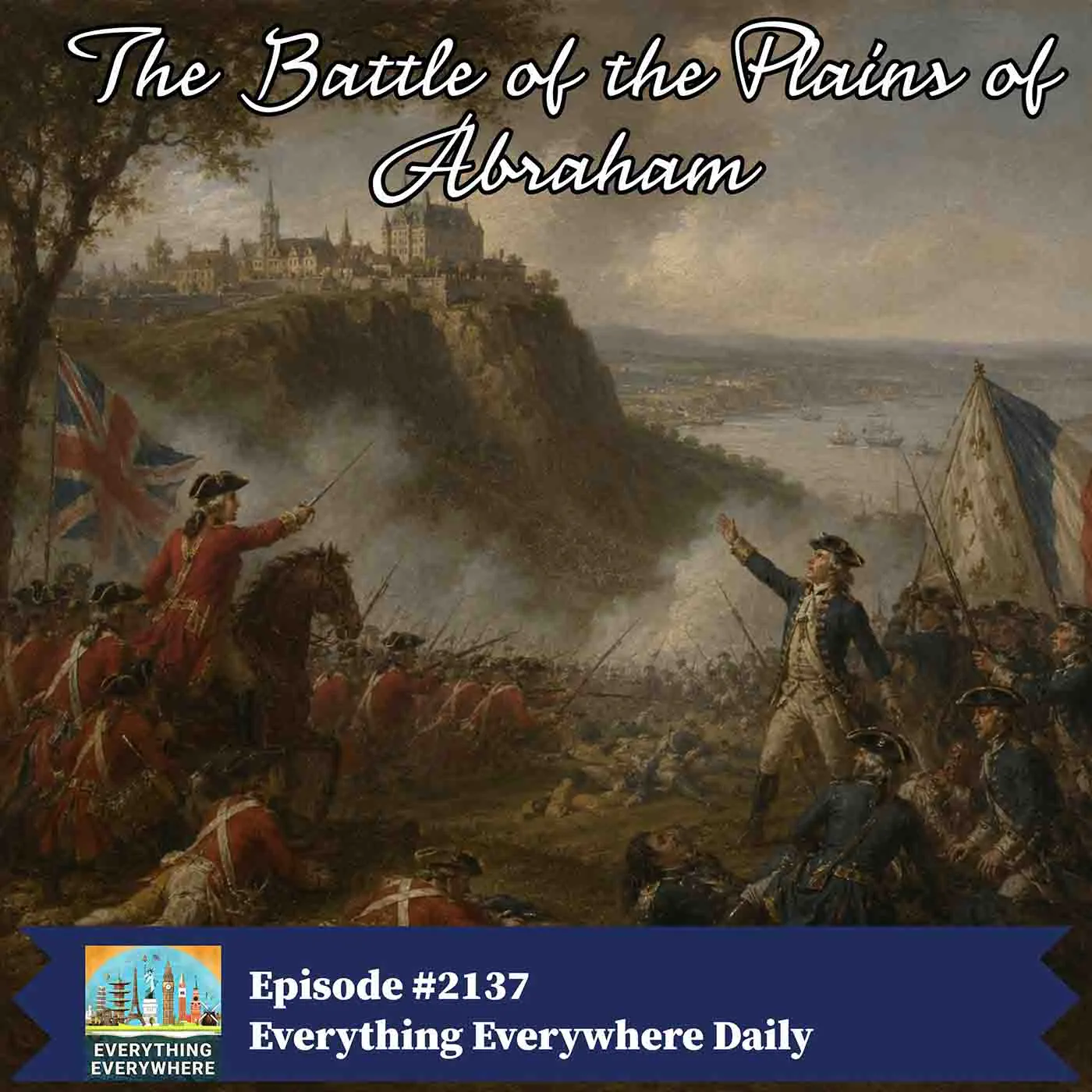
Everything Everywhere Daily: History, Science, Geography & More
The Battle of the Plains of Abraham: How Quebec Became British
00:15:32
Loading summary
Transcript1 lines
- [00:01]
A
In 1759, on a plateau outside of Quebec City, two armies met in a battle that lasted less than an hour but changed the course of a continent. The battle determined the fate of New France, reshaped Canada's future, and marked a turning point in the global struggle between Britain and France. It was a clash defined by daring strategy, brutal speed, and the deaths of two commanding generals. Learn more about the Battle of the Plains of Abraham and how Quebec became British on this episode of Everything Everywhere Daily. This episode is sponsored by Mint Mobile. Most of you might have something that you're saving up for. Maybe it's the trip of a lifetime. Your children, your retirement, or maybe even something nice for yourself. And if you're looking for some extra money, the easiest thing you can do is to cancel your current mobile plan and switch to Mint Mobile. With Mint Mobile you can get high speed data and unlimited talk and text delivered on the nation's largest 5G network starting at only 15 bucks a month. Use your own phone and number, activate with ESIM in minutes and start saving immediately. No long term contracts and no hassle. That's why I recommend Mint Mobile. If you like your money, Mint Mobile is for you. Shop plans@mintmobile.com eed that's mintmobile.com eed upfront payment of $45 for 3 month 5GB plan required equivalent to $15 a month new customer offer for first 3 months only, then full price plan options available, taxes and fees extra. See Mint Mobile for details. This episode is sponsored by Quints. I recently moved into a new, larger place and I faced the challenge of decorating it. I of course am turning to Quince to help get the job done. In addition to clothes, Quince offers stylish home furnishings that makes my place look great at affordable prices. And I've also recently picked up a second cashmere sweater that I've talked about before just because I like it so much. The great thing about Quince is that their prices are 50 to 60% lower than those of similar brands. How Quint's works directly with ethical factories and cuts out the middleman so you're paying for quality, not brand markup. Everything is designed to last and makes getting dressed and decorating your home easy. Refresh your everyday with luxury you'll actually use. Head to quints.com daily for free shipping on your order and 365 day returns. Now available in Canada too. That's Q U-N-E.com daily for free shipping and 365 day returns. Quince.com daily. All of you are familiar with Quebec, the French speaking province of Canada, but have you ever wondered how such a large French speaking region became a British territory? Surprisingly, it all happened quite Suddenly. Throughout the 18th century, Britain and France engaged in a fierce rivalry for dominance in European trade. The competition then extended to North America, where the two powers contested for territory. The Seven Years War, also known as the French and Indian War in the North American theater, became a focal point of this rivalry with Britain and France fighting for territory and commercial supremacy. Many historians consider this conflict to be the first true world war. And if you remember, I did a previous episode on this titled World World War Zero. Beginning with territorial disputes over the Ohio River Valley, which oddly enough was sparked by a young British lieutenant named George Washington. The conflict sparked alliances with other European powers and led to fighting on multiple continents. During the early stages of the Seven Years War, France held the upper hand. They had won important early battles, including a series of victories at Mohongahela, Oswego and Fort William Henry. These victories were achieved despite Britain having a clear advantage in manpower. In many ways, these early victories signified French military superiority, making the British look chaotic, disorganized and unprepared. After these losses, the British took steps to improve their military and reinforce their position and prestige in North America. Meanwhile, as the French shifted focus to the European fronts, their position in North America was weakened, setting the stage for a British resurgence. With France's attention divided, the British initiated a retaliatory campaign to reclaim their territory in North America. In 1758, they went forth into Canada, recapturing Oswego and conquering a part of modern day Nova Scotia known as Lewisburg. The British also pushed the French back from upstate New York and the Ohio River Valley and the Great Lakes region. Louisbourg's capture was pivotal, providing the British access from the sea to the St Lawrence river, opening up a route to Quebec. With the territorial acquisitions, Britain continued to take more steps to weaken French control in North America. Part of this was making peace with France's native American allies and blockading the French coast. By creating a blockade, Britain prevented the flow of resources in to New France. With supplies limited and French native alliances weakened, Britain was positioned to mount an attack on Quebec City. Capturing Quebec would be a crucial victory for Britain for several reasons. Symbolically, the region was the cornerstone of the French presence in the Americas. The region was commonly known as New France and was the first permanent settlement in the region. Quebec was a critical strategic hub for the fur trade, served as the capital of New France and was the linchpin for French economic, military and transportation infrastructure. If the British could successfully take Quebec City, it would force the French out of Canada and secure British superiority in North America. Recognizing the importance of Quebec City, the British worked to assemble an unstoppable force for the invasion. They ended up placing James Wolfe, a rising star in the British army, in charge of the invasion. Despite only being 32 years old, Wolfe had served in the British military for 18 years and was held in high regard. Despite reportedly being hard headed, Wolfe was trusted with control over the British campaign. He began training troops in April of 1759 in Halifax, Nova Scotia. The majority of the army was made up of British soldiers, but there were a few units from the American colonies as well. Wolfe repeatedly had little respect for the colonial troops, viewing them as undisciplined, but they were included in the invasion as well. On June 26, 1759, Wolfe began advancing towards Quebec City. They ended up landing east of the city on an island in the St. Lawrence river and later took up a position at Pont lvis. Meanwhile, the French forces in Canada weren't going to give up the city without a fight. The French commander, the Marquis de Montcalm, was setting up defensive forces in the city, preparing for a long siege. Montcalm had been in control of French troops within North America from the start of the conflict. In this position, he had been in charge of the early string of victories that the French had. When the British attack on Quebec grew increasingly imminent, a. Montcalm was given command of all French military forces in North America. This power enabled him to consolidate military control during a crisis. However, the situation in Quebec was not ideal for the French. The region had suffered a poor harvest the previous year, leading to food rationing. Although this was a specific problem that was mitigated with supplies coming from France. The real problem was was the army. A large part of the French force was composed of Canadian and native troops. While not poor fighters, both the Canadian militiamen and the natives were not accustomed to fighting in professional open field set piece battles. Despite these two disadvantages, Montcalm was determined to hold the city. He hunkered down, ordering his troops to dig 10 miles worth of trenches outside the city and along the riverbank in preparation for a frontal assault. Wolfe had hoped that the British troops landing on the northern bank of the St. Lawrence would force a quick, decisive victory. However, this didn't happen. Montcalm's fortifications in Quebec allowed the French to repel the British attack with relative ease. Undeterred, Wolfe remained determined to take the city, but knew that his initial plans wouldn't work. Knowing that a direct invasion of Quebec City was no longer on the table, Wolff decided to switch tactics. Bringing in explosives and cannon, Wolfe began bombarding the city over the course of several weeks. The decision to bombard Quebec City was made for several reasons. The first was that it demoralized the city's population. However, the real goal of bombarding the city was to force Montcalm away from the city's defenses and move into a more traditional open field battle. Wolfe believed that his highly trained and disciplined troops were likely to crush the French forces who had less formal training. This led Wolff to make multiple attempts to force Montcalm out of the city. The first of these Attempts came on July 31. Wolfe attempted to cross the Montmorency river and land at the nearby French army encampment at Beauport. Despite being heavily defended, Wolfe thought it was the best landing point for the invasion. The goal of landing in Beauport was to force the French out of their entrenchment. This backfired spectacularly as Wolfe miscalculated how far away his warships were from the French defense defenses. Due to his poor planning, the French were able to fire back at the British warships attempting to cross the river without leaving their defenses. Wolffe was eventually forced to retreat from Beauport. As the attempted landing went poorly, they were disorganized and their gunpowder was soaked. Attempting to invade at this point was futile. Wolfe once again switched tactics. He sent an officer, James Murray, upriver to target French shipping and stores north of the city. This decision helped reduce the amount of supplies that were entering Quebec City. While this move weakened the French army, it was not enough to lure Montcalm and his troops away from their defenses and into open battle. Frustrated and desperate to get Montcalm out of the city, Wolfe decided to systematically destroy buildings outside of the city. Still, Montcalm did not engage with the British. However, by late August, Wolffe did make some progress. The British had managed to navigate a few ships up the St. Lawrence River. This allowed the British to set up camp past the French defenses and establish a British naval presence north of the city. From this new strategic location, Wolfe decided to launch an invasion from the upper river region. Success here would cut Quebec City off from its supply lines. In Montreal, the British landed about three miles upstream from Quebec City. The area was lightly defended, allowing them to quickly defeat the French advance guard. From there, the British began advancing further, and the entire 4500 man force was able to come together and form ranks across the Plains of Abraham on September 13, 1759, Montcalm heard of the British landing and decided that the best course of action was finally to mount a quick attack on the British before they could establish their positions. This decision is very poorly received by historians. If Montcalm had waited to respond, he could have gotten reinforcements from other French forces in the area. Montcalm's forces at that time, despite consisting of 4,500 men, were mostly made up of local militia or native forces, who were again less experienced in open field battle. Compared to Wolfe's highly trained and disciplined troops, this was a significant disadvantage. The first shots fired at the Battle of the Plains of Abraham were fired by the French native allies as they were advancing towards the British. Despite the French forces advancing, Wolfe's army stood firm until the French were about 40 meters away. The British return fire halted the French advance, which soon turned into a full French retreat. The entire battle took between 15 minutes and a half an hour. The British won, but it was not without cost. As Wolfe had been shot in battle and later succumbed to his injuries. Montcalm and his army retreated from battle, but at that point it was essentially over. Montcalm also died from his wounds, but passed thinking that he would never see the British in Quebec. He reportedly found peace in this fact, although it was totally wrong. The British made aggressive movements to continue pursuing the French army. Despite the French army returning to Quebec City, the remaining French forces could hold the city only another five days. On September 18, 1759, the French finally handed over Quebec City to the British. Despite holding Quebec City, the British remained at risk of a counterattack. And this did happen as the French briefly regained control over the city in April of 1760. However, by mid May, the British once again took the city back. New France was formally ceded to the British as part of the Treaty of Paris of 1763. The battle and siege left Quebec City in disarray, yet it remained the region's capital under British control. Quebec underwent fundamental changes. The British brought cultural, economic, linguistic and religious changes to the province. The religious aspect is especially notable as the English were Protestant, while most of the Quebecois were Catholic. Initially, British policy aimed to assimilate the Quebecois into British culture. They worked on replacing their French customary law with British common law. They also prohibited Catholics from positions of government and required loyalty oaths. These changes were fiercely opposed by the Quebecois, leading the British to revise their typical foreign policy. The Quebec act of 1774 changed tactics, switching from forced assimilation to tolerance of the previous French way of life. The Quebec act was the primary reason why Quebec never joined the American Revolution. The British also allowed Catholics to hold office, allowed the church to collect tithes, and reinstalled French civil laws in the region, though criminal laws remained British. The Battle of the Plains of Abraham lasted less than an hour, but its consequences echoed for centuries. Britain's victory ultimately led to the fall of New France and permanently changed the political and cultural future of North America. Despite the change in empires, the French language, law and culture endured in Quebec and remain an important part of Canada today. The battle became more than just a military victory. It became a defining moment in the history of Canada, the British Empire, and the long global rivalry between Britain and France. The executive producer of Everything Everywhere Daily is Charles Daniel. The associate producers are Austin Otkin and Cameron Kieffer. Research and writing for this episode was provided by Olivia Ashe. My big thanks go to everyone who supports the show over on Patreon. Your support helps make this podcast possible, and I also want to remind everyone about the community groups on Facebook and Discord. This is where everything happens that's outside of the show. As always, if you leave a review on any major podcast app or in the above community groups, you too can have it read on the show.