← Everything Everywhere Daily: History, Science, Geography & More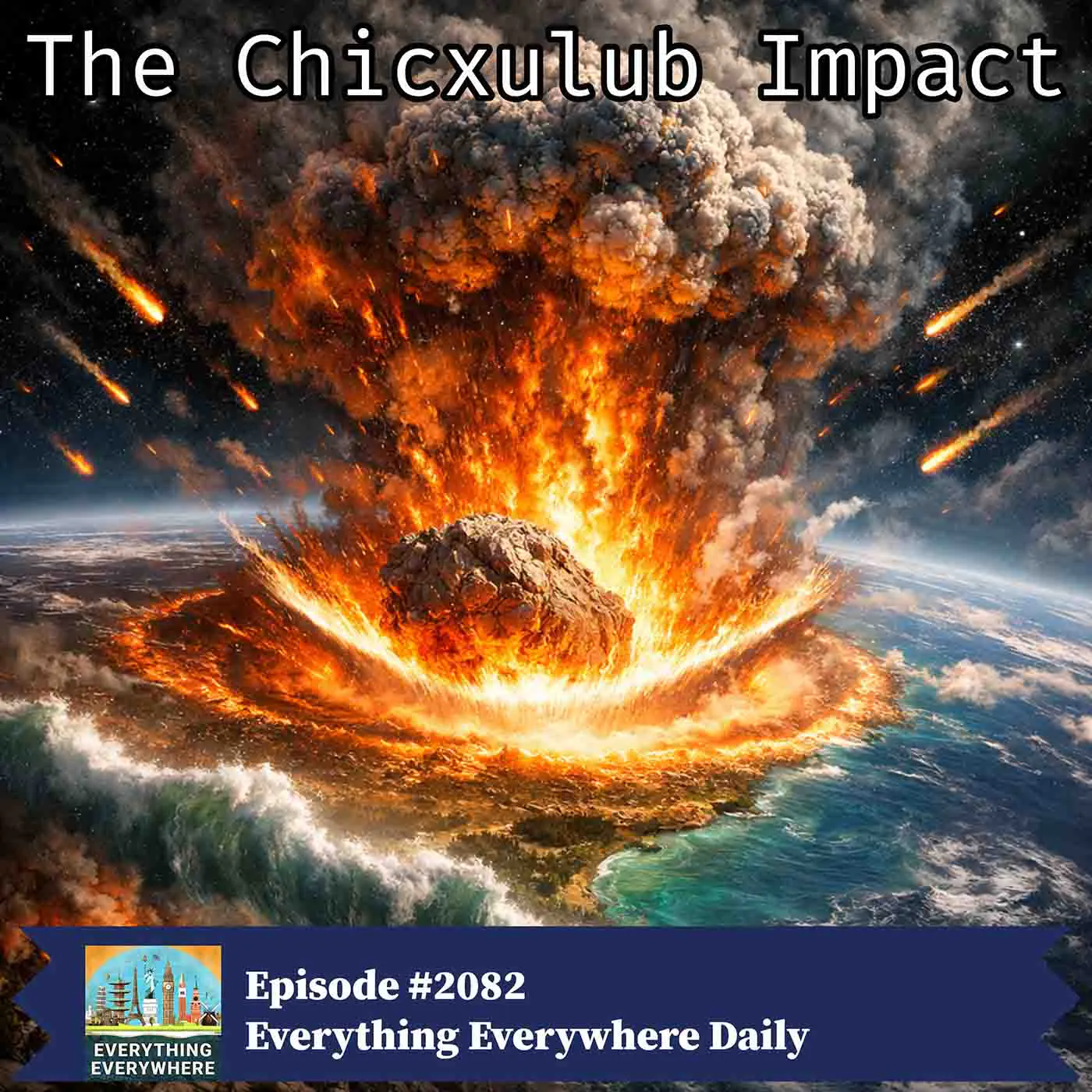
Everything Everywhere Daily: History, Science, Geography & More
The Chicxulub Impact: The Asteroid That Killed the Dinosaurs
00:16:49
Loading summary
Transcript1 lines
- [00:00]
A
Around 66 million years ago, a meteorite smashed into what is today the Yucatan Peninsula of Mexico. The impact of that event changed life on Earth in ways that are still evident today. Proof of this impact, however, wasn't obvious. There was strong skepticism when the theory was proposed, and it took decades for it to become widely accepted, but in the end, the evidence proved overwhelming. Learn more about the Chicxulub impact, how it was discovered, and how it changed the world on this episode of Everything Everywhere Daily. This episode is sponsored by Audible. It's Time to Believe in the Hail Mary, one of the most talked about science fiction adventures of the decade. Project Hail Mary by Andy Weir is now on the big screen, and there's never been a better moment to experience the audiobook that started it all. Ryland Grace is humanity's last hope. Alone in space with no memory of how he got there, he must solve an impossible scientific mystery before the Earth is wiped out forever. What follows is a smart, thrilling and surprisingly emotional journey that blends hard science with non stop suspense. Fan's favorite narrator Ray Porter delivers an unforgettable performance, balancing humor, heart and escalating tension as the stakes grow higher with every chapter. Part scientific puzzle, part interstellar adventure, Project Hail Mary is a story about curiosity, ingenuity and survival against impossible odds. Now that the blockbuster movie has finally arrived in theaters, there's never been a better time to start listening to the universally acclaimed audiobook Project Hail Mary. Listen. Watch. Save the World. Start listening today@audible.com Hailmary this episode is sponsored by Butcherbox. Spring is right around the corner and for many of you that means firing up the grill and having cookouts. If you're going to barbecue, do so only with the best meats and seafoods. For over a decade, Butcherbox has led the industry with antibiotic and hormone free meat and seafood independently verified because when it comes to fueling your body, quality isn't extra, it's everything. Clean whole protein means better support for strength, metabolism and that steady all day energy. And those of you who are longtime listeners know that I'm a longtime Butcherbox customer and I've used it for everything from steaks to to ground beef for my scotch eggs and meat donuts. As an exclusive offer, new listeners can get their choice between chicken breast or top sirloin for a year or ground beef for life plus $20 off when you go to butcherbox.com everything. That's right, your choice of chicken breast or top sirloin for a year or ground beef for life plus $20 off your first box and free shipping always. That's butcherbox.com everything. Don't forget to use the link so they know I sent you. About 66 million years ago, an asteroid roughly 12 kilometers or 7.5 miles in diameter, struck the Earth at what is now the Yucatan Peninsula, creating the Chicxulub crater. It hit at a speed of around 20 kilometers or 12.5 miles per second, releasing energy equivalent to to billions of nuclear bombs. The impact excavated a crater about 180 kilometers or 110 miles wide and temporarily tens of miles deep, making it one of the largest known impact structures on planet Earth. This is the largest single event to have occurred on the planet over the last several hundred million years. Evidence for something this big and incredible should should be very obvious. But it isn't. Millions of years of geologic activity haven't left a giant obvious hole in the ground. The discovery of the impact was a process that took decades and actually started in the 19th century. In the 19th century, geologists mapping rock layers in Europe realized that fossils changed dramatically between certain strata in older rocks, especially those from the Cretaceous period. There were abundant fossils of dinosaurs and ammonites and other now extinct organisms in the layers above, then known as the Tertiary or now known as the Paleogene. Those species were gone, replaced by entirely different forms of life. This abrupt turnover was so consistent worldwide that it became a formal boundary in the geologic timescale. However, early geologists assumed that the change represented gradual transition over a long period, not a sudden event. This belief stemmed from the doctrine of gradualism in geology. Gradualism is the idea that the Earth's features are shaped by slow, continuous processes acting over vast spans of time, rather than by sudden catastrophic events. It was developed in the late 18th and early 19th century, most notably by James Hutton and later popularized by Charles Lyell, as a reaction against earlier beliefs that landscapes were formed primarily by by short lived dramatic events. By observing processes such as erosion, sedimentation and volcanic activity in the present, these thinkers argued that the same processes acting slowly over millions of years could explain the formation of mountains, valleys and rock layers. Gradualism isn't wrong. In fact, most of the geological phenomenon that we observe results from very gradual processes such as mountain building or continental movement. If you remember back to my episode on J. Harlem Bretz, he was a geologist from eastern Washington State who proposed that the geologic formations there weren't created by gradual processes, but rather by a sudden violent catastrophe. The doctrine of gradualism was so strong that most geologists couldn't accept anything other than a gradual process creating the Washington scablands. It took decades, but eventually Bretts was vindicated, and the geology community came to accept that while gradualism is usually true, sometimes there are exceptions. During the 20th century, geologists began a more focused study of the K PG boundary, the rock layer that I previously mentioned that separates the Cretaceous and Paleogene periods in many places around the world. The transition between these two periods in the rock strata was marked by a very thin layer of clay, often often just a few centimeters thick. Below the layer, fossils of Cretaceous life were common, and above it, they disappeared. The thinness of the layer suggested that whatever happened occurred over a very short span of time on geological timescales, which was difficult to reconcile with a slow gradual extinction. The turning point came in 1980 with the work of the Father Son team, Luis and Walter Alvarez. Louis Alvarez had won the Nobel Prize in Physics in 1968. His son Walter was a geologist at the University of California, Berkeley. While studying limestone sequences near Gubbio, Italy, they analyzed the boundary clay and found unusually high iridium concentrations. This was shocking because iridium is relatively rare in the Earth's crust, and there was no reason why one particular strata would contain so much iridium. While iridium is rare on Earth, it's relatively common in meteorites. They concluded that the layer likely formed from material deposited after a massive extraterrestrial impact. What made this finding so compelling was that the same iridium rich layer was soon identified at sites all over the world, indicating a global, not regional, event. At the same time while all this was happening, paleontologists were compiling increasingly detailed fossil records, particularly in places like the Hell Creek Formation in the Upper Great Plains. These studies showed that many species did not gradually decline over millions of years, but instead disappeared abruptly right at the boundary. Dinosaurs, which had dominated terrestrial ecosystems for over 150 million years, were present right right up to the boundary and then vanished entirely above it. The same pattern appeared in marine environments, where groups such as ammonites and many plankton species disappeared suddenly. Additional evidence strengthened the case. Scientists found shocked quartz, tiny glass sphericals formed from molten rock and soot layers consistent with widespread fires. All concentrated at the thin clay boundary layer. These were all signatures of a massive high energy event. So if this impact took place, the big question now was where on Earth did it take place? Researchers began by mapping the area with the thickest fallout layers of the K PG boundary, containing ejecta such as glass sphericals. And shocked minerals were found to be especially abundant and coarse in The Caribbean region and along the Gulf coast of North America, suggesting that that the impact site was nearby in places like Texas, Haiti, and Mexico. The boundary deposits were not just a thin clay layer, but thick, chaotic sediments consistent with tsunami, backwash and nearby debris, further narrowing the likely region. At the same time, geophysicists revisited data collected by the Mexican oil company Pemex during petroleum exploration in the Yucatan Peninsula in the late 1970s. They had identified a large circular pattern of gravity and magnetic anomalies beneath the surface near the town of Chicxulub, along with a ring of sinkholes known as cenotes that traced a buried circular structure. At the time, these features were not widely interpreted as an impact crater, and much of the data remained internal to the company. In the early 1990s, geologists such as Alan Hildebrand connected these two threads by comparing the geographic distribution of impact debris with the location of the geophysical anomaly. They realized that the Yucatan structure had exactly the right size, shape and age to be the missing crater. Drilling into the site provided decisive confirmation. Core samples revealed shocked quartz, melted rock, and breccias, all hallmarks of a large impact event formed under extreme pressure and temperature. Radiometric dating showed that these rocks formed at the same time as the K PG boundary. What made the identification compelling was the convergence of independent evidence. The chemistry of the boundary layer pointed to an extraterrestrial source. The distribution of debris pointed to the Gulf of Mexico region, and the buried circular structure beneath the Yucatan provided a physical crater and and the correct age and scale. Together, these lines of evidence transformed the impact hypothesis from just an idea into a confirmed explanation, with the Chicxulub crater serving as the long sought site of the event that ended the age of the dinosaurs. So you'd think with so much independent evidence, convincing the rest of the scientific world would have been a slam dunk. But it wasn't. The difficulty in accepting the impact hypothesis wasn't about a lack of evidence so much as it was about how radically it changed the way geologists and paleontologists thought the Earth worked. The assumption of gradualism was still very strong. When Lewis and Walter Alvarez proposed that a single asteroid impact caused the extinction at the K PG boundary. Many scientists were instinctively skeptical because it sounded like a return to catastrophism, which the field had spent generations moving away from in the 18th and 19th centuries. There were also legitimate scientific objections. Critics pointed out that no crater had been identified where the Alvarezs made their claim, which was a major shortcoming. Others argued that extinctions in the fossil Record might not be as sudden as they appeared and could reflect incomplete data or gradual environmental stress. Many researchers favored alternative explanations, especially massive volcanism from the Deccan Traps in India, which could have altered the CL climate over a long period of time. In addition, some paleontologists felt that dinosaur extinction patterns were more complex than a single instantaneous event could possibly explain. Throughout the 1980s, the debate was intense and often divided among disciplinary lines. Physicists and geochemists tended to support the impact hypothesis because of the iridium evidence and physical modeling, while many paleontologists and geologists remained cautious or opposed. The idea of the turning point came in the early 1990s with the identification and confirmation of the Chicxulub crater. But even then, acceptance was not instantaneous. Throughout the 1990s, debate continued about whether the impact was the sole cause or one contributing factor. But by the late 1990s and early 2000s, a broad consensus had formed that the Chicxulub impact was the primary driver of the K PG extinction. And even if other factors like volcanism, may have played a supporting role. In total, it took roughly 10 to 15 years from the publication of the Alvarez hypothesis in 1980 to the early 1990s for the idea to move from controversial to widely accepted and closer to two decades for it to become the dominant explanation taught and referenced across the scientific community. So now that we have several decades of data under our belt, what is the current explanation for what exactly happened at the start of the episode? I gave you the estimated size and speed of the meteorite when it hit the Earth. The immediate regional effects of the impact were almost unimaginable. The shock wave would have flattened for us across much of North America, while earthquakes far stronger than any ever recorded in history rippled around the globe. The impact site, which was a shallow sea at the time, generated colossal tsunamis that swept across the Gulf of Mexico and into surrounding coastlines. Debris ejected into space began falling back to Earth within minutes to hours, re entering the atmosphere at high speeds and heating it to the point that much of the planet's surface experienced intense thermal radiation. This likely ignited widespread and possibly global wildfires. The longer term events were even more consequential. The impact blasted enormous quantities of dust, ash and sulfur rich gases into the atmosphere. Because the target rocks contained large amounts of sulfur, the collision produced sulfate aerosols that reflected sunlight back into space very efficiently. Within days to weeks, sunlight reaching the Earth's surface dropped dramatically. Temperatures plunged in what's often described as an impact winter, with some models suggesting Global surface temperatures fell by more than 10 to 20 degrees Celsius. Photosynthesis collapsed almost immediately because of the lack of sunlight, and this was the crucial turning point. Plants on land and photoplankton in the oceans form the base of most food chains. And when they fail, entire ecosystems start to unravel. Herbivores died first, followed by carnivores that depended on them. In the oceans, food webs collapsed from the bottom up, devastating marine life. The speed of these changes is one of the most striking aspects of the event. The initial devastation near the impact occurred within minutes to hours. The atmospheric heating and wildfires likely unfolded within hours to days. The collapse of photosynthesis and the onset of global darkness happened within days to weeks. Mass starvation and ecosystem collapse followed over weeks to months, with the majority of extinctions occurring within a relatively short geological window, possibly a few years to decades. In total, about 75% of the Earth's species went extinct. All non avian dinosaurs disappeared, along with many marine reptiles, ammonites, and a large fraction of plant and plankton species. Smaller animals, especially those that could burrow, live in water or survive unlimited resources, had a better chance of surviving. Over time, the dust and aerosols settled out of the atmosphere and sunlight gradually returned. However, the biosphere that re emerged was totally different. The extinctions opened up ecological niches that allowed mammals and eventually birds, the descendants of surviving dinosaurs, to diversify and dominate the planet. The Chicxulub impact didn't just end the age of dinosaurs. It reset the trajectory of life on Earth, setting the stage for the world that we live in today. The executive producer of Everything Everywhere Daily is Charles Daniel. The associate producers are Austin Otkin and Cameron Kiefer. My big thanks go to everyone who supports the show over on Patreon. Your support helps make this podcast possible and I also want to remind everyone about the community groups on Facebook and Discord. That's where everything happens that's outside the podcast, and links to those are available in the show notes. As always, if you leave a review on any major podcast app or in the above community groups, you too can have it read on the show.