← Everything Everywhere Daily: History, Science, Geography & More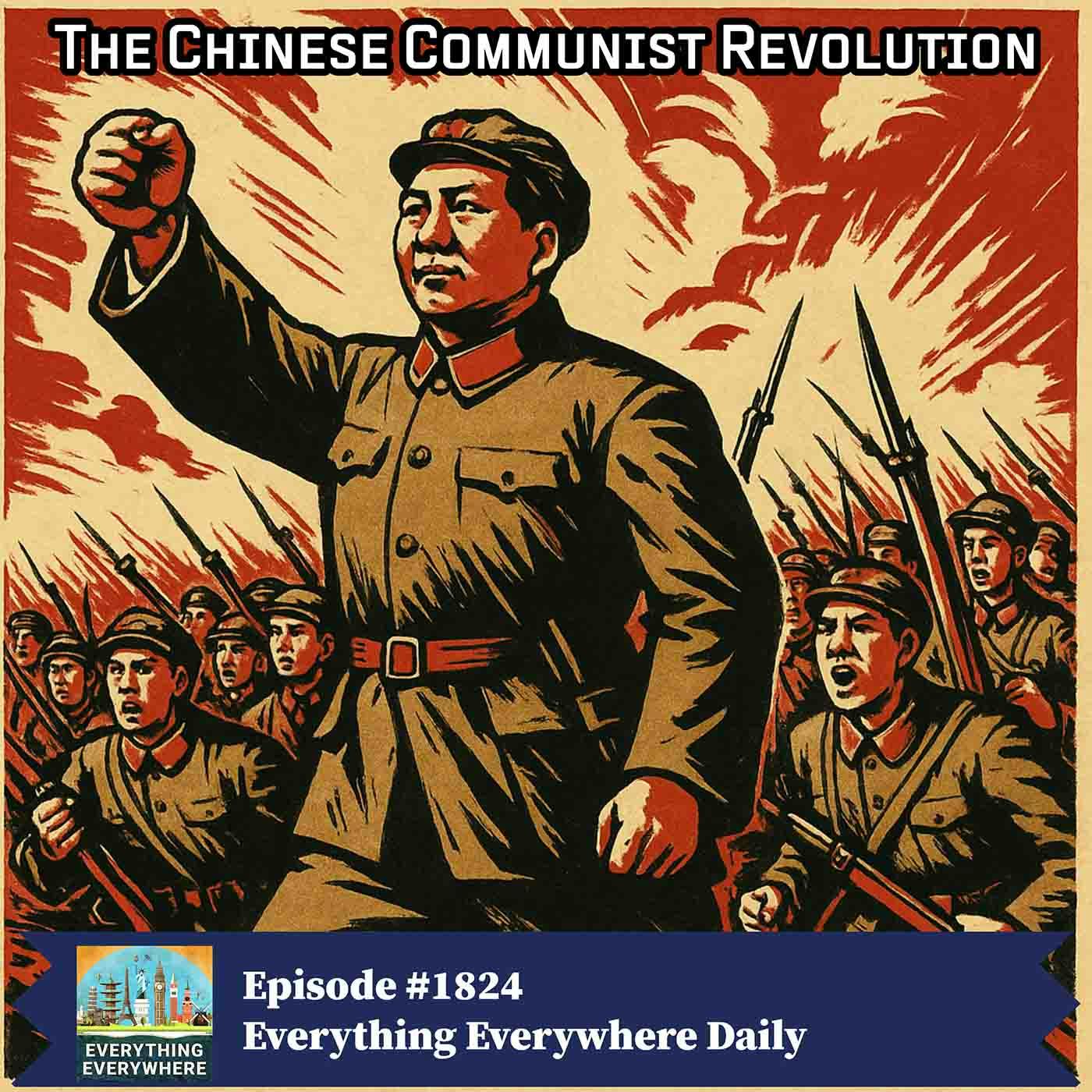
Everything Everywhere Daily: History, Science, Geography & More
The Chinese Communist Revolution
00:16:08
Loading summary
Transcript1 lines
- [00:01]
Gary Arndt
The 19th century wasn't a good one for China. It was marked by the nation being taken advantage of by foreign powers and by the signing of lopsided treaties. The 20th century started out a bit more promising, but eventually devolved into a series of warlords and a civil war between two major forces for control of the country on top of a Japanese occupation. When the dust finally settled in 1949, the victors were the Communists and China, and the world hasn't been the same since. Learn more about the Chinese Communist revolution, why it happened, and how the Communists won on this episode of Everything Everywhere Daily. This episode is sponsored by Fiji Water. You've probably heard of Fiji Water and have seen it in stores. Well, Fiji Water really is from the islands of Fiji. Drop by drop, Fiji Water is filtered through volcanic rock 1600 miles away from the nearest continent and all its pollution protected and preserved naturally from external elements. In this process, it collects a unique profile of electrolytes and minerals, resulting in more than double the electrolytes as the other top two premium bottled water brands, giving Fiji Water its smooth taste. Fiji Water's electrolytes are 100% natural and this water even has a perfectly balanced pH of 7.7. I've recently been trying to reduce my consumption of diet soda and I've found Fiji Water to be a great alternative. Visit your local retailer to pick up some Fiji Water today for your next backyard party, beach day hike, or even your home office. Fiji Water is earth's finest water. This episode is sponsored by Quint's. No one is ever going to confuse me with someone fashionable or trendy. That being said, if I'm going to buy something, I want it to look good, be of high quality and ideally be affordable. That is where Quint's comes in. Quint's is the kind of stuff you'll actually wear, like breathable flowknit polos, crisp cotton shirts and comfortable lightweight pants. In addition to clothing, they also offer a range of great items for the home and travel. Everything with Quince is half the cost of similar brands. By working directly with top artisans and eliminating the middleman, Quince offers luxury pieces without the markup. And I've told you all about the great items that I've purchased from Quince. From towels to blankets to a duvet, Quince has become my go to source. Stick to the staples that last with elevated essentials from quince. Go to quince.com daily for free shipping on your order and 365 day returns. That's Q U-I-N-E.com daily to get free shipping and 365 day returns. Quince.com daily when the Russian Revolution took place in 1917, it shocked the world. Never before had a Communist government taken power, let alone in a country so large. The Soviets were explicitly internationalist in their outlook on spreading revolution. However, in the decades that followed the Russian Revolution, there weren't many grassroots Communist uprisings. There was a revolution in Mongolia in 1921, but that was mostly the doing of the Soviets. And likewise, there were smaller revolutions in what would later become Soviet republics in Asia. Perhaps the biggest communist movement to arise in the aftermath of the Russian Revolution was in China. While the Chinese Communists were supported by the Soviet Union, it was not explicitly a Soviet operation like the other previous Asian revolutions were. To understand how the Chinese Communists managed to come to power, we need to understand what was happening in China in the early 20th century. In previous episodes, I covered how the Qing Dynasty, which had been in power since 1644, had been severely weakened throughout the 19th century. They were taken advantage of by foreign powers such as Russia, who took land from China, and Britain, who forced lopsided trade deals. This, plus rising poverty and natural disasters, increased resentment of the Qing, which eventually led to the collapse of the dynasty in 1911. The collapse of the Qing Dynasty created a power vacuum that various groups rushed in to fill. The Republic of China, established by Sun Yat Sen and his followers, represented China's first attempt at democratic government. However, the new republic lacked the military strength and organizational capacity to control the vast country effectively. The period known as the Warlord Era, which lasted from 1916 to 1928, saw China fragment into territories controlled by military strongmen. It was within the context of this national weakness and fragmentation that the Chinese Communist Party emerged. Founded in 1921 by a small group of intellectuals, including a young library assistant named Mao Zedong, the party initially had fewer than 60 members. They were inspired by the success of the Russian Revolution and believed that Marxist Leninist ideology offered a path to China's salvation. The Chinese Communist Revolution wasn't a single event, but rather a prolonged struggle spanning roughly 30 years. The first phase, which took place from 1921 to 1927, involved cooperation between the Communists and the Nationalist Party, or Kuomintang, led by Sun Yat Sen and later by his successor, Chiang Kai Shek. Both parties shared the goal of reunifying China and ending foreign domination. However, this alliance was fragile, built more on mutual convenience than genuine trust. The alliance shattered in 1927 when Chiang Kai Shek launched A surprise attack against Communist forces in Shanghai and other cities. This event, known as the White Terror, nearly destroyed the Communist Party, killing thousands of members and forcing survivors underground. The survivors faced a stark abandon their revolutionary goals or find new ways to continue the struggle. Mao Zedong, who had been working with peasant organizations in rural areas, proposed a revolutionary strategy that would reshape communist thinking worldwide. Instead of focusing on urban workers as traditional Marxist theory suggested, Mao argued that Chinese Communists should build their movement among the peasantry. He famously declared that political power grows out of the barrel of a gun and established the principle that the Party must control the army and not the other way around. And here I should note that China did not fit the model for a Communist revolution that Karl Marx envisioned, because Marx believed that Communism would emerge in industrial societies with a large organized proletariat class exploited by capitalist factory owners. In contrast, early 20th century China was overwhelmingly agrarian, with over 80% of the population consisting of rural peasants and only a small industrial working class. The Chinese Communist Party under Mao Zedong shoehorned Marxist theory into China's reality by shifting the revolutionary focus from the urban proletariat to to the peasantry who were mobilized through promises of land reform and liberation from feudal landlords, which was not Marxist at all. After the 1927 white tear, the Chinese Communists were forced to retreat to rural areas where they regrouped and established Soviet style base areas, most notably in Yangxi. There, under Mao's leadership, they built a peasant based revolutionary movement and formed the Chinese Soviet Republic. While growing their numbers. By 1934, the Nationalists had begun encircling the Communists in their stronghold in the south of China. With the Nationalists tightening the noose around the communists, approximately 100,000 communist fighters began an epic retreat covering 6,000 miles through some of China's most difficult terrain. This retreat became known as the Long March. Only about 8,000 people survived the journey, but those who did were hardened veterans absolutely committed to the Communist cause. The Long March also established Mao's leadership of the Communist Party and created a powerful founding myth that would inspire future generations of Party members. The survivors of the Long March ended up in Yanan, a remote city in the northern Shaanxi province. This area became the new revolutionary base of the Chinese Communist Party. After their arrival in 1935 from Yan', an, the Communists rebuilt their strength, expanded their influence in the countryside and developed the ideological and organizational foundation that would form the basis of the Party going forward. The Japanese invasion of China in 1937 fundamentally altered the dynamics of the Chinese civil War Suddenly, both the Communists and the Nationalists faced an external threat that dwarfed their internal conflicts. The war period actually strengthened the Communist position, although this wasn't immediately apparent. The Nationalists, as the official government, bore the primary responsibility for conventional military resistance against the Japanese. They absorbed enormous losses defending major cities and industrial areas. The Communists, however, operating from bases in northwestern China, pursued a different strategy. They focused on guerrilla warfare behind Japanese lines, gradually expanding their influence in rural areas. This period allowed the Communists to perfect their approach to revolutionary warfare. They developed what they called a mass line, a system of political organization that emphasized close cooperation between Communist cadres and local peasants. Instead of simply imposing their will on rural communities, they fought a battle of hearts and minds. Communist organizers worked to identify and address local grievances, whether they involved corrupt officials on fair taxation or land disputes, things that they would often later undo once they achieved power. The effectiveness of this approach became clear during the land reform campaigns that Communists implemented in the areas under their control. They redistributed land from wealthy landlords to poor peasants, creating a large constituency with a direct stake in a Communist victory. When the Japanese surrendered In August of 1945, China immediately returned to civil war. However, the balance of power had shifted dramatically. The Nationalists appeared stronger on paper, with better equipment, much of it provided by the United States during the war, and formal international recognition. But the appearances were deceiving. The Communists had spent eight years building a disciplined organization with deep roots in rural society. Their army, now called the People's Liberation army, was highly motivated and experienced in guerrilla warfare fighting the Japanese. More importantly, they had developed an effective strategy that combined military action with political action. The final phase of the civil war, which lasted from 1946 to 1949, saw the Communists employ a three stage strategy. First, they used guerrilla tactics to wear down Nationalist forces and capture equipment. Second, they transitioned to mobile warfare, using captured equipment to build larger military units. And finally, they launched conventional campaigns to capture major cities and complete their victory. The speed of the final collapse surprised many observers. Major cities fell in rapid succession through 1948 and 1949. Beijing fell in January of 1949, followed by Nanjing, the Nationalist capital, in April. By October 1949, when Mao proclaimed the establishment of the People's Republic of China from atop the Gate of Heavenly Peace in Beijing, Nationalist forces only controlled the island of Taiwan and and a few offshore islands. And this is the situation that still exists today and is the reason for the split between the People's Republic of China on the mainland and the Republic of China on the island of Taiwan. The Communist victory in China sent shockwaves around the world. The emergence of a Communist government controlling the world's most populous country fundamentally altered global politics during the Cold War era. China's population in 1949 was larger than that of the United States, Soviet Union, and all of Western Europe combined. The emergence of a Communist China created what many Western observers saw as a unified Communist bloc stretching from East Europe to the Pacific Ocean. This perception, although not entirely accurate, shaped American foreign policy for decades. The American reaction to the Communist victory in China in 1949 was one of shock, destroyed dismay, and political upheaval. US policymakers had supported the Nationalist government under Chiang Kai Shek with aid and diplomatic backing during and after World War II, viewing him as the bulwark against the spread of communism in Asia. But the unexpected collapse of the Nationalists and the establishment of the People's Republic of China under Mao were seen by many in the United States as a major geopolitical defeat and a failure of American foreign policy. The rise of Communism in China intensified the atmosphere of suspicion and fear during the early Cold War. It contributed to the rise of McCarthyism with accusations that communist sympathizers or incompetents in the US State Department had lost to China. The United States refused to recognize the People's Republic of China and instead maintained formal diplomatic relations with the Nationalist regime in Taiwan, a policy that lasted until 1979. The Korean War provided an early test of the new international order. When North Korean forces invaded South Korea, the United States intervened under United nations auspices. The conflict demonstrated that the new Chinese government was willing and able to challenge American power in East Asia. The Chinese revolution also inspired communist movements throughout the developing world. Mao's strategy of rural based revolution, now dubbed Maoism, seemed particularly relevant to other agricultural societies struggling against colonial rule or authoritarian governments. Revolutionary movements in Vietnam, Cuba, and various African countries studied Chinese methods and adapted them to local conditions. However, the relationship between China and the Soviet Union proved far more complex than many observers initially realized. Despite their shared Communist ideology, the two countries had different national interests and eventually became rivals. As you are very aware, the story of China in the 20th century really just gets started with the establishment of the People's Republic of China in 1949. I wanted to do this episode before I get into many other topics that deal with China in the 20th century. This includes the Great Leap Forward, the Cultural Revolution, Mao's death and the rise of the Gang of Four, Chinese conflicts with the Soviet Union and the emergence of Deng Xiaoping and many other significant events. The Chinese Communist Revolution was undoubtedly one of the most pivotal events of the 20th century. It directly affected the lives of over a billion people, and its reverberations can still be felt in the world today. The Executive producer of Everything Everywhere Daily is Charles Daniel. The associate producers are Austin Okun and Cameron Kiefer. Today's review comes from Listener Excellent. Except music over on Apple Podcasts in the United States. They write Excellent. Dear Everything Everywhere Daily, I just discovered your excellent podcast today. Although I have a diverse interest in topics, having a love of history, world travel, reading, science, people, along with an old school Ivy education, I found your podcast a true treasure. Totally out of character. I spent several hours binging on 14 episodes as they were all diverse, thorough, while concise, highly informative and most delightful. Additionally, you have a very smooth and pleasing voice, far better than most podcasters. Non tiring. Best wishes for your continued success. Well, thanks. Excellent. Except music. I'm glad you find the show binge worthy and that my voice is not boring and I will do my best to continue to create binge worthy episodes in a smooth and pleasing way. Remember, if you leave a review or send me a boostogram, you too can have it running the show.