← Everything Everywhere Daily: History, Science, Geography & More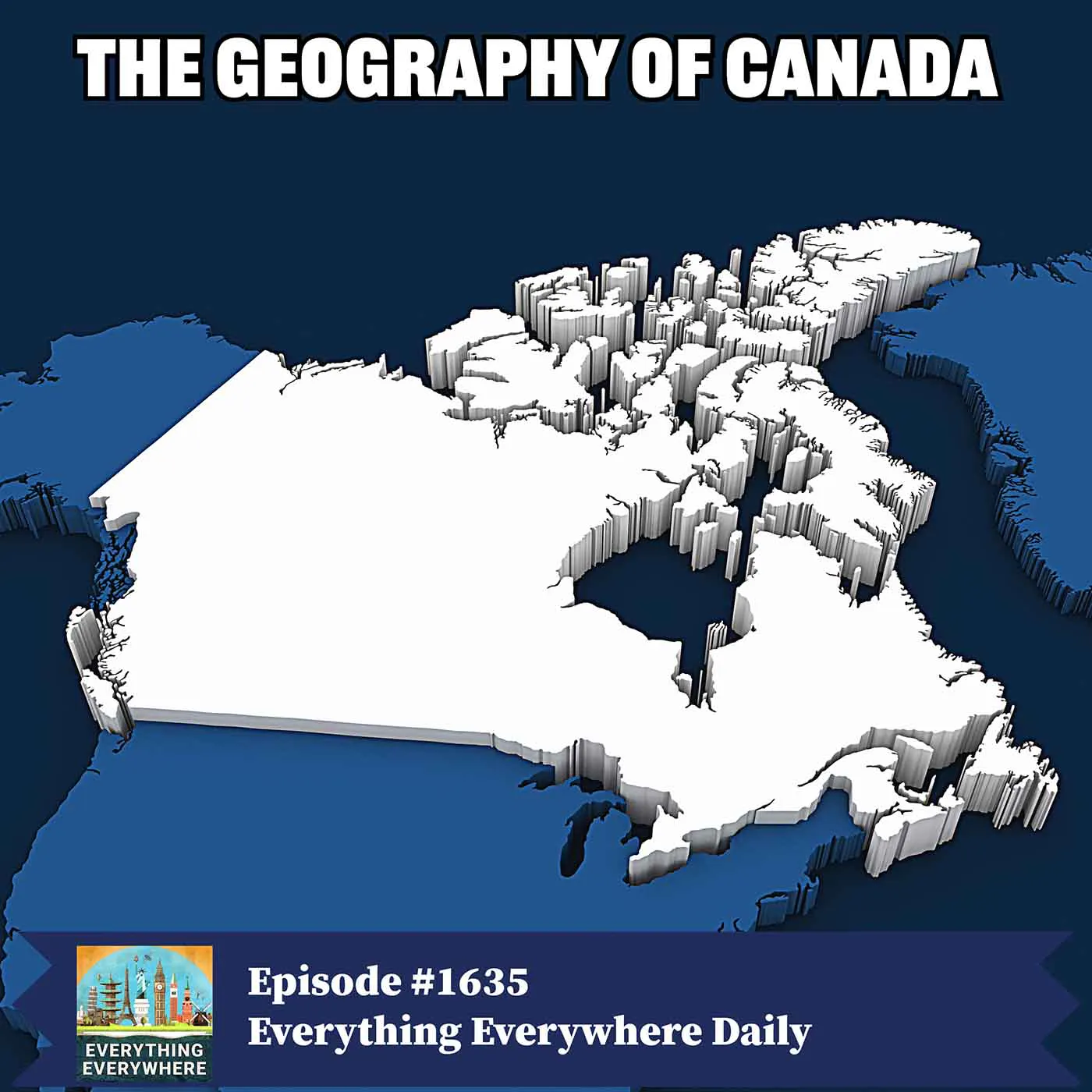
Everything Everywhere Daily: History, Science, Geography & More
The Geography of Canada
00:16:32
Learn how geography made Canada what it is today
Loading summary
Transcript1 lines
- [00:01]
Gary Arndt
Canada is a really big country, second largest country in the world. In fact, its size can hide the fact that it's a country with enormous geographical diversity. It has a geography that's unlike any other country in terms of its landscape and population distribution. And it isn't all just a cold wasteland, although much of it is. Learn more about the geography of Canada and how it shaped the country into what it is today on this episode of Everything Everywhere Daily. This episode is sponsored by Mint Mobile. After years of fine print contracts and getting ripped off by overpriced wireless providers, if we've learned anything is that there's always a catch. So when I heard that all Mint Mobile wireless plans are $15 a month when you purchase a three month plan, I thought, what's the catch? Well, there isn't one. Mint Mobile's secret sauce is that they sell wireless services online. They don't have retail stores or salespeople. I recently moved my phone to Mint Mobile and it was super easy. I didn't have to go into a store. And here's the best part. I'm using the exact same cell towers and network that I was using before, along with the exact same phone and same phone number. To get this new customer offer and your new 3 month unlimited wireless plan for just $15 a month, go to mintmobile.com that's mintmobile.comeed cut your wireless bills to 15 bucks a month at mintmobile.comeed $45 upfront payment required, equivalent to $15 a month new customers on first 3 month plan only. Speed slower above 40gb on unlimited plan. Additional tax fees and restrictions apply. See Mint Mobile for details. This episode is sponsored by Masterclass. If you're listening to this podcast, then you are someone who is curious about the world and loves to learn. And if you want to give the gift of learning and knowledge this Christmas, you can't do better than Masterclass. Masterclass offers online classes from some of the most successful instructors in the world in their fields. You can learn cooking from Gordon ramsay, conservation from Dr. Jane Goodall, disruptive entrepreneurship from Sir Richard Branson, mathematical thinking from Fields Medal winner Terrence Tao, and diplomacy from former Secretaries of State Madeleine Albright and Condoleezza Rice. You can access over 200 classes across 11 different categories. Masterclass always has great offers during the holidays, sometimes up to as much as 50% off. Head over to masterclass.com everywhere for the current offer. That's up to 50% off@masterclass.com everywhere. Once again, that's masterclass.com everywhere any discussion of the geography of Canada should start with its size. Canada is well known as being the second largest country in the world behind Russia, and that is true depending on the definition. If you include all sovereign territory, including land and sea, Canada is the second largest country in the world. However, if you only include land, then Canada is only the fourth largest country in the world, behind China and the United States. There are a few reasons why Canada has so much territory that is Water. The first is the fact that Canada has by far more coastline than any other country. It has approximately 202,000 kilometers of coastline, which is about 2.5 times more than Norway, which is second, and almost four times more than Indonesia, which is third. The other reason is the large number of inland bodies of water that are considered to be full Canadian territory. This includes tens of thousands of freshwater lakes, approximately half of four of the Great Lakes, and the enormous Hudson Bay. There's also water between the islands in the Canadian archipelago in the far north that are considered full Canadian territory by international law, even though the distances between the islands extend more than the 12 nautical miles that normally define territorial waters by treaty. Canada also borders three different the Pacific in the west, the Arctic in the north, and the Atlantic in the east. As a landmass, Canada can be divided into seven different geographic the Appalachian region, the Canadian Shield, the Interior Plains, the Western Cordillera, the Arctic region, the St. Lawrence Lowlands, and the Hudson Bay Lowlands. I'll go through each of these briefly. The Appalachian region is located in eastern Canada. It includes parts of the provinces of Quebec, Newfoundland and Labrador, New Brunswick, Nova Scotia, and Prince Edward Island. The Appalachian Mountains are usually only thought of as a mountain chain in the eastern United States, where the highest peaks are, but they actually run all the way north to the island of Newfoundland. Characterized by ancient eroded mountains, rolling hills, and rugged coastlines, this area is often just referred to as Atlantic Canada. The Canadian Shield is far and away the largest of the seven geographic regions of Canada. The Canadian Shield covers nearly half of Canada's land area, stretching from Quebec, Ontario, Manitoba, Saskatchewan, and parts of Alberta, the Northwest Territories, and Nunavut. It's characterized by rugged terrain, rocky outcrops, and numerous lakes and rivers that were created by glacial activity during the last ice age. Composed primarily of Precambrian rock, the Shield is one of the oldest geological formations on Earth, and it's rich in minerals such as nickel, gold, copper, and uranium. Its landscape is dominated by boreal forests in the south and tundra in the north, providing a unique ecosystem that supports a diverse wildlife. The Canadian Interior Plains is a vast region of flat to gentle rolling terrain, stretching across the provinces of Alberta, Saskatchewan, Manitoba, and extending into parts of the Northwest Territories. This is the northern Canadian part of the Great Plains, which extends southward into the United States. Formed by sedimentary deposits from ancient seas, the Plains are rich in fossil fuels, including oil, natural gas, and coal, as well as fertile soils that support extensive agriculture, particularly wheat and canola farming. This region is characterized by wide open spaces, grasslands and prairie ecosystems in the south, transitioning into boreal forests and wetlands in the north. The Western Cordillera is a stunning and geologically diverse region that stretches along the western edge of the country, encompassing British Columbia, the Yukon, and parts of Alberta. It's characterized by a series of mountain ranges, including the Rocky Mountains, the Coast Mountains, and the Columbia Mountains, interspersed with deep valleys, plateaus, and fjords on the coast. This region was formed through tectonic activity, including the collision of the Pacific and North American plates, which results in its rugged peaks and frequent seismic activity. The Western Cordillera features diverse ecosystems, from temperate rainforests along the Pacific coast to alpine tundra at higher elevations. It's rich in natural resources such as timber, minerals, and hydroelectric power, and its breathtaking landscapes include Banff and Jasper national parks, which attract millions of visitors every year. The Canadian Arctic Region encompasses the northernmost parts of Canada, including the Territories of Nunavut, most of the Northwest Territories, and the Yukon, along with the Canadian Archipelago, which contains thousands of islands like Baffin, Ellesmere, and Victoria. The region is dominated by tundra and permafrost, with a cold, harsh climate characterized by long, frigid winters and short, cool summers. The Arctic is a fragile and unique ecosystem, which is home to iconic wildlife such as polar bears, caribou, Arctic foxes, musk ox, and seals, as well as marine species like narwhals and beluga whales. It's sparsely populated, with much of the population being made up of indigenous communities. The St. Lawrence Lowlands is a small but densely populated and agriculturally rich region in southeastern Canada, spanning southern Quebec and ontario along the St. Lawrence river and the Great Lakes. This is the smallest of Canada's geographic regions, but arguably the most important, as over half of Canada's population lives here, and it contains the major cities of Toronto, Ottawa, Montreal, and Quebec City. It's also the most agriculturally productive part of Canada. The last region is the Hudson Bay Lowlands. This is the second smallest region and consists of the area south and southwest of Hudson Bay. It's mostly in northern Ontario, northeastern Manitoba, and a small Part of Quebec, it's characterized by wetlands and peat bogs, making it one of the largest continuous wetlands in the entire world. The region has a cold climate and supports boreal forests in the south and tundra in the north, providing habitat for wildlife like caribou, polar bears, and migratory birds. Personally, I've been able to visit all seven of these regions. I've been on two polar bear photography expeditions along the Hudson Bay, and I've driven up to the Arctic Circle in the Yukon. And I've been to every province at least three times. One of the major differences between Canada and the United States to the south is the lack of inland waterways in the heart of the country. Canada shares a significant waterway with the United States in the Great lakes and the St. Lawrence Seaway. However, reaching this from the west requires transportation by rail, not river. The longest river in Canada is the Mackenzie river, which empties into the Arctic Ocean and it's frozen for at least half the year. It also flows through the largely uninhabited Northwest Territories. Many of the other long rivers in Canada, save for the St Lawrence, all have similar problems of flowing into the Arctic, flowing through sparsely inhabited areas, or being unnavigable. Canada has only one deep water port on the Arctic Ocean, Churchill, Manitoba, on Hudson Bay. The railroad there has been neglected over the years, which led to the disuse of the port. But recent investments in the Hudson Bay Railway may have changed the fate of the port. As of August 2024, a notable milestone was achieved with the first shipment of critical minerals in decades as 10,000 tons of zinc concentrate were transported to European markets from Churchill. Politically, Canada is divided into 10 provinces and three territories. The provinces are Labrador, Newfoundland, Nova Scotia, New Brunswick, Prince Edward Island, Quebec, Ontario, Manitoba, Saskatchewan, Alberta, and British Columbia. The territories are Yukon, the Northwest Territories, and Nunavut. The divisions, as is the case with much of North America, are somewhat arbitrary and are marked by a lot of straight lines on a map that, for the most part, do not follow natural geographic boundaries. Perhaps the most interesting thing about Canadian geography is its population distribution. The country that is most comparable to Canada would probably be Russia, which is also very large and in the far north. However, Canada and Russia have totally different population distributions. Most of the population of Russia lies in the east, and in Canada it's in the south. The fact that most of the population is in the south shouldn't be that surprising. That's the warmest part of the country, the part that gets the least amount of snow, and the part that generally has the most productive agriculture over 80% of Canadians live within 160 kilometers or 100 miles of the US Canadian border. And it isn't just the favorable climate. It's access to transportation networks and easier economic integration with both the US and the rest of Canada. The major exceptions to the 100 mile rule are Edmonton, Halifax and the island of Newfoundland. However, it isn't just that the population lives in the south, which again is understandable. The other major fact is that despite all of the space they have, Canada is an extremely urban country. Most Canadians live in urban areas with over 70% residing in major cities such as Toronto, Montreal, Vancouver, Calgary and Ottawa. To this extent, Canada is similar to Australia, which is also very large but also very urban. Canada has five cities with a population of over a million. Toronto, Montreal, Calgary, Ottawa and Edmonton. The U.S. despite having a population 8.5 times larger, has only nine cities with more than a million people. What this means is that looking at the strict population density of Canada only tells part of the story. The extreme population density of the major Cities and the St. Lawrence Lowlands means that the rest of the country has a significantly lower population density than statistics would otherwise indicate. The southern and urban concentration of the Canadian population leads to some interesting things. There is one major road route that connects Canada from east to west, the TransCanada Highway. The TransCanada highway technically isn't a single road as there are sections that run parallel to each other. However, it's still rather one dimensional and a far cry from the road systems in other countries which have to cover a two dimensional area. Another interesting fact results from Canada's population distribution. The 49th parallel is often given as the border between Canada and the United States. Yet more than half of the population of Canada lives south of the 49th parallel. As a large country, Canada has some extreme geographical points which will give you an idea as to its size. The northernmost point of Canada is Cape Columbia on Ellesmere island in the territory of Nunavut. It's located only 769km or 478 miles from the North Pole. Also located on Ellesmere island is Canadian Forces Station Alert, the northernmost continually inhabited place in the world. The southernmost point of Canada is Middle island, which is located in Lake Erie. The distance between these two points is 4,625 kilometers or 2,874 miles. The westernmost point is boundary peak 187 in the Yukon on the border of Alaska, and the easternmost point is Cape Speer on the island of Newfoundland just outside the capital, Saint John's. The distance between the westernmost and easternmost points is 5,446 kilometers, or 3,385 miles. To put the width of Canada into perspective, Cape Spear is closer to Berlin than it is to Vancouver, and Vancouver is closer to Honolulu than it is to St. John's. I want to close with what is perhaps the oddest geographical curiosity in all of Canada. Located in the southwest corner of the Nunavut territory is a lake called Yat Kid Lake. The lake isn't very big, and there really isn't anything special about it except that inside that lake is an island, and on that island is a lake, and inside that lake is an island, and that island has a lake. No one has ever been here because it's so hard to reach, but satellite images seem to indicate that there might actually be a very tiny unnamed island inside that lake. So that unnamed island would then be an island on a lake on an island on a lake on an island on a lake, the most recursive lake island system in the world. There's obviously a lot more to be said about the geography of Canada, as each province is the size of a country. But Canada, like every other country, is a product of its location, which means that everything from the location of its population to having hockey teams and even expensive real estate can all be attributed to geography. The executive producer of Everything Everywhere Daily is Charles Daniel. The associate producers are Benji Long and Cameron Keever. I want to give a big shout out to everyone who supports the show over on Patreon, including the show's producers. Your support helps me put out a show every single day, and also Patreon is currently the only place where Everything Everywhere Daily merchandise is available to the top tier of supporters. If you'd like to talk to other listeners of the show and members of the Completionist Club, you can join the Everything Everywhere Daily Facebook group or Discord server. Links to Everything are in the show Notes.