← Everything Everywhere Daily: History, Science, Geography & More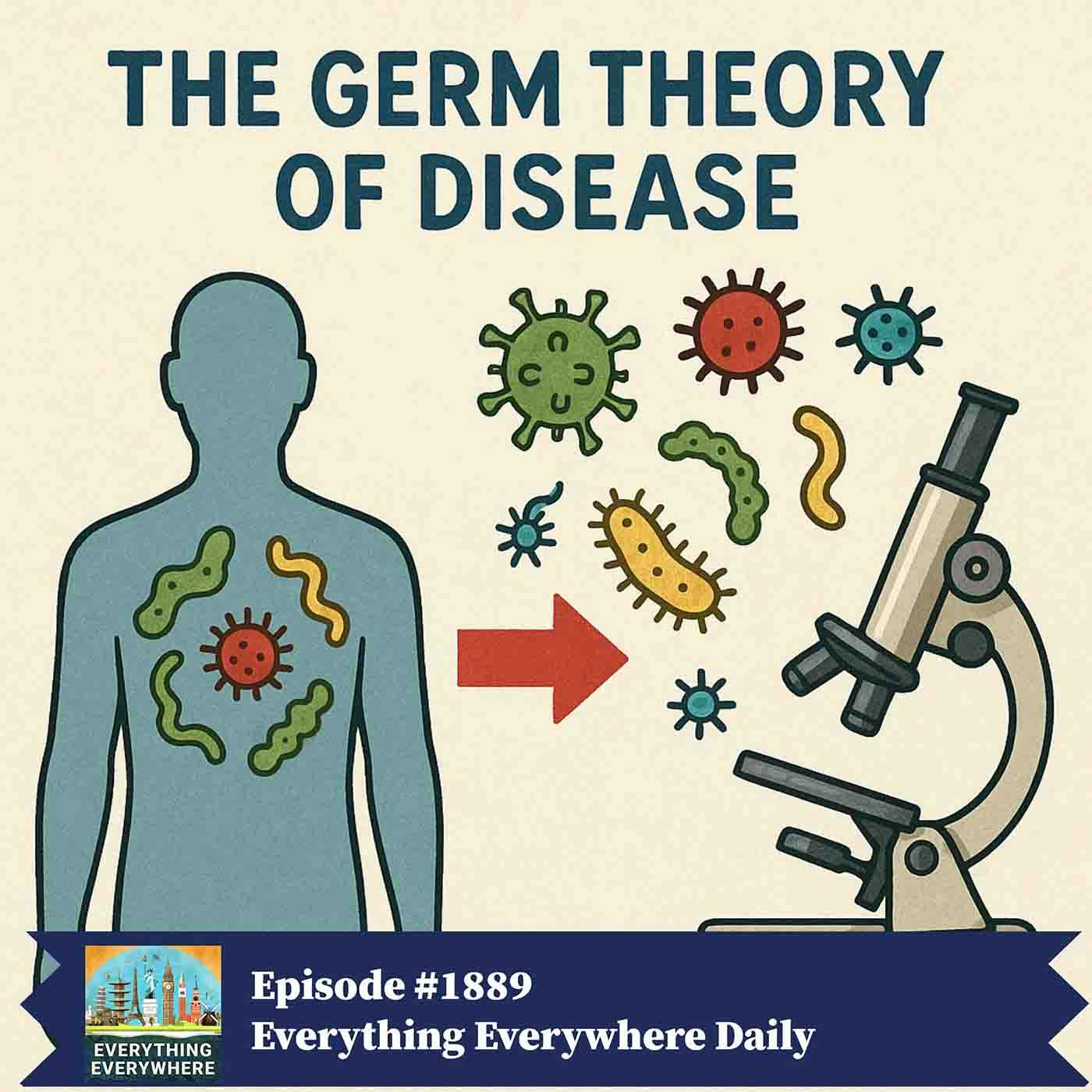
Everything Everywhere Daily: History, Science, Geography & More
The Germ Theory of Disease (Encore)
00:14:59
Loading summary
Transcript1 lines
- [00:00]
A
The following is an encore presentation of Everything Everywhere Daily over thousands of years, many theories have been put forward as to the cause of communicable diseases. These theories range from the religious to the magical and sometimes quasi scientific, but what they all had in common was that there was no proof for anything. Over the centuries, these theories became dogma and often prevented a better understanding of diseases. It wasn't until the late 19th century that we got a clear picture of what the cause actually was. Learn more about the germ theory of disease and why it took so long to recognize on this episode of Everything Everywhere Daily. This episode is sponsored by Fiji Water. You've probably heard of Fiji Water and have seen it in stores. Well, Fiji Water really is from the islands of Fiji. Drop by drop. Fiji Water is filtered through volcanic rock 1600 miles away from the nearest continent and all its pollution protected and preserved naturally from external elements. In this process, it collects a unique profile of electrolytes and minerals, resulting in more than double the electrolytes as the other top two premium bottled water brands, giving Fiji Water its smooth taste. Fiji Water's electrolytes are 100% natural and this water even has a perfectly balanced pH of 7.7. I've recently been trying to reduce my consumption of diet soda and I've found Fiji Water to be a great alternative. Visit your local retailer to pick up some Fiji Water today for your next backyard party, beach day hike, or even your home office. Fiji Water is Earth's finest water. This episode is sponsored by Quince. I've been telling you about Quince for quite a while now, but perhaps it still hasn't sunk in for some of you just how affordable Quince can be. I went to their website and checked out several prices. A woman's Mongolian cashmere tee, which costs up to $175 from other retailers is available for just $44.90 on quints. A men's comfort stretch trench coat that goes as high as $498 on other sites costs only $99.90 on Quinn's, a European linen chambray fitted sheet set that will run you $270 at competitors can be purchased for only $85.90 on Quinn's. These are serious discounts on high end luxury items and they can do this by working directly with top artisans and cutting out the middlemen. Quinn's gives you luxury prices without the markup, passing the savings on to you. Keep it classic and cool this fall with long lasting staples from Quince go to quince.com daily for free shipping on your order and 365 day returns. That's Q U I-N-E.com daily free shipping and 365 day returns. Quince.com daily before I begin, I should clarify a few things about the phrase germ theory of disease, because each of those words can be a bit confusing. For starters, germ is just a catch all term for anything microscopic that can cause disease, including bacteria and viruses. There is no set scientific definition of germ, and the term usually isn't used in research circles. Next is the word theory. A theory does not mean that something is unproven. It is simply a set of statements or principles devised to explain a group of facts. The theory of gravity is still called a theory, even though we have a pretty good understanding of how gravity works. The final word that needs to be clarified is disease. For the purpose of this episode, disease will refer specifically to communicable diseases. These are diseases that are spread from one person to another. The term disease is very broad and is applied to a host of ailments such as heart disease, Parkinson's disease, Alzheimer's disease, alcoholism and cancer. There are certain ailments that are caused by genetics, diet, exposure to chemicals, and a host of other things that are not germs. So the term germ theory of disease is a historical term that I'm going to be using, because that's what it's called. So don't try to be too pedantic about it. With that out of the way, the germ theory of disease is something that I have touched on many times in previous episodes. Ignaz Semmelweis discovered that washing your hands could reduce fatalities in a maternity hospital. John Snow discovered the source of a cholera outbreak in London by tracking where people got their water. In a question and answer episode, I was asked what one of the most important innovations was that helped make the modern world. And one of my answers was the germ theory of disease. So I figured it was time to devote a full episode to the subject. The germ theory of disease is something that most people in the world today understand intuitively. We know to wash our hands, sterilize objects, clean wounds, purify water, and sanitize surfaces where we cook and prepare food. The idea is so entrenched that some people develop a psychological condition known as mysophobia, which is an extreme fear of germs, something that never existed before people knew that there were germs. Even if you can't look through a microscope, we can probably all make personal observations regarding cleanliness and health. So why did it take so long to figure this out? If you remember back to my episode on the Plague of Justinian, epidemics and pandemics didn't start to occur on a really large scale until the development of long distance trade. When such epidemics and pandemics broke out, people started dying in the hundreds and thousands and nobody knew what to make of it. It seemed like a judgment from the gods, which is exactly what most people thought it was. However, there were some rational people at the time who thought that this wasn't the doing of the gods. They thought that there was something else going on. One of the first people to propose an alternative theory was Hippocrates of Kos, the ancient Greek doctor and philosopher who was considered to be the father of medicine. Hippocrates believed that these diseases were spread because of something in the air. He called this thing in the air miasma. Miasma, he thought, came from rotting organic matter. Miasma comes from the ancient Greek word for pollution. This was alternatively called bad air, night air, or noxious air at different periods. The idea of miasma wasn't just a Greek idea. Miasma theory was independently developed in ancient China and India as well. The Chinese version of miasma actually developed before the Greek version of the Chinese theory was developed in southern China, where warm, humid air was thought to be a breeding ground for disease. One particular train of thought in China believed that insect waste was the source of the poisonous gas and that it was particularly dangerous to go into the deep woods. For this reason, the Chinese miasma theory developed over time, and many physicians in China thought it was unique to southern China. Some people in northern China actually developed a fear of traveling to southern China because they thought they would become ill from the air. In India, a paste was created from the gambir tree that was used as an antimiasma treatment for diseases. And I'm actually going to be a little bit sympathetic to ancient beliefs. While they got it wrong, they ultimately got it wrong in an understandable way. The human nose is attuned to smells of rotting organic matter. We find it offensive. Odors can be experienced from a distance and, and by many people. And people with diseases will often have odors emanating from them. Odors do spread in the air. So at least as an initial hypothesis, the idea wasn't crazy. The miasma theory held that there were small particles in the air that spread from person to person, and that was how disease spread. Part of that was kinda right. They just got the Mechanism wrong. Just as an aside, you can find a nugget of truth in otherwise wrong theories about nature and science. In many ancient authors. They made observations that were kind of true, but had wholly wrong explanations for them. Miasma theory wasn't the only theory to explain disease and illness in Western medicine. Humorism was also developed alongside the miasma theory. Humorism posited that human health and temperament were governed by four bodily fluids or humors. Blood, phlegm, yellow bile and black bile. Each humor corresponded to one of the four elements of air, water, fire and earth, and was associated with specific personality traits and physical conditions. Humorism may have first been developed in Egypt or Mesopotamia, but it became a fully fleshed out theory in Greece. It also shouldn't surprise you that it was Hippocrates who was also the one who developed the theory of humorism. Indian Ayurvedic medicine also had a similar system with three humors and five elements. These beliefs in miasmas and humors were the predominant belief in Western medicine for almost 2,000 years. If you learned medicine, which for most of that time was an art more than a science, you learned about humors and miasmas. When the Black Plague struck in the 14th century, many plague doctors wore a creepy looking mask with a long beak. The reason for the odd looking mask was miasmas. The beak would often be filled with some sort of pleasant smelling substance such as ambergris, mint or rose petals. The theory was that if miasmas came from foul smelling rotting substances, then it could be counteracted by pleasurable smells. Needless to say, this did not work. A version of the germ theory of disease was proposed as early as 1546 by Girolamo Fracastoro. In his seminal work on cognation and contagious diseases, published in 1546. Fracastoro posited that diseases were spread by tiny invisible particles or seminaria that could transmit infection by direct or indirect contact or even over long distances through the air. This theory was also promoted by the Slovenian physicist Marcus Plenic in 1758. However, the theory was not popular and it was often ridiculed because it went against the established doctrine of miasma, the which had existed for centuries. By the 17th century, optics and lenses had improved enough that it was now possible to actually see cells and microscopic organisms. In 1665, the English scientist Robert Hooke used a microscope to see the first cells and microorganisms. Dutch microbiologist Antony van Leeuwenhoek extended Hooke's work and the descriptions of microscopic life. So by the start of the 18th century, knowledge of microorganisms was widespread. However, even though it was known that microorganisms existed, there was still an enormous amount about how they lived and reproduced that was still unknown. Few people thought of linking these tiny creatures to diseases. One of the problems was yet another erroneous belief in how simple life worked. The prevailing theory at the time was something called spontaneous generation. The spontaneous generation theory held that life could arise from non living matter and and that it happened all the time. An example of this would be if you left a piece of meat out and after a couple days maggots would appear on the meat. According to the theory of spontaneous generation, the meat created the maggots. Spontaneous generation goes back just as far, if not further, than the theory of miasma, and it was coherently synthesized by Aristotle. So when microscopic life was found, the framework it fit into was one where such life forms could just appear from the material surrounding it. The idea of how it could reproduce and spread wasn't something that was immediately considered. It wasn't until the 1830s that Matthias Schleiden and Theodore Schwann developed the theory that all living things were made up of cells. This theory was crucial because it suggested that diseases might involve cellular changes, possibly due to external agents. In 1865, the Hungarian physicist Ignaz Semmelweis, to whom I've previously devoted an entire episode, realized that something was spreading from corpses to mothers giving birth at a maternity hospital. And if you remember back to the episode, his proposal for washing hands to stop the spread of disease wasn't just rejected, it was vehemently rejected by the medical establishment. The person who really changed medical orthodoxy and put a nail into the theories of miasma, humorism and spontaneous generation was Louis Pasteur. Pasteur's experiments in the 1860s refuted the notion of spontaneous generation, showing that organisms come from other organisms and do not spontaneously appear. This was pivotal in suggesting a biological basis for the transmission of disease. The other person who played a pivotal role was the German microbiologist Robert Koch, who developed a series of criteria, dubbed Koch's postulates, to demonstrate the causal relationship between a microbe and a disease. These postulates became the gold standard for identifying the microbial causes of disease. The microorganism must be found in abundance in all organisms suffering from the disease, but should not be found in healthy organisms. The microorganism must be isolated from a diseased organism and grown in a pure culture. Postulate 3. The cultured microorganism should cause disease when introduced into a healthy organism. In postulate 4, the microorganism must be re isolated from the inoculated diseased experimental host and identified as being identical to the original specific causative agent. These postulates provided a way to prove that a given microorganism caused a disease, and it should be noted that he modified the first postulate after he discovered asymptomatic carriers of some diseases. Koch applied these postulates to himself to identify the pathogens that caused cholera and tuberculosis. Once the work of Koch and Pasteur gained acceptance in the late 19th century, the race was on and there were rapid advances in immunology, public health, and the development of medical microbiology as a science. There was now a theory that could explain why the practice of inoculation worked to stop smallpox, because the germ theory explained what caused smallpox in the first place. Clean water, sterilizing surgical instruments, vaccines, antiseptic bandages, antibiotics, well, anything antibacterial, and a host of other innovations that improved life expectancy in the 20th century were all the result of the germ theory of disease. As I noted at the start of this episode, the germ theory of disease hasn't solved every health problem, and antibacterial resistance, which is an over application of the germ theory, has caused a host of problems all its own. But many illnesses such as smallpox and cholera which once ravaged humanity, have been all but eliminated. And it was all due to abandoning the pseudoscience of miasma and accepting the reality of germs. The executive producer of Everything Everywhere Daily is Charles Daniel. The associate producers are Austin Otkin and Cameron Kiefer. My big thanks go to everyone who supports the show over on Patreon. Your support helps make this podcast possible, and I also want to remind everyone about the community groups on Facebook and Discord. That's where everything happens that's outside the podcast, and links to those are available in the show Notes. As always, if you leave a review on any major podcast app or in the above community groups, you too can have it read in the show.