← Everything Everywhere Daily: History, Science, Geography & More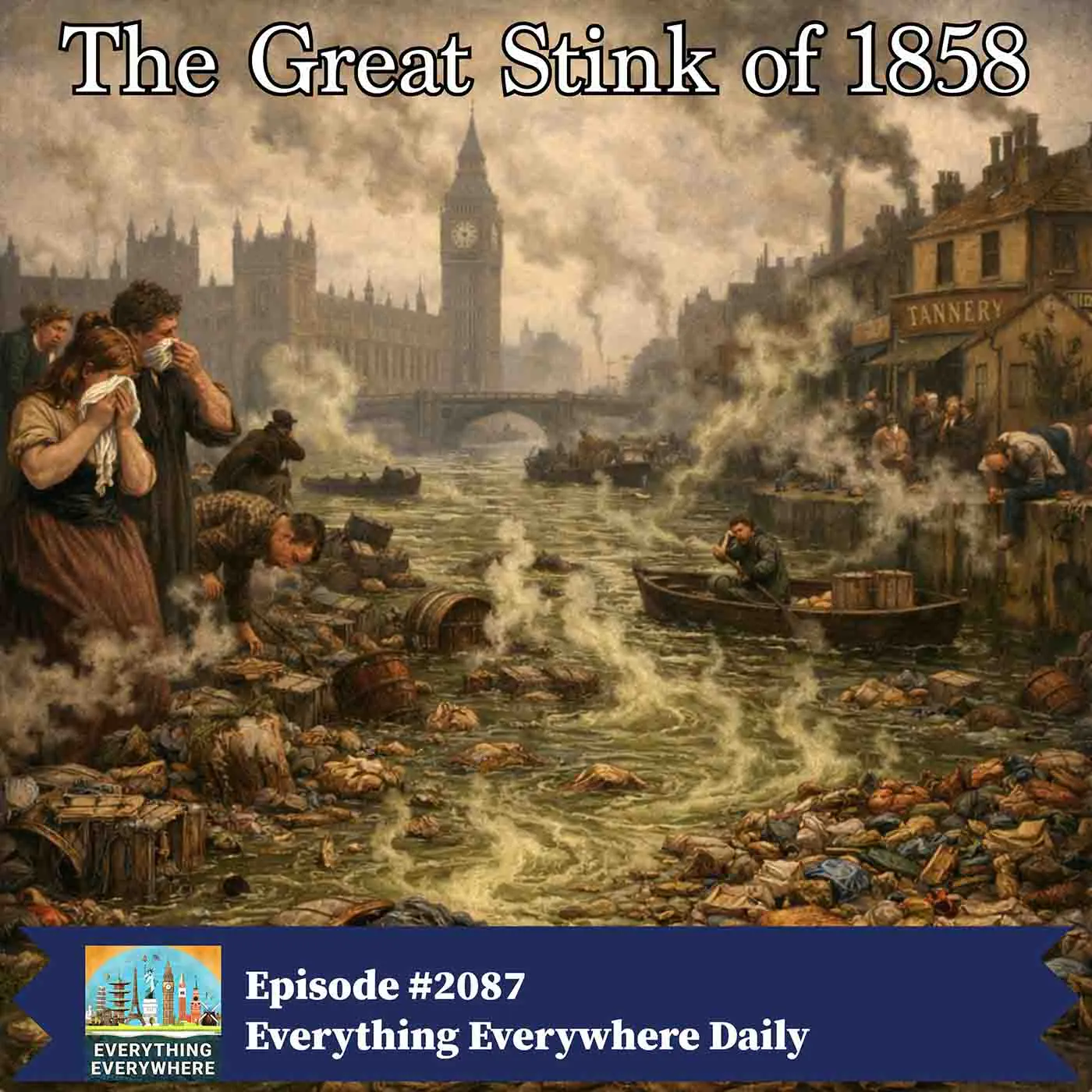
Everything Everywhere Daily: History, Science, Geography & More
The Great Stink: How a Horrific Smell Changed London Forever
00:13:53
Loading summary
Transcript10 lines
- [00:01]
Narrator
In the summer of 1858, London was brought to a standstill by something you couldn't see but definitely couldn't ignore, the overwhelming stench of the River Thames. The event known as the Great Stink wasn't just unpleasant, it forced a modern city to confront a growing crisis of sanitation, public health and urban planning. What happened that summer would reshape one of the world's greatest cities and change how we think about infrastructure forever. Learn more about the great stink of 1858 and the smell that changed history on this episode of Everything Everywhere Daily. Carvana is so easy. Just a click and we've got ourselves a car.
- [00:51]
Carvana Advertiser 1
See so many cars. That's a clicktastic inventory.
- [00:55]
Narrator
And check out the financing options payments
- [00:57]
Carvana Advertiser 2
to fit our budget.
- [00:58]
Narrator
I mean that's Clickonomics 101 delivery to our door.
- [01:02]
Carvana Advertiser 1
Just a hop, skip and a click away and bought. No better feeling than when everything just clicks. Buy your car today on Carvana. Delivery fees may apply Eczema is unpredictable,
- [01:19]
Eczema Treatment Advertiser
but you can flare less with epglis, a once monthly treatment for moderate to severe eczema after an initial four month or longer dosing phase. About four in ten people taking Eblis achieved itch relief and clear, almost clear skin at 16 weeks, and most of those people maintain skin that's still more clear at one year with monthly dosing.
- [01:35]
Carvana Advertiser 2
Hemglus Lebricizumab LBKZ a 250mg per 2ml injection is a prescription medicine used to treat adults and children 12 years of age and older who weigh at least 88 pounds or 40 kilograms with moderate to severe eczema, also called atopic dermatitis that is not well controlled with prescription therapies used on the skin or topicals or who cannot use topical therapies. EBGLIS can be used with or without topical corticosteroids. Don't use if you're allergic to ebglis. Allergic reactions can occur that can be severe eye problems can occur. Tell your doctor if you have new or worsening eye problems. You should not receive a live vaccine when treated with EGLIS before starting ebglis. Tell your doctor if you have a parasitic infection.
- [02:09]
Eczema Treatment Advertiser
Ask your doctor about Eglis and Visit or call 1-800-LillyRx or 1-800-545-5979.
- [02:20]
Narrator
When looking back on the origins of the crisis in 1858, it's important to remember that London was one of the first great industrial cities of the world and faced unique challenges that no city in history had ever faced before. The driving force behind the industrial revolution during this period Was the coal powered steam engine. These coal engines were extremely dirty and emitted exhaust and soot, which basically covered everything and would often just hang in the air. Writers of the era such as Charles Dickens Provided stark accounts of the environmental devastation caused by the widespread use of coal. Their descriptions frequently painted a picture of factories polluting the air with smoke and contaminating waterways such as the Thames with industrial waste. Urbanization posed equally severe challenges for English waterways, Especially in cities like London. London's population surged from 1 million to 2.5 million by the mid-19th century and exceeded 6 million by the 20th century. This rapid urbanization placed pressures on the environment that it couldn't sustain, Leading to increasingly dire consequences and setting the stage for a crisis in Charles Dickens era. London's population neared 3 million people, but its sewage system remained stuck in the dark ages. London's antiquated sewer system Was little more than a series of underground channels. These took waste to the river, which also happened to be London's only source of drinking water. If you remember back to my episode on the history of sewers, they're one of the most important inventions that make life in cities possible. Urban London had long paid the price for its abuse of the river Thames with reoccurring cholera outbreaks. Cholera is largely caused by consuming water that's been contaminated with human waste. A particularly vivid reminder of this was the 1831 cholera outbreak, which spread through the London water system and killed as many as 30,000 people. It wasn't until John Snow's work During the outbreak of 1854 that people began to realize that water was the source of the problem. At the time, the miasma theory held sway, which said that disease came from breathing corrupted air, which was an interesting concept given that the the water they were drinking Was literally the color of mud. However, most of the drinkware at the time was made out of pewter, and they couldn't see the putrid color of the water Even after it was boiled for their morning tea. The hastily constructed homes For London's booming urban population Often lacked toilets, so human waste was collected in buckets. Rather than keeping it indoors, which would have been intolerable, Residents dumped it in the street from the buckets. It ended up coating the streets, and in some areas, the road was covered by several inches of human and animal waste. Estimates from the 19th century suggest that up to 300,000 horses lived in London, and each of them produced up to 30 pounds of manure per day and several litres of urine whenever it rained. In London, this horrifying runoff made its way into the city's archaic storm system and inevitably into the Thames. Charles Dickens predicted what would happen in his novel Little Dorrit, published a year before the summer of 1858, when he said, miles of close wells and pits of houses where the inhabitants gasp for air stretch far away towards every point of the compass. Through the heart of the town, a deadly sewer ebbed and flowed in the place of a fine fresh river. In Little Dorrit, Dickens harshly criticized the City Sewer Management Office by lampooning it as the Circumlocution Office, a fictional body whose sole purpose was to explore how not to do things. A clear dig at the real bureaucratic failings of the City of London. When he wasn't writing novels exposing the trials of urbanization, Dickens published his own weekly journal, Household, A weekly Journal of Charles Dickens. During the summer of 1858, he addressed the sewage problem when he the Thames, which before reaching London, is polluted by the drainage from several hundred thousand people and in London, deposits the filth of hundreds of thousands upon mud banks exposed daily at low water and in these hot days, festering at the heart of the metropolis. Dickens wasn't alone in his concern for London. His worries resonated with others on the front line of science and public health. Alongside Dickens, the city's most famous scientist, Michael Faraday, stepped forward in the crusade against the pollution of the river. In addition to his work on electromagnetic induction and electric motors, Faraday was among the first to sound the alarm on the crisis of the Thames. In 1855, several years before the catastrophic summer of 1858, Faraday conducted his white card stock experiments. Deeply concerned about the Thames pollution, Faraday devised a simple test. As he walked along the river's banks, he dropped white card stock into the water, recording the depth at which it vanished from view. Faraday reported the cards vanished from sight before they had even sunk one inch. The water was a pale, opaque brown fluid. Faraday published his findings in an editorial in the Times of London on July 9, 1855, published under the title Observations on the Filth of the Thames, he warned that if the city didn't act, it was effectively inviting disaster. Faraday warned, if we neglect this subject, we cannot expect to do so with impunity. Nor ought we be surprised if a hot season should give us sad proof of our carelessness. In the summer of 1858, a confluence of factors brought the Thames river to a crisis point. As July temperatures reached an astounding 118 degrees Fahrenheit, or 48 degrees Celsius. The river's condition rapidly deteriorated, fulfilling earlier ominous warnings. The perfect storm of events ultimately led to an environmental disaster. Centuries of built up waste in the Thames began to literally ferment in the water. The putrid fermentation intestified, unleashing a relentless fetid odor that swept across the city. The city's suffering was captured by a series of famous cartoons in the Times of London illustrating Father Thames rising from a stew of putrid water with dead animals and industrial waste. By a twist of fate, Parliament had just relocated to the Westminster campus directly on the Thames. And now, at the epicenter of the catastrophe, the Parliamentarians resorted to coating all of the building's curtains with calcium hypochloride, also known as chloride of lime, in an effort to mask the odor. And it did not work. Members of Parliament had to flee their offices, forced to hold scented handkerchiefs to their faces as the odor overwhelmed any attempts to mask them. Conditions grew so vile that even the most steadfast Londoners were finally forced to flee the city. Chancellor of the Exchequer Benjamin Disraeli was among those who could no longer endure it, leaving London for his country home by July. Even Queen Victoria wasn't spared by the disaster. As the crisis continued to escalate, in an effort to calm the public, Queen Victoria and Prince Albert took a boat ride in the Thames to show the city that all was well. And the trip was a colossal failure. Despite scented handkerchiefs and a luxury boat, the royal couple managed only a few minutes before ordering the boat back as the dropping water levels exposed even more sewage. Ironically, just a month after the Queen's rapid retreat, she sent the world's first transcontinental message to America via 2000 miles of undersea cable, an astonishing technological feat considering London's waste problem that existed just miles from her palace. Charles Dickens argued that the message had now finally reached the Circumlocution Office. Now the political leaders experienced the crisis firsthand. Parliament was compelled to act, launching years of blame and debate that produced little action at first. Ironically, the plan to solve the crisis had been known for decades. It was just waiting for adoption. The famous landscape artist and Faraday's associate, John Martin, had drawn up a plan to solve the problem. Back in 1828, Martin had published a plan for supplying pure water to the cities of London and Westminster, and of materially improving and beautifying the western parts of the metropolis, in which he called for creating embankments along the river to capture waste and carry it parallel to the river, not into it. Surprisingly, even dire public health warnings failed to spur Parliament into action. An 1842 report published by health reformer Edwin Chadwick in the Lancet claimed that as a result of the filth, only half of children born in urban England would reach their fifth birthday. Another cholera outbreak in 1849, which was again blamed on the miasma theory, didn't move the needle. The city was not ready for a solution on this scale until the events of 1858. Benjamin Disraeli, one of the staunchest advocates for reform, explained the need for a solution when he said that noble river, which has so long been the pride and joy of Englishmen, which has hitherto possessed every quality that can condition a great city to prosperity and health, has now become a stygian pool, reeking with ineffable and unbearable horror. The daunting task of saving the city fell onto Joseph Bazalgette, chief engineer of the Metropolitan Board of Works. Basil Genius was based on several fundamental insights. He concluded that the north south alignment of London's sewer system, which emptied into the Thames, needed to be altered. The new design would run the sewers parallel to the river and extend them to the river's estuaries outside the city, allowing tidal currents to carry the waste out to sea. Understanding the great cost, Bazalgette convinced parliamentarians that the size of the system's pipes needed to be expanded at a high cost. But given London's urbanization, it would have to be done sooner or later. The city's engineers also implemented Martin's embankment plan to catch waste before it enters the Thames. Bazalgette championed the use of Portland cement for the new sewer systems, asserting that this modern material would endure the passage of time and withstand the strain of London's continued growth. The gamble to use Portland cement paid off as the sewer system still functions and is structurally sound. More than 160 years later, Bazalgette's plan saved the city with 82 miles of main intercepting sewers and over 1100 miles of street sewers. He ensured that waste was caught before it reached the Thames and funneled east towards the ocean. Bazalgette was knighted and remains a celebrated figure in English history. Out of the stink of 1858 came one of the greatest engineering achievements in modern history, transforming London and setting a standard for cities worldwide. It's a reminder that sometimes progress doesn't begin with inspiration, but, but rather desperation. And it turns out that sometimes the driving force of progress isn't vision or ambition, but the overwhelming desire to escape a really bad smell. The executive producer of Everything Everywhere Daily is Charles Daniel. The associate producers are Austin Otkin and Cameron Kiefer. Research and writing for this episode was provided by Joel Hermanson. My big thanks go to everyone who supports the show over on Patreon. Your support helps make this podcast possible, and I also want to remind everyone about the community groups on Facebook and Discord, as this is where everything happens outside of the podcast. As always, if you leave a review on any of the major podcast apps, you too can have it running the show.