← Everything Everywhere Daily: History, Science, Geography & More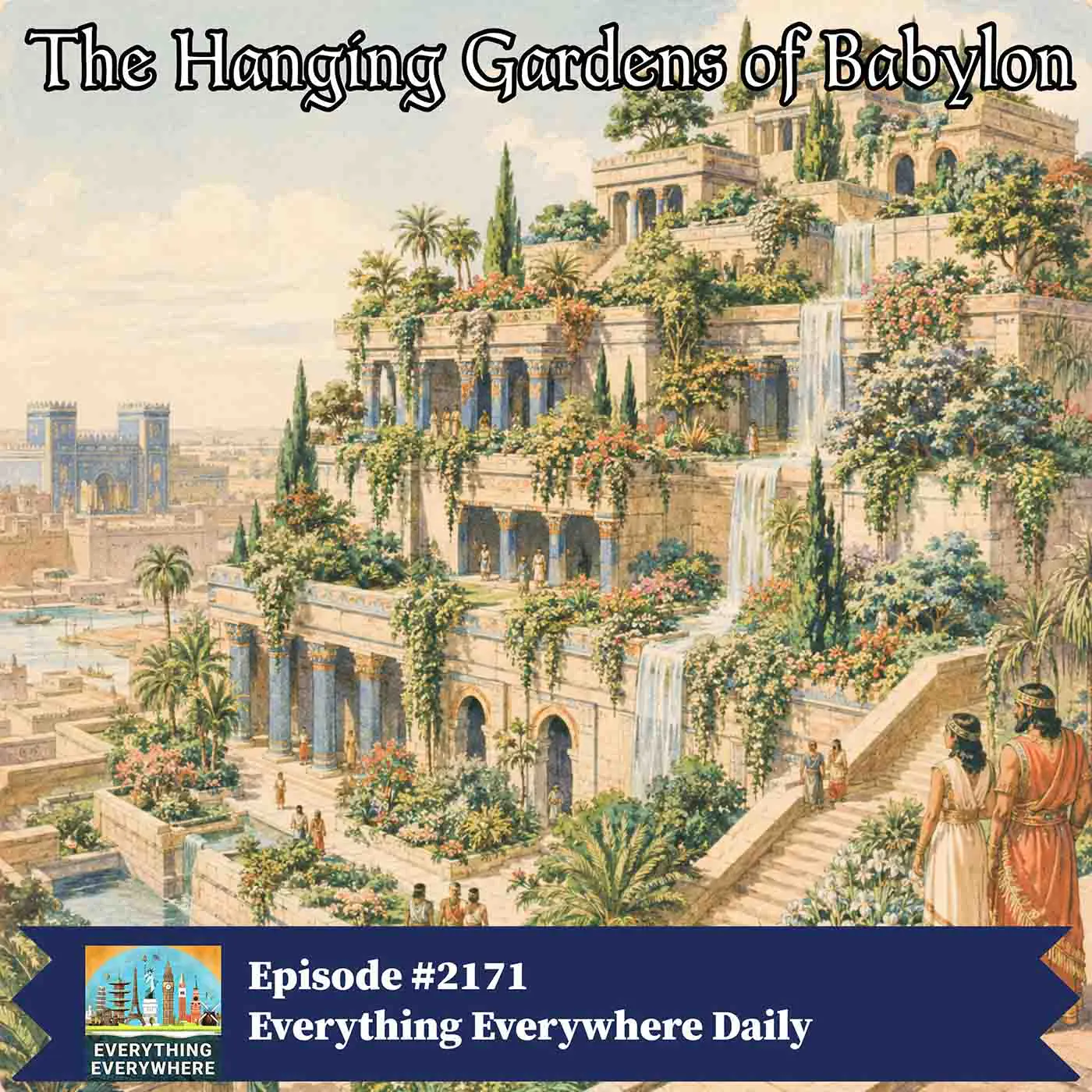
Everything Everywhere Daily: History, Science, Geography & More
The Hanging Gardens of Babylon
00:14:12
Loading summary
Transcript1 lines
- [00:00]
A
The Hanging Gardens of Babylon was one of the Seven Wonders of the ancient world. It was described as a marvel of engineering and architecture, and it was considered stunningly beautiful. However, unlike the other ancient wonders, we have no idea who built it, where it exactly was, or whether it even existed. But this hasn't stopped archaeologists and historians from searching for the elusive wonder. Learn more about the Hanging Gardens of Babylon on this episode of Everything Everywhere Daily. This episode is sponsored by Drip Drop. Travel Exercise, heat, long days and even just forgetting to drink enough water can all leave you feeling drained. And when that happens, water alone isn't always enough. That's where Drip Drop comes in. Drip Drop uses science based formulas for rapid hydration so you feel results fast while getting three times the electrolytes of leading sports drinks. It has six key electrolytes as well as 15 essential vitamins and nutrients. Drip Drop comes in a variety of flavors including zero sugar options, and it's trusted by athletes, medical professionals, first responders, and people who simply want to stay better hydrated. I use the zero sugar version and it tastes great. Right now, Dripdrop is offering my podcast listeners 20% off their first order. Go to dripdrop.com and use promo code everything. That's dripdrop.com promo code everything for 20% off. Stock up now@dripdrop.com and use promo code everything. This episode is sponsored by Mint Mobile. When people hear that Mint Mobile plans are only $15 a month, a lot of people wonder why. What's the catch? Well, I can tell you that there isn't one. There are no gimmicks and no gotchas. Just unlimited talk, text and data with fast, reliable coverage on the nation's largest 5G network. You can use your same phone with the same phone number and all of your contacts. All you do is pay less money. That's why I recommend Mint Mobile. To get your new wireless plan for just $15 a month, go to mintmobile.comeed that's mintmobile.comeed cut your wireless bill to 15 bucks a month at mintmobile.comeed that's it. There's no catch. $45 upfront payment required. Equivalent to $15 a month new customers on first three month plan only slower speeds above 40gb on unlimited plan. Additional taxes, fees and restrictions apply. See Mint Mobile for. In a previous episode, I covered the seven Wonders of the Ancient World. Six of the seven Wonders were located around the eastern rim of the Mediterranean Sea. Six of the seven Wonders have eyewitness accounts recorded for centuries and some even have ruins that are still visible today. And the seventh is the Hanging Gardens of Babylon. Unlike the other wonders, the existence of the hanging gardens remains unproven. The others were either still standing or their destruction has been documented. But for the gardens, we have to rely on speculation about their existence and ultimate fate. The Hanging Gardens of Babylon were most commonly believed to have been located in Babylon. However, some historians propose that the gardens were actually in the city of Nineveh, which was part of the Assyrian Empire. This debate centers on the interpretation of ancient sources and archaeological evidence, leaving the precise location uncertain. Supporters of the Nineveh theory point out that King Sennacherib of the Assyrian Empire carried out a massive architectural overhaul of his capital city. His renovations included a palace known as the Palace Without Rival and a grand garden complex, which some people believe may be the actual hanging gardens. The elevation of the Nineveh gardens might suggest this being the hanging gardens of legend, a claim that's bolstered by findings such as a substantial irrigation network with water raising screws near the palace. This series suggests that classical sources confuse the actual location and there's some evidence to support this. The main theory is that multiple cities were called Babylon, which just means gate of the Gods. The city gates of Nineveh were renamed after their gods, suggesting that Sennacherib wanted Nineveh to be like Babylon. As the ancient Greeks were likely unaware that there were multiple Babylons, it's plausible that they confused the location. However, this is just one theory. For the rest of the episode, I'm going to assume that the gardens were in fact located in the city of Babylon, as that is where most of the evidence points. However, I figured I should give the alternative theory before continuing. It's believed that the second king of the Neo Babylonian Empire, Nebuchadnezzar ii, was responsible for the construction of the hanging gardens. The Neo Babylonian Empire was the final great Mesopotamian empire ruling Babylon from 626 to 539 BC, reaching its height under Nebuchadnezzar II before being conquered by the Persians. The ancient city of Babylon was its capital and was located in modern day central Iraq, about 85 kilometers or 53 miles south of modern day Baghdad. Nebuchadnezzar is best known for his role in expanding the Neo Babylonian Empire across the Middle east and for turning Babylon into a legendary city. Nebuchadnezzar had earned the reputation as a great builder king as he believed that large infrastructure projects secured his legitimacy as a ruler. One of Nebuchadnezzar's Best known projects was the construction of another architectural wonder, the Ishtar Gate, a massive decorated brick gate that served as the main entryway into the city of Babylon. During his reign, Nebuchadnezzar built and restored temples and other architectural wonders across the city. Historians can't prove whether or not Nebuchadnezzar II is responsible for building the hanging gardens, however, due to conflicting sources. That being said, those who do credit Nebuchadnezzar believe that the gardens were located near the palace and were a gesture of love towards his wife Amytis, rather than a show of power. Amytis was from Media, a powerful empire in modern day northern Iran, Azerbaijan and Kurdistan. Her marriage to Nebuchadnezzar II was a political alliance and not a love match. Upon arriving in Babylon, Amytis is said to have been homesick for Media. Her homeland was known for its mountains and greenery, which was very different from the flat, hot and dry climate of Babylon. Wanting to comfort his new wife and ease the transition, Nebuchadnezzar is said to have ordered the construction of the hanging gardens to mimic the greenery and hills of her home. For the rest of Babylon, the hanging gardens were a source of pride and strength. They helped Babylon gain a reputation as a paradise for its city's beauty. The plants brought in demonstrated the empire's strength and displayed the new lands that they had conquered. All of that however, is basically supposition. As previously mentioned, we know very little about the hanging gardens of Babylon. While we do have sources that describe the gardens, there is little to no first hand evidence of their existence. As a result, there is little information about what the gardens actually looked like. However, based on a few accounts written centuries later, we have an idea of what it might have looked like. The earliest written reference to the hanging gardens was by the priest Berossus of Babylon. This account was preserved only because he was cited by a 1st century historian named Flavius Josephus. In this account, Berossus described the gardens simply stating that they were a stone terrace resembling hills. Interestingly, he is the only source to have credited the construction of the gardens to Nebuchadnezzar ii. Flavius Josephus also cited Berossus, stating that the gardens were made for his wife, which provided most of the information that we have about them. However, taking Berossus description of the hanging gardens is a bit risky. None of his original work has survived and this is thought to have been written centuries after the hanging gardens were constructed. Despite this, much of Berossus other claims about Babylon have been supported by archaeological evidence. So this lends some credibility to his claims about the hanging gardens. Another ancient account of the hanging gardens of Babylon came from the ancient Greek geographer Strabo. In his book Geographica, Strabo describes the gardens as cube shaped pillars with vaulted terraces raised one above the other. Strabo wrote that the pillars were made of asphalt and brick. He said water engines were placed at one end and workers raised water to the gardens. Based on a description given by Diodorus siculus sometime between 60 to 30 B.C. the garden stretched 400 by 400ft and rose 80ft into the air. He described the walls as 22ft thick with 10 foot long passageways beneath them. It is widely thought that the Babylonians used a complex irrigation system to keep the gardens alive and well, with layers so perfectly separated that water from one would not seep into the other. All of this is completely believable given that the cultures of Mesopotamia had pioneered advanced irrigation techniques. Inside the gardens, it said that there was a variety of exotic foliage, luxurious fruits, blooming flowers and waterfalls. Because of the raised platforms, the vegetation inside the garden seemed afloat. Hence the gardens being referred to as hanging. While we're still unsure of what the hanging gardens actually looked like, there is no denying that assuming they were real, the gardens would have been an example of architectural and engineering mastery. Because we can't confirm if the hanging gardens were actually real, we can only speculate on what might have happened to them. If the hanging gardens did exist, they were likely destroyed after the first century. It's speculated that the gardens probably weren't destroyed suddenly, like with an earthquake, but rather by a drawn out period of erosion and warfare that slowly chipped away at their grandeur until they no longer existed. After a few centuries had passed, the garden's ruins may have been leveled, erasing any evidence of their location. However, this too is just a theory with no archaeological evidence to support it. Interestingly, ancient Babylonian texts say absolutely nothing about the hanging gardens. There's nothing describing its construction or what it looked like. And stranger still, none of the archaeological digs have ever found any evidence to prove it existed either. The lack of information from Babylonian sources is concerning as they wrote all about Nebuchadnezzar II's other achievements and projects. This includes things as small as giving road names. So why would they leave out their marvelous, world renowned hanging gardens? Also, because Greece was so far away from Babylon, they might have just heard about it only through rumors and other people who themselves might have only heard about it because of the lack of evidence from Babylonian sources. There are concerns that the gardens were simply a figment of the Greeks imagination, were wildly exaggerated, or were an elaborate propaganda ruse from the Babylonians themselves. But not all hope is lost for the gardens being located in Babylon. There have been some archaeological finds that could have been the hanging gardens of Babylon. The most notable of these was made by a German archaeologist named Robert Kolduay. While searching around the northern part of the palace in Babylon, Koldeway uncovered unusual looking vaults and fountain chambers. This led to the discovery of a well and chain pump which might have been part of the hanging garden substructure. This shows that the necessary irrigation figures for the hanging gardens did exist in the city, but does not definitively prove their existence. There is some evidence that the remains of the hanging gardens of Babylon may actually lie beneath the Euphrates River. The river was the lifeline of Babylonian society, providing drinking water to its people, sustaining agriculture and serving as a trade route. Because rivers shift over time, the river's route covered the majority of the western part of the historic city of Babylon. Because the bottom of the Euphrates river can't be safely excavated by archaeologists, we simply don't know whether the hanging gardens were there. Despite little evidence that the hanging gardens existed, it's nearly impossible to believe that they did not. The sheer legend of the gardens, the the coverage of ancient writers from other civilizations and its place on the list of wonders suggests that something probably existed. But perhaps the answer is actually much simpler. Maybe the Greeks were impressed that the Babylonians could grow plants in a beautiful exotic garden that by Babylonian standards was unimpressive. Maybe some guy had a really epic garden that he grew on his terrace and it just got exaggerated by word of mouth. Or maybe we just haven't found it yet. Regardless, the lack of architectural evidence is not the be all and end all for the garden's existence. There is a saying in archaeology that absence of evidence isn't evidence of absence. So just because we haven't found anything doesn't mean that it didn't once exist. At the end of the day, we're limited in our search for the hanging gardens of Babylon. Most of the historical textual evidence has disappeared over time and our ability to fully explore Babylon's ruins is severely limited. However, in many ways, the mystery behind the hanging gardens of Babylon makes them the epitome of an ancient wonder. Because of our lack of knowledge, we're left to wonder and speculate on their grandeur and existence. And none of the other ancient wonders has that ability. The executive producer of Everything Everywhere Daily is Charles Daniel. The associate producers are Austin Otkin and Cameron Kiefer. Research and writing for this episode was provided by Olivia Ashe. My big thanks go to everyone who supports the show over on Patreon. Your support helps make this podcast possible, and I also want to remind everyone about the community groups on Facebook and Discord. This is where everything happens that's outside of the show. As always, if you leave a review on any major podcast app or in the above community groups, you too can have it read in the show.