Loading summary
Transcript1 lines
- [00:01]
A
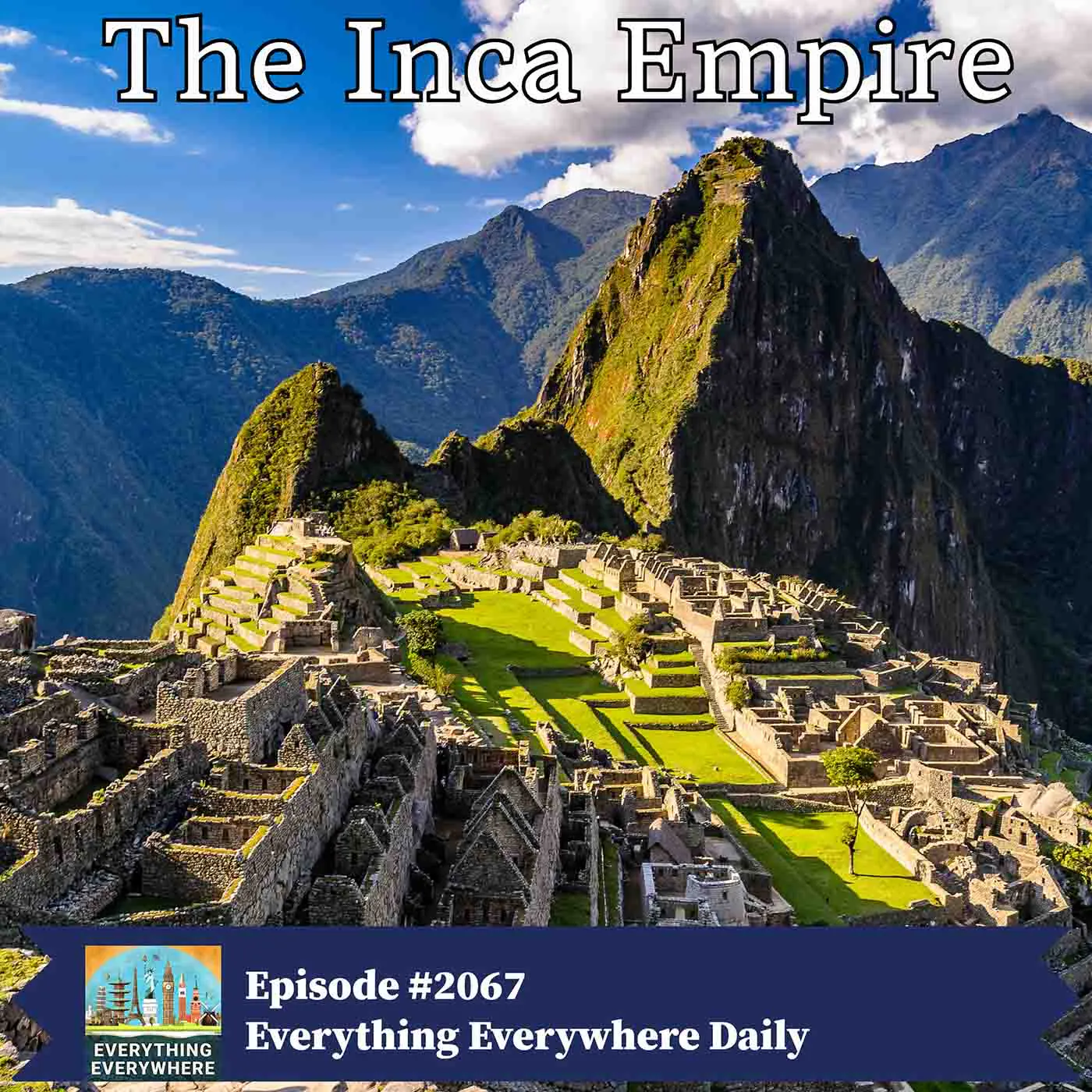
The Inca Empire was the largest and most sophisticated state ever created in the pre Columbian Americas, stretching along the Andes Mountains from present day southern Colombia to central Chile and Argentina by the early 16th century. What makes it historically significant is that the Inca managed to build and administer this enormous realm without many technologies that Eurasian civilizations relied on, such as iron tools, wheels, draft animals, or a conventional writing system. As great as its accomplishments were, its fall at the hands of the Spanish was just as dramatic and sudden. Learn more about the Incan Empire on this episode of Everything Everywhere Daily. This episode is sponsored by Mint Mobile. Spring is finally around the corner, which means spring cleaning. And it's also a good time to get rid of your unnecessary subscriptions and expensive mobile contracts. Mint Mobile is here to rescue you with premium wireless plans starting at 15 bucks a month. All plans include high speed data and unlimited talk and text on the nation's largest 5G network. Bring your own phone and number and activate with ESIM in minutes and start saving immediately. No long term contracts and no hassle. That's why I've been telling people to switch to Mint Mobile. If you like your money, Mint Mobile is for you. Shop plans@mintmobile.com eed that's mintmobile.com eed upfront payment of $45 for 3 month 5GB plan required equivalent to $15 a month new customer offer for first 3 months only, then full price plan options available, taxes and fees extra. See Mint Mo for details. This episode is sponsored by Quint's. I've been telling you for a while now how Quints works directly with top factories and cuts out the middleman. As such, they can sell top quality merchandise at a fraction of the price of luxury brands. But they aren't just selling products that look just as good. Their products are also made out of the exact same materials. Their cashmere is 100% Mongolian, the same stuff that luxury brands use. The Pima cotton is long staple, which means it stays soft and doesn't pill. The European jersey linen is breathable and lightweight. Everything is built to hold up to regular wear and still look good. I've been wearing my cashmere sweater every other day for months now and it's held up great right now. Go to quince.com daily for free shipping and 365 day returns. That's a full year to build your wardrobe and love it. And you will now available in Canada too. Don't keep settling for clothes that don't last. Go to q u I n-e.com daily for free shipping and 365 day returns quince.com daily. At its height, the Inca territories extended more than 2,300 miles, or 3,700 kilometers along the Andean coast of South America and governed as many as 13 million people. The Incan practice of splitting inheritance propelled the Incan world into a cycle of never ending conquest. Under this principle, the political inheritance passed from the ruler to a chosen heir, known as the Sapa Inca. The deceased ruler's material wealth, known as the panaka, was passed to the heir's male descendants. The panaka was to provide for the new ruler's descendants and extended family and was also to support the deceased Incan rulers. The Inca venerated their rulers as semi divine beings and treated them with extraordinary reverence, even in death. The empire provided these mummified monarchs with constant care, elaborate rituals and their own vast estates. This financial obligation meant that the incoming Incan ruler had to rebuild their own physical wealth with each secession cycle, creating a perpetual cycle of conquest. The Incas called their empire Tawatzinsuyu in the Quechua language, meaning the world of the four quarters. The empire was centered on the city of Cuzco, from which it stretched outwards in four directions, encompassing not only vast distances, but also considerable vertical terrain. The Incan governed a vast area, but it also had to govern a vertical archipelago of communities that extended well above 12,000ft, or 3,600 meters, across several different climate zones. Given its central location in the empire, Cuzco became an important cultural and political center. Governing such an expanse required a unique political system. In the Incan political system, the emperor was the son of the Sun. Incan mythology held that the first Incan ruler was sent to the earth by the sun God Inti. From this lineage, a dynasty of rulers carried divine blood through their veins. This unique form of political legitimacy gave Incan rulers unquestioned power and influence over the world. Of the four quarters, the Inca emperor governed over a large and elaborate bureaucracy staffed by noble families, within which every Inca subject played a role. The primary focus of the bureaucracy was overseeing the Mit', a, an elaborate labor based taxation system. The Inca were unique in world history as they were the only state without a market economy or money for financial transactions. The Inca lacked a formal currency and instead relied on shared labor, and each person paid a set amount of labor to the state annually to help complete important tasks such as road building. Their lack of currency isn't surprising as the Inca also hold the unique distinction of being the only major civilization in world history to to lack a Written script. The Inca maintained records of grain trade and labor using a khipu. A khipu was a series of colored cotton threads tied with a distinct pattern of knots. The direction of the thread and the nature of the knots formed an elaborate decimal system that enabled the interpreter of the khipu to understand the information encoded in the knots and threads. That the Inca achieved such a remarkable feat constructing the largest civilization in the pre Columbian western hemisphere is all the more extraordinary given the challenges that they overcame without writing. Their reliance on labor as a commodity inspired the Spanish who distorted their system into the encomienda system that dominated the Spanish empire in the Americas. The encomienda system was a colonial labor arrangement in which the Crown granted Spanish settlers the right to demand tribute and forced labor from indigenous communities in exchange for supposed protection and Christian instruction. While the Inca used the Mit? A as a labor based system of taxation, the Spanish transformed it into forced labor for sugar cultivation and mining. The Incan system was based on reciprocity, while the incomienda system was based on force and exploitation. The Incan mittas system never kept people away long enough to harm agriculture or the harvest. The Incan people managed to be highly self sufficient and in a system with limited economic exchange. The Incan state also gathered food at storage sites throughout the empire called qolkaz. In times of famine or need, the state allowed people to take food from the storehouses. The Inca were masters of farming in the difficult environment that they inhabited. They pioneered agricultural methods based on terracing of the mountain geography of the Andes and terrace farming is still the norm in this part of the world today. These terraces allowed the Inca to cultivate a wide variety of crops, including potatoes, corn and quinoa across varying altitudes, soil types and rainfall. A 17th century descendant of the Spanish conquistadors described the farming practices by noting in this way the whole hill was gradually broadened or cultivation, the platforms being flattened out like stairs in a staircase, and all of the cultivable and irrigable land being put to use. Analyzing the agricultural success of these terraces fell to the domain of the Incan priests, who made predictions about the upcoming harvest and rainfall by interpreting the entrails of a sacrificial lama. The most unique feature of the Incan landscape was the Tambo system. Like the Mongols, the Incans had to cover a vast territory and needed to provide travelers with the opportunity to rest and recover. Whereas the Mongols used the yam system to provide fresh horses and food. The Tambo system allowed Incan runners to Rest and eat. The incas oversaw approximately 2,500 Tambo stations, each approximately a one day journey apart. Messengers known as chaski were crucial to the Inca empire because they relayed information, goods and official orders across the vast Andean road network with remarkable speed, allowing the centralized government to administer and coordinate such a large territory. The Incan religion has long fascinated historians and cultural anthropologists. Inca religious values are erroneously associated with the religious practices that mirrored those of the Aztecs. Given their overlap and proximity, however, there is no concrete proof that these two cultures ever had any communication with each other. And their lack of interaction isn't surprising given that they were separated by nearly 2,000 miles, including some of the most difficult terrain on Earth and the fact that they traveled solely on foot. While the Aztecs relied on human sacrifice in religious ceremonies, the Incas preferred to sacrifice everyday items such as cloth and food. The primary deity in Incan ceremonial life was Inti, the Sun God. The famed Temple of the sun in Cuzco is a testament to Inti's importance in Incan life. Another major deity was Viracocha, the creator. The priests of the last Incan emperor, Atahuallpa, interpreted the Spanish arrival in the region as a consort of viracocha, and this misinterpretation had disastrous consequences for the entire Incan empire. The Inca also believed in huacas, or holy shrines. Incan traditions held that huacas were everywhere in the natural world, in a mountain stream, the sky or the ocean. Wakas could also be important tombs or sacred locations that required maintenance by local clans. Known as alyu, the Alu mobilized community labor to maintain the sacred locations as part of the Mitta tax based labor system. Sadly, many of the Incan sacred sites, such as the Temple of the sun in Cuzco or the Temple of Viracocha in Rachi, were built over during the Spanish period that followed Pizarro's conquest. One site that avoided Spanish plunder and desecration was the legendary Machu Picchu. Amazingly, there are no references to Macupichu in any Spanish chronicles. The rediscovery of Macapicchu by Hyrum Bingham in 1911 occurred during an expedition that he led through the Andes of southern Peru while searching for the lost Incan city of Vilcabamba, which was the last holdout of the Inca against the Spanish. Guided by local farmers, Bingham was taken in July of 1911 to a remote mountain ridge above the Urbamba river, where dense vegetation covered extensive stone ruins. A local boy led him up the steep slopes to the site, where he found terraces, temples, and finely constructed stone buildings that were largely hidden by jungle growth. Despite the veil of neglect and dense vegetation, Bingham knew he had arrived at a sacred location. Bingham wrote in his journal, dimly, I began to realize that this wall, with its adjoining semicircular temple over the cave, was as fine as the finest stonework in the world. It fairly took my breath away. What place could this be? What followed was one of the most important excavations in archaeological history. In the years to follow, Bingham and his team cleared the area of overgrowth and cleaned the monument. Although local farmers living nearby had known about the ruins forever, Bingham's expedition brought Makupicchu to the attention of the rest of the world through photographs, archaeological study, and articles in National Geographic magazine. In a first for the magazine, they dedicated the entire April 1913 issue to Makupicchu, and it is literally the only issue from the last 115 years that I don't have in my collection. Thanks to Bingham and the National Geographic Society, the discovery of Makupicu became a global sensation. His work helped establish Macu Picchu as one of the most important archaeological sites of Incan civilization and eventually one of the most famous ancient sites in the entire world. Bingham died in 1956, still believing that he had found the historic city of Vilcabamba. The discovery of Vilcabamba had to wait until 1980, when the site was confirmed to be in the rainforest north of Cusco. The end of the Inca empire began with the arrival of the Spanish conquistador Francisco Pizarro in 1532, which happened to coincide with a period of internal instability following a civil war between the Incan princes Atahualpa and Huascar. At the Battle of Cajamarca, which I covered in a previous episode, Pizarro lured Atahuallpa into the town of Cajamarca under the pretense of a peaceful meeting, then launched a sudden ambush with fewer than 200 Spanish soldiers armed with horses, steel, weapons, and firearms. Thousands of unarmed Inca attendants were killed in the chaos, and Atahualpa was captured, an event that effectively crippled the centralized leadership of the empire. Although Atahualpa later paid a massive ransom in gold and silver for his release, the Spanish executed him in 1533, and the resulting political collapse allowed the Spanish to seize control of the Incan state and ultimately conquer the empire. The decline and fall of the Incan empire was one of the fastest and most complete collapses of any major empire in world history. The speed of their collapse was even more stunning given how large and powerful they were before the arrival of the Spanish. The executive producer of Everything Everywhere Daily is Charles Daniel. The associate producers are Austin Otkin and Cameron Kiefer. Research and writing for this episode was provided by Joel Hermanson. My big thanks go to everyone who supports the show over on Patreon. Your support helps make this podcast possible. I also want to remind everyone about the community groups on Facebook and Discord, as this is where everything happens outside of the podcast. As always, if you leave a review on any of the major podcast apps, you too can have it right on the show.