← Everything Everywhere Daily: History, Science, Geography & More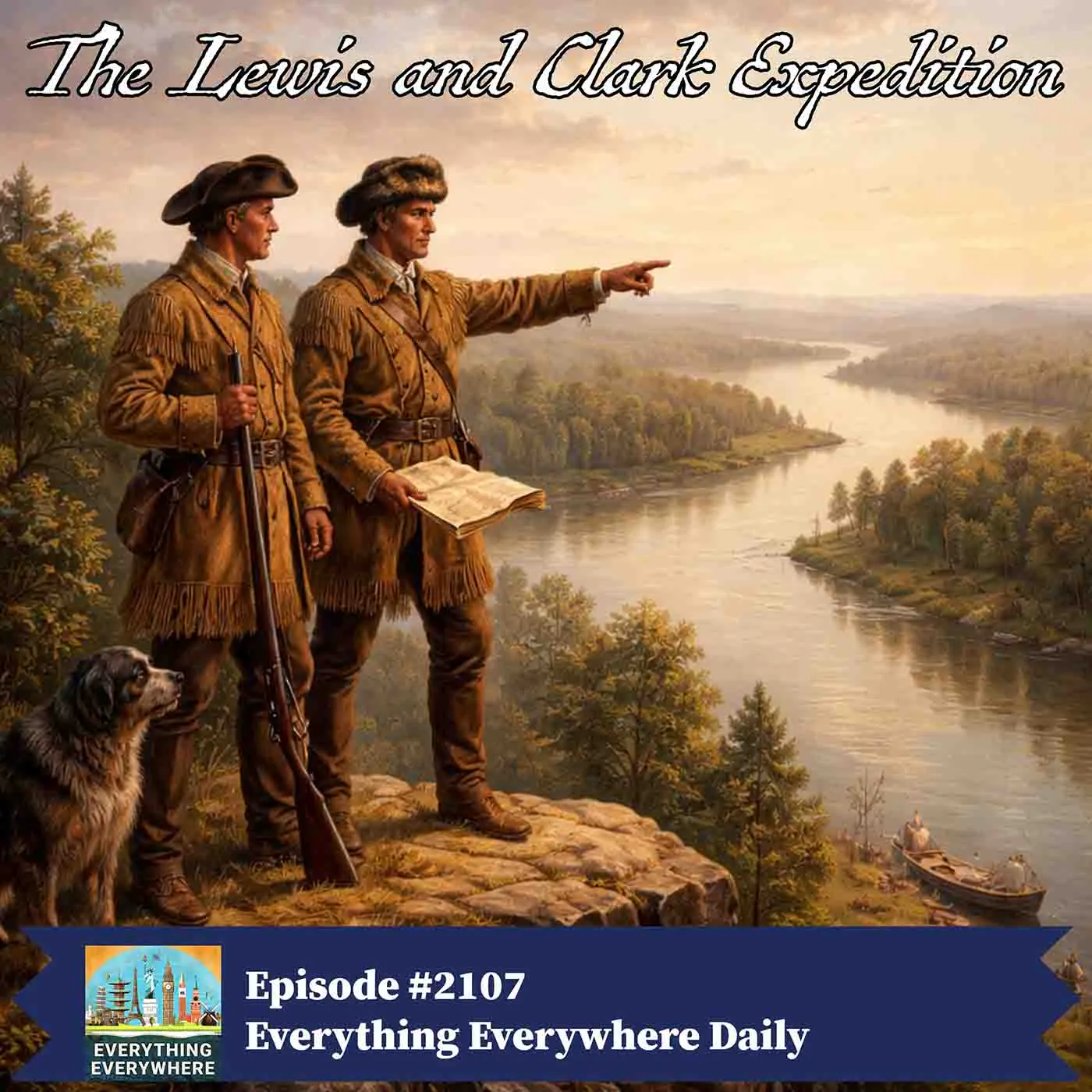
Everything Everywhere Daily: History, Science, Geography & More
The Lewis and Clark Expedition
00:14:54
Loading summary
Transcript1 lines
- [00:00]
A
When Thomas Jefferson concluded the Louisiana Purchase, it was one of the greatest land deals in history. For a relatively small sum, the young United States purchased a large part of the North American continent. However, there was a catch. The government had no clue what exactly was in the land that they had purchased. Much of it was unexplored. To address this problem, an expedition was formed to explore the new land which would ultimately shape the future of the United States. Learn more about the Lewis and Clark expedition on this episode of Everything Everywhere Daily. This episode is sponsored by Audible. It's time to believe in the Hail Mary, one of the most talked about science fiction adventures of the decade. Project Hail Mary by Andy Weir is now on the big screen and there's never been a better moment to experience the audiobook that started it all. Rylem Grace is humanity's last hope. Alone in space with no memory of how he got there, he must solve an impossible scientific mystery before the Earth is wiped out forever. What follows is a smart, thrilling and surprisingly emotional journey that blends hard science with non stop suspense fans favorite narrator Ray Porter delivers an unforgettable performance, balancing humor, heart and escalating tension as the stakes grow higher with every chapter. Part scientific puzzle, part interstellar adventure, Project Hail Mary is a story about curiosity and ingenuity and survival against impossible odds. Now that the blockbuster movie has finally arrived in theaters, there's never been a better time to start listening to the universally acclaimed audiobook Project Hail Mary. Listen. Watch. Save the World. Start listening today@audible.com Hailmary this episode is sponsored by Mint Mobile. It's been said that insanity is doing the same thing over and over again and expecting different results. I'd like to update this and suggest that insanity is paying too much for something when you can get something equally as good for less. With Mint Mobile you can stop the insanity and get high speed data and unlimited talk and text delivered on the nation's largest 5G network starting at only 15 bucks a month. Bring your own phone and number, activate with ESIM in minutes and start saving immediately. No long term contracts, no no hassle. That is why I recommend Mint Mobile. If you like your money, Mint Mobile is for you. Shop plans@mintmobile.com eed that's mintmobile.com eed upfront payment of $45 for 3 month 5GB plan required equivalent to $15 a month new customer offer for first 3 months only, then full price plan options available, taxes and fees extra. See Mint Mobile for details. If you remember back to my episode on the Louisiana purchase. A war in Europe and a successful slave insurrection in Haiti led Napoleon Bonaparte to abandon his North American holdings. President Thomas Jefferson secured the Louisiana purchase for just $15 million, doubling the size of the United States at $0.03 an acre. Even adjusted for inflation, it was a really good deal. The deal contradicted Jefferson's mission to shrink the federal government. Yet westward expansion was critical to his vision of the United States. Jefferson had been interested in the west ever since the American Revolution. Most Americans in the time of Thomas Jefferson lived within 50 miles of the Atlantic Ocean. To Jefferson, the West represented possibility, potential and mystery. His focus on westward expansion was old news by the time that he was elected president in 1800. In fact, his fascination with the west began before he even wrote the Declaration of Independence. Jefferson was infatuated by the Mississippi and uncharted river systems west of it. He hoped that there would be a direct river system that would lead to the Pacific Ocean. The historian Stephen Ambrose put Jefferson's vision of the west into perspective when he wrote, in An Age of Imperialism. He was the greatest empire builder of them all. His mind encompassed the entire continent. The limited knowledge that he had of the region came from reports of fur traders. French explorers also brought news from the fur bearing regions of the Great Lakes. However, these reports lacked the scientific rigor that Jefferson sought. Jefferson secured funding for a Western expedition as early as January 1803, before the Louisiana Purchase. Jefferson asked Congress for a mere $2,500 to fund the mission. To keep costs low, Jefferson paid the expedition members a soldier's salary and drew on funds from the defense budget. He dubbed the expedition the Corps of Discovery, a unit of the United States Army. Jefferson asked Meriwether Lewis to lead the mission. He outlined his ambitions for westward expansion by noting, the purpose of your mission is to explore the Missouri river and by its course and communication, the waters of the Pacific Ocean. Although Lewis already held a captain's commission in the US army, he knew his military training wasn't sufficient to meet Jefferson's ambitions. He had to become a scientist to fulfill the wide ranging goals of Jefferson's mission. Jefferson wrote to Lewis in June of 1803 giving a lengthy description of his objectives and wrote, your observations are to be taken with great pains and accuracy and to be entered distinctly and intelligibly to for others as well as yourself. Lewis wasn't a scientist, so he needed to study to prepare to take the observations that Jefferson requested. He spent the summer of 1803 in Philadelphia, and there he got a crash course in many areas of Scientific study. He worked with experts in botany, geology, zoology, cartography and astronomy. Benjamin Rush, a revolutionary era doctor, gave Lewis medical training for the expedition. Rush famously provided the expedition with 600 thunderbolt pills, a powerful laxative of his own design. He claimed that they would produce explosive bowel movements that would relieve any ailment. After training, Lewis went to Harpers Ferry, Virginia to gather supplies. Lewis shipped the supplies to Pennsylvania and traveled there to meet his former military commander, William Clark. Lewis and Clark were very different leaders. Jefferson selected Lewis for his bookish mine, but Lewis recruited Clark for his grit. On the frontier, Clark was recruited to bolster the group's spirits, serving as a steadfast and dependable anchor for the entire expedition. Clark distinguished himself as an exceptional cartographer. Despite having no formal education in the field. His maps are still considered high quality by modern standards. Data from the National Park Service highlights that he was a highly skilled mapmaker who utilized tools such as a telescope, a quadrant and a compass to achieve his results. In guiding the men on their journey, he had kept remarkable records of their distance. He was off by a mere 40 miles in his calculation of how far they had traveled from Camp dubois outside of St. Louis to the Pacific Ocean. But Clark should be taken with a grain of salt on the expedition. Clark brought his enslaved servant named York, who became the first African American to cross the continent. York was indispensable, helping with river navigation and hunting through harsh winters. The expedition treated York as an equal on the trail, even granting him a vote during the brutal winter of 1805. Widely considered to be the first vote cast by an African American in US History. York's equality ended upon his return. While every other man walked away with 320 acres and their promised double pay, York received nothing. When the expedition ended, York asked Clark for his freedom and Clark refused. The expedition began from Fort Dubois, upstream from St. Louis on the Mississippi, where they had spent the winter of 1803 and 1804. They spent that fall and winter recruiting, bringing the total size of the group to 40 people. Lewis and Clark hand picked every member of the expedition for a specific vital skill. Each man excelled in woodworking, hunting, sailing or blacksmithing. After loading all the supplies into a 55 foot keel boat that Clark and the crew had constructed, the men set out on the Missouri River. Lewis and Clark began keeping detailed journals, a practice that defined their expedition. Their journals offer vivid details of every stage of the journey. Historians access the digitized journals more frequently than almost any other set of primary materials in American history. The daily logs tell us about their discoveries, triumphs and tragedies. One tragedy occurred on August 20, 1804, when Charles Floyd died of a ruptured appendix. Clark's journal entry from that day chronicles the tragedy. He wrote yesterday, Floyd was taken very bad. He died with a composure which justified his character as a man and a soldier. The journals revealed the changing geography, animal discoveries and relationships with Native Americans. The journals also included sketches, maps, animal drawings and recipes. They offer insight into the expedition members and their remarkable deeds. Perhaps the journal's most famous figure is Sacagawea. Sacagawea first appeared in the journals in November of 1804 as the expedition reached North Dakota. William Clark hired a French fur trader named Toussaint Charbonneau to help the expedition obtain horses and serve as a representative and translator in Native American relationship. However, the only real reason they hired him was because of his wife, Sacagawea. The expedition was in desperate need of horses as they entered the Rocky Mountains. And they also needed to negotiate and maintain peaceful relations with the Shoshone tribe. The negotiation was a pretty complicated endeavor, Sort of a linguistic game of telephone. Lewis and Clark had to speak to a French speaking member of their expedition who then spoke to Charbonneau, who then spoke to Sacagawea, who then spoke to the Shoshone who sent the message back. The expedition held Charbonneau in fairly low regard. They derided him for his blunders, including nearly destroying all of their records when he panicked and nearly capsized the boat. Lewis wrote of Charbonneau, he is perhaps the most timid waterman in the world. Of his wife, their opinion was quite clear. They viewed her as resourceful and essential. In the same passage in which Lewis chastised her husband, he wrote of Sacagawea as possessing fortitude and resolution, revolution. It's no understatement to say that she was the one who saved the expedition. Her skill as a negotiator allowed the group not only to gain access to the much needed horses, but also to secure safe passage. The expedition also carried a secret, the Ghiradani air rifle. Capable of firing 20 rounds in under a minute. The rifle stunned the Native peoples that Lewis and Clark encountered during their formal negotiations. As they reached the Three Forks of the Missouri, Sacagawea recognized her childhood home. Lewis and Clark quickly arranged a meeting with the local Shoshone band. As Sacagawea began interpreting, Providence intervened and she realized that the chief was her long lost brother. The expedition benefited from her deep connections to the region, her keen geographic Instincts and understanding also guided the expedition through unfamiliar terrain. Her knowledge of the region's plants enabled her to forage for food after food stores ran out. And it should be noted that she did all of this while caring for an infant son and as Lewis may have noted, also her husband. Clark had a unique relationship with Sacagawea and her infant son, Jean Baptiste, to whom he called Pomp and my little dancing boy. His bond with Sacagawea was built on a profound platform of respect. While he had genuine paternal love for the boy. One of the most interesting side stories of the expedition was the future of John Baptiste. In 1806, upon returning from the expedition, Clark offered to raise the boy and even offered land and a farm to Charbonneau and Sacagawea if they would move the boy closer to him so he could provide the child with an education. The family took him up on the offer of a farm, but after realizing it wasn't for them, they left in 1811 to return to the fur trade, leaving Jean Baptiste in in the care of William Clark. Clark became the legal guardian of John Baptiste and his younger sister after sacagawea's death in 1813. While the expedition failed to find the mythical river passage to the Pacific, they succeeded in something far more important. Proving that it didn't exist and inspiring a never ending passion for the American West. Jefferson had given the expedition the authority of asserting US Sovereignty over the lands of the Louisiana Purchase. Lewis presented the groups that they encountered with Sacagawea's help statements asserting US Dominion in the area as a result of the Louisiana Purchase. Although the expedition faced friction, especially with the Sioux, it was successful in reaching the Pacific and establishing land claims for the United States. Jefferson also charged the expedition with a massive scientific mission to categorize every resource and animal that they encountered on their 8,000 mile journey. Their journal entries on plant and animal life may have been Lewis and Clark's greatest success. Lewis and Clark documented The discovery of 178 plants and 122 animal species previously unknown to American scientists. In their journals they drew the animals and described their habits, behavior and value. The journals characterized legendary western animals, from the grizzly bear to the bighorn sheep. And arguably their favorite discovery was the prairie dog. What was dubbed the barking squirrel halted the expedition for an entire day in northeast Nebraska as they watched it and tried to catch one. After much effort, they caught and caged a live prairie dog, which then was sent to President Jefferson, who was equally amazed by the creature. Despite keeping the prairie dog for several weeks. Jefferson ultimately sent it to the Peale Museum in Philadelphia, where it became a star attraction. The Lewis and Clark Expedition claims a prominent place in the American story. The members of the Corps Discovery were the first US Citizens to see the grandeur of the Great Plains, to traverse the Continental Divide at the crest of the Rocky Mountains, and to see the Pacific Ocean. Their chronicles of plants, animals, and geological features fueled science and ignited a race to settle the West. The expedition represented the start of of American westward expansion. For better and worse, the events of the next century in the American west can be directly linked to the Lewis and Clark Expedition. The executive producer of Everything Everywhere Daily is Charles Daniel. The associate producers are Austin Otkin and Cameron Kiefer. Research and writing for this episode was provided by Joel Hermanson. My big thanks go to everyone who supports the show over on Patreon. Your support helps make this podcast possible. And I also want to remind everyone about the community groups on Facebook and Discord, as this is where everything happens outside of the podcast. As always, if you leave a review on any of the major podcast apps, you too can have it running the show.