Loading summary
Transcript1 lines
- [00:01]
A
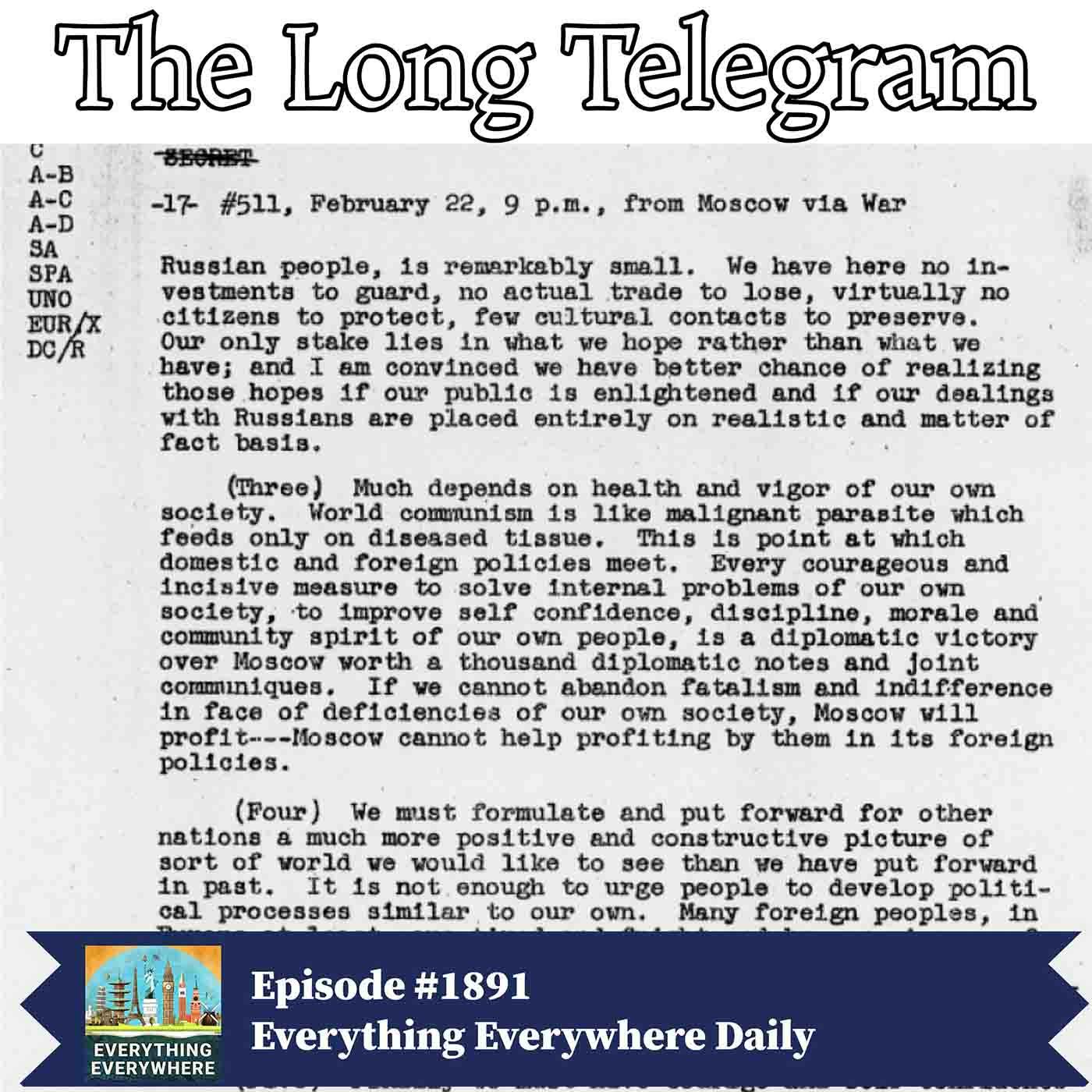
On February 22, 1946, George F. Kennan, a career diplomat working in the American Embassy in Moscow, sent an 8,000 word cable to the State Department in Washington, D.C. in it, he explained why the Soviet Union behaved as it did, outlining its unique combination of a communist ideology and historical Russian paranoia and suspicion. He also gave a prescription for how the United States should respond. Although he couldn't have known it at the time, that message became the foundation of American policy during the Cold War. Learn more about the Long Telegram and its influence on this episode of Everything Everywhere Daily. This episode is sponsored by Quince. I've been telling you about quints for quite a while now, but perhaps it still hasn't sunk in for some of you just how affordable Quince can be. I went to their website and checked out several prices. A woman's Mongolian cashmere tee, which cost up to $175 from other retailers is available for just $44.90 on quints. A men's comfort stretch trench coat that goes as high as $498 on other sites costs only $99.90 on quints. A European linen chambray fitted sheet set that will run you $270 at competitors can be purchased for only $85.90 on quints. These are serious discounts on high end luxury items and they can do this by working directly with top artisans and cutting out the middlemen. Quince gives you luxury prices without the markup, passing the savings on to you. Keep it classic and cool this fall with long lasting staples from quince. Go to quince.com daily for free shipping on your order and 365 day returns. That's Q-U I-M C-E.com daily free shipping and 365 day returns quince.com daily this episode is sponsored by Fiji Water. You've probably heard of Fiji Water and have seen it in stores. Well, Fiji Water really is from the islands of Fiji. Drop by drop, Fiji Water is filtered through volcanic rock 1,600 miles away from the nearest continent and all its pollution protected and preserved naturally from external elements. In this process, it collects a unique profile of electrolytes and minerals, resulting in more than double the electrolytes as the other top two premium bottled water brands, giving Fiji Water its smooth taste. Fiji Water's electrolytes are 100% natural and this water even has a perfectly balanced pH of 7.7. I've recently been trying to reduce my consumption of diet soda and I've found Fiji Water to be a great alternative, visit your local retailer to pick up some Fiji Water today for your next backyard party, beach day hike, or even your home office. Fiji Water is earth's finest water to understand why the long telegram was written, we need to understand the geopolitical climate in the months immediately after the end of the Second World War. In late 1945 and early 1946, the wartime alliance was unraveling. Soviet forces were entrenching in Eastern Europe, disputes over Poland, the Balkans and Germany were sharpening and crises flared in Iran and over the Turkish Straits. Communist parties were gaining influence in France and Italy. Britain was exhausted. The United States held the atomic monopoly while rapidly demobilizing and and no clear peace, settlements or security framework existed. The Americans couldn't understand why the Soviets were being so difficult to work with. After having been allies for the last several years, the Soviets refused to join the World bank and the International Monetary Fund, which the Americans considered to be key international institutions for the future. What really caught the attention of American policymakers was a speech given by Soviet leader Joseph Stalin on February 9, 1946. Stalin argued that World War II was not an accident or the blunder of a few leaders. He said it flowed inevitably from the dynamics of monopoly capitalism which generates crises, splits the capitalist world into rival camps and produces wars when powers seek to redivide markets and raw materials. He stated plainly that the war broke out as the inevitable result of the development of world economic and political forces on the basis of present day monopolistic capitalism. He also framed the wartime alliance as an anti fascist coalition of convenience rather than as a durable basis for post war harmony. The State Department asked the Moscow Embassy for an explanation for the Soviet behavior and the person who responded was the number two man at the Embassy, George F. Kennan. Kennan was a 42 year old career diplomat serving as the Deputy Chief of Mission at the US Embassy in Moscow. Kennan was uniquely qualified to analyze Soviet behavior. He was fluent in Russian, had studied Russian history and culture extensively, and served in various diplomatic posts in the Soviet union since the 1930s. He was arguably America's foremost Russia expert at a crucial moment in history. He had previously served at the Moscow Embassy before the war but had a falling out with the Ambassador, Joseph E. Davies, and just as an aside, Davies was a massive Stalin supporter and refused to believe any of the negative things said about Stalin. He later wrote a book titled Mission to Moscow which was made into a movie in 1943, which is one of the most embarrassing films ever made by a Hollywood studio Most diplomats might have sent back a brief technical response to the State Department. But Kennan, who had been observing Soviet behavior for years and felt that Washington fundamentally misunderstood the nature of the Soviet system, saw this as his opportunity to provide a comprehensive analysis. As he later wrote, he had been waiting for just such a chance to explain what he saw as the deeper currents driving Soviet policy. On February 22, 1946, Kennan sent an 8,000 word cable which was extraordinarily long for a diplomatic telegram that would become known as the Long Telegram. To put this into perspective, most diplomatic cables were just a few paragraphs. Kennan's message was more like a small book. The telegram was structured in five main sections, each building upon the previous one, like a carefully constructed academic argument. In Part one, Kennan opens by summarizing the doctrine pushed by the Kremlin's propaganda. The USSR depicts a world split between socialist and capitalist centers, insists capitalism is ridden with insoluble conflicts that produce wars, and claims there can be no lasting peaceful coexistence. From that presence flows working rules, increase Soviet power, exploit rifts amongst capitalist states, use progressive forces abroad, and attack non communist socialists as the most dangerous rivals on the left. In part two, Kennan provides historical context explaining how Russian insecurity, Marxist Leninist ideology and Stalin's personal paranoia combined to create a regime that needed external enemies to justify internal repression. The result is secrecy at home, so suspicion abroad and a habit of seeking security by wearing down rival powers rather than by compromise. In part three, Kennan outlined how the Soviet worldview would manifest in practical policy through support of communist parties abroad, propaganda campaigns and efforts to weaken Western institutions. He said to expect relentless strengthening of the Soviet state, cautious moves to widen formal influence in nearby strategic necessity areas like northern Iran and Turkey, tactical use of the United nations organization and efforts to weaken Western influence in colonial regions. In part four, he explained how the Soviets would work through a concealed inner core of communist parties, front groups in labor, youth and cultural life, selected churches, emigre or Pan Slavic movements, and sympathetic regimes. Typical tasks include undermining Western unity and morale, inflaming colonial grievances, pushing out unhelpful governments, and playing allies off against each other with special attention to penetrating police and administrative posts. Finally, in part five, was Kennan's policy treat the USSR as a powerful, disciplined adversary that is sensitive to strength, avoids needless risks and can be deterred by firm, well handled resistance without general war. This message had huge implications. It meant that this wasn't just a post war friction that would fade with time and goodwill. It was built into the DNA of the Soviet system. The Soviet leadership needed an external enemy to justify its harsh internal control over its own people. He contended that the Soviets were patient and opportunistic rather than recklessly aggressive. They would probe for weaknesses and advance when they encountered little resistance, but they would pull back when they met firm opposition. Finally, Kennan argued that this challenge could be met without war. The Soviet system had internal contradictions and weaknesses that would eventually cause it to moderate or collapse if consistently opposed. The Long Telegram arrived in Washington like a revelation. Secretary of the Navy James Forrestal was so impressed that he had hundreds of copies made and distributed throughout the government. It quickly became required reading for senior officials across multiple departments. But why was it so influential? The Telegram provided a coherent framework for understanding Soviet behavior at exactly the moment when American policymakers desperately needed one. It was like finally getting a user's manual for dealing with a confusing and frustrating situation. The Telegram's influence could be seen almost immediately in American policy. Within weeks, President Truman took a much firmer stance with the Soviets over Iran, and the Telegram's analysis influenced the development of what would be known as the Truman Doctrine. While this was widely circulated within the government, it still hadn't been shared publicly. Keenan rectified this when he had an article published in the July 1947 issue of Foreign affairs titled the Sources of Soviet Conduct. The author of the article was simply listed as X, and it became known as the X article. The Long Telegram and the X Article gave senior officials a vocabulary and strategy for dealing with Moscow. In March of 1947, President Truman announced the Truman Doctrine, asking Congress for aid to Greece and Turkey and asserting a general U.S. commitment to support free peoples under pressure. Although broader and more global than Kennan preferred, it aligned with the Telegram's core, warning that Soviet pressure must be met with sustained resistance. The Marshall Plan, announced in June of 1947, represented another direct application of Long Telegram thinking. Kennan had argued that the Soviets would try to exploit economic weaknesses and social instability in Western Europe. The Marshall Plan's massive financial aid to rebuild European economies was designed to remove these vulnerabilities. The formation of NATO in 1949 reflected yet another dimension of Kennan's analysis. He had argued that the Soviets respected strength and would modify their behavior when faced with firm, consistent opposition. NATO created precisely the kind of clear, credible deterrent that Kennan believed to be most effective in managing Soviet the Long Telegram became the intellectual foundation for what Secretary of State Dean Acheson would later call the containment strategy. This wasn't just about military confrontation. It was a comprehensive approach involving economic, political, cultural and military tools to prevent Soviet expansion while waiting for internal changes within the Soviet system itself. The Long Telegram's influence extended far beyond the immediate post war period. Its core insights shaped American policy through multiple administrations and different phases of the Cold War. During the Korean War, American leaders drew on Kennan's analysis that the Soviets were opportunistic but would avoid direct confrontation when faced with firm resistance. This helped guide the US Decision to fight a limited war rather than risk global conflict. It should be noted that the piece sparked immediate argument. Columnist Walter Lippmann warned that a broad open ended containment idea could pull the United States into peripheral commitments and drain resources. Kennan countered that his emphasis was on vital centers such as Western Europe and Japan, not on matching the USSR everywhere. That debate over the scope of US Policy ran through the next decade. It's also important to note that Kennan himself later became concerned about how his ideas were being applied. By the 1950s, he worried that containment had become too militarized and that America was applying the strategy too broadly around the world. Rather than focusing on key strategic areas, Kennan's nuanced analysis of Soviet psychology and behavior became simplified into a more rigid doctrine that sometimes emphasized military responses over the political and economic tools that Kennan had originally stressed. The Long Telegram's ultimate validation came with the end of the Cold War itself. Kennan had predicted in 1946 that the Soviet system contained the seeds of its own destruction and that consistent Western pressure was would eventually lead to internal changes within the Soviet Union. The collapse of the Soviet Union in 1991 seemed to confirm his fundamental analysis. It should be noted that the Long Telegram wasn't a guidebook that was used to determine every decision. During the Cold War. Kennan was against the United States supporting France and Vietnam and later the Vietnam War itself. Kennan thought that the US did not have a vital interest in Southeast Asia and would have better spent its resources in other parts of the world. Nonetheless, American Cold War policy wasn't just made up on the fly. There was a plan of sorts, even though it wasn't followed perfectly. By and large, the avoidance of any direct military conflict with the Soviets over The course of 40 years is a testament to the strategy of the Long Telegram. Also, when the Soviet Union fell, it took most people by surprise, but not everyone. With the end of the Cold War, Kennan remained a geopolitical thinker and critic of foreign policy until his death at the age of 101 in 2005. The long telegram reminds us that ideas matter in international relations. A single, well reasoned analysis by one insightful diplomat helped shape four decades of American foreign policy and contributed to one of the most significant geopolitical transformations in modern history. It shows how understanding the deeper currents driving international behavior can be just as important as military strength or economic power in shaping world events. The executive producer of Everything Everywhere Daily is Charles Daniel. The associate producers are Austin Otkin and Cameron Kiefer. My big thanks go to everyone who supports the show over on Patreon. Your support helps make this podcast possible, and I also want to remind everyone about the community groups on Facebook and Discord. That's where everything happens that's outside the podcast, and links to those are available in the show notes. As always, if you leave a review on any major podcast app or in the above community groups, you too can have it read on the show.