← Everything Everywhere Daily: History, Science, Geography & More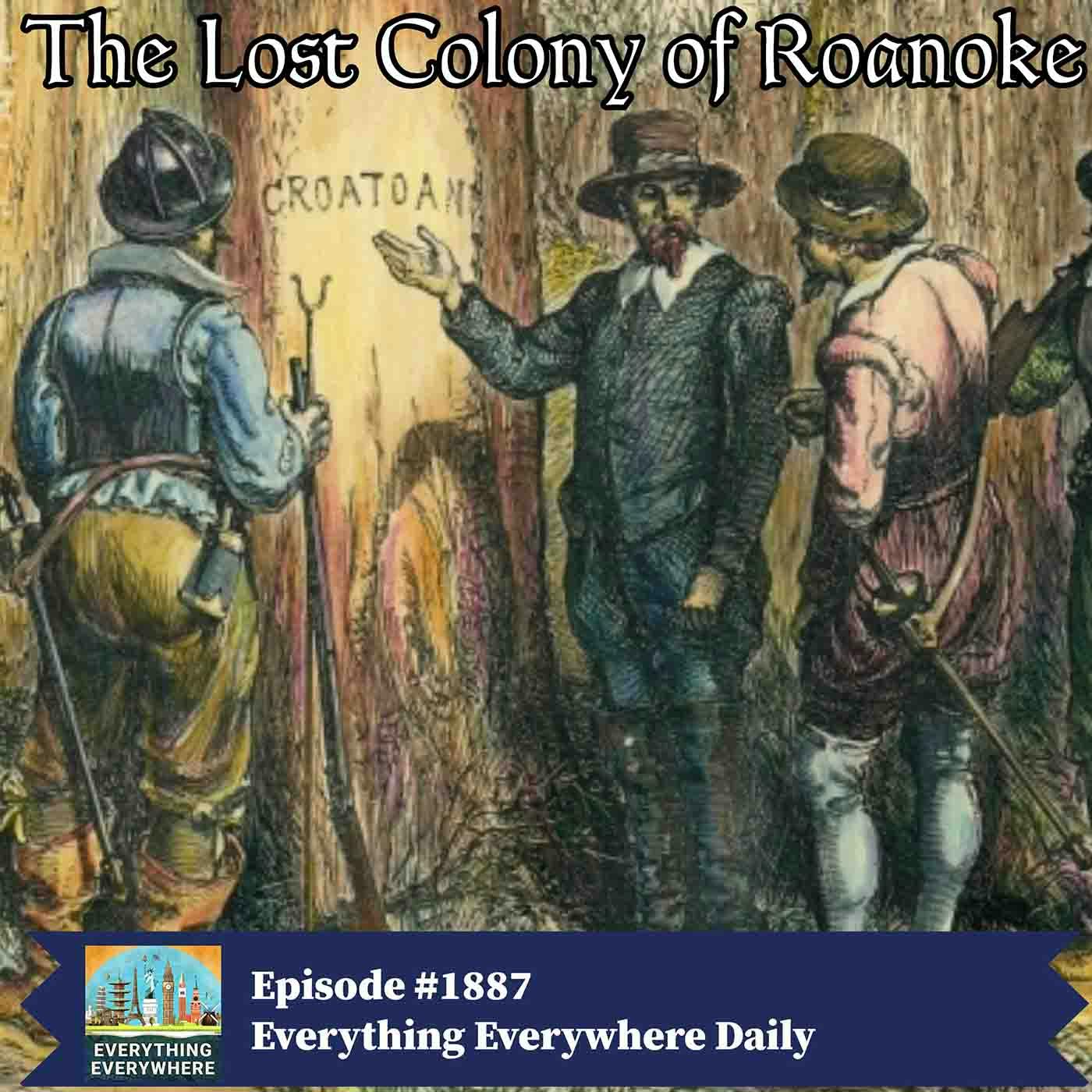
Everything Everywhere Daily: History, Science, Geography & More
The Lost Colony of Roanoke (Encore)
00:13:58
Loading summary
Transcript1 lines
- [00:00]
A
The following is an encore presentation of Everything Everywhere Daily. In 1585, Sir Walter Raleigh established an English colony on an island in what is today the state of North Carolina. After a slow start, over 100 people moved to the island to start a new life and established this English outpost at the edge of the New World. But when a ship returned to the island in 1590, what they found shocked them and began a mystery that remains unsolved to this day. Learn more about the lost colony of Roanoke and the puzzle that still challenges historians on this episode of Everything Everywhere Daily. This episode is sponsored by Fiji Water. You've probably heard of Fiji Water and have seen it in stores. Well, Fiji Water really is from the islands of Fiji. Drop by drop. Fiji Water is filtered through volcanic rock 1,600 miles away from the nearest continent and all its pollution protected and preserved naturally from external elements. In this process, it collects a unique profile of electrolytes and minerals, resulting in more than double the electrolytes as the other top two premium bottled water brands, giving Fiji Water its smooth taste. Fiji Water's electrolytes are 100% natural and this water even has a perfectly balanced pH of 7.7. I've recently been trying to reduce my consumption of diet soda and I found Fiji Water to be a great alternative. Visit your local retailer to pick up some Fiji Water today for your next backyard party, beach day hike, or even your home office. Fiji Water is Earth's finest water. This episode is sponsored by Quince. I've been telling you about Quince for quite a while now, but perhaps it still hasn't sunk in for some of you just how affordable Quince can be. I went to their website and checked out several prices. A woman's Mongolian cashmere tee, which costs up to $175 from other retailers, is available for just $44.90 on quints. A men's Comfort stretch trench coat that goes as high as $498 on other sites costs only $99.90 on Quinn's. A European linen chambray fitted sheet set that will run you $270 at competitors can be purchased for only $85.90 on Quinn's. These are serious discounts on high end luxury items and they can do this by working directly with top artisans and cutting out the middlemen. Quince gives you luxury prices without the markup, passing the savings on to you. Keep it classic and cool this fall with long lasting staples from quince. Go to quince.com daily for free shipping on your order and 365 day returns. That's Q U I-e.com daily. Free shipping and 365 day returns. Quince.com daily. The first colonies established by Europeans in North America were the 16th century equivalent of lunar bases. A bunch of people were sent to live in a place they didn't know or understand, where they were often unprepared for the weather and surrounded by native people who didn't particularly want them there. Just like with space travel, there were several failures before there was success. Many people are aware of the first permanent English settlement in North America in Jamestown, Virginia. Established in 1607. Jamestown may have been the first success, but it was hardly the first attempt. The English claims to North America were first made by Sir Humphrey Gilbert in 1578. He was given a very vague charter by Queen Elizabeth I to explore and colonize any unclaimed Christian kingdoms. He claimed everything north of Spanish Florida for England. However, he died, sailing back to England in 1583. Gilbert's charter was then split between his brother Adrian Gilbert, and his half brother, the English explorer and sailor, Sir Walter Raleigh. Adrian was given Newfoundland and everything to the north, which at the time was considered the Plum Territory because it would have contained the sought after Northwest Passage. Walter was given everything to the south. No one living there of course, was consulted on any of this. The charter expressly stated that for Raleigh to keep his claim, he had to establish a colony by 1591. In 1585, Raleigh sent an expedition of seven ships carrying 600 men to establish his colony. To meet the terms of the charter, the first colony was not intended to be a collection of families moving to start a new life. Rather, it was a military operation with the intent of creating a base that could be used to harass Spanish shipping. The expedition encountered problems from the outset. Ships were separated, supplies never arrived, and the colony was established at only a fraction of its size. A resupply ship sent in June was diverted to Newfoundland. Unbeknownst to the men of the colony, and this made them heavily reliant on the native people who lived nearby. The English spent most of their time trying to find gold and silver, yet came up empty handed. This meant that they had to rely almost exclusively on the generosity of the Sakotan people, given how much they depended on locals for their survival. The English managed to antagonize the native population, making life very difficult for them. In 1586, just a year after the colony was established, it was abandoned and the remaining men left for England with Sir Francis Drake, who Had stopped by after a campaign of harassing Spanish ships in the Caribbean. Undaunted by the failure of the first colony, Raleigh attempted to form a second colony. This attempt wasn't going to be a military base. This was intended to be an actual settlement with families that could grow into a prosperous community. There were 115 people who were selected to found this new colony. Most of the settlers were middle class people from London, including women and children. The reason why most of them were willing to undergo this journey is that they held out the hope of becoming the new core of a landed gentry class in the Americas. The leader of the new community was John White, who was an artist and cartographer who was part of the previously abandoned colony. The original plan was not necessarily to settle on Roanoke island, again like the first colony, but rather in Chesapeake Bay. However, when they arrived on the island, the colonists disembarked and the expedition's navigator wouldn't let them back on the ships. So Roanoke island it was. The first order of business was repairing the structures created by the first colonial attempt over two years earlier. There were 15 men who had stayed behind from the first colony, and it was found that hostile tribes had killed all 15 of them. Again, like the first colonial attempt, the colonists bungled their relations with nearby native people. They tried to get retribution for the 15 men who were killed, but ended up attacking a group that was actually friendly to them and innocent of the attack. As with the previous group, the settlers had a difficult winter and didn't have enough supplies. Moreover, no one knew they were there, as they were supposed to be near Chesapeake Bay, so no passing ships would bother to stop. The only good thing that the settlers could point to was the birth of Virginia Dare, White's first granddaughter, the first English person born in the New world. In late 1587, the community agreed that John White should sail back to England to plead for more supplies to be sent. So White left the roanoke Colony on August 27, 1587. When he arrived back in England in November, he found a country preparing for an invasion by Spain. The Spanish armada was being assembled and preparation took priority over everything else, including small outposts on the edge of the world. With every ship in England pressed into service, there was to be no immediate return to resupply the colony. White was desperate to get supplies back to Roanoke, so he managed to get permission for two ships not suitable for military combat to sail back. In April of 1588, however, pirates off the coast of Morocco attacked The ships, where 12 crew members were killed and all of the supplies intended for Roanoke were looted. The anticipated battle with the Spanish Armada took place in August 1588. But the prohibition of ships leaving England continued Beyond. Wasn't until 1590, three years after he returned to England for supplies, that John White was able to sail back to Roanoke. He finally arrived back at the colony on August 18, 1590. When he came ashore, however, what he found was disturbing. There was no one there. Everyone was missing. There were no bodies. There were no signs of a struggle or a fight. They had built a wooden palisade around the settlement. Houses had been carefully dismantled and taken away. Everything which could be moved had been taken and all of the boats that the colony had were gone. There were only two clues that were discovered. The first was a tree with the letters CRO carved into it. The next was carved into one of the wooden posts of the palisade. It said Croatoan. White assumed that Croatoan meant that the settlers had moved to the nearby island of Croatoan, which is today known as Hatteras Island. White's plan was simple. Set sail immediately for Croatoan island to find the settlers. However, just as luck was against him on the resupply missions, luck intervened here as well. The ship's anchor cable broke, which endangered the mission. The ship originally intended to sail to the Caribbean for repairs and then sail back in the spring of 1591 to resume the search. However, that plan got scrapped when a storm blew the ship off course. They wound up just returning to England in November of 1590, having never stopped at Croatowan to find the missing settlers. When White returned to England, he submitted his report to Walter Raleigh that he believed that the settlers had moved to Croatoan Island. Raleigh had every incentive to claim that White's report was fact, because so long as everyone thought that the colony still existed somewhere, his royal charter was still valid. However, by his actions, he seems to have presumed that they were actually dead. In 1595, Raleigh went on his first expedition to the Americas and never bothered to actually search for the settlers. He was really searching for the legendary city of el Dorado. In 1602, he sponsored another expedition, but again, the real purpose was to harvest sassafras, whose price had skyrocketed. The expedition did never searched for the settlers anywhere near the island of Croatoan. In 1603, Raleigh was implicated in a plot to remove King James, which ended his royal charter. There was one final expedition in 1603 to find the missing colonists led by Bartholomew Gilbert. However, he was killed by natives somewhere around Croatoan island, and the expedition was called off and returned to England. In 1607, a new settlement, Jamestown, was established to the north of Roanoke Island. One of the leaders of the settlement, John Smith, was captured by the Powhatan people, and he was then allowed to speak to their leader, Wahunseneca. Wahunsenaca spoke of a place where people wore European clothing and lived in houses with walls. Smith intended to launch an expedition to look for the community, but it never happened. By 1609, 22 years after the last confirmed contact with the Roanoke Colony, rumors had started to spread back in England that the colony had been massacred back in 1587. But there is no known source for those rumors. After the 1622 massacre in Jamestown, the narrative surrounding the Roanoke Colony was that it had been massacred. It supported whatever retaliation against local tribes that the English sought after the Jamestown massacre. As time passed, no evidence of the Roanoke Colony ever surfaced. Nothing indicated that they had survived. Nothing indicated that they had been killed. Whatever happened to the 115 people of the Roanoke Colony was simply a mystery. But where there's a mystery, you will find people trying to solve it. One of the first people to try and solve the riddle was John Lawson. In 1672, Hatterask and Croatoan Islands fused together to form Hatteras Island. Lawson visited Hatteras island in the early 18th century and met with the Hatteras people who lived there. He found that the Hatteras had influences of English culture more than what was found in any other known tribe. Moreover, their elders spoke of ancestors that were white, and some members of the tribe had gray eyes, which was unknown amongst native people in the region. Lawson theorized that the Roanoke colonists had moved to Croatoan island and had assimilated into the Hatteras people. Lawson also searched the original settlement site on Roanoke island and found some artifacts that were still there. Nothing else really happened until the late 19th century when archaeological digs began on the island. After more than a century of searching, there has yet to be anything found which can conclusively point to the 1587 colony as opposed to the 1585 colony or potentially later arrivals or items which could have been traded with native people. That has left many professional and amateur historians to theorized what might have happened. One theory is that everyone moved to another location where they were killed. One version is that they went to Croatoan island, and another holds that they went to Chesapeake Bay. Either way, they went somewhere and were killed in a place that no one has ever found. The second theory is one advanced by Lawson. Desperate to survive, the community simply joined up with a local tribe, which they eventually assimilated with. Given that it was decades before any serious attempt was made to find them. By that point, a new generation with mixed ancestry wouldn't have had any desire to have been found. The current Hatteras tribe claims ancestry from both the original habitants of Croatoan island and from the Roanoke settlers. Another theory holds that they may have attempted a return trip to England and were lost at sea. Yet another theory holds that the colonists were the victims of political intrigue purposely abandoned by Sir Francis Walsingham, principal advisor and spymaster to Queen Elizabeth. According to this theory, Walsingham wanted to discredit Walter Raleigh. He also may have thought the colonists to have been religious separatists who were creating a separate colony that was a threat to the realm. Fiction writers have also joined in, providing theories that vampires, demons and ghosts were responsible for the missing colony. The truth is, no one knows what happened to the lost Roanoke colony. Based on the initial evidence found by John White, it would seem that the settlers had packed up and moved somewhere else, most probably Croatoan Island. Where they went and what happened to them afterwards island is anyone's guess. Unless something is found that can be definitively linked to the 1587 colonists, it is unlikely that the fate of the lost Roanoke Colony will ever be resolved. The executive producer of Everything Everywhere Daily is Charles Daniel. The associate producers are Austin Otkin and Cameron Kiefer. My big thanks go to everyone who supports the show over on Patreon. Your support helps make this podcast possible, and I also want to remind everyone about the community groups on Facebook and Discord. That's where everything happens that's outside the podcast, and links to those are available in the show Notes. As always, if you leave a review on any major podcast app or in the above community groups, you too can have it read on the show.