Loading summary
Transcript1 lines
- [00:01]
Host
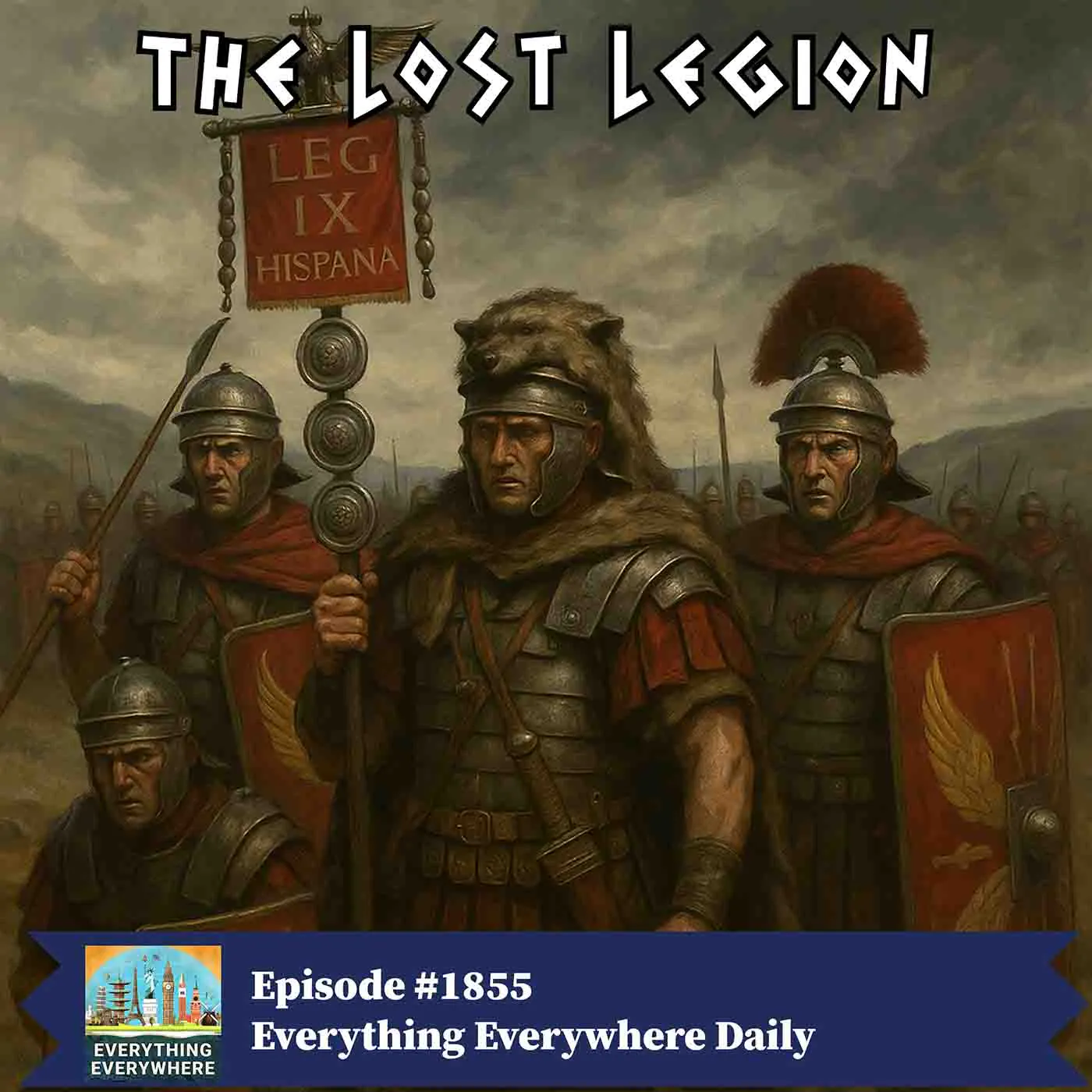
One of the most legendary legions in the history of the Roman military was the Legio Nonum Hispana, or the Ninth Spanish Legion. They served under Pompey the Great and later with Julius Caesar In Gaul. They served Emperor Augustus and were pivotal in the conquest of Britain under the Emperor Claudius. And then at some point they simply disappeared. There was never a mention of them again in the historical record, and for almost 2,000 years it's been one of the world's greatest historical mysteries. Learn more about the missing legion and what might have happened to them on this episode of Everything Everywhere Daily. This episode is sponsored by Fiji Water. You've probably heard of Fiji Water and have seen it in stores. Well, Fiji Water really is from the islands of Fiji. Drop by drop, Fiji Water is filtered through volcanic rock 1,600 miles away from the nearest continent and all its pollution protected and preserved naturally from external elements. In this process, it collects a unique profile of electrolytes and minerals, resulting in more than double the electrolytes as the other top two premium bottled water brands, giving Fiji Water its smooth taste. Fiji Water's electrolytes are 100% natural and this water even has a perfectly balanced pH of 7.7. I've recently been trying to reduce my consumption of diet soda and I've found Fiji Water to be a great alternative. Visit your local retailer to pick up some Fiji Water today for your next backyard party, beach day hike, or even your home office. Fiji Water is Earth's finest water. This episode is sponsored by Quince. I recently purchased a new sweatshirt on Quince. It was a black long sleeve cashmere sweatshirt and if that sounds fancy, it sort of is. But I only paid a fraction of what I would have paid if I purchased the same thing from a name brand designer. The Quint's website literally showed me how much an equivalent sweatshirt of the same color and same material would have cost from other fashion designers and my savings were between 78 to 94%. I've been telling you for months now about how Quints brings you quality items at a fraction of the price and it's not just a marketing slogan. You can go to their website and see the savings for yourself by working directly with top artisans and cutting out the middleman. Quint gives you luxury pieces without the markup and they pass the savings on to you. Keep it classic and cool with long lasting staples from quince. Go to quince.com daily for free shipping on your order and 365 day returns. That's quince.com daily to get free shipping and 365 day returns. Quince.com daily. In a previous episode, I covered how Roman armies worked. The base unit of the Roman military was the legion. A Roman legion typically consisted of about 5 to 6,000 soldiers. The number could vary based on the legion, the circumstances and the period in history, but 5 to 6,000 was the historical average. In addition to the core infantry forces, a legion also included support personnel such as engineers, clerks, medics, blacksmiths and animal handlers, as well as a small cavalry unit. When auxiliaries who are non citizen troops attached to the legions were included, the total fighting force associated with the legion could exceed 10,000 men. And on top of that, estimates suggest that for every legionary soldier, there may have been at least one, and possibly as many as two civilians. The civilians may have included legionnaires, unofficial wives or concubines, children, merchants, prostitutes, and even slaves. Legions were initially raised from Roman citizens during the Republican period and later became full time professional armies. Throughout history, legions would be raised and occasionally disbanded. Three legions were disbanded for cowardice after the Batavi revolt in the year 70. The 17th, 18th and 19th legions were wiped out in the Battle of Teutobrik Forest, and those numbers were never used again. Most legions existed for decades, if not centuries. Over time, they developed distinct identities that went beyond their functions as mere military units, evolving into institutions with deep cultural significance, proud traditions, and fiercely guarded reputations. Each legion developed its personality through the accumulation of battle honors, the cultivation of specific traditions, and the development of distinctive customs that set it apart from other legions. This process began from the moment of formation and continued throughout the legion's existence, creating military cultures that persisted for centuries. All legions were given a number. The highest numbered legion that we know of was the 30th. And each legion also had a moniker which which came from early battlefield accomplishments. The 10th Legion was known as the Fretentis, which means of the strait, and is based on their early naval accomplishments. The 12th Legion was known as the Fulminata, which means thunderbolt. Most legions had a name based on a geographic area where they found early success, including Germany, Syria, Macedonia, Gaul and Sicily. And of course, each legion had a standard which was considered to be an almost sacred object. A standard which was a golden eagle was carried into battle. And the most humiliating thing that could happen to a legion was the loss of its standard. Emperors sometimes negotiated for decades to get lost standards returned. The point of all of this is that the legions were large and important things that had a continuity that often lasted for Centuries, legions didn't just disappear. Which brings me to the subject of this the Legio Nonem Hispania, or the Ninth Spanish Legion. Its origins trace back to the late Roman Republic, most likely around the year 65 BC, during the campaigns of Pompey the Great in Hispania, which is the source of its honorary title, Hispania. By the time of Julius Caesar's Gallic wars, the Ninth Legion was a seasoned and respected force. It played a prominent role in Caesar's conquest of Gaul and later supported him in the civil war against Pompey, fighting at key battles such as Pharsalus in 48 BC. Following Caesar's assassination, the Legion served under his heir, Augustus, during the final conflicts of the Republic. After Augustus secured his power, the Legion was stationed in Hispania for some time and subsequently deployed to the Rhine frontier. Under Augustus and his successors, the Ninth Legion participated in numerous campaigns that expanded and consolidated Roman power. For example, the Legion fought in the Pannonian revolts in the Balkans. The Legion's most famous chapter began with the Roman invasion of Britain in the year 43. Under the Emperor Claudius. The Ninth Legion formed part of the invasion force that established Roman rule in southern Britain, and it would remain associated with the British frontier for the next several decades. This posting was both prestigious and dangerous, as the Legion found itself at the forefront of Rome's expansion into one of Europe's most challenging regions. During the early years of the conquest, the Ninth Legion established itself in the modern city of Lincoln. Known to the Romans as Lindum Colonia, this location was strategically chosen to control the gap between the Pennine Mountains and the North Sea, effectively dividing the unconquered tribes of the north from those already under Roman control. The Legion's most severe test came during the Boudicca Rebellion in the year 1661, one of the most serious challenges to Roman rule in Britain, which I covered in a previous episode, when Queen Boudicca led her confederation of tribes in revolt, the Ninth Legion marched south from Lincoln to help suppress the uprising. However, the Legion walked into a carefully prepared ambush and suffered catastrophic losses. Classical sources suggest that the Legion lost most of its infantry, with only the cavalry and senior officers managing to escape back to their fortified camp. This disaster may have ended the story of most legions, but the Roman system was remarkably resilient. The Ninth Legion was rebuilt with fresh recruits and reinforcements, showing the Empire's ability to recover from even severe setbacks. Following its reconstruction, the Ninth Legion continued to serve on the British frontier, participating in the campaigns of Gnaeus Julius Agricola. In the 70s and 80s, these campaigns pushed Roman control far into Scotland, and the legion likely fought at the famous Battle of Mons Grapius, where Agricola claimed to have decisively defeated the Caledonian tribes. Archaeological evidence suggests the legion maintained bases in northern England and southern Scotland during this period. The mystery of the Ninth Legion begins in the early second century. The last definitive evidence for the legion's presence in Britain comes from inscriptions and archaeological finds dated to around the year 108. And this last inscription can still be seen at the Yorkshire Museum in York, England. After this point, the historical record becomes silent. No further inscriptions mention the legion, no military documents reference its activities, and archaeological evidence for its continued existence simply vanishes. And I should reiterate that many of the legions from this period existed well into the 4th or 5th centuries. If a legion was disbanded, it probably would have been due to some disastrous defeat, and there's no such defeat in the historical record. So what happened? Well, we don't know. There is no definitive evidence pointing to anything. All we really have are theories. The theory which dominated the 19th and early 20th century was developed by the German historian and winner of the 1902 Nobel Prize in Literature, Theodor Mommsen. Mommsen's magnum opus and the work for which he was awarded the Nobel Prize was titled A History of Rome. Mommsen believed that the 9th Spanish Legion met its end in Britain, most likely during a major but poorly documented military disaster in the early second century. He placed this event sometime during or shortly after the reign of the Emperor Trajan, when evidence of the legion just abruptly vanished. Mommsen hypothesized that the 9th was destroyed in the far north of Britain, possibly in modern day Scotland, during an expedition against the Caledonian tribes. This theory was rooted in the assumption that the lack of later inscriptions in Britain indicated its annihilation. In his analysis, Mommsen emphasized the pattern of Roman military administration and frontier policy. He believed that a major loss like the destruction of the 9th would explain the decision to withdraw from further northern expansion and ultimately to build Hadrian's wall in the 120s under the emperor Hadrian. Absent any other evidence, Mommsen's hypothesis was widely accepted for decades. And to be fair, it wasn't a crazy idea. It explained why the Romans pulled out of Scotland, and it also ties cleanly to the last known location of the legion. Mommsen's theory was the basis for several fictional works, including Rosemary Sutcliffe's 1945 novel The Eagle of the Ninth. And and the 2007 movie The Last Legion. However, in the 1990s, a significant archaeological discovery in Nijmega, Netherlands, contributed to a major shift in scholarly thinking about the fate of the Ninth Legion. This discovery included a cache of Roman military artifacts, notably tiles, inscriptions and coins, which provided fresh evidence that at least elements of the Ninth Legion were present on continental Europe, specifically in the Rhine frontier region after its last known activity in Britain. The Nijmeged findings built upon earlier discoveries from the 60s and 70s, including a tombstone of a centurion of the Ninth. But the 90s excavations reinforced the argument that the Legion, or at least a significant detachment of it, had been transferred from Britain to the Rhineland around the early second century. Among those more consequential finds were roof tiles stamped with the mark of the Ninth Hispania and coins dating from the reign of Trajan and Hadrian, strongly suggesting that these tiles and the structures they were part of were constructed in the early to mid second century. This contradicted the long standing theory popularized by Mommsen and others that the Legion was destroyed in Britain. Instead, the Nijmegan evidence suggested that the Legion survived the Boudokan revolt and continued to operate after the year108, the date of its last known inscription in York. However, while this evidence indicates a presence of the 9th in Nijmegen, it doesn't conclusively prove that the Legion was stationed there, nor does it conclude what ultimately happened to it. As a result, since the 1990s, the academic consensus has shifted away from a purely British based destruction of the Ninth. Instead, scholars now consider it more likely that the Legion was transferred out of Britain sometime after the year 108 and and ultimately vanished from history under uncertain circumstances sometime in the 2nd century. The Nijmegen artifacts changes the story of the Lost Legion, but it doesn't fundamentally solve the mystery. We still have no idea what happened in the Legion. We can be reasonably sure that they weren't destroyed or disbanded in Britain, but that just moves the mystery forward a few decades. New theories have come forward which include the Legion being sent to Judea, Armenia or the Balkans, or just being merged into other legions. Unless new archaeological discoveries are made, we may never know what happened to the Legio Nonum Hispania. So no matter how many theories about them are put forward, absent new evidence, they might forever be the Lost Legion. The executive producer of Everything Everywhere Daily is Charles Daniel. The associate producers are Austin Otkin and Cameron Kieffer. My big thanks go to everyone who supports the show. Over on Patreon Your support helps make this podcast possible. And I also want to remind everyone about the community groups on Facebook and Discord. That's where everything happens that's outside the podcast, and links to those are available in the show Notes. As always, if you leave a review on any major podcast app or in the above community groups, you too can have it read on the show.