Loading summary
Transcript6 lines
- [00:00]
A
At some point you may have been called or might have called someone else a Luddite due to a refusal to adopt a new technology. Nowadays it's usually done in jest, but the Luddites were real. While the term is often used to describe an anti technology attitude, the actual Luddite worldview was more subtle than simply opposing anything new and innovative. And in some respects, the Luddite worldview has never gone away. Learn more about the Luddites, what they did and why on this episode of Everything Everywhere Daily.
- [00:43]
This episode is sponsored by auraframes. If you're looking for a gift for someone close to you, I highly Recommend Checking out auraframes. With auraframes, you can set it up in about 2 minutes and and share memories all year long. You can upload directly from the Aura app on your smartphone and share your images more securely than email or social media. It can also display short videos up to 30 seconds long with audio. Aura frames have meticulously calibrated high resolution displays. Unless you look really closely or see a photo transition, you'd never even know it was a screen. I have an Aura frame in my house and I love it as it's a great and simple way for me to display the many thousands of photos I've taken on my travels. For a limited time, save on the perfect gift by visiting auraframes.com to get $35 off Aura's best selling Carver mat frames, named one by Wirecutter by using promo code daily at checkout. That's auraframes.com promocodedaily. The deal is exclusive to podcast listeners and frames sell out fast, so order yours now to get it in time for the holidays. Support the show by mentioning it at checkout. Terms and conditions apply. This episode is sponsored by the Tourist Office of Spain. If you've been listening to this podcast long enough, you might think you know Spain well. Think again. There is so much more to Spain than what most people think. In fact, every part of Spain is packed with history and culture. Extremadura in the west is home to fantastic Moorish architecture and Hamonibirico, the world's greatest pork product. In the north, Galicia, Asturias and the Basque country have stunning coastlines, amazing food and unique cultures. The island of Lanzarote in the Canary Islands has a volcanic landscape and the Tabernacle Desert has been a filming location for many Western films. The city of Merida has some of the greatest Roman ruins you'll find, and in Valencia, the home of Paella, you can even find the Holy Grail plan your next trip and learn about all the lesser known gems in Spain@spain.info Once again, that's spain.info.
- [02:50]
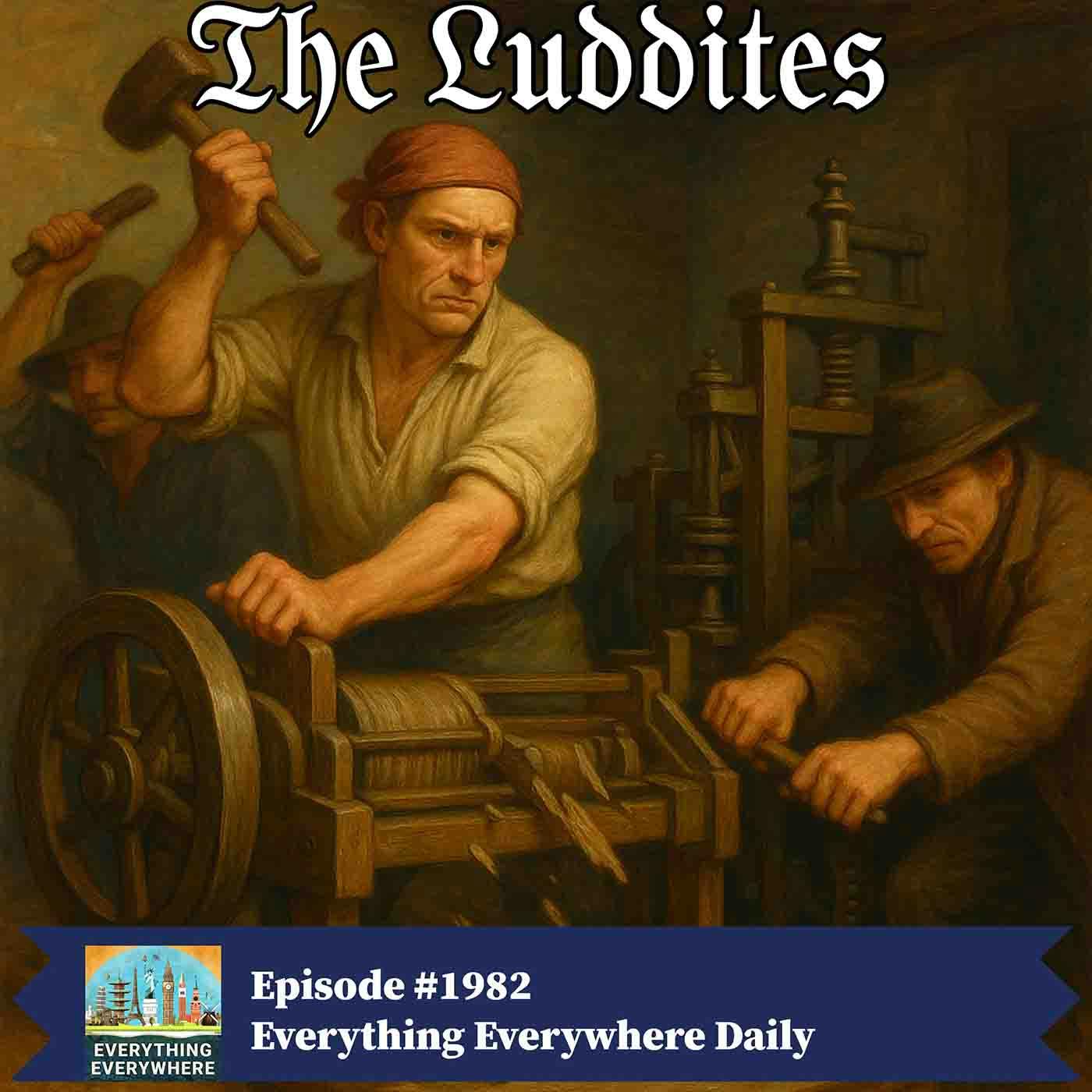
Today, being accused of being a Luddite is considered to be a pejorative. We live in a world of technological wonders that prior generations would have considered magic to reject. Many of our technological advancements is considered alien to our modern civilization. The Luddites were not a fictitious group. They were real and they had genuine grievances. But they weren't as one dimensional as they're usually made out to be. To understand why the Luddite movement arose in the first place, we need to understand what life was like for artisans before the Industrial Revolution. A craftsperson who found themselves drawn into the Luddite movement typically lived a life defined by skill and autonomy. They likely began their trade young through a formal apprenticeship, learned a complex craft such as framework knitting, weaving or cropping under the supervision of a master. This training took years and produced a sense of identity inseparable from the tools they used and the quality of the goods they produced. Their livelihood depended upon precision and experience, and in earlier decades, that skill guaranteed stable wages and a respected place in the community. They worked at home or in small workshops, often alongside family members, setting their own pace and maintaining control over the details of their labor. This system of artisanal production was fulfilling for those who were employed in it, but it was highly inefficient. By the early 19th century, this world had changed dramatically, and it was in this environment that the Luddite movement emerged between 1811 and 1816, primarily in the textile producing regions of Northern England. The movement took its name from the legendary figure Ned Ludd, also known as King Ludd or Captain Ludd, who most probably wasn't a real person. According to popular legend, Ned Ludd was a young apprentice who smashed two stocking frames in a fit of rage in the village of Anstey, near Leicester, sometime around 1779. A stocking frame was a hand operated mechanical knitting machine. Whether this story was true or apocryphal, Ned Ludd became a symbolic figure, with machine breakers claiming to act under his orders and signing their threatening letters in his name. The specific cause of Luddism were many and deeply rooted in the economic and social problems of the Industrial Revolution. The introduction of new machinery, particularly wide stocking frames in the hosiery trade, power looms in the cotton trade and shearing frames in the wool trade, threatened the livelihood of skilled artisans who had traditionally enjoyed relative autonomy, decent wages and respected social status. However, the new machines allowed manufacturers to employ less skilled workers, including women and children, at significantly lower wages. This deskilling of labor fundamentally altered the relationship between workers and employers. The traditional bonds and customary practices that had governed labor relations were now breaking down, replaced by what the Luddites saw as the ruthless pursuit of profit at the expense of workers. Welfare manufacturers increasingly produced cheap, inferior goods that flooded the market and undermined both quality standards and and the position of skilled craftsmen. The greater economic situation in England made these transformations particularly devastating. The period of Luddite activity coincided with severe economic hardship. Britain was engaged in the Napoleonic wars, which disrupted trade and caused food prices to soar. The Continental system, Napoleon's economic blockade of Britain, severely restricted export markets for British textiles. Simultaneously, poor harvests in 1809 and 1810 led to food shortages and inflation. Workers found themselves facing unemployment or drastically reduced wages at precisely the moment when the cost of bread and other necessities was climbing to unprecedented levels. The legal and political environment also contributed to workers sense of desperation. Traditional forms of worker organization and negotiation had been criminalized under the combination acts of 1799 and 1800, which prohibited workers from forming unions or collectively bargaining for better conditions. The medieval system of craft guilds had been dismantled and attempts to appeal to Parliament for protective legislation had largely failed. Workers felt that they had no legitimate means to voice their grievances or to protect their interests within the existing system. The Luddite movement can trace its origins to Nottinghamshire In March of 1811, when framework knitters began systematically destroying stocking frames. The attacks were typically well organized, disciplined operations rather than spontaneous riots. Groups of masked men, sometimes numbering in the hundreds, would gather at night and march to specific workshops or factories. They would break down doors, smash the offending machinery with sledgehammers and hatchets, and then disperse quickly into the darkness. Significantly, the Luddites were often selective in their targets, destroying only those machines that produced inferior goods or belonged to particularly exploitive employers with while leaving others untouched. The framework knitters of Nottinghamshire were protesting against wide frames which were used to produce cheap stockings, and the practice of colting, employing unapprenticed workers who undercut skilled craftsmen. Their actions sent threatening letters to stocking manufacturers demanding better prices for their work and warning against the use of certain machines. These letters, signed by Ned Ludd or General Ludd, combined threats with appeals to traditional notions of fair dealing and moral economy. The movement spread to Yorkshire in early 1812, where it took on a somewhat different character. The Yorkshire Luddites were primarily croppers, highly Skilled workers who finished wool cloth, they faced displacement by shearing frames and gig mills that could perform their work more quickly and cheaply. The croppers had been amongst the most prosperous and independent artisans, and they had the organizational capacity to mount sustained resistance. The attacks in New Yorkshire were often larger in scale and more violent than those in Nottinghamshire, sometimes involving exchanges of gunfire between Luddites and guards protecting mills. One of the most dramatic episodes occurred in April 1812, when a large group of Luddites attacked William Cartwright's mill at Rawfolds, near Huddersfield. Cartwright had fortified his mill and armed his workers in anticipation of attack. When approximately 150 Luddites assaulted the building, they were met with gunfire. Two Luddites, Samuel Hartley and John Booth, were both mortally wounded and the attack was repelled. This marked a turning point, demonstrating that mill owners were prepared to use lethal force to defend their property. The violence escalated further when, a few weeks later, William Horsfall, a mill owner who had publicly boasted about his willingness to ride up to his saddle in Luddite blood, was ambushed and shot while riding home from Huddersfield. He died from his wounds and his murder shocked the propertied classes and intensified the government's determination to suppress the movement. In Lancashire, Luddism emerged in the spring of 1812among cotton weavers facing unemployment and wage reductions due to the introduction of power looms. The Lancashire movement was characterized by larger crowds and more open confrontation, sometimes blending machine breaking with food, riots and attacks on factories. The British government responded to Luddism with overwhelming force, treating it as a serious threat to public order and property rights. Parliament passed the Frame breaking act in February 1812, making machine breaking a capital offense, punishable by death. This was a remarkably harsh response, putting the destruction of machinery on the same legal footing as murder. The legislation reflected the ruling class's determination to protect industrial property and suppress working class resistance to economic change. The government deployed thousands of regular army troops to the affected regions, more soldiers than had been sent with Wellington to fight the French in the Peninsular War. At certain points, the military presence transformed the industrial districts into occupied territories, with troops stationed in mills and billeted in towns and villages. Spies and informers were recruited to infiltrate Luddite networks and substantial rewards were offered for information leading to arrests. The legal repression culminated in a series of mass trials in 1813 in York, 64 men were tried for various Luddite related offences. 17 men were executed, including George Mellor, William Thorpe and Thomas Smith, who were all hanged for the murder of William Horsfall. Others were transported to Australia. Similar trials and executions took place in Lancashire and Chester. The severity of these punishments was intended to send a clear message that destruction of industrial property would not be tolerated.
- [11:38]
By 1813, the combination of military suppression, mass prosecutions, and improving economic conditions had largely broken the Luddite movement. The end of the Napoleonic wars in 1815 Reopened export markets and eased some of the economic pressures that had fueled the unrest. The executed and banished Luddite served as a grim warning of the consequences of machine breaking, and the massive military presence made organized resistance extremely difficult. However, the Luddites did not simply disappear from history. Many former Luddites and their communities continued to resist the new industrial order through other means. Some participated in the reform movements of the 1820s and 30s, agitating for political representation and workers rights. The Chartist movement of the 1830s and 40s, which demanded universal male suffrage and other democratic reforms, drew on some of the same grievances in communities that had fueled Luddism. The historical legacy of the Luddites has been complex and hotly debated. For much of the 19th and 20th centuries, Luddite became a term of derision used to describe anyone opposed to technological progress or modernization. This narrative presented the Luddites as backward looking reactionaries who foolishly tried to stop the inevitable march of progress. However, more recent historical scholarship has offered a more nuanced and sympathetic interpretation of the Luddites. Historians like E.P. thompson, in his seminal work the Making of the English working class in 1963, argued that the Luddites were not anti technology per se, but were defending their communities, livelihoods and values against a new economic system that treated labor as merely another commodity to be exploited. Thompson and others demonstrated that the Luddites operated within a moral economy framework, appealing to traditional notions of fair prices, quality workmanship, and mutual obligations between employers and workers.
- [13:32]
The relevance of the Luddite experience has been repeatedly invoked in the 200 years since they were active. In the late 20th and early 21st centuries, as automation, computerization, and globalization have disrupted traditional industries and employment patterns, many have looked back to the Luddites as precursors who grappled with similar problems. The term neo Luddite has been applied to those who question whether technical innovation always serves human welfare or whether there can be significant downsides to much of the technology we use today. Neoluddites aren't so much about destroying technology as just not using it. In the end, the Luddites lost their battle. The machines they destroyed were replaced often with more advanced technology, and the factory system became the dominant mode of industrial production throughout Britain and eventually the world. The artisans whose livelihoods the Luddites sought to protect were mainly displaced and their crafts were reduced to nostalgia or niche production. The social and economic transformations against which they fought continued and even accelerated. So despite the modern use of the word, Luddites weren't so much against technology per se, they were more concerned about preserving their traditional way of life and protecting their livelihoods.
- [14:50]
The executive producer of Everything Everywhere Daily is Charles Daniel. The associate producers are Austin Otkin and Cameron Kieffer. My big thanks go to everyone who supports the show over on Patreon. Your support helps make this podcast possible and I also want to remind everyone about the community groups on Facebook and Discord. That's where everything happens that's outside the podcast and links to those are available in the show notes. As always, if you leave a review on any major podcast app or in the above community groups, you too can have it read on the show.