Loading summary
Transcript1 lines
- [00:01]
A
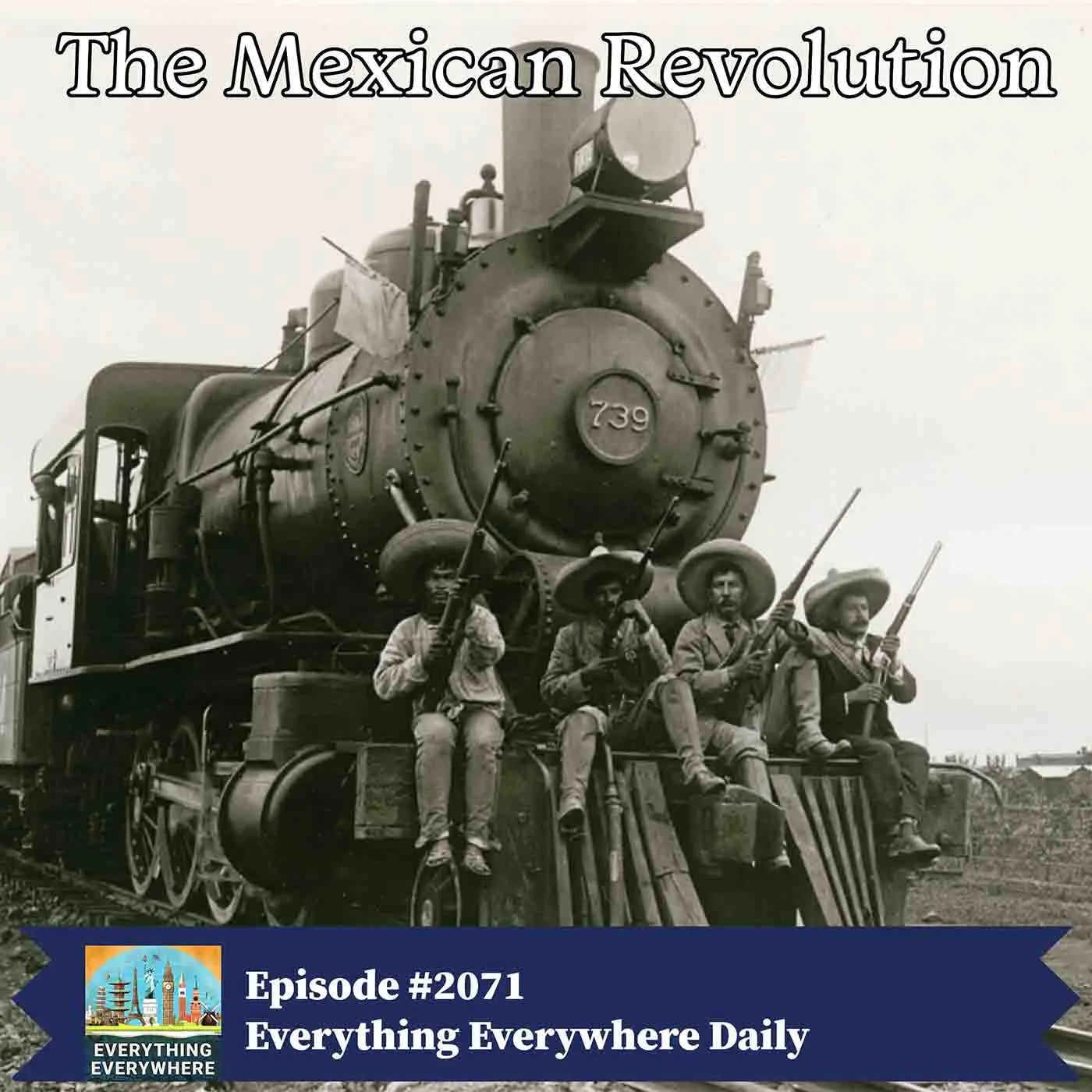
After Mexico gained independence From Spain in 1821, hopes for democracy gradually gave way to decades of instability and dictatorship. By the early 20th century, frustration with the long rule of Porfirio Diaz finally erupted into revolution. What followed was a decade of coups, assassinations, shifting alliances, and civil war involving figures like Pancho Villa and Emiliano Zapata. Learn more about the Mexican Revolution and why it remained one of the most important upheavals of the 20th century. On this episode of Everything Everywhere Daily. This episode is sponsored by Quint's. I've been telling you for a while now how Quint's works directly with top factories and cuts out the middleman. As such, they can sell top quality merchandise at a fraction of the price of luxury brands. But they aren't just selling products that look just as good. Their products are also made out of the exact same materials. Their cashmere is 100% Mongolian, the same stuff that luxury brands use. The Pima cotton is long staple, which means it stays soft and doesn't pill. The European jersey linen is breathable and lightweight. Everything is built to hold up to regular wear and still look good. I've been wearing my cashmere sweater every other day for months now and it's held up great right now. Go to quince.com daily for free shipping and 365 day returns. That's a full year to build your wardrobe and love it and you will now available in Canada too. Don't keep settling for clothes that don't last. Go to Q u I n c-e.com daily for free shipping and 365 day returns. Quince.com/daily. This episode is sponsored by Fast Growing Trees. Did you know that Fast Growing Trees is America's largest and most trusted online nursery with thousands of trees and plants and over 2 million happy customers. They have all the plants your yard or home needs, including fruit trees, privacy trees, flowering trees, shrubs and houseplants. I live in an apartment and I've got a lot of indoor plants. I got a small indoor tree from Fast Growing Trees and I love it. There was no dragging soil through the trunk of my car. It was straightforward and honestly, far less expensive than you'd think. What really gave me confidence was their alive and thrive guarantee. You know your plants are going to arrive healthy and ready to thrive. Right now they have a great deal on spring planting essentials, up to half off on select plants and listeners to my show get 20% off their first purchase when they use code daily at checkout. That's an additional 20% off better plants and better growing at fastgrowingtrees.com using code daily at checkout. Thank you fastgrowingtrees.com code daily now's the perfect time to plant. Let's grow together. Use daily to save today. Offer is valid for a limited time. Terms and conditions may apply. Mexico joined the Spanish Empire after Hernan Cortes conquered the Aztecs in 1521, marking the start of a centuries long struggle. One of the things that Mexico suffered from under the Spanish was the Costa system, a social hierarchy favoring Spanish born migrants over indigenous people by the 19th century. Criollos were people of full Spanish ancestry born in the Americas rather than Spain. In the early 19th century they formed much of the elite class, owning land, holding political power and dominating economic life. Mestizos were people of mixed Spanish and indigenous ancestry. They made up a large and growing portion of the population and generally occupied the middle or lower levels of society, working as farmers, laborers, artisans or soldiers. Napoleon's 1807 invasion of Spain during the Peninsular War gave Mexico a window for independence, a chance seized by Father Miguel Hidalgo. Hidalgo led a nationalist movement uniting the indigenous and mestizos people against the Spanish and criollo rule in 1810 during the Mexican War of Independence. After Hidalgo's arrest and execution by the Criollo elite, his movement lost momentum and as a result Mexico reverted to earlier political patterns declined temporarily stalling hopes for change. Hidalgo's movement ultimately culminated in a corelle monarchy which then transitioned to autocracy by military leaders known as caudillos. The creation of a constitution in 1857 offered hope to advocates of democracy. However, despite its basis in American democratic ideals, the government repeatedly backslid into autocracy, continuing the cycle of reform and regression. Benito Juarez came to power in 1858 and served as president until his death in 1872. But his refusal to step down antagonized many military looters, including Porfirio Diaz, who began a rebellion against Juarez. Diaz was a hero of the Battle of Puebla where the Mexicans defeated the French in 1862, a victory celebrated by the festival of Cinco de Mayo. Juarez's replacement after his death was the head of the Mexican Supreme Court, Sebastian Lerdo de Tejada. In the 1876 election, Tejada was elected with over 90% of the vote, but a Diaz led military coup interrupted his presidency. Diaz justified the coup by claiming that Tejada had already served a term in office. After occupying Mexico City and exiling Texada to New York, Diaz appointed a general as A provisional president, and was poised to run for the office the following year. Diaz won the office, and one of his first orders of business was to amend the constitution to limit Mexican presidents to just one term. But Diaz seemed to forget the importance of this rule, as he would go on to serve seven terms as president of Mexico. During his tenure as president, Diaz forged lucrative relationships with American interests. But he always had to walk a fine line between Mexican interests and antagonizing the United States. Regarding this relationship, Diaz reportedly said, poor Mexico, so far from God and so close to the United States. Diaz took full advantage of the geographic proximity to the United States. He established a network of patron client relationships built on his support of American businesses. Americans reaped enormous benefits from this arrangement. Mexico offered packages that included free land, tax breaks, and rights to oil and minerals. This lucrative relationship was very powerful in the halls of Washington and Wall street, and not surprisingly, the arrangement was not popular in the fields of northern Mexico or the former Mayan heartland in the south. The wealth gap continued to expand as the Diaz regime and its military allies feasted on riches sustained by the very web of patronage that kept Diaz entrenched in power. Some estimates suggest that during the porfiriado, the top 1% of Mexicans controlled more than 95% of the nation's wealth. Meanwhile, the wages of Mexican labor continued to plummet. Some estimates suggest that wages in Mexico were less than half those in the United States for doing the same work. The agricultural sector became a nightmare under the renewed hacienda system. 19th century Mexican farmers were at the whim of powerful landlords called haciendados, A paternalistic type of feudal lord who oversaw these massive estates, some covering nearly a million acres. At the same time, the agricultural laborers toiled in poverty and obscurity. As Mexico was still technically a democracy, this system was vital to Diaz's interests. His control and patronage over the haciendados delivered him a steady stream of votes, as patrons expected hacienda laborers to fulfill their political whims. One of the talents that Diaz used in maintaining control for so long was convincing Mexicans that the country was nearly ready for real, popular democracy, but that they weren't quite there yet. At nearly every election cycle, he openly mused about retiring and returning the country over to the next generation of candidates. But then he would back off and run for one more term. In a 1908 interview, he noted that Mexico was ready for democracy and that it was time for him to retire and for the next generation of Mexican leaders to emerge, preferably ones that he could control. When the 1910 election approached, a challenger emerged from the elite class that Diaz could not control. Francisco Madero. Madero surprised Diaz as despite his wealth and landowning status, he had populist leanings. Madero published a book that called to restore the one term policy for Mexican elections. His campaign caught fire with his vision of one term president striking a chord with an electorate eager for change. Diaz was no longer in control of the election and was losing his grip on power. So 10 days before the election, Diaz had Madero arrested and thrown in jail on charges of inciting rebellion. And Diaz used this opportunity to claim a landslide victory for himself in the election and in the process had had awoken the ire of an angry Mexican electorate. Madero escaped and fled to the United States. In absentia, Madero controlled a rebel faction that launched a campaign against Diaz and the federal army. The rebels were largely farmhands from the countryside and they were facing off against a well funded federal force with far greater access to weapons and resources. However, the heavy handed tactics of the federales quickly turned popular support against Diaz. A raid against a suspected rebel often led the federales to plunder local villages and execute local leaders in a swift show of force. The rebellion began as an amorphous movement, but eventually evolved into a revolution on two fronts. Pancho Villa emerged in the north, leading a coalition of unemployed workers and underpaid farmhands who had fallen victim to the policies of the diage regime. Villa's success came from his overwhelming use of guerrilla tactics against the more conventional federal forces. A crucial element of this strategy was disrupting rail traffic, A move that simultaneously hampered the movement of Diaz's forces and interrupted the flow of American wealth. An equally powerful movement emerged in the south under the leadership of Emiliano Zapata. Zapata arose as a spokesman for the indigenous, the landless and the impoverished. He maintained a force fixated on ending the hacienda system and restoring land rights. Zapata did not support Madero, as Madero had not endorsed Zapata's platform to restore stolen lands and had offered only a gradual approach to reform. On May 21, 1911, Madero and Diaz signed the Treaty of Citidad Juarez to settle their disagreements. While Madero assumed the presidency under the treaty and secured the peaceful exile of Diaz, the federal army was to remain and the rebels in the north and the south were to turn over their arms. On November 28, 1911, Zapata issued the Plan de Ayala declaring rebellion against Madero and mounted a Guerrilla campaign against Madero's forces in the south. Generals from inside the federal army began to revolt against Madero across the country. Madero used the generals that he believed were still loyal against them to try to suppress the unrest. The rebellion of General Pascual Orozco was particularly difficult for Madero to deal with as it angered many of Madero's American financial supporters. Madero dispatched General Victoriano Huerta to suppress the uprising. However, Huerta had long term ambitions of his own. Buttressed by conservative support within the federal army, Huerta organized a coup against the weakened Madero. On February 18, 1913, Huerta arrested Madero and forced him to resign. Huerta then assumed the presidency. Madero and his vice president were then assassinated just a few days later on February 22. The assassination of Madero did not result in the restoration of order. Despite an initial suite of reforms, Huerta's regime turned to brutality as it murdered political opponents and suspended Mexico's legislature by military force. Huerta's rule ended any pretense of democracy. The rebellion intensified and Huerta's position deteriorated until he fled the country to Texas on July 15, 1914, where US officials arrested him. Huerta. With Huerta out of the picture, the revolutionary factions now turned on each other, unleashing the bloodiest phase of the Mexican Revolution, the war of the winners. During this phase of the war, all rebel groups pretty much were fighting against one another, including a group known as the Constitutionalists led by Venuziano Carranza. The violence of this period raged for more than a year, generating an estimated 300,000 casualties. It was a staggering toll for a single conflict, but it was only a fraction of the total devastation. The Mexican Revolution resulted in the deaths of an estimated 2 million people, nearly 1 eighth of the total population, succumbing to death, disease and famine. By the time the conflict had ended, Carranza defeated the coalition of Zapata and Villa and then attempted to soothe the nation by calling for a constitutional convention. The Mexican Constitution of 1917 was a marvel of modern thinking as it restored the previous landowning system, guaranteed rights for women, recognized the right to revoke foreign ownership of resources and established the mestizahe principle. It was this last principle that was the most enduring. The Mestizahe declaration sought to end the social classifications of the Costa system and recognized that Mexicans were Mexican regardless of their ancestry. Despite the new constitution, the the revolution continued because the various factions didn't get everything they wanted. The violence continued intermittently under the one party rule of the National Revolutionary Party, or PRI, which held the presidency for 11 consecutive elections over 71 years. Emiliano Zapata's rebels refused to disarm after promised land reforms were not implemented, leading to his assassination by government forces in 1919. Pancho Villa was assassinated on July 20, 1923, when gunman ambushed his car in the city of Parral kill in a carefully planned attack. It is widely believed to have been carried out with the knowledge or approval of President Alvaro Obregon, who had won the 1920 election. The Mexican Revolution is one of the most transformative events in modern Latin American history. What began as an uprising against the long dictatorship of Porfirio Diaz quickly spiraled into a decade of shifting alliances, rival factions and a brutal civil war. Out of the chaos emerged the Constitution of 1917, which reshaped Mexico's political system, strengthened the power of the central state, and promised land reforms and labor rights. Although the revolution did not resolve every problem facing the country, it created the political and social foundations of modern Mexico and left a legacy that continues to shape the nation today. The executive producer of Everything Everywhere Daily is Charles Daniel. The associate producers are Austin Otkin and Cameron Kiefer. Research and writing for this episode was provided by Joel Hermanson. My big thanks go to everyone who supports the show over on Patreon. Your support helps make this podcast possible and I also want to remind everyone about the community groups on Facebook and Discord, as this is where everything happens outside of the podcast. As always, if you leave a review on any of the major podcast apps, you too can have it running the show.