← Everything Everywhere Daily: History, Science, Geography & More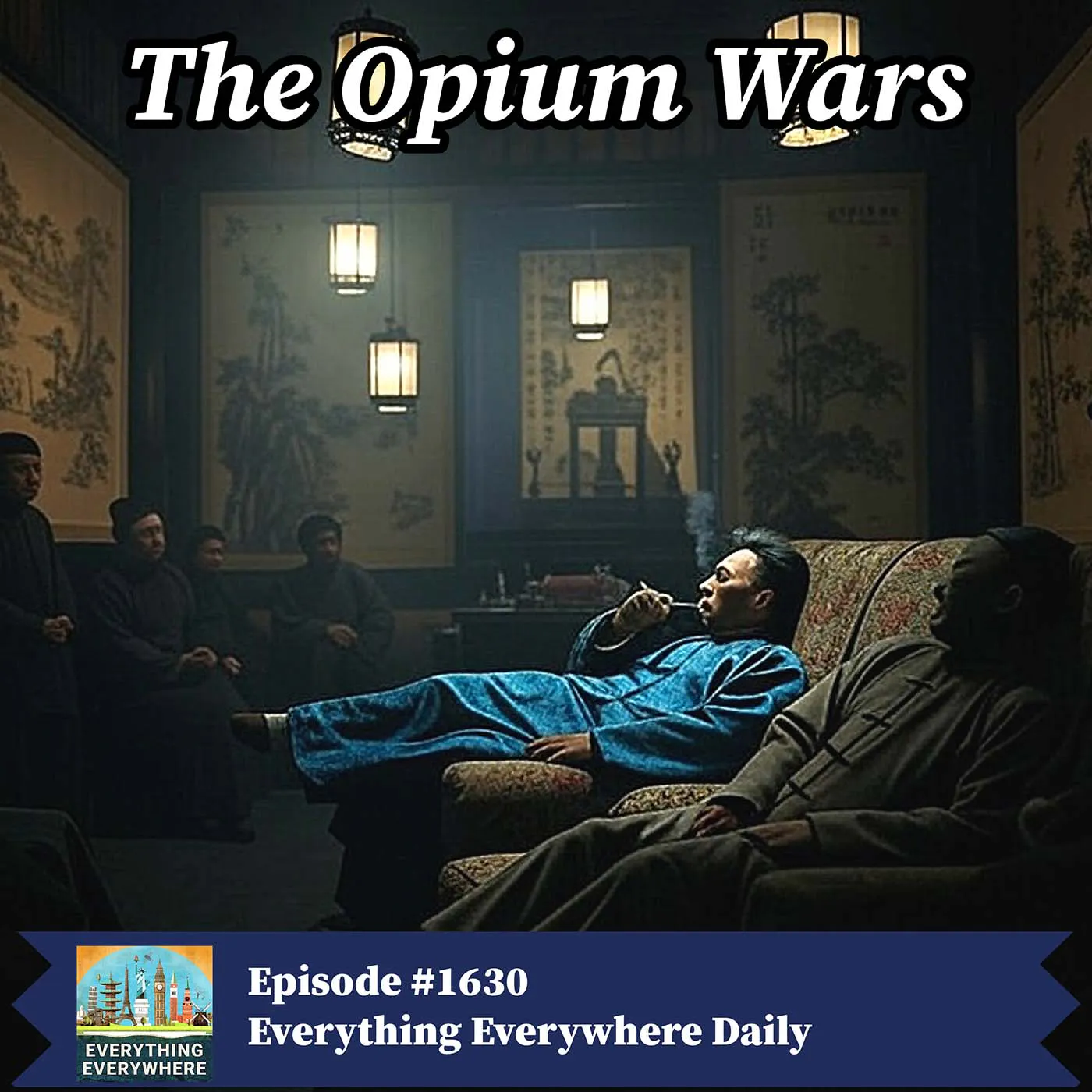
Everything Everywhere Daily: History, Science, Geography & More
The Opium Wars (Encore)
00:16:35
Learn about how the British Empire became a drug dealer
Loading summary
Transcript1 lines
- [00:00]
Charles Daniel
The following is an encore presentation of Everything Everywhere daily In the 19th century, the British and Chinese went to war on two separate occasions. The reasons why they went to war are both simple and complicated. The more complicated reason has to do with the trade policies of the British Empire and centuries old entrenched attitudes on the part of the Qing Dynasty. The simple reason had to do with pushing drugs as a matter of national policy. Learn more about the Opium wars, why Britain and China went to war, and how it affected the future of China on this episode of Everything Everywhere Daily. This episode is sponsored by Butcherbox. You've probably heard me talk about how ButcherBox only sells 100% grass fed grass finished beef, but what exactly is that and why does it matter? This type of beef comes from cattle that have grazed on grass for their entire lives as opposed to being finished on a diet of grains and other feed at a feedlot. Basically, cattle eat what cattle are designed to eat. Grass fed beef tends to have higher levels of omega 3 fatty acids and grass fed beef often contains more antioxidants such as vitamin E. Beyond personal health benefits, choosing grass fed grass finished beef can also improve soil health through natural fertilization and aer promote greater biodiversity on grazing lands. Consuming grass fed grass finished beef not only contributes to better health, but also supports more sustainable farming practices. Sign up@butcherbox.com daily and get a special deal. New users who sign up for Butcherbox will receive 2 pounds of grass fed ground beef in every box for the lifetime of their subscription plus $20 off your first box when you use code daily at checkout. This episode is sponsored by Quints. Finding the perfect gift can be pretty overwhelming. This year I found the perfect spot for timeless gifts made from premium materials. So you gotta check out Quince. Quince lets you treat your loved ones and yourself to true quality at an affordable price. I got a Cotton Fisherman throw blanket from Quince and I literally use it when I am writing many of the episodes for this podcast. I also have some Turkish cotton bath towels from Quince that I absolutely love. By partnering directly with top factories and cutting out the cost of the middleman, Quint's passes the savings on to you. Quint's is also on the nice list. They only work with factories that use safe, ethical and responsible manufacturing practices and they use premium fabrics and finishes for that luxury feel in every piece. Gift Luxury this holiday season without the luxury price tag. Go to Quince.com daily for 365 day returns plus free shipping on your order. That's Q-U-I-N-C-E.com daily to get free shipping and 365 day returns. Quince.com daily I normally give a bit of background to explain most episodes that deal with a historical event. For this episode it is especially necessary because the causes of the conflict between Britain and China were rather complicated. Understanding the Opium wars, and there were two of them, requires understanding how China got to such a point, how Britain got to such a point, and the history of opium. But first, let's start with China. The 18th and 19th centuries were the tail end of the Qing Dynasty. If you remember back to my episode on Chinese dynasties, It began in 1636 and after 300 years it was starting to experience a terminal decline. It would be the last imperial Chinese dynasty. It suffered from corruption, an inefficient bureaucracy and internal rebellions such as the White Lotus Rebellion which took place from 1794 to 1804. However, the Qing Dynasty also had to deal with something that other Chinese dynasties never pressure from European naval powers. The Chinese also continued to practice cultural traditions that had been the norm for centuries. Perhaps the biggest meta tradition and the one that dominated how China viewed itself in relation to the rest of the world was that of the Middle Kingdom. The Chinese often called themselves the Middle Kingdom. The idea behind the Middle Kingdom is that China was the center of the civilized world. As such, they felt themselves to be self reliant and didn't really need anything that the outside world had to offer. This had enormous implications for Chinese trade policy. Basically, China wasn't interested in what the Europeans were offering. The only thing that the Europeans were able to trade and the only thing that the Chinese wanted was silver. The Chinese only allowed Europeans to trade from certain trading ports. Teaching Europeans the Chinese language was forbidden and Europeans weren't allowed to leave the ports and enter Greater China. For the British, this caused huge problems. The British East India Company was a huge trading enterprise. In addition to finding markets for British produced goods, they also brought goods from Asia to Britain. The British people had an insatiable demand for Chinese luxury products including porcelain, silk and most importantly, tea. If you remember back to my episode on tea, at the time, China had an almost monopoly on tea and the British had developed into a tea drinking culture more than any other country in Europe. The problem was that the Chinese only wanted silver and the British didn't produce any silver. They had to get their silver from places like Mexico, which was very inefficient. What the British needed was some product that they could trade with the Chinese to help reduce their enormous trade deficit. And they found that product in opium. Here I should explain a little bit about what opium is. Opium is a milky latex that comes from the seeds of a particular species of poppy plant known as Papaver salmoneiferum, otherwise known as opium poppy. Opium is a narcotic drug that has been traditionally used as a pain reliever. The primary opium poppy growing region at that time extended from modern day Iran through Afghanistan, Pakistan and northern India. Opium had been known since ancient times. The Sumerians were growing opium poppy as early as 5,400 years ago. Other Mesopotamian cultures, the Greeks and Egyptians, all used poppy. They used poppy milk to sleep, to relieve pain, and even to calm crying children. However, back then, there were limits to the amount of opium that could be produced and consumed, and the strength and potency was limited. So addiction was seldom a problem, even though opium is highly addictive. The Chinese had a long history with opium that was brought over the Silk Road, and it was used sometimes in traditional Chinese medicine. And I should also note that opium is the basis for morphine, which is the basis for other highly addictive drugs such as heroin. But that's for another episode. In 1764, after the battle of Bucksar, the British captured a large poppy growing region in eastern India. Not only was the area large, but the opium produced in this region was much more potent than the type traditionally used. Rather than eliminating poppy production and destroying the poppy crop, the British decided to continue production so they could trade it with China. In 1793, the British established a formal monopoly on opium production in India and began using this monopoly to raise money. The British had been trading opium with China for decades, but in relatively small amounts. In 1730, for example, they shipped about 15,000 kg to China, but by 1775, it had increased to 75,000 kg. In response to this, the Qing emperors had banned opium importation in 1729 and again in 1799. The bans, however, did next to nothing. Opium production and importation only increased. Local officials were bribed and the opium kept flowing in. By 1804, Britain's trade deficit with China had turned into a surplus, largely due to opium. Throughout the 19th century, the problem of opium addiction got worse and worse in eastern China. And it wasn't just the British. In 1809, American traders got in on the action by importing low quality opium from Turkey. By 1830, the problem had become an epidemic. Some estimates placed the number of young men in eastern China who had become opium addicts as high as 90%. It wasn't just something done by the lower class either. Smoking opium, which had become the preferred method of consumption, was now finding its way into the bureaucratic and aristocratic classes. Opium addiction had a devastating effect on the Chinese economy as enormous amounts of time, money and effort went into the purchase and consumption of opium. The Emperor put further bans on opium in 1814 and 1831, but these measures were just as effective as the previous ones. By 1838, the amount of opium imported into China was over 1.5 million kg annually. In 1839, things were coming to a head. The Emperor had charged Governor General Lin Zeixu with the task of ending the opium trade. He wrote an appeal directly to Queen Victoria, but she never got the letter. However, it was published in the London Times, and here I should at least note that the British opium trade was highly controversial in Britain itself. It wasn't as if most people in the country didn't recognize the moral and ethical problems with dealing drugs. With no end in sight, Lin Jiaxu seized over 1 million kg of illegal opium and destroyed it in the town of Humen along the Pearl River. This was worth a lot of money, and needless to say, the British traders were furious with the destruction of so much of their product. British opium traders appealed to Charles Elliot, the chief Superintendent of British trade in China, to try to make them whole. When they realized they weren't going to be compensated, they appealed to the former Chief Superintendent of Trade, William Jardine. Jardine believed the only solution was war. He began to lobby Parliament in London, and In March of 1840, the House of Commons voted 271 to 262 to send a fleet to China to enforce British demands. The first British ships arrived in June of 1840. Without going into the details of every battle, suffice it to say that it was a lopsided conflict. The Chinese navy was no match for the British navy, which was the most powerful in the world at that time. After the war went so badly for the Chinese, the end result was the Treaty of Nanking in 1842. The Treaty of Nanking was a major humiliation for the Chinese. It was a complete reworking of the trade system with China. It ceded Hong Kong to the British, opened up more trade ports, gave British citizens immunity to Chinese law, and forced the Chinese government to pay reparations for the cost of the war and the lost opium. Moreover, this wasn't the only treaty that China was forced to sign during this period. They were also pressured into signing the Treaty of Huangpu with the French and the Treaty of Huangsha with the United States, both of which were similarly lopsided. This was not the end of things between Britain and China. While the opium trade was still technically illegal in China, it didn't stop after the Treaty of Nanking. In fact, it increased in the following years. The British found themselves with more colonies in the region that needed money like Singapore, and their trade deficit with China had returned due to the sheer amount of tea that they were now importing. The British began pressuring China to renegotiate the Treaty of Nanking to give the British even better trade terms. The Qing Emperor continued to try to stop the importation of opium and its consumption and he once again appointed a commissioner to stop the opium trade. And once again mirroring what happened in 1839. Everything came to a head on October 8, 1856 with the ARRW incident. The incident involved the seizure of the Chinese owned ship Arrow by Chinese officials in Canton, which is today Guangzhou. The ship, flying a British flag, was suspected of engaging in illegal activities and its crew, which included Chinese and Indian sailors, was detained. The British, viewing this as a violation of their extraterritorial rights previously negotiated, demanded the release of the crew and an apology. And when the Chinese refused, tensions escalated, leading to an armed conflict. The British began bombarding Chinese positions along the Pearl river, which resulted in Chinese reprisals on European and European buildings. This included the execution of a French missionary, which brought France into the conflict. Just as during the First Opium War, things did not go well for China. The British and the French seized multiple cities along the Pearl river, including Guangzhou and Guangdong. In 1858, it resulted in the Chinese signing the treaties of Tianjin with Britain, France, Russia and the United States. The treaties allowed foreign embassies in Beijing, opened up more Chinese ports for trade, allowed foreign navigation of the Yangtze river, allowed foreign travel within China, and forced China to pay more reparations. Russia then signed a separate treaty later that year, the Treaty of Aigun, where China ceded most of Outer Manchuria to Russia. These treaties just mounted the humiliation for China and it wasn't even the end of the war. Advisors to the Emperor urged him to resist, honoring the treaties, which only resulted in the British taking forts near Tianjin and eventually marching into Beijing in 1860, sacking the city and burning the Imperial Summer Palace. The sack of Beijing saw the destruction of the Yongol Encyclopedia, which was written in 1408 during the Ming Dynasty. At the time, it was the single largest encyclopedia in the World and only 3.5% of the Encyclopedia survived. The sacking. The end of the Second Opium War was marked by the Treaty of Peking, which was similar to the other treaties that China was forced to sign. It further opened up China to the west and gave more land concessions to the British, including the Kowloon Peninsula across from Hong Kong. The Opium wars have largely been forgotten in the West. Many people in Britain, France and Russia, the countries that took part in the conflict, have never even heard of it. However, it has never been forgotten in China. The Opium wars was the start of what was called the Century of Humiliation, a period of domination by foreign countries that lasted through the Second World War. The lopsided treaties signed by the Qing government were responsible for further domestic unrest, including the Boxer Rebellion, which will be the subject of a future episode. Rectifying and reversing the Century of Humiliation has been central to Chinese foreign policy ever since the mid 19th century. There are still over 600,000 square kilometers, or 231,000 square miles of land that was handed over to Russia during this, which has never been returned, an area approximately the size of a country like Ukraine. As for opium use in China, production eventually shifted to domestic growers and away from imported opium. By 1907, the British agreed to cease imports. Once opium production had become largely domestic, it was possible to halt production later in the 20th century. It would not be an exaggeration to say that that the modern international narcotics trade had its origin in the 19th century opium trade. In the end, the British created tens of millions of drug addicts and permanently altered the course of China simply to address a trade deficit which came about largely from the British desire for tea. The executive producer of Everything Everywhere Daily is Charles Daniel. The associate producers are Benji Long and Cameron Keever. I want to give a big shout out to everyone who supports the show over on Patreon, including the show's producers. Your support helps me put out a show every single day and also Patreon is currently the only place where Everything Everywhere Daily merchandise is available to the top tier of supporters. If you'd like to talk to other listeners of the show and members of the Completionist Club, you can join the Everything Everywhere Daily Facebook group or Discord server. Links to Everything are in the show notes.