← Everything Everywhere Daily: History, Science, Geography & More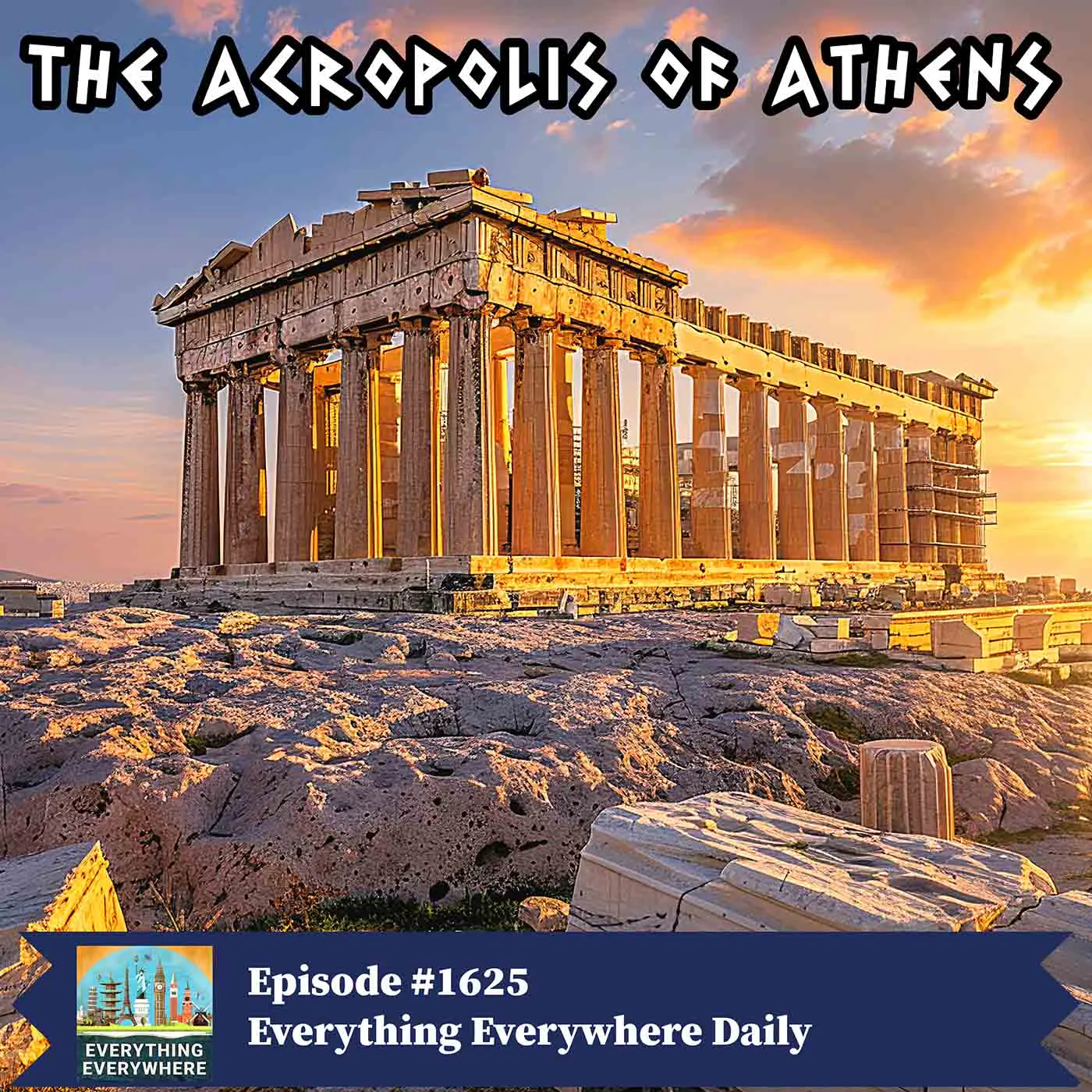
Everything Everywhere Daily: History, Science, Geography & More
The Parthenon and the Acropolis of Athens
00:16:38
Learn more about the most famous structure from the classical Greek world
Loading summary
Transcript1 lines
- [00:01]
Gary Arndt
Situated on a rocky hill overlooking the city of Athens is a former religious center, military fortress and cultural hub known as the Acropolis. The Acropolis of Athens is one of the most important locations in all of Greece and perhaps in all of Western civilization. Situated on top of the Acropolis is the Parthenon, a masterpiece of ancient Greek architecture and one of the most recognizable landmarks of the classical world. Learn more about the Acropolis of Athens, the Parthenon, and their roles in history on this episode of Everything Everywhere Daily. This episode is sponsored by Masterclass. If you're listening to this podcast, then you are someone who is curious about the world and loves to learn. And if you want to give the gift of learning and knowledge this Christmas, you can't do better than Masterclass. Masterclass offers online classes from some of the most successful instructors in the world. In their fields. You can learn cooking from Gordon ramsay, conservation from Dr. Jane Goodall, disruptive entrepreneurship from Sir Richard Branson, mathematical thinking from Fields Medal winner Terence Tao, and diplomacy from former Secretaries of State Madeleine Albright and Condoleezza Rice. You can access over 200 classes across 11 different categories. Masterclass always has great offers during the holidays, sometimes up to as much as 50% off. Head over to masterclass.com everywhere for the current offer. That's up to 50% off@masterclass.com everywhere. Once again, that's masterclass.com everywhere. This episode is sponsored by Butcherbox. You've probably heard me talk about how ButcherBox only sells 100% grass fed grass finish beef, but what exactly is that and why does it matter? This type of beef comes from cattle that have grazed on grass for their entire lives as opposed to being finished on a diet of grains and other feed at a feedlot. Basically, cattle eat what cattle are designed to eat. Grass fed beef tends to have higher levels of omega 3 fatty acids and grass fed beef often contains more antioxidants such as vitamin E. Beyond personal health benefits, choosing grass fed grass finished beef can also improve soil health through natural fertilization and aeration and can also promote greater biodiversity on grazing lands. Consuming grass fed grass finish beef not only contributes to better health but also supports more sustainable farming practices. Sign up@butcherbox.com daily and get a special deal. New users who sign up for Butcherbox will receive 2 pounds of grass fed ground beef in every box for the lifetime of their subscription, plus $20 off your first box when you use code daily at checkout. I'm sure that most of you are at least somewhat familiar with the Acropolis and the Parthenon. If you've ever been to a Greek restaurant, there's a good chance that they may have had a photo of it, or maybe the restaurant was even named after it. The Acropolis and the Parthenon are technically two separate things, but they're often confused with each other. The Acropolis refers to the entire ancient citadel on a rocky hill in Athens containing multiple structures such as temples, sanctuaries and gateways, including the Parthenon. The Parthenon is a specific temple within the Acropolis complex dedicated to Athena Parthenos, the patron goddess of Athens, and serves as its most iconic structure. The story of the Acropolis is intertwined with the history of Athens itself. The first thing to know is that the term Acropolis is a generic term in almost any ancient Greek city. The Acropolis was the central citadel of the city. It would usually be based on a hill and would be the defensive fortification for a Greek city. If you say Acropolis without any qualifier, it is almost always associated with the Acropolis of Athens because it's simply the best known Acropolis. For the rest of this episode, I'll be referring to the Acropolis of Athens generically as the Acropolis, but keep in mind that there are others in other cities. The earliest history of the Acropolis dates back to the Mycenaean period, which was between 1600 and 1100 BC. The Acropolis became a prominent citadel featuring Cyclopedan walls and a palace complex, reflecting its role as the center of political and military power for the region. Cyclopedon is a type of masonry used during this period, involving massive limestone blocks and little to no mortar. Shrines dedicated to local deities likely existed, laying the groundwork for the site's later religious significance. The Acropolis prominence waned after the fall of the Mycenaean civilization. However, it retained religious importance, with worship focusing on Athena, the patron goddess of Athens. One of the significant temples built on the Acropolis during the period that followed was the Hecatompydon. The Hecatompidon, meaning hundred footer in Greek, was an early temple on the Acropolis of athens constructed around 570 to 550 BC during the Archaic period. Dedicated to Athena, the temple was named for its approximate length of 100ft and served as a precursor to the Parthenon. Built of limestone, the Hecatompidon was richly decorated with painted scriptural panels including mythological scenes such as lions devouring bulls, which symbolized strength and protection. Positioned on the southern part of the Acropolis, it held a central role in the city's religious life. The Hecatompidon was dismantled sometime around 500 BC, likely to make way for the old Parthenon, and some of its architectural fragments were later repurposed in the fortifications of the Acropolis after the Persian sack of Athens in 480 BC. The old Parthenon was an earlier temple dedicated to Athena that preceded the construction of the iconic Parthenon on the acropolis. Begun around 490 BC during the aftermath of Athens victory at the Battle of Marathon, it symbolized the city's growing power and devotion to its patron goddess. And I covered the Battle of Marathon in a previous episode. Constructed primarily out of limestone, the old Parthenon was an ambitious project reflecting Doric architectural principles. However, its construction was interrupted by the Persian invasion of 480 BC, during which the temple was destroyed and then left unfinished. After the destruction of the old Parthenon, the golden age of the Acropolis began under the leadership of Pericles. Pericles was a prominent statesman, orator and general of Athens during its golden age in the 5th century BC. He was known for his leadership in developing Athenian democracy and spearheading the city's cultural and architectural advancements. Under Pericles, several large structures were built on the Acropolis that would come to define the hill. Four major ones are still standing today in one form or another. One of the first structures built was the Propylaea. The Propylaea is the monumental gateway to the acropolis, constructed between 437 and 432 BC. Designed by the architect Menesocles, the Propylaea marked the formal entrance to the sacred precinct and reflected both grandeur and symmetry. Its design combined Doric and Ionic architectural elements, featuring a central hall with five doorways flanked by two projecting wings. Construction of the Propylaea was halted due to the outbreak of the Peloponnesian War, leaving it incomplete. Although its unfinished state did not diminish its status as an architectural marvel. The Temple of Athena Nike is a small temple on the acropolis constructed around 427 to 424 BC during the Peloponnesian War as part of Pericles building program. Designed by the architect Callicrates, it was dedicated to Athena Nike, the goddess of victory, symbolizing Athens hope for success in its ongoing conflicts. Inside the temple stood a 30 foot bronze statue of Athena holding a pomegranate symbolizing peace and a helmet symbolizing war. The Erechtheion is an architecturally distinctive temple on the acropolis built between 421 and 406 BC. Dedicated to both Athena and Poseidon. It was designed to accommodate multiple religious functions and sacred sites, including the olive tree gifted by Athena and the salt spring created by Poseidon during their mythical contest for the city's patronage. The temple is renowned for its asymmetrical layout and elegant columns, as well as for the porch of the Caryatids, where six draped female figures serve as supporting columns. All of these structures that I've just mentioned can be found on the Acropolis today. However, the main attraction is the Parthenon. The Parthenon was built between 447 and 432 BC. Dedicated to Athena Parthenos, the patron goddess of Athens. It was designed by the architects Ikinos and Kallikrates. The central feature of the temple was a colossal gold and ivory covered statue of Athena. The statue was constructed entirely of Pentelic marble, which comes from Mount Pentelicus outside of Athens. The Parthenon measures 69.5 meters by 30.9 meters, with eight columns on the short sides and 17 on the long sides. The Parthenon is considered the greatest example of classical Greek architecture, and that is a distinction that it has held for well over 2000 years. It isn't just the ratios and proportions of the Parthenon that make it so special. There are many extremely subtle details that most people wouldn't even notice outside of a close up inspection. One such detail is Entesus, a slight swelling in the center of the columns, which counteracts the optical illusion of concavity, making the columns appear straight to the observer. Another element is the stylobate, the temple's platform, which features a gentle upward curvature, preventing the appearance of sagging lines and also aiding in rainwater drainage. The columns also lean slightly inward, so that if extended, they would meet nearly 1.5 km above the temple, creating a sense of harmonious convergence. And finally, the columns on the corner all have a slightly wider diameter for support. The Parthenon could be seen almost everywhere in Athens, given its prominence on top of the Acropolis, which is one of the reasons why it became the iconic image of the city. While the buildings of the Acropolis were built during the 5th century BC, the Golden Age of Athens, the history of the area and the buildings didn't stop there, as is evidenced by the fact that they're still standing today. When the Romans conquered Greece, for the most part, the buildings didn't change in function. The Greeks continued to worship Greek gods, although the Romans did use the Parthenon as a treasury building. Given how well defended the Acropolis was, Athens remained a center of culture and learning during the Roman period, and these buildings underwent continual upkeep. With the fall of the Western Roman Empire and the rise of the Greek speaking Christian Byzantine Empire in the east, the Parthenon was repurposed as a church. It was dedicated to the Virgin Mary and was named Pania Atheniotissa. Many pagan statues and decorations were removed or defaced during this period, including most probably the giant statue of Athena inside. Athens remained a Byzantine Orthodox city until the Fourth Crusade. In the 13th century, Athens fell under Frankish control, was ruled as the Duchy of Athens, and the Parthenon was used as a Roman Catholic church. During this period, the Franks built a brick tower on the Acropolis, known as the Frankish Tower. The tower had a commanding view of the city and was used for defensive purposes. The Frankish period lasted from 1204 to 1458. After that, the Ottomans took over and the Ottomans used the Parthenon as a military structure. As late as 1687, the Parthenon looked closer to its original design than what it looks like today. In 1867, during the Marine War fought between the Ottomans and Venice, the Parthenon sustained catastrophic damage when a Venetian mortar struck the temple, which the Ottoman forces had been using as a gunpowder magazine. The resulting explosion, which took place on September 2nd of that year, led to the destruction of the Parthenon's roof and a significant portion of its walls, causing many of its columns to collapse and inflicting severe damage on its sculptural decorations. This event transformed the Parthenon from a relatively intact ancient structure into the ruins that we see today. Between 1801 and 1812, agents of Thomas Bruce, 7th Earl of Elgin and British Ambassador to the Ottoman Empire, took multiple artifacts from the Acropolis, including significant portions of the Parthenon, frieze and pedimental sculptures. Elgin transported the marbles to Britain, where the British Museum later acquired them in 1816, where they remain on display to this day. I covered the Elgin Marbles in a previous episode and they still remain a diplomatic sore spot between Greece and Britain. In 1834, Greece became independent of Ottoman rule. Greek independence changed the status of the Acropolis. It was now seen as a symbol of national identity, and as such, efforts were made to preserve it. The Frankish tower was torn down in the late 19th century by archaeologists who wanted to return the Acropolis to its classical appearance. Restoration efforts began to preserve its structures, focusing on undoing damage caused by centuries of neglect and war and ensuring that no further damage would occur. Archaeological excavations have revealed important artifacts and provided insight into the Acropolis history the Acropolis and the Parthenon have become the premier tourist attractions in Athens. In 1987, the entire Acropolis Citadel was named a UNESCO World heritage site. In 2009, the Acropolis Museum in Athens opened. It's a state of the art archaeological museum dedicated to preserving and showcasing artifacts from the Acropolis and its surrounding slopes. Located just 280 meters from the Parthenon, the museum spans 14,000 square meters and houses over 4,250 objects, offering visitors a comprehensive insight into ancient Greek civilization. There's also a large empty space for the future display of the Elgin Marbles should they ever return to Greece. Today, the Acropolis complex gets approximately 4 million visitors per year. The Acropolis is a testament to the artistic, architectural and cultural achievements of ancient Greece. It embodies the ideas of democracy and philosophy, as well as the art and architecture that shaped Western civilization as a center of worship and military power for millennia. It reflects the diverse history of Athens all the way from prehistoric times to the modern era. The executive producer of Everything Everywhere Daily is Charles Daniel. The associate producers are Benji Long and Cameron Keever. I want to give a big shout out to everyone who supports the show over on Patreon, including the show's producers. Your support helps me put out a show every single day and also Patreon is currently the only place where Everything Everywhere Daily merchandise is available to the top tier of supporters. If you'd like to talk to other listeners of the show and members of the Completionist Club, you can join the Everything Everywhere Daily Facebook group or Discord server. Links to Everything are in the show. Notes.