Loading summary
Transcript9 lines
- [00:01]
Gary
Located in the heart of West Africa is the nation of Ghana. Ghana is a medium sized country in terms of both population and area, but from West Africa, it has multiple distinctions and firsts which set it apart from the rest of the region. Its course since independence has taken it down a path that in some ways has been very similar to other African countries, yet in other ways has been very, very different. Learn more about Ghana and what makes it unique on this episode of Everything Everywhere Daily. This episode is sponsored by Quints. It's summertime and that means it's time to bring out the summer clothes. If you're looking to update your wardrobe this summer, I suggest you check out Quince. Quince has all the things you actually want to wear this summer, like organic cotton silk polos, European linen beach shorts, and comfortable pants that work for everything from hanging out in the backyard to nice dinners. And the best part, everything with Quint's is half the cost of similar brands. By working directly with top artisans and cutting out the middleman, Quint's gives you luxury pieces without the markups. I recently needed a new duvet and I went to Quint's and picked up a great one that looked much better than what I had before and all at a fraction of the price I'd pay elsewhere. Stick to the staples that last with elevated essentials from Quince. Go to Quince.com daily for free shipping on your order and 365 day returns. That's Q-U-N-C-E.com daily to get free shipping and 365 day returns. Quince.com daily hey Kristen, how's it tracking.
- [01:49]
Kristen
With Carvana Value Tracker?
- [01:51]
Gary
What else?
- [01:52]
Kristen
Oh, it's tracking in fact. Value surge alert. Trucks up 2.5%, vans down 1.7, just as predicted.
- [02:02]
Gary
So we gonna I don't know, could.
- [02:04]
Kristen
Sell, could hold the power to always.
- [02:07]
Gary
Know our car's worth.
- [02:08]
Kristen
Exhilarating, isn't it? Tracking Always know your car's worth with Carvana Value Tracker.
- [02:20]
Gary
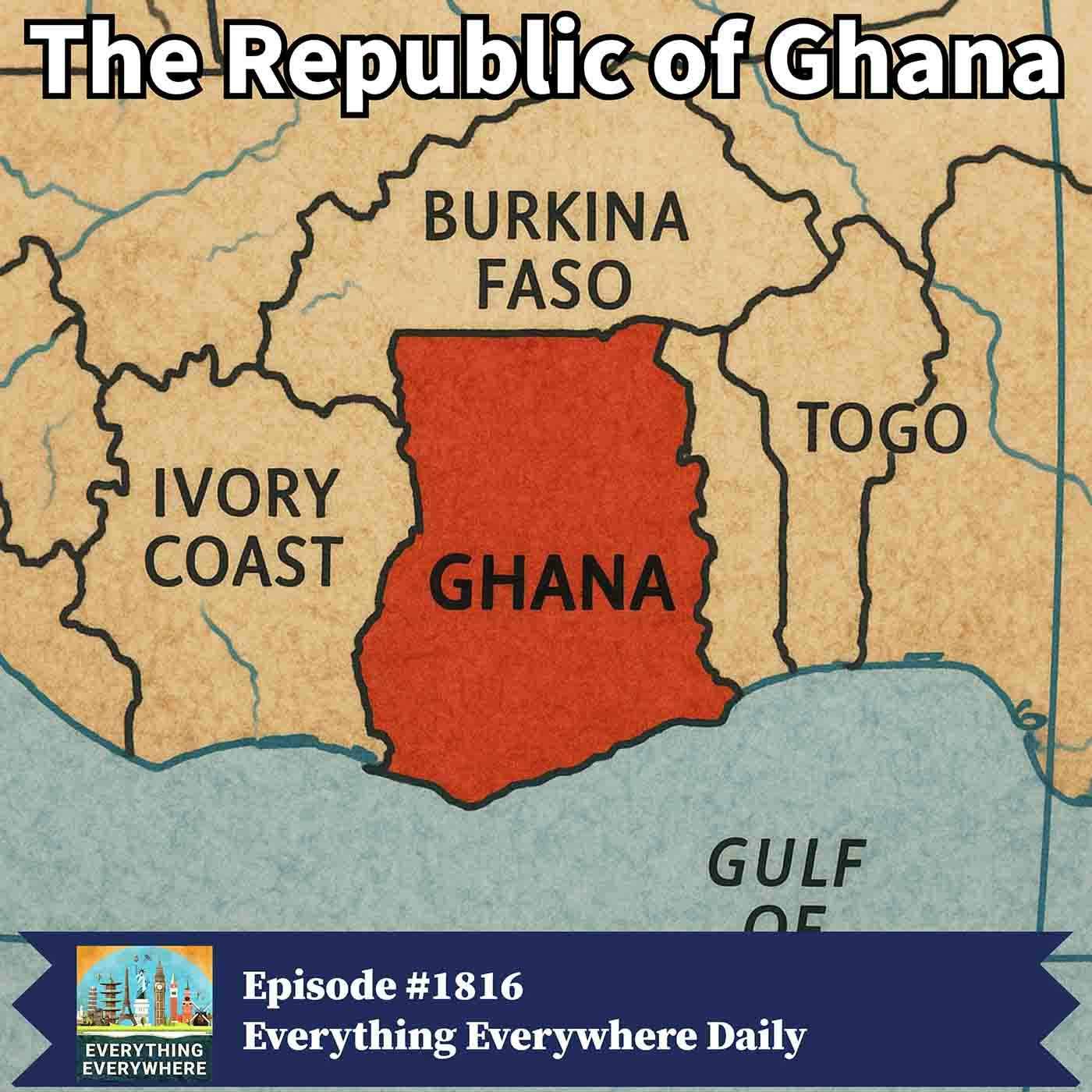
Before I get into the history of Ghana, I should start with some basic facts about its geography. Ghana is located in West Africa. It is situated to the west of the nation of Togo, to the east of Cote d' Ivoire, south of Burkina Faso and north of the Atlantic Ocean's Gulf of Guinea. It has an area of approximately 240,000 square kilometers, or 93,000 square miles, which places it between Uganda and Romania in size. Its current population is a bit over 35 million people, which places it between Mozambique and Peru. The country's terrain is mostly low lying plains and gently rolling hills rising to higher elevations in the east and central regions. The Volta river, which originates in neighboring countries, has been dammed to create Lake Volta, one of the world's largest man made lakes and is the most prominent water feature in the country and an important source of hydroelectric power. Ghana enjoys a tropical climate with two primary the wet season and the dry season. Its ecosystems are diverse ranging from lush rainforests in the south to grassland savanna in the north. Before 2,000 years ago, the area that is now Ghana was home to small scattered communities of hunter gatherers and early agriculturalists who developed complex societies long before the development of large empires. Archaeological evidence including stone tools, pottery and early ironworking suggests that people in the region practiced subsistence farming and animal husbandry and that they engaged in trade networks with other groups across West Africa. These societies were not part of a single centralized kingdom, but were instead organized into clan or village based communities that were adapted to their local ecological zones. One of the biggest changes to the region was the establishment of the Ghana Empire, also known as Wagadu. The Ghana empire was one of Africa's earliest and most sophisticated political entities, and it could arguably be seen as the foundation upon which West African civilization was built. The empire emerged around the year 300 in the Western Sahel, strategically positioned between the Sahara Desert and the more fertile lands to the south. The empire's strength lay in its control of the trans Saharan trade routes. These routes connected North Africa with sub Saharan Africa. Ghana sat at the crossroads of these pathways, allowing its rulers to tax the gold flowing north and the salt flowing south. This positioning made Ghana incredibly wealthy and powerful. The Ghana empire operated on a feudal like system where the king called the Ghana, which literally means warrior king, ruled over provincial governors who controlled local territories. This decentralized approach allowed the empire to manage vast distances effectively while maintaining some sort of unity. The society was hierarchical with the king at the top, followed by nobles, merchants, craftsmen, farmers, and finally enslaved people. By the 11th century, the empire faced mounting pressures. The Almoravid Berber invasions from the north, combined with the rise of competing trade routes and internal conflicts gradually weakened Ghana's power. The empire officially ended around the year 1200, but its legacy lived on in its successor states that emerged, particularly the Mali Empire. During this period, various ethnic groups began settling in what is now modern Ghana. The Guan people were amongst the earliest inhabitants, followed by waves of migrants including the Akan, the Ewe, Ga, and Agomba people. Around this time we begin to see the emergence of smaller kingdoms and chieftains in the area of modern Ghana. These early states developed sophisticated political systems. Which were often based on matrilineal inheritance among the Akan peoples, which was unusual in Africa, where patrilineal systems dominated. The 15th century marked the beginning Of a new chapter in Ghana's history. With the rise of the powerful Akan speaking kingdoms. The most significant of these was the Ashanti empire, which emerged in the late 17th century under the leadership of Osi Tutu. The Ashanti empire, as well as the Mali empire. Will be the subject of their own future episodes. The Portuguese were the first Europeans to reach the coast of Ghana in 1471, followed by other European powers, Including the Dutch, British, and Danes. Initially, these contacts were limited to coastal trading posts. Where Europeans exchanged manufactured goods for gold, ivory, and other African products. This early European presence Was confined Mainly to coastal enclaves. African kingdoms such as the Ashanti Maintained their independence. And often dictated the terms of trade. Europeans were in many ways, Junior partners. In these early commercial relationships. The tragic transformation of this trade occurred. As European colonial expansion in the Americas. Created an enormous demand for enslaved labor. The Gold coast, as the region was known to Europeans, Became a major source of enslaved Africans Shipped across the Atlantic. And this period represents one of the darkest chapters In Ghana's history. The slave trade disrupted societies, Fueled warfare between African states. And led to the depopulation of vast areas. Coastal fortresses like Cape Coast Castle and Elmina Castle. Became horrific symbols of human suffering, Serving as dungeons where enslaved Africans Awaited transportation across the Atlantic. The formal colonization of Ghana. Began. With the British establishment Of the Gold coast colony in 1874. This marked a fundamental shift from trade relationships. To direct political control. The British gradually extended their authority inland, Bringing them into conflict with the powerful Ashanti empire. African kingdoms that had been independent for centuries. Suddenly found themselves under foreign rule. The British imposed new legal systems, Economic structures, and administrative practices. That totally disrupted traditional ways of life. The colonization of Ghana Wasn't accomplished without resistance. The Ashanti empire fought a series of wars Against British expansion from 1824 to 1900. The final Anglo Ashanti War of 1900, known as the War of the Golden Stool, Was sparked by the British desire for the Ashanti sacred symbol that was central to their culture, the Golden Stool. The war ended with British victory. And the incorporation of the Ashanti into the Gold coast colony. The roots of Ghana's independence Can be traced to the early 20th century. When educated Africans began forming political organizations. To advocate for greater rights and eventual self government. The independence movement reached its climax with the emergence of Kwame Nkrumah as a political leader. Nkrumah, who had studied in the United States and Britain, returned to the Gold coast in 1947 with a vision of immediate self government. In 1949, Nkrumah founded the Convention People's Party with the slogan Self Government Now. This marked a shift from the gradualist approach of earlier nationalist leaders to a demand for immediate independence. Nkrumah's charismatic leadership and ability to mobilize mass support made him the dominant figure in the independence movement. The British colonial government initially resisted demands for immediate independence, but the combination of mass protests, international pressure, and changing British attitudes towards colonialism gradually shifted the balance. The Positive action campaign of 1950, led by Nkrumah, demonstrated the strength of the independence movement. Elections in 1951 and 1954 gave the CPP overwhelming victories, making it clear that the people of Ghana supported independence. The British government, recognizing the inevitable, began negotiations for the transfer of power. On March 6, 1957, the Gold coast colony became the nation of Ghana, the first African colony to achieve independence. The choice of the name Ghana was symbolic, connecting the new nation to the ancient Ghana empire and asserting African historical greatness. Nkrumah became Ghana's first prime minister and later president when Ghana became a Republic in 1960. His vision extended far beyond Ghana's borders. He dreamed of a united Africa that could stand as an equal partner with other world powers. This Pan African vision influenced Ghana's foreign policy and made its capital of Accra the center of African liberation movements. Domestically, Nkrumah launched ambitious development programs aimed at modernizing Ghana's economy and society. Projects like the Volta River Dam and the establishment of universities and hospitals demonstrated his commitment to rapid development. However, Nkrumah's rule became increasingly authoritarian. Political opposition was suppressed and economic problems mounted as ambitious projects strained the national budget. The contradiction between Nkrumah's democratic ideals and his authoritarian practices created tensions that would eventually lead to his downfall. In 1966, while Nkrumah was on a state visit to China, the military overthrew his government in Ghana's first coup. And this began a long period of political instability characterized by alternating civilian and military governments. Notable periods include the brief civilian Second Republic under Covey Bussia from 1969 to 1972, the military government of General Echampong from 1972 to 1978, and the revolutionary government of Flight Lieutenant Jerry Rawlings, who first seized power in 1979. Jerry Rawlings is, I think, one of the most interesting characters in 20th century African history. Jerry Rawlings dominated Ghana's politics from 1979 to 2001, first as a military leader and later as an elected president. His initial coup d' Etat in 1979 was motivated by anger over corruption and economic decline. After briefly returning power to civilians, he led another coup in 1981. Rawling's early years in power were marked by revolutionary rhetoric and attempts at socialist economic policies. However, faced with severe economic crisis, his government eventually embraced structural adjustment programs recommended by the World bank and the International Monetary Fund. The most significant achievement of the Rawlings era was the transition to constitutional democracy. Under international and domestic pressure, Rawlings agreed to democratize Ghana's political system. A new constitution was adopted in 1992 and Rawlings won an open multi party election as the candidate of the National Democratic Congress. Since 1992, Ghana has maintained a stable democratic system that's become a model for other African countries. The country has held regular competitive elections and power has been transferred peacefully between different political parties. The Fourth Republic has been characterized by economic growth, improved governments, and greater respect for human rights. Ghana's discovery of oil in 2007 has provided new opportunities for development, although it's created new challenges in managing natural resource wealth. Ghana has been a standout amongst the other countries of West Africa. It was very obvious when I visited the region that it had a higher standard of living compared to its neighbors. I remember being on the Togo side of the border and it was one of the most dramatic borders I had ever seen. Traveling Ghana isn't rich, but it's also doing much better than its neighbors. Ghana has produced sub Saharan Africa's only UN Secretary General in Kofi Annan, and they've also made it to the quarterfinals of the World cup in 2010, which they took into overtime, almost becoming the first African team to make it to the semifinals. And along the way they also beat the United States in the round of 16. If you ever wanted to visit West Africa, Ghana would be the place that I would recommend that you visit first. Ghana has a deep history that most people are totally unaware of, from being the location of one of the first great African empires to becoming the first African country to achieve independence. The executive producer of Everything Everywhere Daily is Charles Daniel. The associate producers are Austin Okun and Cameron Keefer. A reminder that I'll be hosting the Everything Everywhere Daily 5th Anniversary event on July 19th in Appleton, Wisconsin. If you'd like to attend and are in the area, information and an RSVP link are available in the show Notes and I might just have some pieces of swag for people as well as A live Q and A event with Audiovisual. Today's very appropriate review comes from listener Kofi over on podchaser. He writes, the world is busy developing artificial intelligence and Gary is busy curing natural stupidity. This makes me feel better about the state of affairs in the world. I love your podcast. I'm on my third round and wondering if I can open a clubhouse in Kumasi, Ghana afterwards. Even though I live in the us America has enough members, they don't need me. But a clubhouse in Ghana? Now that would be great. We could serve fufu with groundnut soup and wash it all down with a cold, refreshing palm wine daily. You do a good job. Thank you. I hope someday I can do something like this with a focus on everything everywhere in Africa. Woo Gary. This might be a franchise idea. Have a blessed day, ko fi. P.S. i'm sure you know what day I was born from my name. If not, I think naming in different cultures would be an excellent podcast topic in the future. Thanks Ko Fi. First, let me congratulate you for achieving Platinum Elite status in the Completionist Club and for your soon to be Diamond Elite status. That is a very rare accomplishment and I should share with you and everyone else why I know that you were born on a Friday. When I visited Ghana, I shared with some people I met that I went to the same university as former UN Secretary General Kofi Annan. They then asked me if I knew what the word kofi meant and I told them no, I didn't and they informed me of how many people in Ghana were named after the day of the week they were born. And Ko Fi was reserved for men who were born on a Friday. Also Ko Fi. If you have ideas for Africa themed episodes, feel free to pass them along. The Facebook group or the Discord server are both good places to give suggestions. Remember, if you leave a review or send me a boostagram, you too could have it right on the show.