← Everything Everywhere Daily: History, Science, Geography & More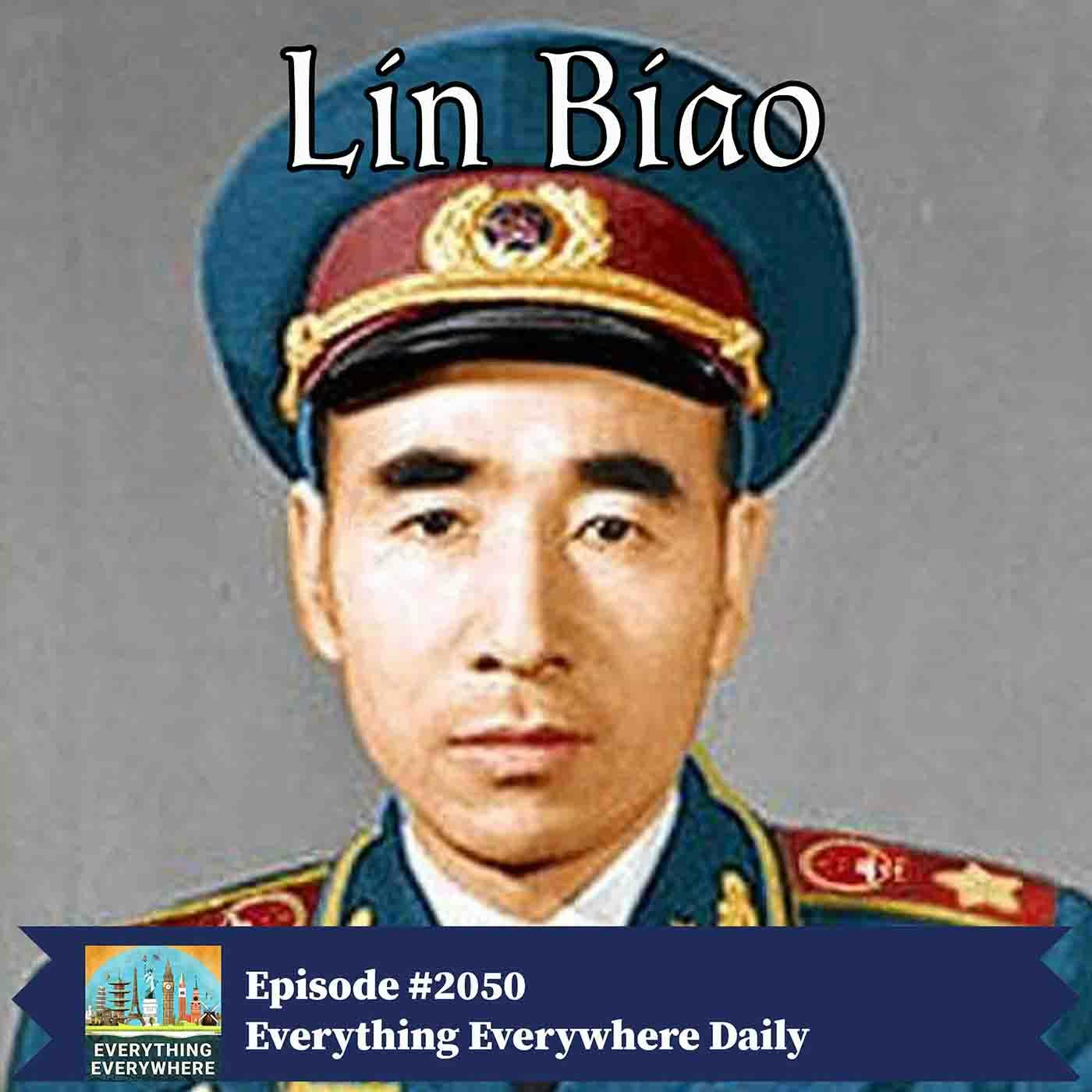
Everything Everywhere Daily: History, Science, Geography & More
The Rise and Fall of Lin Biao
00:14:41
Loading summary
Transcript1 lines
- [00:01]
A
From the outside, the Chinese Communist Party can appear to be a unified entity devoid of any internal dissent. However, history suggests that the machinations of power at the top of the Communist Party can often take on Shakespearean turns, and few figures illuminate the shadows and secrets of the Party's organization as completely as Lin Biao, who had experienced one of the greatest rises and falls in Chinese history. Learn more about the legacy of Lin Biao and his fall from grace on this episode of Everything Everywhere Daily. This episode is sponsored by Mint Mobile. Everybody knows someone who insists on doing things the hard way. There's a friend who keeps paying for a subscription they forgot they had, or the one refusing to update their phone just because it still works. Mint Mobile exists purely to fix that problem. You get the same coverage, same speed, just without the inflated price tag. That's why I recommend Mint Mobile. For a limited time, get 50% off 3, 6 or 12 month plans of unlimited Premium Wireless. Ready to stop paying more than you have to. New customers can make the switch today and for a limited time, get unlimited Premium wireless for just $15 a month. Switch now@mintmobile.comeed that's mintmobile.comeed upfront payment of $45 for three months, $90 for six months or $180 for 12 month plan required $15 a month equivalent taxes and fees Extra initial plan term only. Over 50gb may slow when network is busy. Capable device required. Availability, speed and coverage varies. Additional terms apply. See mintmobile.com this episode is sponsored by Quint's. For months I have been telling you about the high quality products at great prices at Quint's, but I want to share with you a recent experience I had with them. I recently purchased a new laptop bag from Quince. I ordered it online and waited for it to arrive but it never showed up. It turns out the postal service lost it, not Quince's fault, but I went to their website to report it. I was able to contact a live customer service agent via chat. They confirmed the issue and had a new bag sent to me immediately. The entire process took about a minute. No hoops to jump through and no waiting. Quint's works directly with top factories and cuts out the middleman. So you're not paying for brand markup, just quality clothing. And they also happen to have amazing customer service. Refresh your wardrobe with quince. Go to quints.com daily for free shipping on your order and 365 day returns now available in Canada too. That's Q U-I-N-E.com daily free shipping and 365 day returns quints.com daily. Lin Biao was born in 1907 in Hubei Province into a lower middle class family at a time when China was wracked by warlords and social upheaval. As a teenager, he was drawn to radical politics and revolutionary nationalism, eventually enrolling in the Whampoa Military academy in the 1920s. Whampoa was a vital training ground for both Nationalist and Communist officers, and Lin quickly distinguished himself for his tactical brilliance, intelligence and discipline. Like many of his generation, the young Lin was influenced by the passionate student protests of the May Fourth Movement in 1919. Lynn's enthusiasm encouraged him to register for military training at the Huangpo National Military Academy. He graduated as a distinguished student and the academy taught him military strategy and tactics. His academic brilliance prompted a quick rise through the ranks of the military and a position in the First United Front. The First United Front was an alliance between Chiang Kai Shek's Nationalist Party, the Kuomintang, and the Chinese Communist Party. The United Front was an amorphous movement that emerged to combat crises in China, such as the expanding influence of warlords. Choosing between the Communists and the Nationalists was challenging for all military academy graduates. Lin's alliance was clarified in 1927 after the Nationalists in Chiang Kai Shek opened up a civil war with the Communists after the Shanghai Massacre. The massacre was a joint effort between the Kuomintang and Shanghai's infamous criminal organization, the Green Gang. They jointly attacked Communists, resulting in an astonishingly high death toll, with some estimates reaching as high as 10,000. As bad as the massacre was, the long term costs were even greater as the event began a civil war that devastated China until 1940. Following the massacre, Lin Biao became a member of the Communist Party. His subsequent friendship with Mao Zedong was a critical factor in establishing the Chinese Red army and influencing the political direction of the Chinese Communist Party. Afterward, Mao concentrated on combating the Nationalists in Hunan Province, where he eventually was defeated and forced to withdraw. At the same time, Lin's own engagements with the Nationalists resulted in a retreat after the Communists were defeated in the Nanchang uprising. Both retreating Communist forces eventually converged in the remote jingang Mountains in 1928. This became known as the Jingang Shang Convergence. The moment is a celebrated part of Chinese Communist history and was memorialized in the propaganda art of early Communist China. This led to the foundation of the Yangxi Soviet. The Yangtze Soviet was the largest and most important Chinese Communist revolutionary base in the early 1930s, where the communist Party under Mao established a de facto state in rural Yang Yangtze Province. The Yangtze Soviet became a prime target for Chiang Kai Shek and the Nationalists. They surrounded the region with nearly 700,000 troops with the goal of destroying the Communist base and its infrastructure. In 1934, the fourth year of the siege, 86,000 communists broke through the Nationalist lines. They fled west in what became one of the most important events in Chinese Communist history, the Long March. Mao was sharing power with Zhao Enlai and Zhu Da in Yangtze. But the events of the Long March left no doubt as to who was to be the leader of the movement going forward. Mao led the March an astonishing 6,000 miles to the northern city of Yan'. An. The marchers had to endure constant air bombardment by the Nationalist Chinese forces and persistent ground offensives while crossing 18 mountain ranges. Estimates indicate that of the 86,000 who began the march, only 8,000 completed the trek. Lin built his reputation on the Long March. He commanded the 1st Army Corps that led the march. He displayed valor and courage, qualities that captivated Mao Zedong. And by the end of the March, Mao had Lin's unquestioned loyalty and confidence. Their friendship would come to shape the revolution. By 1937, China faced a new problem. The Japanese had invaded China, and fighting the Japanese was now a much larger problem for both the Nationalists and the Communists. The two forces set aside their differences, forged an uneasy truce, and united to combat the Japanese threat. During the Second United Front, Lin Biao's stature grew considerably. Commanding Communist forces, Lin led direct confrontations with the Japanese and secured several seminal victories, significantly enhancing his fame and importance within the Communist movement. Lin and the army's leadership were forced to recognize that the Second United Front lacked the resources to launch full scale operations against the Japanese. So he organized the highly effective guerrilla operations against the Japanese forces in northern China. The defeat of the Japanese saw the resumption of the civil war with the Nationalists, which ultimately ended in a Communist victory, a subject I've discussed in an earlier episode. And Lyn was crucial to this outcome. His leadership in Northeast China, particularly his decisive victories there, were instrumental in securing the final Communist victory and further solidified his standing amongst the party elite. Lyn maintained a low profile following the Communist victory Due to health issues and a reluctance to engage in political life, he was initially assigned only minor roles. His decision to remain inconspicuous during the Great Leap Forward later proved to be a brilliant strategy. His role in the early governmental structure as vice chairman of the military and later Vice Premier kept him out of the spotlight and out of the way of the disastrous consequences of the Great Leap Forward. His quiet advocacy of Mao's initiatives brought him closer to Mao, and he was rewarded with promotions. When Mao's Minister of National Defense, Peng Di Hui, was purged for contradictory opinions on the effects of the Great Leap Forward, Mao turned to Lin and appointed him the Minister of National defense. And in 1959, Mao had ambitious plans to foster greater unity between his government and the military. Mao had always harbored concerns about the relationship between the political and military power structures in China. Lin could help Mao create a closer relationship between the two. Lin's role grew in importance during the Cultural Revolution. During the Cultural Revolution, Lin's star never shone as brightly, nor would his status ever be as dark. The Cultural Revolution held that to preserve the original ideas of the Communist Revolution, any perceived dissent had to be purged from the system. Mao also felt he was losing power and influence after the discord caused by the Great Leap Forward. Creating a unified consciousness was essential to the success of the Cultural Revolution. So Mao turned once more to Lin Biao. During the early Cultural Revolution, Lin was the architect of the propaganda responsible for the widespread dissemination of the cult of personality surrounding Mao which defined the entire movement. A review of the propaganda paintings of that time often showed Mao flanked by a smiling Lin Biao. In an effort to elevate Mao, Lin oversaw the publication and distribution of a collection of his sayings which resulted in the creation of the Little Red Book. The goal, as summarized in Lin's foreword to the first edition of the book, is to provide Maoist writings and messages that reinforce the values of Communism. He study Chairman Mao's writings, follow his teachings, act according to his instructions, and be his good soldiers. Lin's efforts were rewarded with shocking clarity in Mao's 1969 constitution for the People's Republic of China, which said, comrade Lin Biao has consistently held high the great red banner of Mao Zedong thought and has most loyally and resolutely carried out and defended Comrade Mao Zedong's proletarian revolutionary line. Comrade Lin Biao is Comrade Mao Zedong's close comrade in arms and successor. Outlining succession in a constitutional document in this manner is incredibly rare in any country. And Lin had now gone as far as was possible so long as Mao Zedong was alive. And it turns out that being the heir apparent to a megalomaniac dictator was not the best position to be in. And his story was about to take a tragic turn in 1971, with order restored following the twin calamities of the Great Leap Forward and the Cultural Revolution, Mao's confidence in his own rule and his paranoia of the military led him to reduce the influence and power of the People's Liberation Army. Military leaders around Lyn began to fall victim to Mao's purges. Since granting Lyn the title of leader in Waiting, Mao had become very suspicious of Lyn's every move. Mao feared that Lyn was maneuvering to oust him. By the summer of 1971, Mao began publicly calling Lyn out for errors in judgment, which was the Chinese Communist equivalent of a death sentence. The details of what happened next are obscured by the secrecy surrounding high level leadership in China. What is known is that Lin Sun Lin Ligou, a senior officer in the Chinese Air Force, created a plan called Project 571. In Chinese, the numbers 571 kind of sound similar to the phrase for armed uprising. The project was an outline for the assassination of of Mao Zedong. The plan was likely enacted in an effort by Lin's son to save his father's life. History suggests that based on earlier Maoist purges, Lyn was in grave danger. The plan had created several scenarios based on Mao's travel plans. Mao was known to be incredibly paranoid and often changed his travel plans in an effort to throw off any attempted assassinations. The details of the plot are unclear, but we do know that the assassination attempt was unsuccessful. After the failed assassination, Limbiao acted quickly to save his family. The family boarded a plane and planned to fly to the Soviet Union. The hope was that the Soviets would grant him protection for his years of loyal service to global communism. On the night of September 12, 1971, Lyn, his wife, his son and several associates boarded a Hawker Siddeley Trident aircraft in the city of Shinhaguan, east of Beijing near the coast. The plane departed hastily without sufficient fuel or a clear flight plan and headed north, apparently towards Soviet airspace. In the early hours of September 13, the plane crashed near Andor Khan in Mongolia, killing everyone on board. Pilot error coupled with fuel exhaustion is the most common explanation for the crash. However, sabotage and mechanical failure have also been proposed as well. The political fallout was enormous. Mao ordered an immediate cover up while the leadership assessed the implications of losing the country's designated successor under such circumstances. Once the story was made public, Lin was denounced as a traitor and a counter revolutionary. His name was erased from official history and his former praise of Mao retroactively recast as cynical manipulation. The incident deeply shocked the Chinese political elite, undermined the moral authority of the Cultural Revolution, and reinforced Mao's distrust of concentrated military power. Lin Biao rose from a gifted battlefield commander to Mao Zedong's chosen successor. By showing absolute loyalty and political discipline, he helped create a system that rewarded devotion to a single leader and punished anyone who had doubt as to Mao's authority. When Mao grew suspicious and turned on Lyn, Lyn had no independent base to protect himself anymore. He fled in panic and died in a failed escape attempt. Not on the battlefield. Like a tragic Shakespearean figure, Lyn was undone by loyalty mistaken for security, and by living too close to supreme power. The executive producer of Everything Everywhere Daily is Charles Daniel. The associate producers are Austin Otkin and Cameron Keefer. Research and writing for this episode was provided by Joel Hermanson. My big thanks go to everyone who supports the show over on Patreon. Your support helps make this podcast possible, and I also want to remind everyone about the community groups on Facebook and Discord, as this is where everything happens outside of the podcast. As always, if you leave a review on any of the major podcast apps, you too can have it running the show.