← Everything Everywhere Daily: History, Science, Geography & More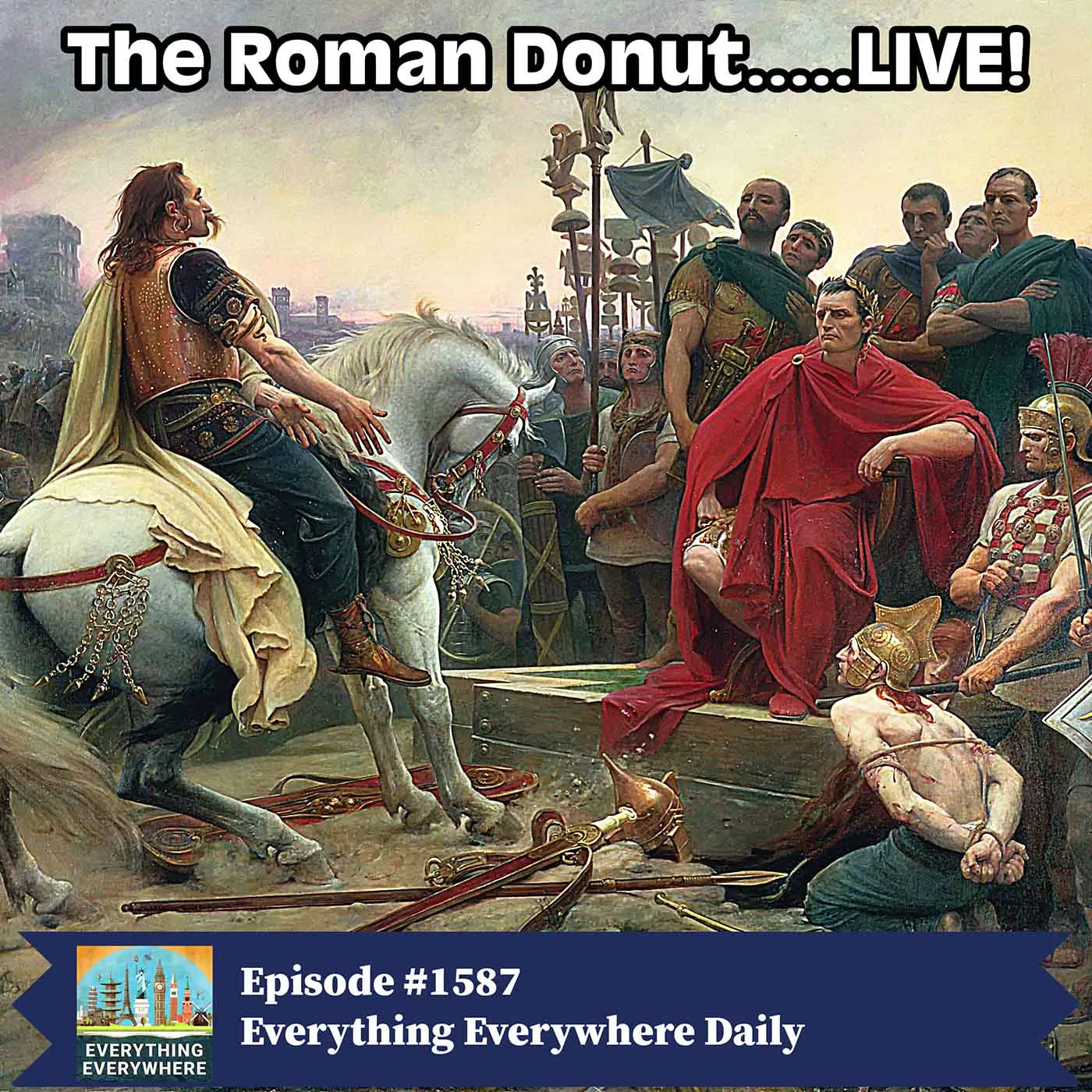
Everything Everywhere Daily: History, Science, Geography & More
The Roman Donut - LIVE!
00:16:08
This is the first episode of Everything Everywhere Daily to be recorded in front of a live audience.
Loading summary
Transcript22 lines
- [00:01]
Gary
Hey everyone, this is Gary and I.
- [00:02]
David
Wanted to let you know that this.
- [00:03]
Gary
Episode is very different than the episodes that you are used to. This is the very first episode of Everything Everywhere Daily that was recorded in front of a live audience. Last night, a local podcasting group had a night where podcasters were able to do live versions of their show and the time allotments for each podcast were about the same length as one of my episodes. So I just did an episode in.
- [00:24]
David
Front of the crowd.
- [00:25]
Gary
What also makes this different is that in addition to being in front of a live crowd, I did not use a script and it was all done in a single take. Everything was totally extemporaneous. So with that, enjoy the first live episode of Everything Everywhere Daily. This episode is sponsored by Butcherbox. Thanksgiving is right around the corner and that means Thanksgiving dinner for friends and family. A Thanksgiving dinner can be a massive ordeal and a nerve wracking affair. You have to buy all the food and spend the better part of the day preparing everything before serving it. So why not take one thing off your plate by letting Butcherbox take care of the centerpiece of your Thanksgiving meal. The turkey. Not only will Butcherbox deliver the turkey directly to your door, but they will also offer some of the highest quality turkeys that you can find. Their turkeys are never given antibiotics or hormones, and they're all certified to be raised humanely. And in addition to turkey, they also have ham, beef and seafood, if that's what you prefer. New Butcherbox members that sign up using my link will receive their choice between a whole turkey, turkey breast or a spiral ham, plus $20 off when they visit butcherbox.com daily and enter code daily at checkout. Once again, that's butcherbox.com daily code daily at checkout.
- [01:57]
Unknown
Bada bada boom. Sold.
- [02:00]
Huh?
- [02:00]
Just sold my car on Carvana. Dropping it off and getting paid today.
- [02:04]
Oh, ready?
- [02:05]
Gary
What?
- [02:05]
Unknown
You still haven't sold yours? You told me about it months ago.
- [02:08]
I just.
- [02:08]
Is the offer good?
- [02:09]
Oh, the offer's great.
- [02:11]
Don't have another car yet.
- [02:12]
I could trade it in for this car I love.
- [02:15]
Come on, what are we waiting for?
- [02:17]
Ah, you're right.
- [02:18]
Let's go.
- [02:19]
Whether you're looking to sell your car right now or just whenever feels right. Go to Carvana.com and sell your car the convenient way, turn and conditions apply.
- [02:30]
David
And when David asked me to do this, I thought of what am I going to talk about? And it came to me instantly. The Battle of Alesia. How many people here have heard of the Battle of Alysia. Excellent, because I can make everything up and none of you will know. Let me ask you another question. What month is it? November. What does November mean? It's my birthday. What does it mean? The ninth month. Except it's really the eleventh month, but it means the ninth month. Just like October is the eighth month. December is the tenth month. It all comes from ancient Rome. 30% of the words in the English language come directly from Latin, not from French, which is also a Romance language, which comes from Latin. So we rely heavily on that. Our calendar is the Gregorian calendar, which is a slight modification of the Julian calendar which Julius Caesar created. Actually, he lifted it from a guy called Cysogenes of Alexandria. But it's the calendar we have today. Our Alphabet is the Latin Alphabet. So the reason I'm bringing this up is because the Romans were horrible people, truly horrible people. And as I'll explain, Julius Caesar was a pretty horrible guy. If we were living in that area, instead of making analogies and comparisons to Hitler, we would make comparisons to Julius Caesar. But nonetheless, the world we live in was in large part in the west, created by Rome. And Rome was in three phases. There was the Roman Kingdom, which nobody ever talks about, the Roman Republic and the Roman Empire. And this story is at the tail end of the Roman Republic. And this is the part of history that gets all the attention. William Shakespeare wrote about Anthony and Cleopatra. He wrote the play Julius Caesar. All happened at the end of the Republic. The HBO series Rome, if you ever remember that, which is actually pretty good. End of the Republic, the movie Cleopatra, starring Elizabeth Taylor, Richard Burton. End of the Republic. All of the people that you may have heard of from this period come here. And this is fundamentally a story about Julius Caesar, the guy who killed the Republic. Caesar was incredibly ambitious, and this was an attribute which was encouraged in the Roman nobility. They had this thing called the Cursus Honorum, which was a series of elected positions that you went up throughout your life. You started at the age of about 30, and then you worked your way up. And then maybe by the age of 42, was the earliest age you could become the highest office in the land, which was consul. There were two consuls selected every year to check each other, and it was a one year term. And after your year as consul, they normally shift you off to the provinces where you can make a whole bunch of money by being corrupted. Caesar becomes consul, and afterwards he says, I want to become the governor of two provinces, Transalpine and Cisalpine. Gaul. And that basically means Gaul on this side and that side of the Alps and Gaul is what we would call today France. The Gauls scared the hell out of the Romans. In the year 390, a bunch of Gauls came into Italy and sacked Rome. And for three centuries the Romans told stories of the Gauls. That they were like, the boogeyman better be good or the Gauls are going to come and get you. And the Gauls were totally different than the Romans. The Romans were organized, they were cool. Collected the Gauls. Does anyone here remember a band called Molly Hatchet? Have you ever seen a cover of a Molly Hatchet album? Those were the Golls. They had the enormous mustaches, they had the double edged battle axes. If you've ever played a video game like Civilization or Age of Empires, they were the berserkers. When they fought, they were looking for individual glory. One on one combat. And to the Romans, what made them barbarians is that they wore trousers. Literally. To be a trouser wearer was to be a barbarian. And Caesar wants to go to this place. He gets there and he immediately picks a fight. There was a group called the Helveti and Helvetica, if you've ever heard the font, are named after these people, as is the name of Switzerland. In Swiss. In Swiss German. They're moving. And Caesar's like, oh well, you're violating a treaty. I guess I better attack you. And so he starts doing this and picking off all of these Gallic tribes one by one. And for six years he begins doing this with absolutely no approval from the Roman Senate. He just does it because he can make a lot of money and the people back home in Rome love it. He is defeating the boogeyman. These Gauls that 300 years earlier had sacked Rome. The Gauls were not one people. They were a whole bunch of individual tribes. And after getting their butts handed to them by Caesar for several years, they realize we need to do something. And so they come together and they choose a single leader to run their armies called Vercingetorix. Vercingetorix changes everything completely. He starts organizing raids against the Romans and Romans start losing territory. He does a pretty good job. But Caesar eventually corners Vercingetorix in a city known as Alesia in what is today France. Alesia is a well fortified town. It's up on a hill and Caesar surrounds it with about 40,000 men. With about equivalent number of men inside. Alesia is on a hilltop and it's well fortified. So rather than attack the town, what Caesar decides to do is I'm going to starve him out. And he builds a wall around Alesia, an 11 mile wooden wall to make sure that nobody ever escapes. Vercingetorix realizes what's happening here, so he sends out several units to try to confront the Romans while they're building the wall. Building the wall takes about three weeks and a couple of them manage to sneak past. But eventually the wall is built and they are completely surrounded. Vercingetorix is now playing a waiting game because there's a quarter million Gauls that can come to the rescue to fight the 60,000 Romans that are besieging Alesia. They just have to wait and have enough food. Problem is they do not have enough food. So eventually they make the decision to send the women, the children and the old people out of the gates of Alesia, figuring that Caesar will do the reasonable thing and let them pass. I told you Caesar was a bastard. And he does not. He lets them starve. And they're stuck between the walls of the city of Alesia and the walls that they built. But Vercingetorix decided they needed walls for their war or they needed the food for their warriors if this was ever going to happen. Because they needed to wait for this huge army to arrive. Caesar catches wind that this enormous army was going to arrive to wipe out the Romans. A quarter million men to fight about 40 to 60,000 Romans. Now the question is, what would you do? You're besieging these people over here and now all of a sudden you have a massively superior force coming to attack you. What do you do? I contend that 99 times out of 100 from a general in history, doesn't matter what point in history you're going to retreat. We can't do these things. We don't have enough people. We're outnumbered. We're going to pull back, fight another day. But not Caesar, because he's incredibly ambitious and incredibly lucky. So we talked. So when David introduced me, he talked about a roman donut, that 11 mile wall that surrounded Alesia. Caesar built a 13 mile wall around the other wall and the Romans were inside the two walls, creating the Roman donut. Now, in many times in history, an army may have been surrounded. The United States, 101st Airborne during the Battle of the Bulge and Bastogne was surrounded by the Germans. Happens many times. This is the only time I can think of in history where an army was surrounded and then inside the surrounding had another army. So it was a doughnut filled with Romans. So the day eventually arrives where the other army shows up. And they got a lot of guys, but they had built the wall by then. They had enough time to do it. And they start attacking. And Vercingetorix sees what's happening. And he leaves the city of Alesia and starts attacking. And Caesar is putting out fires everywhere. They're attacking this part of the wall. He's moving people all over, all the time. He is personally taking part in all of these battles, getting people to go from here to there. One of his top lieutenants was Mark Antony, a guy you've probably heard of from history. He's leading troops here and there. Two separate occasions, Vercingetorix tries to take his units out of Alesia, attack the wall, and they fail. Finally, on their third attempt, Caesar realizes that they cannot be doing this forever. Being in a Roman donut is not a good place to be. We have enemies on the outside and the inside. So they attack again. And Caesar decides, okay, this is what we're going to do. They do a massive cavalry attack. They leave the outer wall. They attack the rear of the big army that came to visit them, and they crush the Gauls. Being in a Roman donut inside a wooden fence, he defeats this larger army. And the next day, Vercingetorix surrenders. Gaul basically ceases to exist and becomes a province of Rome. Caesar writes about this. The Commentaries of Caesar are the oldest known autobiography in history that we know was written by the person who participated in the events. Granted, it was all propaganda designed for the Roman people, but we're very confident that he wrote this. He wrote it in the third person. He referred to himself as Caesar, describing all the events that happened. The Roman people go nuts. They think that this is just swell. The Gauls, this boogeyman that has confronted Rome for 300 years, have been defeated. The Senate provides games, but they do not provide Caesar the one thing that he wants. The highest honor that can bestowed upon any Roman general. A triumph. And over the next two years, this causes a political conflict between Caesar and the Senate, who quite frankly, don't like Caesar, because everything he did was never approved by the Senate. He became fantastically wealthy, became the richest man in Rome, and has a whole bunch of legions that are now loyal just to him him. Two years later, Caesar ends up going to Rome to make his claim. Crosses the Rubicon, something I'm sure you're familiar with. Claims that the die is now class. Marched on Rome. There's a civil war. Caesar wins. He's declared dictator for life. Stab. Stab. Stab by Brutus. There's another civil war with Octavian and Marc Anthony and it creates the Roman Empire. They take over everything around the Mediterranean, eventually it collapses in the west, blah blah blah blah blah. But the world we live in today is by and large a result of the crazy decision made by Julius Caesar to make a Roman donut.
- [15:09]
Gary
The executive producer of Everything Everywhere Daily is Charles Daniel. The associate producers are Benji Long and Cameron Kiefer. I want to give a big shout out to everyone who supports the show over on Patreon, including the show's producers. Your support helps me put out a show every single day and also Patreon is currently the only place where Everything Everywhere Daily merchandise is available to the top tier of supporters. If you'd like to talk to other listeners of the show and members of the Completionist Club, you can join the Everything Everywhere Daily Facebook group or Discord server. Links to Everything are in the show Notes.