Loading summary
Transcript1 lines
- [00:01]
A
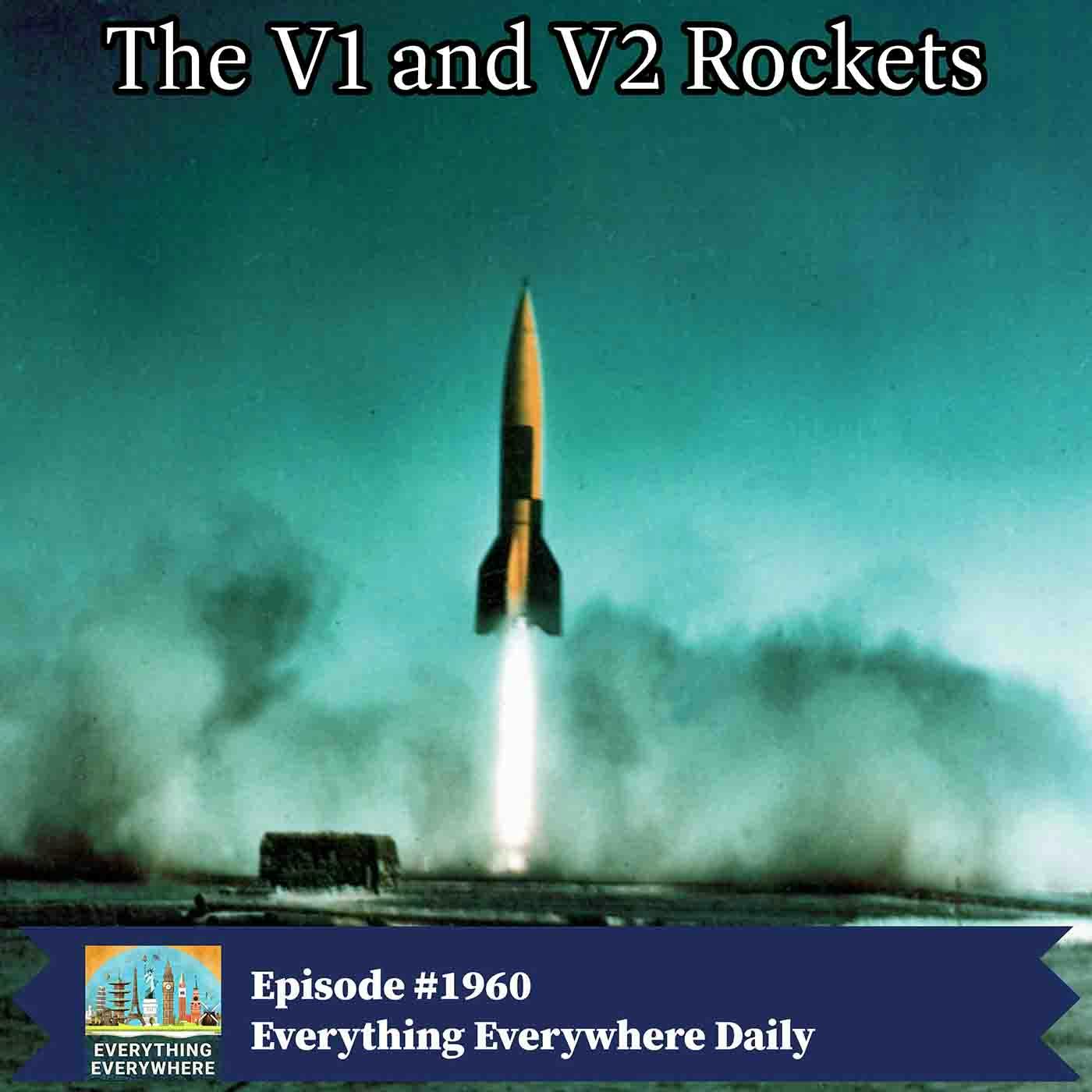
The Second World War saw the development of many new weapons, but perhaps none was more terrifying than the development of long range strategic rockets. Rockets had been used in combat for centuries, dating back to their development in ancient China. However, the rockets developed by Germany were a different matter altogether. They terrorized civilians and actually served as the starting point of the space race. Learn more about the V2 rocket and the Nazi rocket program on this episode of Everything Everywhere Daily. This episode is brought to you in part by Stash. What if you could start investing without ever picking a single stock? With Stash, the experts handle the hard part for you. Stash just isn't another investing app. It's a registered investment advisor that combines automated investing with expert guidance so you don't have to worry about figuring it out on your own. You can choose from personalized investments or let Stash's award winning smart portfolio do the work for you. With Stash, investing doesn't feel like gambling. It's simple, smart and stress free so your money can finally start working as hard as you do. Get access to world class financial advice with personalized guidance for just a $3 monthly subscription. Stash has already helped millions of Americans reach their financial goals. Don't let your money sit around. Put it to work with stash. Go to git.stash.com everything to see how you can receive $25 towards your first stock purchase and a view important disclosures. That's git.stash.com everything paid non client endorsement, not representative of all clients and not a guarantee. Investment advisory services offered by Stash Investments LLC and SEC Registered Investment Advisor Investing involve risk offer is subject to T's and C's. This episode is sponsored by Uncommon Goods. The holiday shopping season is officially here. Uncommon Goods takes the stress out of gifting with thousands of unique, high quality finds you won't see anywhere else. Don't wait because the most meaningful gifts get scooped up fast and now is the perfect time to cross names off your list. Uncommon Goods looks for high quality, unique products, often handmade or made in the United States. Many are crafted by independent artists and small businesses, making every gift feel meaningful and truly one of a kind. I've already told you about the cheese board I got on Uncommon Goods, but another cool item I found was a wall hanging made from wood that reproduces the sound wave of your favorite song or podcast. So don't wait. Cross those names off your list before the rush. To get 15% off your next gift, go to UncommonGoods.com daily. That's UncommonGoods.com daily for 15% off. Uncommon Goods were all out of the ordinary. The roots of the Nazi rocket program stretch back to the 1920s, when Germany's defeat in World War I and the treaty of Versailles severely restricted conventional weapons development. This created an unexpected opportunity for experimental weapons research. A young engineer named Wernher von Braun became fascinated with rocketry through his involvement with the German Society for Space Travel, where amateur enthusiasts conducted primitive rocket experiments fueled by dreams of space exploration. The German military, particularly the Army Ordnance Office under Captain Walter Dornberger, recognized the potential of rockets as a means to circumvent treaty restrictions. Unlike artillery, rockets were not explicitly prohibited. In 1932, the military hired von Braun, then only 20 years old, to develop liquid fueled rockets for military purposes. This partnership between von Braun's technical genius and the army's funding would prove transformative. Though it required von Braun and his team to subordinate their space travel dreams to weapons development. By 1937, the program had grown sufficiently important to warrant a dedicated facility. The military established a secret research center at Peenemundi, on a remote island in the Baltic Sea. This isolated location provided both security and space for testing increasingly powerful rockets. Under von Braun's technical leadership and Dornberger's military direction, the team expanded to eventually include thousands of engineers, scientists and technicians. The PanEM1D team's work progressed through a series of increasingly sophisticated prototypes or aggregate test vehicles, from A1 to A3 to reach the A4. The A4 rocket, which would later become known as the V2, represented the culmination of years of development. V2 stood for Vergeltensswafe Zwei, or Vengeance Weapon 2. October 3, 1942. The team achieved a historic milestone when an A4 successfully reached an altitude of 53 miles and traveled 118 miles downrange. This marked the first time a human made object had reached space. Defined as the boundary beyond the Earth's atmosphere, the V2 was a revolutionary weapon system. Standing 46ft tall and weighing over 27,000 pounds at launch, it was powered by liquid oxygen and alcohol fuel that generated 56,000 pounds of thrust. The rocket could carry a one ton warhead approximately 200 miles at speeds exceeding 3,500 miles per hour faster than the speed of sound. Crucially, this supersonic speed meant that, unlike conventional aircraft, the V2 arrived without warning, giving no opportunity for evacuation or defensive measures. The technology represented an extraordinary leap forward. The V2 required sophisticated guidance systems, fuel pumps capable of handling volatile propellants, engines that could withstand extreme temperatures, and Pressures and a structure that was both light enough to fly, yet strong enough to survive launch stress. Von Braun's team solved problems that had never been encountered before and essentially invented the field of modern rocketry through trial and error. While the v2 development proceeded, the German military pursued a parallel program for a simpler, cheaper weapon. The V1 took an entirely different technological approach. Rather than a true rocket, the V1 was essentially an unmanned cruise missile powered by a pulse jet engine. The V1 resembled a small aircraft, measuring approximately 25ft in length with a wingspan of 17ft. Its pulse jet engine produced a distinctive buzzing sound, earning it the nickname Buzz, Buzz Bomb and doodlebug. Amongst allied populations, the V1 carried a 1,870 pound warhead and could travel approximately 150 miles at speeds of around 400 miles per hour. Fast for the era, but far slower than a V2. The V1 was designed for simplicity and mass production. Unlike the complex V2, the V1 used relatively straightforward technology that could be manufactured in large quantities at a lower cost. It was typically launched from fixed ramps using a catapult system, although some were air launched from modified bombers. A simple guidance system based on a preset compass heading, an airspeed indicator and a counter tracking distance meant the V1 could only be aimed at large area targets such as cities. Both weapon systems were developed with specific strategic purposes that evolved as Germany's military situation deteriorated. Initially conceived as tactical weapons that might support military operations, the V weapons increasingly became instruments of terror intended to break civilian morale and force Allied governments to negotiate. Adolf Hitler became personally obsessed with these wonder weapons, or wunderwaffen. Believing they could reverse Germany's declining fortunes, he envisioned massive bombardments that would devastate London and other Allied cities, forcing Britain out of the war. This political pressure led to premature deployment and unrealistic expectations about the weapon's impact. The V1 Campaign began on June 13, 1944, just one week after the Allied D Day landings in Normandy. Launch sites in occupied France began firing V1s towards England, primarily targeting London. This was the beginning of the second Blitz. I previously did an episode on the first and second Blitz. If you want to hear the story of the Blitz from the British perspective, the campaign intensified throughout the summer of 1944 with thousands of V1s launched. While many were shot down by fighters, anti aircraft guns or barge balloons, significant numbers reached their targets, causing substantial civilian casualties and damage. The first V2 attacks followed on September 8, 1944, striking Paris and London. Unlike the V1, the V2 was virtually impossible to defend against with existing technology. Because the rockets couldn't be stopped, the only defense was to destroy launch sites or disrupt the supply chain. The story of the V weapons cannot be told without acknowledging the horrific human cost of their production. As Allied bombing disrupted German industry and the military demanded accelerated production of weapons, the Nazi regime increasingly relied on slave labor from concentration camps. The most notorious production facility was at the Mittelwerk factory, located in the vast underground tunnels near Nordhausen in the Harz Mountains. This facility was connected to the Middle Bow Dora concentration camp, where tens of thousands of prisoners were worked to death under appalling conditions. Prisoners labored in the damp, unventilated tunnels, assembling rockets while suffering from starvation, disease, and brutal treatment by SS guards. The death toll among concentration camp workers who built the V weapons exceeded the number of people killed by the weapons themselves. Estimates suggest that more than 20,000 prisoners died producing V2 rockets. While the V2 attacks killed approximately 9,000 people, including around 5,000 in Britain and 4,000 in continental Europe, most notably in Belgium, the V1 caused roughly 6,000 deaths in Britain. Wernher von Braun and other senior engineers were aware of the conditions and visited production facilities where slave labor was employed. The extent of their complicity became a deeply controversial issue in the postwar years. Despite Hitler's hopes and the amount of resources invested, the V weapons failed to achieve their strategic objectives. Neither weapon was accurate enough to strike military targets effectively, and while they caused civilian casualties and damage, they did not break British morale or significantly affect the war's outcome. Each V2 required enormous resources to produce and launch, yet carried only a single 1 ton warhead, far less destructive than what a conventional bomber aircraft could deliver in a single raid. From a purely military standpoint, Germany would have been better served by dedicating those resources to fighter aircraft or other conventional weapons. In total, between September 1944 and March of 1945, approximately 3,000 V2s were launched, primarily against London, Antwerp and other targets. The attacks continued until advancing Allied armies overran the launch sites. The final V2 struck Britain on March 27, 1945, and the campaign ended when British forces captured the launch areas in the Netherlands. However, this was not the end of the V2 story. As Germany collapsed in early 1945, both American and Soviet forces raced to capture German rocket technology and personnel. The advancing armies discovered vast quantities of equipment to documents and partially assembled rockets. Along with the scientists who had created them, Wernher von Braun and his core team of engineers made a calculated decision to surrender to American forces rather than Soviets. Von Braun correctly reasoned that the Americans would be more interested in their technical knowledge and more likely to allow them to continue rocket development. In May of 1945, von Braun and approximately 120 key members of his team surrendered to American forces. The United States military, recognizing the strategic value of German rocket expertise, initiated Operation Paperclip, a secret program to bring German scientists to America, which was the subject of a previous episode. The operation's name derived from the paperclips attached to the files of those selected for recruitment. American officials downplayed or deliberately obscured the Nazi affiliations and war records of many participants to facilitate their immigration. Over the following years, more than 1,600 German scientists, engineers and technicians were brought to the United States under Operation Paperclip and related programs. Von Braun and his rocket team were initially stationed at Fort Bliss, Texas, where they worked with captured V2 rockets and trained American personnel. In 1950, they relocated to Redstone Arsenal in Huntsville, Alabama, where they would develop a new generation of missiles and rockets for the US Military. Meanwhile, the Soviet Union captured its own contingent of German rocket specialists, along with manufacturing equipment and technical documentation from facilities in the eastern occupation zone. Soviet engineers, led by Sergei Korolev studied the V2 rocket intensively and utilized German expertise to jumpstart their own rocket program. Although they relied more heavily on domestic talent than the Americans did, the long term impact of the Nazi rocket program far exceeded its wartime effectiveness. The V2 represented the world's first ballistic missile and the first human made object to reach space. That technology and expertise developed at Peenemundi became the foundation for both the Cold War missile programs and the space race in the United States. Von Braun emerged as the public face of space exploration. His team developed the Redstone Jupiter and eventually the Saturn series of rockets. The Saturn V, which carried Apollo astronauts to the moon, was a direct technological descendant of the V2. Although vastly larger and more sophisticated. Von Braun's transformation from weapons developer to space visionary was aided by aggressive public relations efforts that glossed over his Nazi past and his use of slave labor. The Soviet Union's rocket program, similarly built on V2 foundations, produced the R7 Semyorka, which launched Sputnik in 1957, and Yuri Gagarin in 1961, making him the first human in space. The V2 also established ballistic missiles as a central element of modern warfare. Both superpowers developed increasingly powerful intercontinental ballistic missiles that extended the principles that von Braun's team had pioneered. The doctrine of mutually assured destruction, which defined Cold War strategy, rested on delivery systems that traced their lineage directly to the rockets developed at Peenemundi. In a very real sense, all modern rocketry, for better or worse, can trace its lineage back to the Nazi rocket program, the same program that killed thousands and terrorized millions. The executive producer of Everything Everywhere Daily is Charles Daniel. The associate producers are Austin Otkin and Cameron Kiefer. My big thanks go to everyone who supports the show over on Patreon. Your support helps make this podcast possible, and I also want to remind everyone about the community groups on Facebook and Discord. That's where everything happens that's outside the podcast, and links to those are available in the show notes. As always, if you leave a review on any major podcast app or in the above community groups, you too can have it read on the show.