← Everything Everywhere Daily: History, Science, Geography & More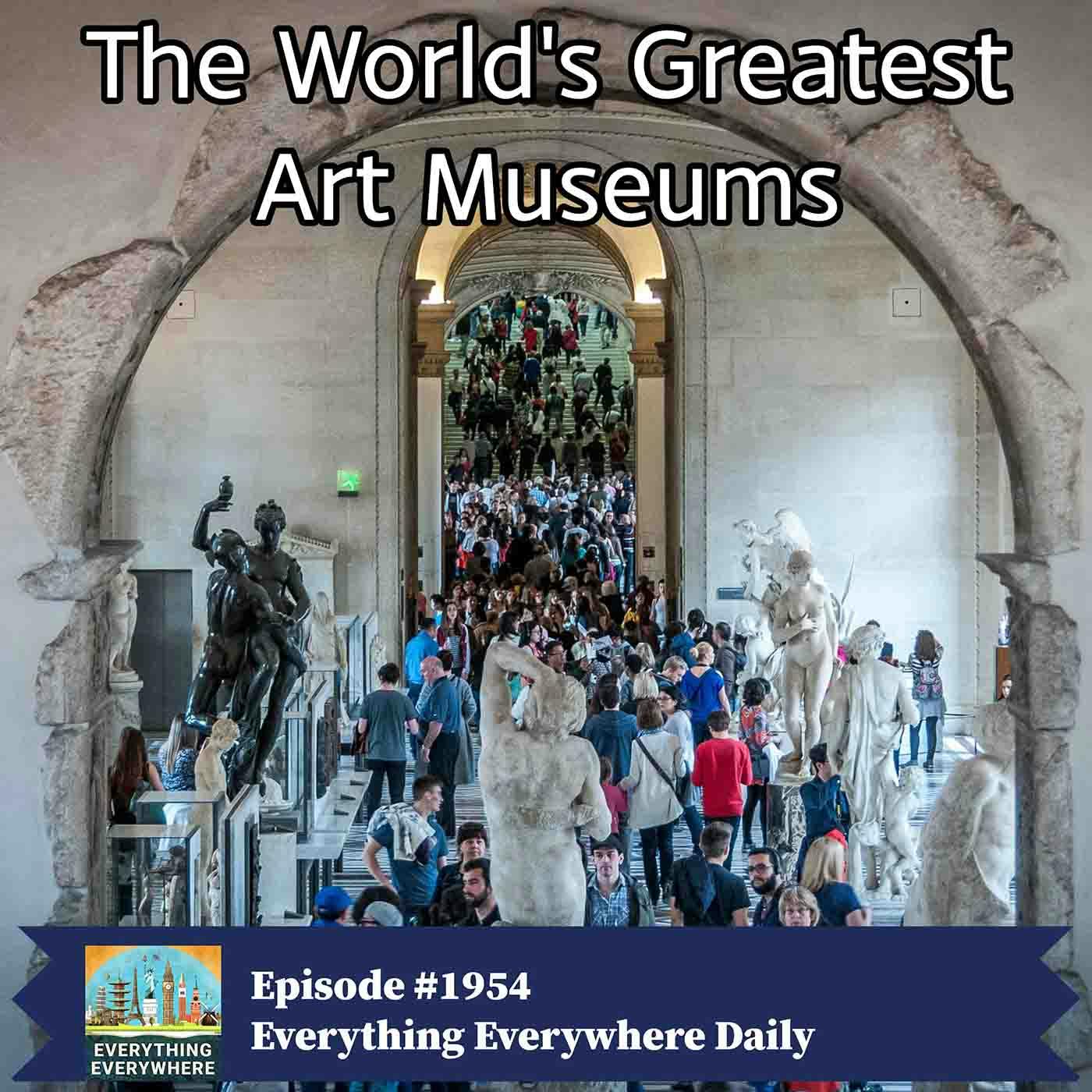
Everything Everywhere Daily: History, Science, Geography & More
The World's Greatest Art Museums
00:14:21
Loading summary
Transcript1 lines
- [00:00]
A
For thousands of years, human beings have created works of art. Many of these works were commissioned by monarchs, merchants or religious leaders. Over time, many of these great works have found their way into the hands of art museums. Museums allow everyone to enjoy and appreciate art that's been produced around the world over the course of centuries. However, not all museums are created equal. Learn more about the world's greatest art museums and what makes them great. I On this episode of Everything Everywhere Daily this episode is sponsored by Quints. The holiday season is upon us and that means buying gifts for friends and family. So why not get something that's top tier but affordable? That's where Quince comes in. Quince has great items like $50 Mongolian cashmere sweaters that feel like an everyday luxury and wool coats that are equal part stylish and durable. And you'll pay a fraction of what you would from other retailers and their prices are literally listed on the Quince website. I just got an Australian merino wool sweater that looks great and cost only half of what it would have if I had bought it somewhere else. By partnering directly with ethical factories and top artisans, Quince cuts out the middleman to deliver premium quality ET at half the cost of similar brands and often even bigger discounts. Give and get timeless quality staples that last this season with quince. Go to quince.com daily for free shipping on your order and 365 day returns. Now available in Canada too. That's Q-U-I-N-C-E.com daily free shipping and 365 day returns. Quince.com daily. This episode is sponsored by Uncommon Goods. The holiday shopping season is officially here. Uncommon Goods takes the stress out of gifting with thousands of unique, high quality finds you won't see anywhere else. Don't wait because the most meaningful gifts get scooped up fast and now is the perfect time to cross names off your list. Uncommon Goods looks for high quality, unique products, often handmade or made in the United States. Many are crafted by independent artists and small businesses, making every gift feel meaningful and truly one of a kind. I've already told you about the cheese board I got on Uncommon Goods, but another cool item I found was a wall hanging made from wood that reproduces the sound wave of your favorite song or podcast. So don't wait. Cross those names off your list before the rush. To get 15% off your next gift, go to UncommonGoods.com daily. That's UncommonGoods.com daily for 15% off. Uncommon Goods were all out of the ordinary this episode is going to be a bit different. I want to go over the world's greatest art museums, which is an inherently subjective exercise. You may have your own list and recommendations for what should be included, and that's fine. There's no right or wrong when it comes to something like this. And if I should leave off a museum that you love, feel free to leave a comment on Facebook, Discord or Spotify. I do have one thing going for me, however, in terms of making such a list, and that is I've personally been to most of them. If you search for greatest art museums, you'll come up with a list that isn't radically different than mine. There's a fair amount of consensus on the subject, although it's not perfect. Most of these museums are situated in major world cities. That is because to assemble a world class art collection at some point someone had to procure everything, and that usually required a king, an emperor, a pope, or one or more very wealthy merchants. It also probably required several generations of art collecting. I'm evaluating museums based on the breadth and depth of their collection. That means that there are great museums that are certainly worth visiting, but just didn't make this particular list. Also, they are in no particular order. Making the list was challenging enough and I didn't want to start ranking it on top of that. And I'll also note that every item on my list is a museum I've personally visited. So with that, let's start in Asia. And to be honest, there are not a lot of museums on my list from Asia. The first is the National Palace Museum in Taiwan. You might wonder why I'd put a museum in Taiwan over, say, a museum in mainland China. The National Palace Museum in Taipei traces its origins to the imperial art collection of China's emperors, which had been housed for centuries in Beijing's Forbidden City. After the fall of the qing dynasty in 1911, these treasures were nationalized by the Republic of China. They form the core of the palace museum, established in 1925 within the former Imperial Palace. During the Second Sino Japanese War, the thousands of the most valuable objects were evacuated from Beijing to protect them from bombing and looting moving across China throughout the 1930s and 40s. When the Chinese civil war turned against the Nationalists in 1948 and 1949, about 600,000 of the most important pieces were secretly shipped to Taiwan for safekeeping. These works form the foundation of the National Palace Museum in Taipei, which opened in 1965 and preserves one of the world's richest collections of Chinese art, spanning over 8,000 years. Two of the most famous items in their collection are the meat shaped stone and the jadeite cabbage. These are literally a piece of stone that looks like a piece of pork belly and a piece of jadeite that looks like a Napa cabbage. They're way more famous in China and Taiwan than they are in the West. The next great museum is in Africa, and I have to put a slight asterisk next to it. The Egyptian Museum in Cairo. The Egyptian Museum is in the heart of Cairo on Tahrir Square and has the largest collection of Egyptian artifacts in the world. The building dates back to 1902 and it's the classical old school encyclopedic museum. The reason I put an asterisk next to this is that the Grand Egyptian Museum recently opened in Giza near the pyramids. This is a brand new building and features many of the mummies of the pharaohs. They actually had a large parade to transport the mummies, which can be seen on YouTube and is kind of interesting. The reason why I put an asterisk next to this one is that I have not been to the Grand Egyptian Museum, but I did visit the Egyptian Museum, which had all the artifacts before the Grand Egyptian Museum opened. If you want to see the artifacts from King Tut's tomb, for example, they are now on display in the Grand Egyptian Museum. The next museum on my list would be the Vatican Museum. The Vatican museum originated in 1506 when Pope Julius II acquired the ancient marble sculpture Laocoon and his sons discovered in a Roman vineyard and placed it on public display in the Belvedere courtyard of the Vatican. That act is often regarded as the birth of the collection. Over the centuries, successive popes expanded it through archaeological finds, papal commissions and purchases, creating one of the world's greatest repositories of art and antiquities. The collection features masterpieces by Michelangelo, Raphael, Leonardo da Vinci and Caravaggio, along with extensive holdings of classical sculpture and ancient artifacts. There are other great museums in Rome as well, such as the Galleria Borghese and the Capitoline Museum. The other great museum in Italy on the list is the Uffizi Gallery in Florence. The Uffizi gallery originated in 1560 when Duke Cosimo de Medici commissioned Giorgio Vasari to design offices, or uffizi in Italian, for Florentine magistrates along the Arno River. Over time, the upper floors of the building were used by the Medici family to display their vast art collection, and in 1769, the gallery was formally open to the public, making it one of the first Modern Museums the Uffizi holds one of the world's greatest collections of Renaissance art, featuring masterpieces such as Botticelli's the Birth of Venus and Primavera, Leonardo da Vinci's Annunciation, Michelangelo's Donitando, Raphael's Madonna of the Goldfinch, Titian's Venus of Urbino, and works by Caravaggio and Rembrandt. Its collection charts the evolution of Italian painting from the Middle Ages through the Baroque era and stands as a testament to Florence's central role in art history. The museum and its collection were given to the state of Tuscany by Anna Maria Luisa de Medici in 1743 in her will. The Galleria dell' Accademia in Florence is also worth visiting because it has Michelangelo's David, but its collection drops off quickly after that. The next museum on my list would be the Prado in Madrid, Spain. The Prado was founded in 1819 as the Royal Museum of Paintings and Sculptures, originally conceived by King Charles III but opened under King Ferdinand VII and Qu Maria Isabella de Braganza to showcase Spanish royal art collections. Housed in a neoclassical building, the Prado became Spain's premier art museum and one of the world's finest. Its collection is focused on European paintings from the 12th to the early 20th centuries, featuring a collection of Spanish masters including Velazquez, Goya, El Greco and Murillo, as well as significant works by Titian, Rubens, Bosch and Raphael. Among its most famous pieces are Las Meninas by Velazquez, Goya's 3 May 1808 and the nude, Maggia Bosch's the Garden of Earthly Delights and Titian's Emperor Charles V at Muhlberg. Also receiving honorable mention in Madrid is the Museo Renia Sofia, known for its modern art, including Picasso's famous painting Guernica and the Thisian Bornamisa Museum. The next museum should be one of the most obvious on the list, the Louvre in Paris. I've dedicated an entire episode to the Louvre, but suffice it to say it's the largest museum in the world and also houses the Mona Lisa, the most famous painting in the world. If you ever visit, plan on spending the entire day there. You won't come close to seeing everything. Not on the list, but well worth visiting is the nearby Musee d', Orsay, which primarily features French art from 1848 to 1914, which overlapped with the Impressionist period. One of the best cities in the world for museums has to be London, and the best museum in London is the British Museum. The British Museum was founded in 1753 as the first national public museum in the world, established by an act of Parliament to house the vast collection of the physician and naturalist Sir Hans Sloane, who had amassed around 80,000 objects spanning natural history, antiquities and manuscripts. It opened to the public in 1759 in Montague House, which was later replaced by the current neoclassical building designed by Sir Robert Smirk. Over the following centuries the museum expanded through exploration, archaeology, imperial acquisition and good old fashioned just taking stuff from other people. Its most famous holdings include the Rosetta Stone, the Parthenon marbles, Egyptian mummies, the Assyrian release from Nineveh, the Sutton Hoo Anglo Saxon artifacts and the Lewis Chessman. There are other great museums in London as well, including the Victoria and Albert, the National Portrait Gallery and the Tate Modern. There are actually over 250 museums in London, most of which have a pretty niche focus. The next museum is in another great museum city, the the Rijksmuseum in Amsterdam. The Rijksmuseum was founded in 1800 in the Hague as the National Art Gallery to display the Dutch Republic's most important art and historical objects. Later moving to Amsterdam in 1808, its world renowned collection includes masterpieces of the Dutch Golden Age such as Rembrandt's the Night Watch, Vermeer's the Milkmaid and the Woman Reading a Letter, Franz Hall's the Merry Drinker and works by Jan Steen and Van Gogh. Other worthwhile museums in Amsterdam include the Van Gogh Museum and the Stedelijk Museum. Before I mention the last museum on my list, I want to highlight several museums that also might be worthy of inclusion, but I haven't listed them simply because I haven't visited them. And the most obvious is the Hermitage in St. Petersburg, Russia. I was outside the Hermitage and I had every intention of visiting, but the lines were so long when I was there that I didn't have enough time before I had to get back on my ship. If you're interested in the Hermitage, I'd recommend the movie Russian Ark. It was shot inside the museum and it's notable because the entire movie was filmed in a single take. I also haven't been to the National Museum of China in Beijing, which is also probably worthy of inclusion. The last museum on my list is the only one that I'm putting on from the entire Western hemisphere, and that is the Metropolitan Museum of Art in New York City. I think there's an argument to be made that the Met might be the world's greatest art museum. The Metropolitan Museum of Art was founded in 1870 by a group of American businessmen, artists and philanthropists, including John Jay and William Cullen Bryant, with the goal of bringing art and art education to the American public. It opened in 1872 in a small building on Fifth Avenue before expanding into its current complex along Central Park. Today, it's one of the largest and most comprehensive museums in the world, with over 2 million works spanning 5,000 years of global culture. The reason why I think the Met is superior to many European museums is that the items weren't collected during a single period of time, and they don't reflect a single country or region of origin. As a result, the Met collection is far more diverse and varied than any other great museum. They have paintings by the great masters, but they also have indigenous art from the South Pacific. They have a bit of everything which really can't be said for any other museum at this level. Strong honorable mentions to other American museums go to the Art Institute of Chicago, the National Gallery of art in Washington, D.C. the Museum of Modern Art and the Guggenheim in New York City, the Museum of Fine Arts in Boston, the Philadelphia Museum of Art, and of course, the Getty in Los Angeles. Some of you may have visited some of the museums that I've mentioned, while others may have never even set foot in any of the cities or even countries that host these museums. My recommendation is to visit what you can Most reasonable sized cities have something, and what they have can often be surprising. When I lived in Minneapolis, I visited the Minneapolis Institute of Art about every other month and I learned a great deal by just simply showing up and browsing. But if you should ever happen to find yourself in a city with any of the museums I've listed, you definitely owe it to yourself to pay a visit. The executive producer of Everything Everywhere Daily is Charles Daniel. The associate producers are Austin Otkin and Cameron Kiefer. My big thanks go to everyone who supports the show over on Patreon. Your support helps make this podcast possible, and I also want to remind everyone about the community groups on Facebook and Discord. That's where everything happens that's outside the podcast, and links to those are available in the show notes. As always, if you leave a review on any major podcast app or in the above community groups, you too can have it read on the show.