Loading summary
Transcript11 lines
- [00:00]
Charles Daniel
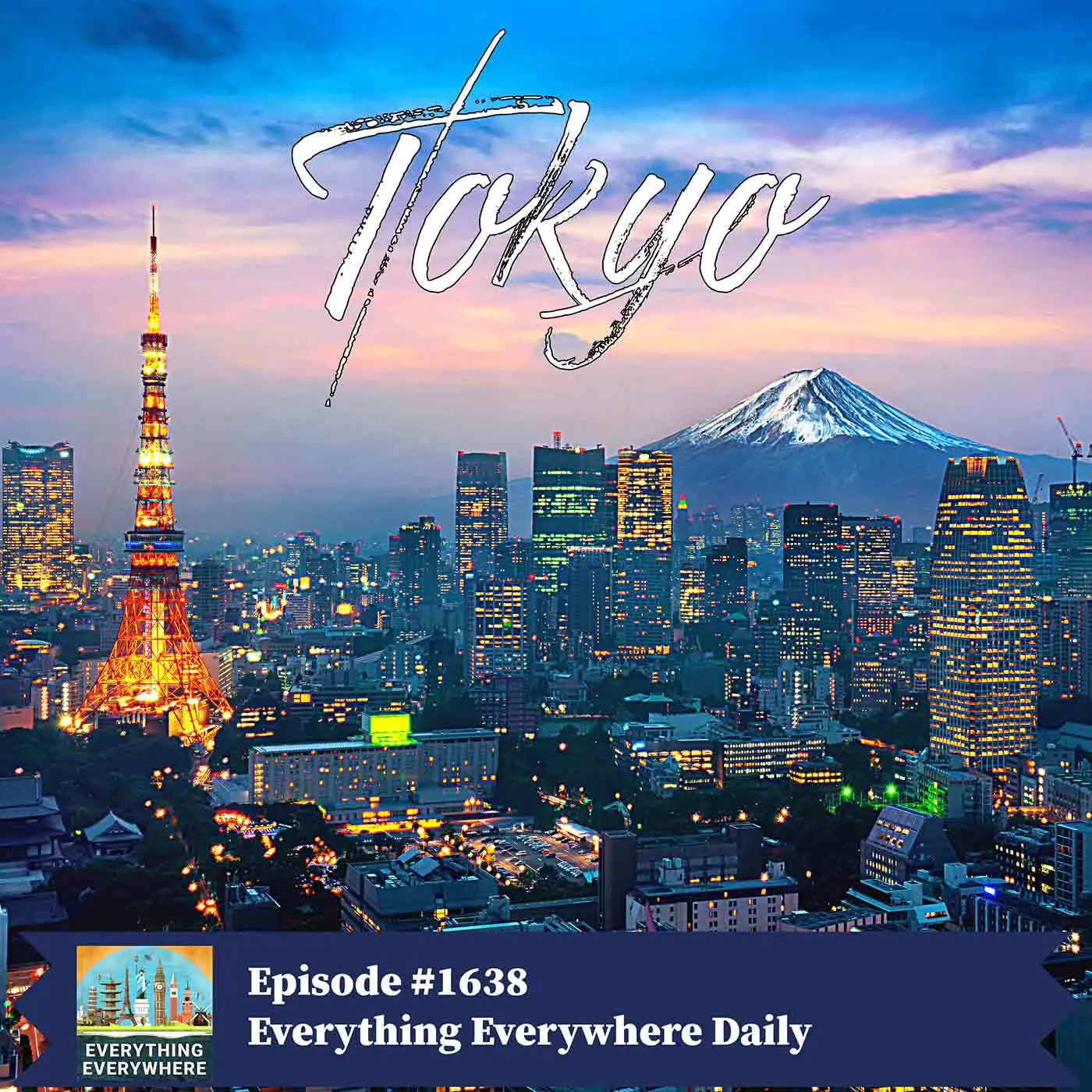
Tokyo, Japan is currently the largest city in the world with a metropolitan population of over 37 million people. However, that wasn't always the case. In fact, unlike many great cities of the world, Tokyo's roots do not go back to ancient times. Its importance as a city is relatively recent. Historically speaking, it was almost completely destroyed several times, yet has come back to become a major center of technology, culture and finance. Learn more about Tokyo and how it became the most populous city in the world on this episode of Everything Everywhere Daily.
- [00:46]
Benji Long
Wow.
- [00:47]
Cameron Keever
What's up?
- [00:47]
Benji Long
I just bought and financed a car through Carvana in minutes.
- [00:50]
Cameron Keever
You, the person who agonized four weeks over whether to paint your wall's eggshell or off white, bought and financed a car in minutes.
- [00:57]
Benji Long
They made it easy, transparent terms, customizable, down and monthly. Didn't even have to do any paperwork.
- [01:03]
Cameron Keever
Wow.
- [01:03]
Charles Daniel
Mm.
- [01:05]
Benji Long
Hey, have you checked out that spreadsheet I sent you for our dinner options?
- [01:09]
Cameron Keever
Finance your car with Carvana and experience total control financing subject to credit approval.
- [01:16]
Charles Daniel
This episode is sponsored by Mint Mobile. After years of fine print contracts and getting ripped off by overpriced wireless providers, if we've learned anything is that there's always a catch. So when I heard that all Mint Mobile wireless plans are $15 a month when you purchase a three month plan, I thought, what's the catch? Well, there isn't one. Mint Mobile's secret sauce is that they sell wireless services online. They don't have retail stores or salespeople. I recently moved my phone to Mint Mobile and it was super easy. I didn't have to go into a store. And here's the best part. I'm using the exact same cell towers and network that I was using before, along with the exact same phone and same phone number to get this new customer offer and your new 3 month unlimited wireless plan for just $15 a month, go to mintmobile.comed that's mintmobile.comeed cut your wireless bills to 15 bucks a month at mintmobile.comed $45 upfront payment required, equivalent to $15 a month new customers on first 3 month plan only speed slower above 40gb on unlimited plan. Additional tax fees and restrictions apply. See Mint Mobile for details. Tokyo's story is very different from that of other great cities of the world. Many of the world's greatest cities have a history going back thousands of years, during which time they served as a capital or at least some sort of seat of power. Not only was Tokyo not a capital for most of Japanese history, but it also wasn't even a city for most of that time. Tokyo is located on the southeastern part of the island of Honshu, Japan's largest island, and on the northwest edge of Tokyo Bay. It lies within the Kanto Plain, one of Japan's most expansive lowland areas, providing ample space for its sprawling metropolitan development. Surrounded by mountains to the west and bordered by water to the east, its strategic position on the bay made it a vital hub for trade and transportation. Historically, its importance was its location on the Edo river, which empties into Tokyo Bay. The ancient history of Tokyo begins with evidence of human habitation during the Jomon pre civilization period dating back about 6,000 years, when Hunter gatherer communities lived in the region. Archaeological discoveries, including shell mounds, pottery fragments and pit dwellings, suggested that the area was a thriving settlement during this time, benefiting from the abundant natural resources of the Kanto Plain. By the Yayoi period, which lasted from 300 BC to the year 300, wet rice farming and metal tools were introduced, leading to more permanent settlements in the area. However, Tokyo remained relatively unimportant during the Japanese ancient periods, overshadowed by political and cultural centers in the Kansai region such as Nara and Kyoto. Around the year 1200 was the first reference to a village in the location of modern Tokyo. The village was called Edo. Edo was a small, largely unremarkable fishing village located on the marshy edges of what is now Tokyo Bay. Its strategic location at the confluence of rivers and its proximity to the fertile lands of the Kanto Plain made it an ideal, if underdeveloped, site. Edo's Transformation began in 1457 when Ota Dokan, a samurai and military engineer, constructed Edo Castle as a fortified base. This marked the beginning of Edo's development as a regional stronghold, but it remained a modest settlement for another 150 years. The fate of the village of edo changed in 1590 when Tokugawa Ieyasu made Edo his base of operations. Tokugawa Ieyasu was a warlord who would go on to unify the warring factions in Japan. After his victory, he was appointed Shogun of Japan by the Emperor in 1603, and Edo became the de facto capital of Japan. Under the Tokugawa Shogunate, the imperial capital remained in Kyoto, but the Emperor was a puppet figure at this point, and the real seat of power was in Edo. As Japan's new power center, Edo grew rapidly. Within a hundred years, it went from being a sleepy fishing village to one of the largest cities in the world. One of the greatest disasters to hit the growing city of edo occurred in 1657. The Great Fire of Mereki. The fire began on March 2 and raged for three days, fueled by Edo's densely packed wooden buildings and narrow streets. Legend has it that the fire started in a temple when a kimono caught fire with strong winds, spreading the flames across the city. The fire destroyed 70% of the city and killed an estimated 100,000 people. The aftermath prompted major reconstruction efforts, including wider streets, improved firebreaks and the relocation of temples and shrines to reduce fire hazards. Despite the destruction, the fire spurred Edo's transformation into a more resilient and systematically planned city. At the start of the 18th century, Edo had a population exceeding 1 million. It was characterized by a strict social hierarchy, a thriving merchant class and a rich cultural life, all of which defined the Tokugawa Shogunate. Edo's development included a complex system of moats and canals and a grid based street system. While Edo grew as a city under the Tokugawa Shogunate, Japan remained culturally and technically stagnant. This period of the Tokugawa Shogunate became known as the Edo Period. This became an ever growing problem as Japan had more and more contact with the outside world, especially with Europeans and North Americans. A cadre of young Japanese wanted to change and modernize. They used the death of the Shogun and the placement of a new young emperor to end the Shogunate and re establish imperial rule in Asia. 1868 this became known as the Meiji Restoration, named after the new Emperor and a topic I covered in a previous episode. The Meiji Restoration saw rapid changes in Japanese society and it also saw major changes to the city of Edo. The biggest change was that the city's name was changed from Edo to Tokyo. The word Tokyo simply means the eastern capital. It's derived from two kanji characters, to meaning east and kyo meaning capital. Along with the name change, it also became the new Imperial capital of Japan, with the Emperor moving his operations from the city of Kyoto. The Meiji era brought rapid modernization and westernization, including constructing Western style buildings, railroads and telegraph systems. The start of the Meiji Restoration saw a massive emigration out of Tokyo. Despite having a million people at the start of the 18th century, by 1873, the population of Tokyo had dropped to about 600,000 people. And I should note that the population numbers I'll be giving for the rest of the episode are for the city of Tokyo proper, not the greater urban area outside of its borders. Unless otherwise noted, this was happening in cities all over Japan. As the collapse of the Shogunate and the samurai system caused a great deal of social upheaval. The population drop was short lived. However, Tokyo became a hub for industry and commerce, attracting people from across Japan. By 1891, the population of Tokyo was back up to 1.1 million people. Tokyo began growing even faster. By 1909, the population of Tokyo had reached 2.1 million people. In 1915, construction began on the Tokyo subway system. The 1920s saw population growth in Tokyo flatline and one of the major reasons was the 1923 Great Kanto Earthquake. The earthquake struck the Tokyo Yokokohama area on September 1, 1923 with a magnitude of 7.9, making it one of the deadliest earthquakes in Japan's history. The quake lasted approximately four to ten minutes, causing widespread destruction across the entire region. Fires ignited by overturned cooking stoves rapidly spread throughout the densely packed wooden buildings. Compounding the disaster in Tokyo, the firestorm was particularly devastating, consuming entire neighborhoods and killing tens of thousands of people. Yokohama, the major port city outside of Tokyo, was almost entirely destroyed. In total, over 140,000 people were killed or went missing and millions were left homeless. The earthquake spurred significant rebuilding efforts, modernizing Tokyo's infrastructure while leaving a lasting impact on its urban development and and disaster preparedness strategies. The population soon sprang back, reaching 2.4 million by 1930. As Japan was placed on a wartime footing in the 1930s, Tokyo became even more important as the center of planning and industrial efforts. Throughout the 1930s, the population of Tokyo exploded and it saw the largest increase in its population to that point. By 1940, the population of Tokyo had reached 6.7 million people. The Second World War was not good for Tokyo. Being the dominant city in Japan, it was the target of Allied bombing campaigns. It began with the Doolittle Raid, which actually did very little damage to the city, but was a huge psychological blow and then escalated throughout the war. The worst firebombing took place on the night of March 9 and 10, 1945. It was one of the most devastating aerial bombardments in human history. Conducted by the United States Army Air Forces. The operation, known as Operation meeting house, involved 334 B29 bombers dropping approximately 1,700 tons of incendiary bombs over Tokyo. The bombs, which were designed to ignite fires, targeted densely populated areas with wooden and paper built homes, creating a massive firestorm. The attack destroyed roughly 16 square miles of the city, obliterating entire neighborhoods. It killed an estimated 100,000 people, injured tens of thousands and left over a million residents homeless. The scale of destruction actually surpassed that of the atomic bombings of Hiroshima and Nagasaki, at least in terms of immediate casualties. Operation Meeting House and the firebombing of Tokyo will be the subject of a future episode. Tokyo's population dropped in the 1940s. As would be expected, by 1950, it was only 5.3 million people. During the 1950s and 60s, Tokyo experienced rapid growth and transformation, emerging as a symbol of Japan's postwar recovery and economic miracle. Following the devastation of World War II, Tokyo underwent extensive rebuilding with a focus on modern infrastructure and urban planning. By the 1950s, the city began recovering its population and economy, supported by investments in manufacturing and technology. The 1964 Tokyo Olympics marked a turning point in the city's development, showcasing Japan's re emergence on the global stage. Major infrastructure projects, including the construction of highways, modern rail networks and the first Shinkansen bullet train were all completed to support this event. These improvements laid the groundwork for Tokyo to become the hub of commerce, culture and transportation for the entire country of Japan. In 1965, the Greater Tokyo Metropolitan Area reached a population of 15 million people and became the largest urban area on earth, a title it has retained to this day. The economic boom of the 1960s further fueled Tokyo's urbanization with a rapid influx of people from rural areas seeking employment opportunities. This led to a dramatic expansion of the city, with new residential areas, business districts and industrial zones emerging. Despite challenges like overcrowding and pollution, Tokyo cemented its position as Japan's economic and cultural center during this period, setting the stage for its rise as a global metropolis. Tokyo had become the primate city of Japan. A primate city is the largest city in a country which is significantly more populous and economically, politically or culturally dominant than any other city in the nation. It typically functions as the primary hub for national activities and often eclipses secondary cities in influence and development. Not every country has a primate city. For example, London is the primate city for the UK and Mexico City is for Mexico. But the United States doesn't have one. Primate cities will also be a future episode. This period also saw the expansion of the Tokyo subway system. The Tokyo subway system is one of the world's most extensive, efficient and heavily used urban transit networks. Serving millions of passengers every day, it operates over 300 km of track across numerous interconnected lines, seamlessly integrating with Japan's broader national rail system. Renowned for its punctuality, cleanliness and complex, yet highly navigable layout, the system features color coded lines, multilingual signage and advanced ticketing options. It is the thing that allows a city of Tokyo size to operate and function. The economy in the 1980s was running extremely hot, to the point where it was considered an economic bubble, real estate prices in Tokyo rose to astronomical levels. For example, by 1989, the estimated market value of the land in Tokyo's Imperial palace grounds exceeded that of the entire state of California. At one point, the office of Northwest Airlines in Tokyo was valued more than the rest of the airline combined. The bubble burst in the early 1990s, leading to a prolonged period of economic stagnation and dramatic decline in property values known as Japan's Lost Decade. Despite economic challenges, Tokyo remains a global leader in technology, fashion, and pop culture. It's the location of several of the world's largest companies, and it consistently is rated as one of the best cities in the world to visit. Tokyo's history is a remarkable transformation. Journey from a small fishing village to the largest metropolis in the world, and the world's largest city exists. All because a 16th century warlord decided that it would be a good place to have his headquarters. The executive producer of Everything Everywhere Daily is Charles Daniel. The associate producers are Benji Long and Cameron Keever. I want to give a big shout out to everyone who supports the show over on Patreon, including the show's producers. Your support helps me put out a show every single day and also Patreon is currently the only place where Everything Everywhere Daily merchandise is available to the top tier of supporters. If you'd like to talk to other listeners of the show and members of the Completionist Club, you can join the Everything Everywhere Daily Facebook group or Discord server. Links to Everything are in the show notes.