← Everything Everywhere Daily: History, Science, Geography & More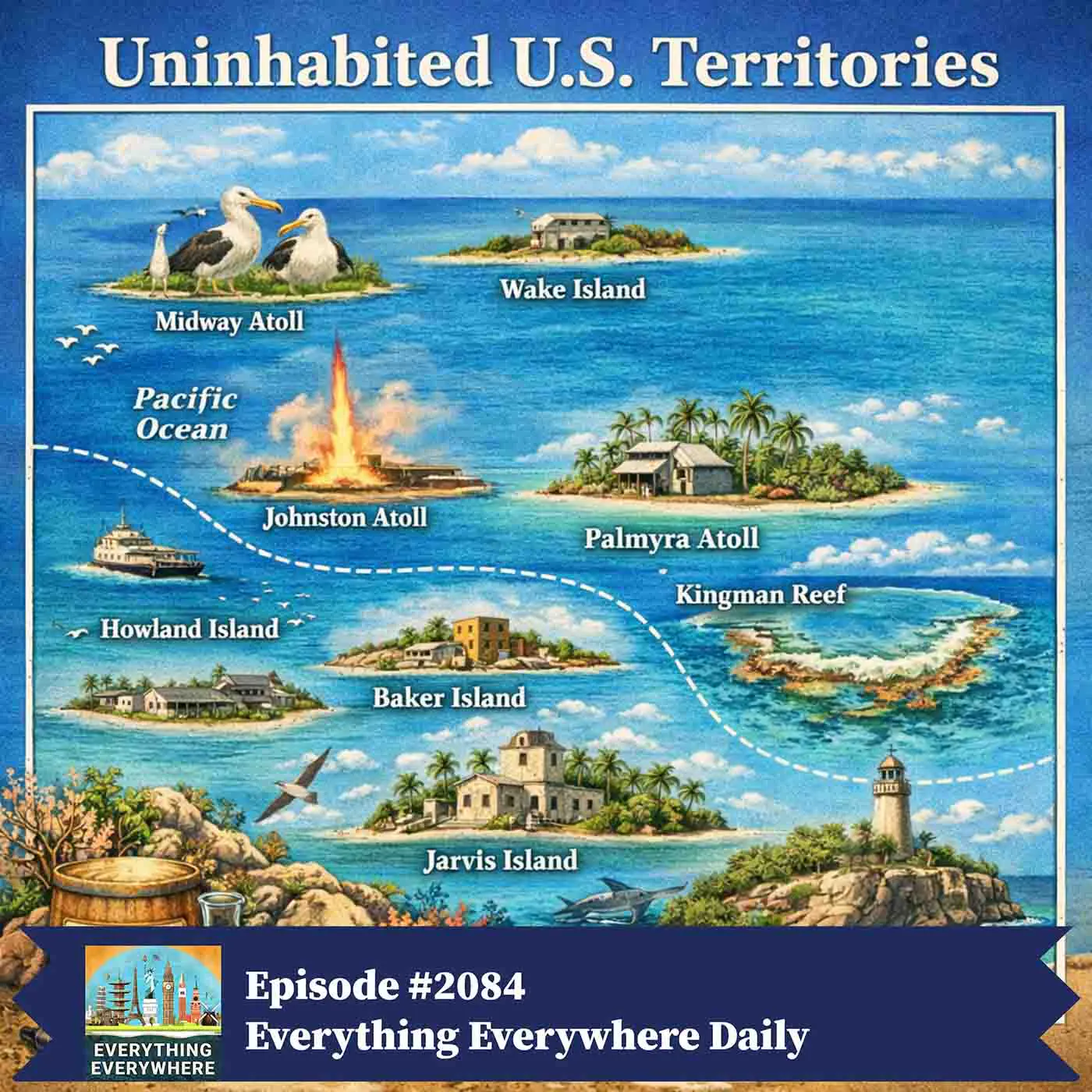
Everything Everywhere Daily: History, Science, Geography & More
Uninhabited US Territories: America's Crumbs
00:14:32
Loading summary
Transcript3 lines
- [00:00]
A
In 1856, the United States passed a law allowing American citizens to claim islands in the country's name, provided that no other country claimed the island and that no one lived there. The result was a host of scattered islands with zero population becoming part of the country. Today, these islands are still U.S. territories, and the vast majority of American citizens have absolutely no clue that they're a part of their country. Learn more about uninhabited U.S. territories and their odd histories on this episode of Everything Everywhere Daily. Reggie, I just sold my car online. Let's go, Grandpa. Wait, you did? Yep. On Carvana. Just put in the license plate, answered a few questions, got an offer in minutes. Easier than setting up that new digital picture frame. You don't say. Yeah, they're even picking it up tomorrow. Talk about fast. Wow. Way to go. So, about that picture frame. Ah, forget about it. Until Carvana makes one, I'm not interested.
- [01:09]
B
Car selling made easy on Carvana. Pick up fees may apply. Score more with the college branded Venmo debit card and earn up to 5% cash back with Venmo stash Got paid back with the Venmo debit card, you can instantly access your balance and spend on what you want, like game day, snacks, gear, tickets, and more. The more you do, the more cash back you can earn. Plus, there's no monthly fee or minimum balance. Sign up now@venmo.com CollegeCard the Venmo MasterCard is issued by the Bancorp Bank. NA Select Schools available. Venmo stash terms and exclusions apply at Venmo me stash terms max $100 cash back per month.
- [01:47]
A
Several years ago, I did an episode on American territories, and I focused on the populated territories that most of you have heard of. Puerto Rico, the US Virgin Islands, Guam, American Samoa, and the Northern Marianas Islands. In this episode, I want to focus on the parts that most of you probably aren't familiar with. These are small, often extremely small islands in the Pacific and Caribbean with no permanent population, no native peoples, and for all practical purposes, no resources. So the first question is, why? And how did these remote islands become part of the United States? It all has to do with bird poop. In 1856, the United States government passed the Guano Islands act, which allowed American citizens to take possession of unclaimed islands containing deposits of guano, which is layers of bird manure that has accumulated over tens of thousands of years. It was a highly valuable fertilizer and a key ingredient in gunpowder at the time. If a US Citizen discovered such an island and and it was not already under another country's control and there were no native inhabitants, the United States could recognize it as a US possession and protect the claim, including with military force if necessary. The law effectively enabled a wave of American expansion across the Pacific and Caribbean, leading to the claim of many small islands. Overall, the policy was basically just picking up low hanging fruit. The government itself didn't have to spend any money as it allowed private citizens to do the work. They didn't have to start conflicts with other countries because only unclaimed islands were allowed. And they also didn't have to deal with native people because the islands had to be uninhabited. Guano, however, is a very finite resource. If you remember my episode on the nation of Nauru, it was a guano island, and for a very brief time in the 1980s, it was the wealthiest country in the world. Until it wasn't. The Guano Islands act had long term geopolitical consequences as the islands remained a part of the United States, while long after the guano deposits were exhausted. By the 1930s, concerns grew over claims to these islands. The Franklin Delano Roosevelt administration launched a quiet effort known as the American Equatorial Islands Colonization Project to establish a human presence on these remote islands. The goal wasn't traditional settlement. They weren't trying to bring families to the island to establish communities. It was about strengthening US Territorial claims, especially as rival powers like Japan were expanding in the Pacific. Young men, mostly from Hawaii, were sent to live on these islands in small groups. They built simple camps, raised the American flag, recorded weather data, and maintained a continuous occupation just to demonstrate sovereignty. Conditions were harsh, with extreme isolation, limited supplies, and no fresh water sources beyond what they could collect from rain. The project ended abruptly in 1942 after Japanese air attacks during the Second World War, which killed some of the colonists and forced evacuations. After that, the US never seriously attempted permanent civilian settlement again. So with that, what and where are these islands? Let's start with the Caribbean, because there are fewer of them. The only real island the United States controls is Navassa Island, Located between Haiti and Jamaica. Navassa island was claimed in 1857 for guano mining, and it briefly supported a mining community. But harsh conditions led to unrest, including a violent Labor Rebellion in 1889. The island was abandoned, and today it's an uninhabited wildlife refuge. Haiti still disputes US ownership, but they've never taken any steps to enforce its claim. The US also claims two other small reefs in the Caribbean that are largely unrecognized and that it does not control, the Bajo Nuevo bank and the Serenilla bank are both small reefs in the middle of the Caribbean that are both claimed by Colombia and Jamaica. The International Court of Justice has ruled in favor of Colombia's claim of both reefs, although neither the US Nor Jamaica recognizes the ruling. Colombia also has a small naval garrison on the Serrania Bank. All of the rest of the uninhabited US Territories can be found in the Pacific, and there are a couple of the islands that you might be familiar with. Wake island is a remote Pacific atoll first sighted by Europeans in the 16th century and formally claimed by the United States in 1899. Its real importance emerged in the 20th century as a refueling stop for Trans Pacific cables and aircraft, and later as a strategic military outpost. Pan Am Airlines once had a refueling base there for its Trans Pacific flights. In December 1941, just hours after the attack on Pearl Harbor, Japanese forces assaulted Wake Island. U.S. marines and personnel mounted a fierce defense over two weeks before being overwhelmed, making it one of the first early battles of World War II. The Japanese occupied the island until 1945. After the war, Wake became a key Cold War military installation supporting missile tests and air operations. Today, it remains under US Control as a highly restricted military base with only temporary personnel and no permanent civilian population. I actually tried to visit Wake island once, and the trip totally fell apart because they couldn't get military approval for the visit. The other island that you probably have heard of is Midway Atoll. Midway was annexed by the United States in 1867, making it one of the earliest US possessions in the Pacific. Its location, roughly halfway between North America and Asia made it strategically valuable first as a cable station and then later as a naval and air base. Midway is the last island in the Hawaiian Emperor Seamount chain of islands and the only island in that chain that is not part of the state of Hawaii. It became famous during the Second World War as the site of the Battle of Midway in June 1942, a U.S. victory that turned the tide of the war in the Pacific against the Japanese. After the war, Midway continued as a military base during the Cold War before being decommissioned in the 1990s. Today, it's a protected wildlife refuge best known for its vast seabird populations, with only a temporary staff and researchers present. I've also tried to visit Midway, and it is almost as hard as visiting Wake Island. Another island that used to be more important than it is today is Johnson Atoll. Johnson Atoll was first claimed by the United States in 1858. Though early commercial use was rather limited, its importance grew dramatically in the 20th century as well, due to its isolated location, which made it ideal for sensitive military activities. During World War II, the atoll was expanded into an airbase and refueling point, supporting operations across the Pacific. In the early Cold War, it became a major testing site for nuclear weapons, Most notably in 1962, the starfish prime test detonated a nuclear device high above the earth, producing an artificial aurora and knocking out satellites and electrical systems as far away as Hawaii. In the decades that followed, Johnson Atoll was used to store and ultimately destroy chemical weapons under the Johnson Atoll Chemic Agent Disposal System, one of the most advanced facilities of its kind in the world. This work continued through the 1990s, making the atoll one of the most tightly controlled locations in the US military system. Military operations ceased in 2004, after which the atoll was closed and Transferred to the U.S. fish and Wildlife Service. Today, it's uninhabited and part of a national wildlife refuge, though access remains highly restricted due to lingering environmental concerns. Palmyra Atoll was first sighted by Westerners in 1798 and formally annexed by the United States in 1898, during the same wave of expansion that brought Hawaii into U.S. control. Unlike every other island I'm mentioning in this episode, Palmyra was designated as an incorporated territory, meaning the full U.S. constitution applies there. In the early 20th century, it passed through private ownership, and During World War II, the US Navy developed it into a base with airstrips and infrastructure. After the war, it was largely abandoned, and much of the land eventually came under the Nature Conservancy's ownership, which now manages it for scientific research and conservation. Today it has no permanent residents, only rotating researchers and staff. The reason Palmyra was not included in the state of Hawaii in 1959 is its unique legal and ownership status. At the time Hawaii became a state, Palmyra was privately owned and legally classified as a separate incorporated territory rather than as part of the territory of Hawaii. Congress deliberately excluded it from the Statehood act, in part to preserve federal control and flexibility over the atoll. As a result, Palmyra remains the only incorporated uninhabited U.S. territory and is administered separately from Hawaii. To this day, Kingman Reef is one of the most remote and least developed US territories. It was first claimed in 1860. Though it has almost no guano, the reef is mostly submerged, with only a tiny strip of land that occasionally is above water, which made permanent settlement impossible in the early 20th century. It was occasionally used as a maritime and aviation waypoint, but it never developed infrastructure or a resident population. Today, Kingman Reef is part of the Pacific Remote Islands National Marine Monument and is valued for its nearly pristine marine ecosystem it remains completely uninhabited and is rarely visited except for scientific research. Jarvis island was claimed in 1857 under the Guano Island Acts and briefly mined for fertilizer. It's one of the most remote and least known territories, roughly halfway between Hawaii and the Cook Islands. American companies soon began guano mining operations after it was claimed. However, by the late 19th century, the deposits were largely exhausted and the island was abandoned. Americans attempted settlement there in the 1930s, and then it was abandoned in 1942 after Japanese attacks. Since then, Jarvis has remained uninhabited and is now protected as part of a national wildlife refuge. Baker Island's story is almost identical to that of Jarvis Island. It was claimed in 1857 and briefly mined for guano. Attempts at settlement in the 19th century failed again due to its extreme isolation and lack of fresh water in 1935. It was reoccupied and abandoned in 1942 after Japanese attacks. Since then, Baker island too has remained uninhabited and is now managed as a protected wildlife refuge. Our final remote island is Howland Island. It was claimed in 1857 and briefly exploited for its guano deposits. But its greatest historical significance came in the 1930s when it was developed as a refueling stop for Trans Pacific Aviation. In 1937, it was the intended destination for Amelia Earhart during her around the world flight, but she never arrived, making the island central to one of aviation's greatest mysteries. Today, Howland island is uninhabited and protected as a wildlife refuge. With the exception of Wake island, which still has a small military presence, none of these islands has any real value. Living on them is next to impossible. They have no resources that can be extracted, they have no fresh water, they aren't necessary for long haul flights anymore, and they have no military importance. All of these islands, save for Wake island are just nature preserves today, either formally or informally. What little infrastructure that was built has been falling into ruin now for decades. Yet despite being remote, totally uninhabited, and mostly unknown, these specks of land are all a part of the United States. The executive producer of Everything Everywhere Daily is Charles Daniel. The associate producers are Austin Otkin and Cameron Kiefer. I got some more short reviews for you today, all of which are from Apple Podcast in the United States. The first comes from podcastlover1234. They write. Great show. It's just good. Five stars easily. I've probably gained a lot of IQ listening mic drop. The real Frodo says Great podcast, Gary Gandalf. JJ Kane says yet a man. Gary, the title sums up my feelings about your podcast. Good sir see you in the Completionist Club someday. The cheesy bread made of apples writes Gary is goaded. No argument. Monita55 says, really enjoy the episode describing National Geographic and King James4 writes, Very good. Everything everywhere daily is always so interesting. Thank you for this awesome podcast. Remember, if you leave a review on any of the major podcast apps, you too may have it read on the show.