Loading summary
Transcript193 lines
- [00:00]
Shopify Representative
It's 2025, a new year and the best time to turn your great idea into a business. Shopify is how you're going to make it happen. Let me tell you how Shopify makes it simple to create your brand, open for business and get your first sale. Get your store up and running easily with thousands of customizable templates. All you need to do is drag and drop. Their powerful social media tools let you connect all your channels and create shoppable posts established in 2025. Has a nice ring to it, doesn't it? Sign up for your $1 per month trial period at shopify.com promo all lowercase go to shopify.com promo to start selling with Shopify today. Shopify.com promo.
- [00:43]
Carvana Customer
Wow. What's up? I just bought and financed a car through Carvana in minutes. You, the person who agonized four weeks over whether to paint your walls eggshell or off white, bought and financed a car in. They made it easy, transparent terms, customizable down and monthly. Didn't even have to do any paperwork.
- [01:00]
Daphne Guinness
Wow. Hey, have you checked out that spreadsheet.
- [01:04]
Carvana Customer
I sent you for our dinner options? Finance your car with Carvana and experience total control financing subject to credit approval.
- [01:21]
Interviewer
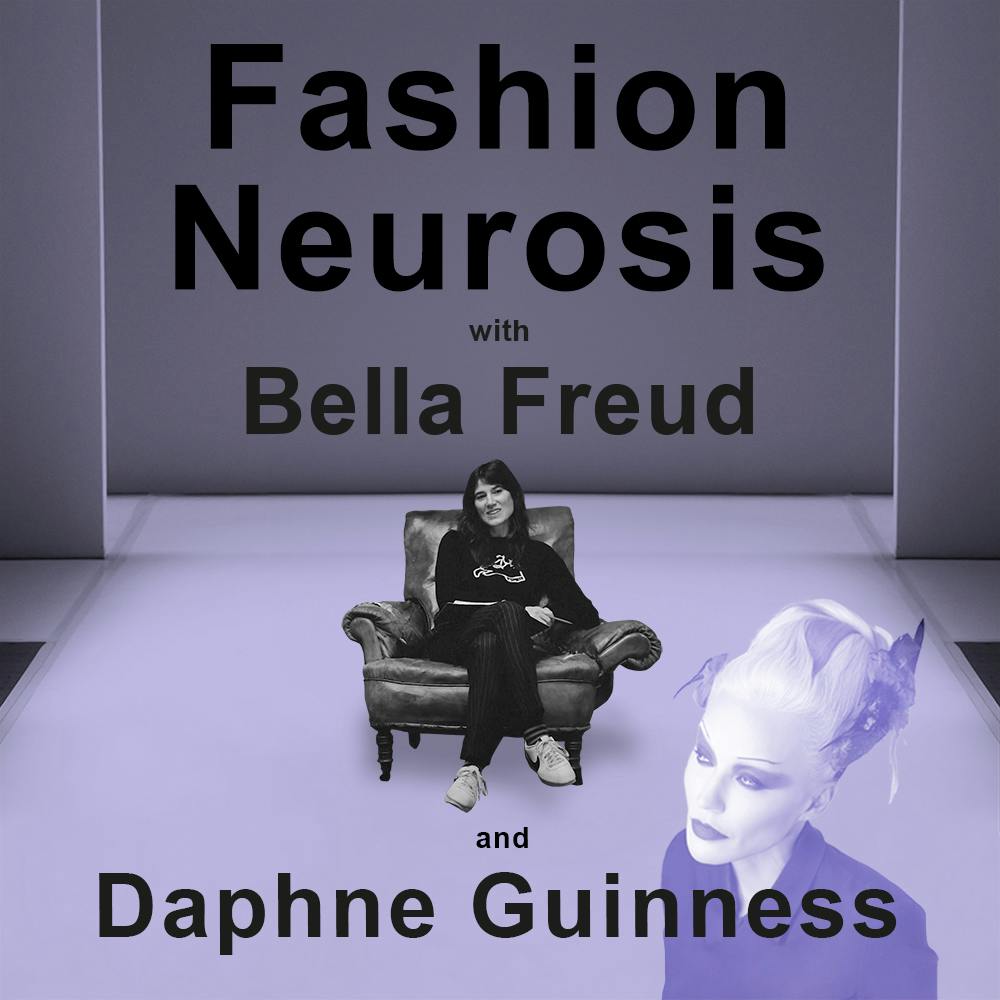
Hi, come in. Welcome to Fashion Neurosis. Daphne Guinness.
- [01:31]
Daphne Guinness
Thank you for having me.
- [01:32]
Interviewer
Bella, can you tell me what you're wearing today and why you chose those particular clothes?
- [01:39]
Daphne Guinness
Well, I'm wearing a tail coat, a black tail coat that was ancient. I had it made a long time ago. A white gilet out of white poplin, which is a fairly new new cut of waistcoat and a pair of black shorts and a pair of old tights and my shoes. And why did I wear it? This is part of my uniform, which I wear most of the time.
- [02:11]
Interviewer
The uniform is a very handy thing.
- [02:15]
Daphne Guinness
A uniform is a fantastic thing. I often feel like I'm such a bore in my uniform.
- [02:21]
Interviewer
I think we need the uniform to do daring acts. It's helpful.
- [02:26]
Daphne Guinness
It's so true. It's a wonderful thing to be able to go back to. And it's. And it's also a nice thing to just to sort of constantly perfect because sometimes I. I mean, it's sort of the old and the new, but, you know, just maybe a little bit more sort of quarter of an inch on the arm or slightly narrower or slightly slimmer shoulder or a new, you know, a summer fabric or a winter fabric. It's all sort of the same thing.
- [02:59]
Interviewer
These small adjustments are everything, aren't they?
- [03:02]
Daphne Guinness
They are.
- [03:04]
Interviewer
I noticed that you Arrived with a bag with a special pillow in it. And I wondered why, where that comes from. Do you always carry a pillow or do you have a thing about bags?
- [03:17]
Daphne Guinness
I do have a thing about bags. I do tend to take a lot of things around with me. When I was at school, I always used to carry around many book bags, so I always think I might have left something behind. But also I do tend to carry around pillows just in case. I sort of feel like having a nap.
- [03:40]
Interviewer
That's a good idea. I can definitely relate to that. I always have a huge bag and sometimes wander around the house with it. In case. I don't know what I think the in case is all about, but you were telling me just before how you moved around a lot as a child and so did I, and maybe that's where it comes from that we keep. Keep our houses in our bags.
- [04:07]
Daphne Guinness
That's correct. Well, definitely for me, I think I was telling you I've moved, I think, in 25 years, over 20 times.
- [04:17]
Interviewer
And why do you think that? Is there something about moving that you enjoy or you're restless or.
- [04:28]
Daphne Guinness
Some of it was just hazard, really. I would have much preferred to have had a more. A more stable life, but I'm slightly used to feeling sort of slightly. Well, completely sort of nauseous from moving around.
- [04:44]
Interviewer
I want to ask you, what was the first time you wore something that made you feel different?
- [04:50]
Daphne Guinness
I remember having a really good pair of corduroy trousers when I was probably about 6 and 7. I thought they were very smart and they had flares that I could wrap three times around my ankle. And I thought that was quite groovy.
- [05:07]
Interviewer
Were there things you longed to wear as a child and did you have a sense of your own identity at that point?
- [05:13]
Daphne Guinness
I always had an idea of myself as sort of wearing what I wear now, sort of tails. Tails. Because I always liked dressing more as a boy rather than as a girl.
- [05:29]
Interviewer
Yeah, I had that too. It felt like a better edit. I felt like I could be more intrepid with a stricter kind of ensemble kind of thing.
- [05:47]
Daphne Guinness
I was always really. I was always very jealous of other. Of male uniforms.
- [05:53]
Interviewer
Yeah. And the cut and the strictness.
- [05:58]
Daphne Guinness
Yes, very much so.
- [06:00]
Interviewer
I hadn't thought of that about. Because you have such a kind of amazingly kind of dazzling look that now you're talking about it. It is a very strict edit of these dazzling pieces. When you were talking about having this ambition to wear what you're wearing now without really knowing what it was, was there anyone in a book that you identified with. I always used to like how Peter Rabbit dressed with that pale blue punkish jacket.
- [06:35]
Daphne Guinness
Oh, my goodness, that's so. Now, think about it. That's sort of true. I. Peter Rabbit's a very good one. The pale blue jacket. Also the romantic poets.
- [06:48]
Interviewer
Anyone in particular?
- [06:50]
Daphne Guinness
I would say Byron. Really?
- [06:53]
Interviewer
Wow. Yes.
- [06:56]
Daphne Guinness
And I. And Hamlet, actually, the idea. The black with the white frill kind of. Or in my head, that's what it looked like. I mean, the other. Of course, then I go to another kind of feeling, which was things like sort of Titania, you know, on the sort of fairy side of things. Yes. But I always ended up sort of almost back where I started with the strict edit. It's easier to pack lots of wafty things.
- [07:31]
Interviewer
Well, your performance seems. Your performances seem to have an element of Titania, her free kind of imagination.
- [07:43]
Daphne Guinness
Oh, my goodness.
- [07:45]
Interviewer
That makes a lot of sense to me.
- [07:46]
Daphne Guinness
I like the sort of idea of sort of being like a billowing kind of cloud. But sometimes I'm not organized enough to sort of pull it off in a sartorial sense.
- [07:57]
Interviewer
I think of your Titania esque as the gesture, but you're much more sort of punk rock David Bowie in your actual deftness.
- [08:11]
Daphne Guinness
Oh, my goodness.
- [08:12]
Interviewer
I like the combination. It's great. Yeah. The Guinnesses are a huge family with a lot of dazzling women in. And, in fact, my father was married to the Guinness. His second wife was Caroline Blackwood. And I wondered who were your early influences and whether your mother had had much of an influence on you.
- [08:35]
Daphne Guinness
Yeah, my mother. Certainly as I get older, I realize that she had more of an effect on me than perhaps I was able to understand when I was younger. And also my grandmother, she had a sort of rather strict edit on her wardrobe.
- [08:57]
Interviewer
What was her look, my grandmother's look.
- [08:59]
Daphne Guinness
Was she dressed very much in sort of pale grays and blues and whites and extremely, extremely sort of edited and simple.
- [09:11]
Interviewer
Was this your Guinness grandmother?
- [09:12]
Daphne Guinness
My Diana. Oh, right. Yeah. She had a very sort of very. A very kind of minimal aesthetic.
- [09:23]
Interviewer
Very beguiling.
- [09:25]
Daphne Guinness
Yeah. Yes. Guinnesses are so much fun.
- [09:28]
Interviewer
Yeah. Also, there's Penny Guinness, who was married to your uncle Desmond Guinness. And she was a girlfriend of my father's and sat for many paintings. But she also looked after me as a very small child. And when we came back from living in Morocco, she was traveling around Gloucestershire in gypsy caravans with Mark Palmer and a group of upper class hippies. And I went and stayed with her while my mother was looking for somewhere for us to live. And she was just a really important influence on my, on my life and my stability.
- [10:14]
Daphne Guinness
I completely relate to that. Penny's been one of the most reliable people in my life too. And so great with small children and so down to earth and so funny and so warm and so with such a great sense of humor. So sort of dry, but really just, just intelligent sense of humor. Very, very down to earth in that kind of bohemian, upper class kind of world, which was really. Didn't have very many anchors. Penny was, it is, is very much a kind of an anchor in a somewhat eccentric storm of characters.
- [10:57]
Interviewer
I remember being at breakfast with, staying at leakslip1, I think it must have been about 15 years or 20 years ago. And Desmond was in a really bad mood and he was really quite apoplectic. Red in the face. Oh God, just furious about something. We looked at Penny and she just went, oh, Desmond, don't you say ridiculous. Go and smoke a joint or something. And it was just so funny.
- [11:28]
Daphne Guinness
She's so funny. Get everybody into shape in about sort of five seconds. She just knew what, unfazed?
- [11:36]
Interviewer
Yeah, she knew what to make a fuss about and what to.
- [11:41]
Daphne Guinness
What not to.
- [11:42]
Interviewer
Yes. Yeah, she was.
- [11:44]
Daphne Guinness
Oh my God, she was fantastic. Thinking about people one loves makes one feel so good.
- [11:50]
Interviewer
Yeah, that's true. It's wonderful. It's very energizing. It's interesting what you said about your mother, you being prejudiced against your mother's tastes and then beginning to incorporate them actually into your work. And I always like that thing of having things that you think you don't like and then suddenly realizing that or deciding you do like them and your horizon expands as a result.
- [12:23]
Daphne Guinness
That's so true. It's so true. And also you come to terms with the relationship that one thought one had with one's. With one's mother or father or anything. When you sort of suddenly realize where it comes from. It's so surprising how much goes in when you. Well, in early childhood and you don't really realize quite how much until you look back.
- [12:52]
Interviewer
It's very easy to be sort of over critical or critical of one's mother, I find, just because they're more vulnerable. And I found with my parents, my mother was. I mean, my mother was 20 years younger than my father. And my father was wild and free and had a lot of power because he had some money. And my mother was wild and free with no money, so she didn't have power. And I wanted that power because there was some element of security in there. And I wondered what the dynamic was like with your parents, do, you know, very difficult to.
- [13:35]
Daphne Guinness
Sort of. The first time I've even thought about them having a dynamic because they seemed. I never really seemed to see them together very much. I had quite a strange childhood, to put it mildly. So I didn't really take on board the dynamics between my parents, if that makes any sense. I'd have to think about it more to. I mean, the person who I was really close to when I was growing up was my dad. So I spent a lot of time with him, more than my mother. I only got to know her later on in my life. But dynamics. It was very difficult for me to kind of think of it in that way. Both of them were fairly eccentric in their own ways. And my father is still, thankfully, alive.
- [14:39]
Interviewer
I remember meeting you in New York the first time I met you with John Richardson. And you were. I mean, you were very young, but you already married with children. And I remember what you were wearing because you were so. You looked so pretty and you were wearing Dolce Gabbana and you had kind of. Kind of modely, pretty blonde hair, and I weren't. It's a very different look from how you are now. And I wondered, looking back, whether you felt like a different person then.
- [15:19]
Daphne Guinness
I think I. Well, I've definitely been. Lots of incarnations of the same thing, which sort of. I suppose when you were talking before about editing and then I think when I. Perhaps I had a bit more of a base at that time when I first met you, and as the base shrunk and things, you know, often in storage, I had to sort of become a much more kind of. I suppose I had to sort of get a sort of uniform of some description going. Because also sort of between music studios or art studios or, you know, packing and unpacking, it just became a narrower. Narrower sort of ledge I was on. But, yes, I think I was the same. But I know what you mean. I mean that the hair was definitely different. I had it. My hair was sort of more. I could tolerate it around my face a little bit more than I can.
- [16:36]
Interviewer
Is that why you like to have it back? Because it annoys you?
- [16:40]
Daphne Guinness
Yeah.
- [16:40]
Interviewer
Or it just feels.
- [16:42]
Daphne Guinness
I don't mind it sometimes when it starts going. Starts falling down at the front, I don't really. It looks quite nice for a bit, but when it's straight down, because it's so long, it gets in the way and I. I don't quite. You know, I just have to pull it all back up again.
- [17:01]
Interviewer
And do you think Was there a trigger for your transformation? Did something happen? Was it a conscious. I'm going to change my. How I. How people perceive me when I walk into a room, or was it a gradual thing?
- [17:19]
Daphne Guinness
I never thought of myself as a particularly pretty or particularly kind of able to be in front of a camera. But the more I was kind of working with Izzy and then I sort of ended up being in pictures for her, and then I started to kind of becoming a kind of part of my friend David LaChapelle's kind of extended troop of kind of models. And when you sort of become a. I suppose as John actually said, you know, he said to me, you know, you are a sort of performance actor. And I said, I'm really not. I'm just trying to get by. And he said, well, you might not know it, but you kind of are. And I don't. He disapproved quite a lot of performance art, but I sort of did it in spite of my shyness and also in spite of kind of not actually thinking that I could do any of these things. And sometimes I think, well, why on earth did I do it to myself? Because it actually goes against all the things that I like, which is sort of being in the shadows and sort of not being in the spotlight. But it sort of went. It's really difficult to explain it, but I went against my own kind of character. And then as I got more and more kind of extreme, the more and more it. I. But I'm not sure if it's not. I think maybe the world also changed because there was so many more people that were individual. I felt. Feel that when I was growing up kind of in the 80s in London, I mean, I wouldn't look too far out of place in 80s London than I do today. I think everything else got a little bit more. I don't know, a little bit more bland. Yeah, I mean, I wouldn't be. I wouldn't be thought to be that different, I think. I'm not sure.
- [19:17]
Interviewer
Yeah, I think you're right. I've always thought of you and watched you as a person with a lot of courage. And I was going to ask, did that come from nurture or fending for yourself?
- [19:36]
Daphne Guinness
Fending, yes, I'm good old fending for oneself. Yeah, yeah. It comes from neglect, I'm afraid.
- [19:48]
Interviewer
But.
- [19:48]
Daphne Guinness
I suppose there are many, many ways to get to a point, however you get there. And I'm still discovering new ways to try and get to the next point.
- [20:07]
Interviewer
Yeah. It's so interesting, you talking about your Shyness. Because I was going to ask you about whether the way you dress is partly a protection for your introvert. Whether you have that. Because you're very good at being in the limelight. You obviously are brilliant at it. But there's this part of you that seems shy. And it's a very endearing and moving combination to watch somebody with that shyness, that interior kind of shyness, be a performer. It's even more intense than just performance.
- [20:59]
Daphne Guinness
Do you think? I mean, I've. I'm. I really do wonder each time I do something if it's worth the kind of the physical and mental anxiety that it puts me through every time.
- [21:16]
Interviewer
Because you said somewhere that music saved you.
- [21:20]
Daphne Guinness
True.
- [21:21]
Interviewer
And I wondered what it saved you from.
- [21:23]
Daphne Guinness
Well, it saved me from after Isabella and then Alexander killing themselves. And I was very much in the. Were several people that, you know, that told me over the years was sort of like, oh, well, when are you going to be next? Or we thought you were going to be the next one. And I really. I wanted to be kind of out of the whole. I was never really much of an insider in the fashion world, and I didn't really ask to be in that position. And I didn't want to. I didn't want. I didn't really feel like my. The thing I was most at home with and the thing that always, through all of my life had saved. Has saved me, you know, from different. Different things that had happened to me was music. Listening to music and being able to sort of go off and sort of think about, you know, you know, be in a different state of mind. And. And I was a. You know, I studied music as a child and as a teenager, and. And I. And I mean, I obviously got a lot better at it now, but it was something that I felt more drawn to than being part of the fashion world, which I didn't. Which intimidated me tremendously. I mean, felt very, very cold and uninviting. And, you know, with lots of such great friends, I didn't see where I could possibly fit in. And especially after Alexander, because him and I shared so much in so many ways. I couldn't imagine having to sort of putting that much effort into sort of anything ever again. And I didn't think I'd ever feel protected by any piece of fashion after he died, because it was very much the sort of conversation I'd have with him. And I think he went out of his way for his friends to sort of make them feel protected by the things that he would make for Them. That definitely was the case for me, I suppose.
- [23:42]
Interviewer
It's like, as designers, we have your back. That's what we try to do, to make someone, everybody, but particularly people you know, care about. It's something that. I think that it's a big part of the power of clothes and why clothes are more than just, you know, it's nothing to do with vanity. It's about getting you through things and giving you a great guise that you can be. That can be your strength when you feel kind of hopeless.
- [24:22]
Daphne Guinness
This is so true.
- [24:24]
Interviewer
Izzy Blow was a famous fashion stylist, and she had a huge influence on lots of people. And she was a great pioneer of avant garde. And in a way, she was a little bit like someone in a Henry James novel with you, where she took you up and nurtured you into. And helped you with a metamorphosis into the Daphne we know you as now. And I wondered what that was like.
- [24:58]
Daphne Guinness
It was a lot of fun. She brought so much joy to my life and so much laughter. And also her grandmother and my great grandfather were sort of were an item, as they say. I met her when I was a teenager, but I only. I re. Met her when I just got divorced, actually. No, I hadn't got divorced yet. It was. It was at Maureen Dufferin's 90th birthday.
- [25:28]
Interviewer
Gosh.
- [25:29]
Daphne Guinness
And so I'd gone as a funereal pony. I remember she came zipping over and sort of said, here I am. I can't remember. She sort of introduced herself and that's when we became friends again. So probably been 1998. And then after I got divorced, she was very much there for me. And, yeah, she really did. She really showed me a side of life and the avant garde that I have been very closeted away from during sort of the times where I was having my children and living in. In a different part of the world, really.
- [26:17]
Interviewer
She was quite maternal in her way, wasn't she? I remember you saying that someone described you as a concept, and I thought that seemed so impersonal compared to how you are. You're such a warm person and so much more faceted than just your kind of dazzling and brilliant performances.
- [26:42]
Daphne Guinness
Oh, my goodness. Sometimes. Sometimes it's annoying just to be. Well, the idea of just being a Persona. But sometimes I sort of think, well, maybe I should just lean into that and just, you know, then at least I can just disappear into it. But life is more faceted than that. Everybody's a big mixture of your living, breathing, human, you know, sometimes you're you're in great shape. Sometimes you're not, you know, you're a mass of emotions.
- [27:16]
Interviewer
I know sometimes it's best not just a perfect concept.
- [27:21]
Daphne Guinness
Gosh, if only.
- [27:23]
Interviewer
Well, I'm glad you're not because it's much more one dimensional. And what's so interesting about you is that you are so multi dimensional and you have so many layers and nuances to you even. And I find that remarkable given how much you put yourself out there in the service of your art. And I suppose it's hard to do that when you're too thinking and feeling. You have to leave some behind.
- [27:59]
Daphne Guinness
Oh God.
- [28:00]
Interviewer
Too nerve wracking.
- [28:01]
Daphne Guinness
Just even thinking about it makes me quiver. Oh, but it's all right. I'm quite happy to be at the. On the other side of my last project and at the beginning of new ones.
- [28:15]
Carvana Customer
Yeah, sure thing. Hey, you sold that car yet? Yeah, sold it to Carvana. Oh, I thought you were selling to that guy.
- [28:23]
Daphne Guinness
The guy who wanted to pay me.
- [28:24]
Carvana Customer
In foreign currency, no interest over 36 months.
- [28:28]
Daphne Guinness
Yeah, no.
- [28:29]
Interviewer
Carvana gave me an offer in minutes.
- [28:31]
Daphne Guinness
Picked it up and paid me on the spot.
- [28:33]
Interviewer
It was so convenient.
- [28:35]
Carvana Customer
Just like that. Yeah. No hassle?
- [28:37]
Interviewer
None.
- [28:38]
Carvana Customer
That is super convenient. Sell your car to Carvana and swap hassle for convenience. Pick up. These may apply.
- [28:44]
Interviewer
And do you ever wear an old tracksuit and a T shirt?
- [28:51]
Daphne Guinness
Yeah, I do sort of. I mean it has to be a very specific kind of. Because I wear, I mean, for the gym. I live and die by my routine. So when I do my sort of yoga y kind of exercises and I'm in a kind of version of a tracksuit.
- [29:12]
Interviewer
What is that version?
- [29:15]
Daphne Guinness
Well, it's a sort of black leggings and a T shirt without sleeves. Has to be. And a zip up, you know, tight hoodie, but it has to be very kind of exact.
- [29:34]
Interviewer
And how about your hair?
- [29:35]
Daphne Guinness
Oh, the hair's exactly the same, but I have a scarf around it unless I'm swimming. But even I can even swim in the hair now. I found a way to do the hair and swim.
- [29:48]
Interviewer
And does it take a long time to put your look together?
- [29:54]
Daphne Guinness
If I'm lucky, it doesn't take long. And then if I get. If I'm in the. If I set it off in the wrong way, it can take a long time. And then if I've gone down, if I've taken the wrong route, then it can get very difficult. But sometimes it happens really quite well. Yes, it really depends. When I'm left to my own devices, sometimes it goes horribly wrong.
- [30:20]
Interviewer
And if you fancy someone and they're wearing something that you don't like, does it kill your attraction to them?
- [30:27]
Daphne Guinness
Probably. Oh, I'm not sure. I've never had. I don't think I've ever. No, I think if. I think if I love someone, I don't mind what they were.
- [30:40]
Interviewer
You don't have any sort of allergies about certain things, I wonder.
- [30:48]
Daphne Guinness
That's such a good question. I can't think of it in that way.
- [30:53]
Interviewer
That's a very loving and magnanimous, you know, attitude towards.
- [30:59]
Daphne Guinness
I haven't really thought about that is really. Can we. Can we circle back onto that one? I really can't. I can't think. It's never quite happened. Maybe one adjusts one's taste because you love someone.
- [31:13]
Interviewer
I think definitely. I notice in myself that if I like someone, I'm attracted to them and I notice I don't like what they're wearing or something. I'm too quick sometimes to override that. And the overriding makes me plunge deeper into loving them. And sometimes the bad outfit is a warning saying, this just isn't right.
- [31:44]
Daphne Guinness
And I think that is so true. Now. I do.
- [31:47]
Interviewer
It doesn't matter. The straw boat. This is awful and I shouldn't be here.
- [31:53]
Daphne Guinness
Oh my gosh, that's so true, Nadia. Absolutely. What an interesting. My dear, it's so true.
- [32:01]
Interviewer
And do you have any feelings about being naked? Do you feel at ease being naked or do you have to wear something that makes you feel good and naked?
- [32:12]
Daphne Guinness
I have to wear something that makes me feel good and naked. Yeah, I don't like being naked.
- [32:19]
Interviewer
What do you wear?
- [32:21]
Daphne Guinness
I wear. Well, I make. I have. I'm always making them again and again. But bodysuits, the flesh colored bodysuits or I have very sort of fine kind of underwear or more for other people. I can't imagine that anybody wants to see my. I'm so sort of small and thin. I can't imagine it'd be very nice to look at. So I'm always thinking about how. How to sort of mitigate the sort of the tininess of all the not so perfect physique that I have.
- [33:00]
Interviewer
Where do you think this exacting view of yourself comes from?
- [33:06]
Daphne Guinness
Have you.
- [33:07]
Interviewer
Have you always felt like that?
- [33:09]
Daphne Guinness
I think. I think I probably have. I've never thought of myself as being particularly attractive. I. I always rather looked at other people rather than looking at myself in the mirror. And I don't know. It's not that it wasn't encouraged but it wasn't encouraged. It wasn't really. I didn't really think about it when I was growing up especially, you know, trying to be such a tomboy.
- [33:44]
Interviewer
I mean, I really identify with that and I had similar experiences of certain amount of neglect and I mean there's always that thing in England of it being sort of very looked down on to draw attention to yourself even when, you know, children describing them as attention seeking, when that's what you're supposed to do as a child to alert people to your needs. But that's so true sometimes I think a very upper class upbringing is particularly unattentive to children in that way. Do you think that was your experience?
- [34:30]
Daphne Guinness
It was my experience, pretty much. That was my experience. And also it was kind of. It wasn't. I don't think anybody was going out of their way to be mean or that's just how things were. It wasn't. No one was trying to be, you know, I just think one wasn't really noticed. I mean, I did have the great one good thing about being. I mean, I was very much the youngest for a long time in sort of my direct family. It was, you know, I made what was nice was being able to talk to adults quite a lot. So I, you know, when you're speaking to people like Aunt Penny or whatever, people who are older, you're not really. I suppose I wasn't really interacting with other people my own age very much, which brings its own other things. So you're not, you're not really. I mean, probably I picked up on things when I was at school, but not so much as maybe other people would because it was rather from my point of view, it was quite isolating my childhood.
- [35:50]
Interviewer
Certainly you've always had admirers. I mean, if I think about the art historian John Richardson, who was, you know, 70 years older than you or whatever. I mean, admirers in the sort of gay fandom world. And he adored you so much. He was such a person and he loved talking about you. And it seems like you seem very at ease with much older people.
- [36:22]
Daphne Guinness
Very much. I love older people. They teach one so much.
- [36:28]
Interviewer
Yeah.
- [36:29]
Daphne Guinness
And they, you know, they were much less, sort of, much less judgmental than people one's own age. Yeah, that's a really uncomforting when, you know, when everything else seemed to be falling apart.
- [36:41]
Interviewer
Do you remember specific people that did encourage you, given you didn't get a lot of encouragement. And it just shows that the. Your drive, how strong your drive is to, you know, express yourself artistically But I wondered who sort of noticed that.
- [37:01]
Daphne Guinness
Well, the other person apart from John, at the same time kind of more or less was Fred Hughes.
- [37:07]
Interviewer
Really? Fred Hughes, who.
- [37:09]
Daphne Guinness
For Andy.
- [37:10]
Interviewer
Worked for Andy Warhol.
- [37:11]
Daphne Guinness
Yeah. And again, he liked white ties and tails quite a lot. So, yeah, maybe now it's coming back to me. That's another sort. That would be another check on the. To be in very sort of in very sleek menswear. Fred always looks so incredibly, you know, brilliant.
- [37:40]
Interviewer
Did you go out dressed the same ever?
- [37:45]
Daphne Guinness
No, I'm not at that time, I mean. But now thinking back on it, when I, you know, first met him as a sort of early teenager and with your.
- [37:57]
Interviewer
With your look, how do you see yourself going forward? Do you have a kind of feeling of something next about how you put your look together?
- [38:11]
Daphne Guinness
And I'm always adjusting little bits of it. I'm trying not to veer off into any new directions at the moment. But I do have some ideas which I'm starting to execute bit by bit. But because of my lack of a stable home, I've been trying not to kind of create too many new distractions.
- [38:35]
Interviewer
And is the stable home on the horizon?
- [38:39]
Daphne Guinness
I hope so. I hope I have a bit more than a perch and not just everything in storage all the time.
- [38:50]
Interviewer
What do you sleep in?
- [38:52]
Daphne Guinness
I sleep in either a black T shirt. It's like a T shirt that goes. It's a sort of T shirt without sleeves and it goes down to about just above my knees. And I've got a black one and I've got a white one.
- [39:07]
Interviewer
You don't have any sort of.
- [39:11]
Daphne Guinness
Oh, yeah. And then I have sometimes. Then I have these sometimes, sort of like, kind of. I wear lots of karate gear, kung fu trousers, because that's my other kind of Persona is a sort of martial arts person.
- [39:28]
Interviewer
What, like a ninja?
- [39:29]
Daphne Guinness
Yeah.
- [39:30]
Interviewer
Is that to do with a kind of spiritual containment, like a deftness that keeps you safe and agile?
- [39:39]
Daphne Guinness
Yeah, and it's. And that's sort of. I kind of. I mean, in my. I'm not. Not in any way very good at it, but I sort of do a kind of. A kind of martial arts type mixed exercise within everything that I do. And I've always admired the sort of Zen martial arts and I'm, you know. And thank goodness now I've got a bit more time to even look into the more. I used to do kickboxing and judo and things like that. Haven't been. I haven't had as much time or health as I would have liked in the Last few years. So it's been more other things that I've been doing. But I love. I like nothing to do with. Quite physically extreme.
- [40:32]
Interviewer
Yeah, I love those things to do with rigor and sort of endurance tests. I used to go to an aikido class about 20 years ago, but it was so sort of strict. And there was an amazing mentor, the teacher. No one would speak to me, so I couldn't really learn anything properly. But I liked the extremeness of the whole thing. So I kept going back to that class where I couldn't learn anything.
- [41:07]
Daphne Guinness
Oh, my goodness.
- [41:08]
Interviewer
And eventually gave up because it was kind of ungratifying because I stayed really bad for a whole couple of years. And I wish I'd tried a few others. But it. It was really exciting seeing how with very small movements you could have this massive effect. And that was exciting.
- [41:29]
Daphne Guinness
I know that's a one to do.
- [41:31]
Interviewer
It's really hard.
- [41:33]
Daphne Guinness
Oh, my gosh. I'm going to definitely go redouble my efforts.
- [41:40]
Interviewer
Do you have a fashion kink?
- [41:44]
Daphne Guinness
In what respect?
- [41:46]
Interviewer
Well, when I think of that word kink, I think of a sort of deviation.
- [41:52]
Daphne Guinness
Right.
- [41:53]
Interviewer
And I just.
- [41:54]
Daphne Guinness
Oh, yeah, probably. My fashion kink is to be asymmetrical, but it has to be asymmetrical in a kind of. In a. It has to be severe in a funny way. It's not. It's not as random as one might think. But I can't. I'm not very good at symmetry.
- [42:12]
Interviewer
So notice when you lay down, you took out one of your hair clips and said symmetry.
- [42:18]
Daphne Guinness
This is true. And like I have. I normally wear one earring, or if I wear an earring here, I'll wear another one in a different place.
- [42:26]
Interviewer
Is that to do with liking things to be almost incomplete? So there's another stage.
- [42:33]
Daphne Guinness
Absolutely. There's something so much better about a triangle versus a square or. And I like odd numbers or prime numbers rather than anything to do with even numbers. Minor keys instead of major keys. I could go on and on. I mean, I like symmetry in terms of. Of nature. That's beautiful. When you look under a microscope, seeing sort of crystals forming that or, you know, in a kaleidoscope, that that's one thing, but if it's on a human being, I don't know. I think the very nature of. To me being a human being feels so incomplete. I kind of almost have to sort of incomplete myself a little bit more.
- [43:29]
Interviewer
I really understand that.
- [43:31]
Daphne Guinness
Oh, my gosh.
- [43:33]
Interviewer
Is that why you have the heel missing? I know it does create Balance, you know, it's a kind of unexpected thing, but it is a balance, a way you. Balance.
- [43:46]
Daphne Guinness
Yeah. Oh, my goodness.
- [43:48]
Interviewer
But it's a very dramatic. You know, there's a feeling of kind of moving towards you to make sure nothing happens. But actually, you're incredibly ninja within this whole miss. You know, the missing heel and the clothes and your poise.
- [44:11]
Daphne Guinness
Oh, thank you. Yeah, I didn't think of it. Some of the things that happen within my wardrobe happen because they're mistakes. And it's just, you know, as they say, shit happens. And you kind of. Kind of try to, you know, work around something that might have broken on a shoot or, like the shoes, and then it ends up becoming something that then you sort of work through and then it becomes part of your look or, you know, accidents with hair dyes or. And then you kind of. You lean into that. Leaning into mistakes is something I found has helped. I mean, in other ways. Sometimes leaning into a mistake is not quite as good as. But, you know, I'd say on a sartorial level, it seems to have worked a bit. Sometimes I feel like everything I do feels almost the same. I get so bored with looking at myself.
- [45:13]
Interviewer
I suppose that's why you're always evolving and, you know, I've never seen you in the same thing. You're always kind of pushing things and.
- [45:25]
Daphne Guinness
Oh, my gosh, I wear the same thing quite a lot. Well, I feel like it.
- [45:30]
Interviewer
I haven't seen enough clearly. But you have a real look. And it's quite a remarkable thing because people want to have a real look and try. But it's quite a thing for that to just be consistent. And you. You have that very successfully. And do you think, you know, when you were talking about this incompleteness, that it's partly, you know, the sort of fight or flight. It's a way of almost relaxing to create, like a perfect storm of being driven by these ambitions and how, you know, in a way it makes you feel sick to the stomach. I mean, sometimes when I think of what I want to do, what I long to do also makes me terrified. But if I do it and go through the pain threshold, then it's very soothing.
- [46:30]
Daphne Guinness
That's so true. That is so true. I'm never sure where the sweet spot is between this. Of anxiety. I'm never quite sure why, when the. When it's over. Because of as. As you said, the fight or flight, it carries on for me, but I think he. I. I don't know. I guess on average, one just has to carry on the alternative is. Is kind of even more discombobulating. Such a good way to put it.
- [47:00]
Interviewer
When you're with your new album. I mean, that must be a feeling of, you know, incredible achievement. But of course, immediately after comes the drive for the next thing and the, you know, don't be complacent. But how does it feel to be making this new work? And.
- [47:24]
Daphne Guinness
I always, as I was saying to you before, it makes me terribly ill sometimes to work. And then, you know, I can sort of just about manage to get over the line and do everything around it. And then of course, after this, you know, you get sort of like a postnatal depression. And the longer it's gone on for the kind of harder the landing is, or the longer the sort of symptoms of malaise sort of go on and on. And then I always sort of try to think, well, I'm going to retire. I'm not going to do anything. I mean that so many times in my life that's happened and I'll try and go and sit and do nothing and think, you know, this is, you know, I'll just try and be really just do nothing for, you know, days and days. But I can only last about a day and a half before. Before I start doing something else. And it. And it invariably leads to some, you know, either a new song or a new drawing or something. I think I'm. I think I'm. I think I'm cursed or blessed.
- [48:36]
Interviewer
Because you're making. Making things, which is what you want to do.
- [48:41]
Daphne Guinness
Like you. Oh, my goodness.
- [48:43]
Interviewer
A real success.
- [48:44]
Daphne Guinness
Creation is a. It's a. It's a mixed. It's a very mixed feeling because I. I like the creation, but I. What I really don't. I'm very uncomfortable with is releases. I'm, you know, I actually Putting a show together or something. I love all the bits up until I have to kind of go and sort of. I'm there on my own. You know, it all start. Starts off like a lovely sort of. Feels like a lovely sort of gag. And you're with your friends and you're with whatever. And then suddenly you find yourself sort of having to face the world or the release or whatever on your own. And you're not quite sure if it's any good or if you're. You know, I sometimes, you know, think, am I. Is this good? If it's. I lose the idea of. If I can't gauge what it is anymore. You think, well, I love it, but I'm not sure if anybody else is going to get this sort of thing, if that makes sense.
- [49:49]
Interviewer
Yeah, it makes total sense because an idea isn't alive until it's alive in the world and you're doing that. So it's very. It's magnificent.
- [50:04]
Daphne Guinness
Without the idea, if you don't release anything, then it's. I suppose you don't allow anybody to criticize it for better or worse, then you, you know, you may as well. It just means nothing. You have to sort of. You have to allow. It's terrifying to sort of know that everybody can throw anything they want, you know, it is terrifying and I'm not never quite sure if I can get through it again.
- [50:35]
Interviewer
You're doing incredibly well. Inspirational to listen to you and it so well described and yeah, I'm in awe.
- [50:48]
Daphne Guinness
Oh my goodness. What you do is so amazing. I mean, you do exactly the same thing.
- [50:56]
Interviewer
Well, the feelings you're describing, I recognize and it's really interesting to hear you, you know, relate it to what you do and yeah, it's fun. It's fun. It's really stimulating. I want to thank you so much for being on Fashion Neurosis and sharing your thoughts and feelings.
- [51:23]
Daphne Guinness
Thank you for having me.
- [51:42]
Carvana Customer
How do you make an Airbnb a furbo? Picture yourself in a vacation rental. You're wondering why you earn loyalty rewards with hotels, airlines, coffee shops. You visit even your local ice cream spot. But this vacation house gives you nothing. When all of a sudden, look at that. You've earned loyalty rewards. Now it's a vrbo where each stay earns you rewards towards your next. Want a vacation rental with rewards? Make it a VRBO. OneKeyCash is not redeemable for cash and can only be used on Expedia, Hotels.com and Vrbove.