Loading summary
Transcript144 lines
- [00:02]
Narrator
Support for the show comes from Anthropic, the team behind Claude. There's a certain kind of person who delights in spending hours figuring something out.
- [00:12]
Bella
For them.
- [00:12]
Narrator
This kind of work isn't a waste of time. It's an irresistible pursuit of the aha moment when everything clicks. And that's exactly the kind of thinking that Claude was designed to do, to skip over the easy answers and dig into the deep stuff. Try Claude for free@claude aifashionneurosis and see why problem solvers choose Claude as their thinking partner.
- [00:50]
Bella
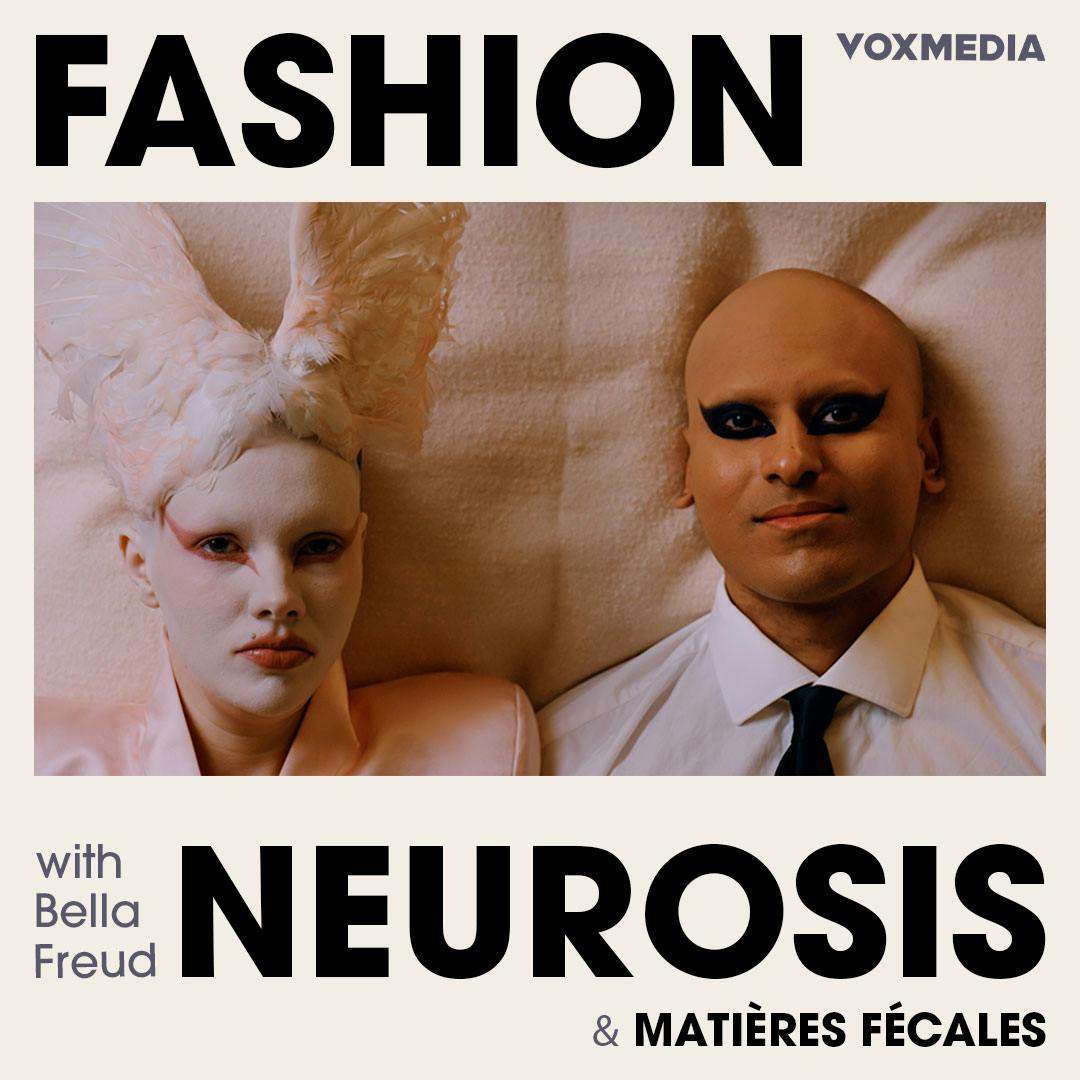
Hi, come in. Welcome to Fashion Neurosis. Hannah Rose and Stephen Raad.
- [01:02]
Hannah Rose
Hi, Bella.
- [01:03]
Stephen Raad
Hi, Bella.
- [01:05]
Bella
Can you tell me what you're wearing today and why you chose these particular clothes?
- [01:12]
Stephen Raad
I'm wearing a dress shirt and a tie and some dress pants and my big combat boots. Yeah, it's just my everyday look. I feel like lately I've been sort of trying to sort of deconstruct masculinity. So I don't know, it feels. Feels right about you, Han.
- [01:38]
Hannah Rose
I'm wearing a pink silk suit and with matching pink silk Louboutin shoes. And this is a look from our spring summer collection. And I just got it back from the factory, because they were. I sent it to the factory to make sure that, you know, when they make the orders for the. For the stores, that it looks exactly like how I liked it from the show. So I just got it back, so I was excited to put it on today. And I'm wearing a pink kind of bird headpiece to complete the outfit. And I don't know. Dressing every morning is such a ritualistic part of my life, and every day is a new day to be something. So I don't know. Today I felt like the pink embodies what I feel. I guess
- [02:37]
Bella
it's very charming and kind of softening to see you. And then I like Stephen, the belt you have around your arm, it's. The whole combination is somehow powerful but gentle. It's really lovely. And you're the design duo Fecal Matter. And your Instagram account, Matier Fikal, has nearly a million followers. And you've described what you do as creating and wearing a style that is not meant to be aesthetic nor a costume, but an extension of your skin. And you've both defied extreme disapproval to and prejudice in every area of your lives to express yourselves in the way that you do, almost like a biological earth. And, Stephen, you were a little ahead of the metamorphosis. And what was the first instance that
- [03:38]
Stephen Raad
you can remember I mean, for me, it was definitely. It all started when I started drawing. And I got. I mean, my high school experience was pretty bad, but drawing was really sort of like, my gateway to expressing myself before I could do it physically. So it was sort of my safe space to just create whatever I wanted. And I was really drawing what we look like today, actually. So I was actually drawing Hannah when I was, like, 11 years old. Like, I drew this bald woman that was androgynous but also sensual. And it was sort of like, yeah, a gateway for me to express myself. So when we met each other, I think that I was already sort of, like, getting that transformation bubbling. But it was really when I met Hannah that I was able to really sort of go all the way, right, Hannah.
- [04:41]
Hannah Rose
I think for me, it was through research when I was 14, I kind of figured out that clothes, like, how fast fashion was made and the clothes that I was buying, how they were being created and how it was really, you know, hurting people and how factories were burning down and people were actually suffering at the cause of, you know, demand for cheap clothing and for fast fashion. So it really. It made me so upset that I decided I'm never going to buy fast fashion anymore, and I would have to just make my own clothes. So I feel like my kind of gateway into transformation was through a little bit of, like, anger towards what I was purchasing and consuming. But still, it took, you know, maybe another decade to have the courage to, you know, wear what I was creating on an everyday basis and take that even further through makeup and through the darkness and all of that.
- [05:46]
Stephen Raad
Yeah, I think our environments, we were both in such different backgrounds, but it was. I think we were both very repressed, and we were scared. I think there was so much fear, at least for me. There was so much fear with my family, my background, because I'm half Sri Lankan and Guyanese. And culturally, I was also. I mean, I was Mormon. I was so many different religions because my mom was getting remarried a lot. So there was a lot of. Yeah, but it was always driven by, like, fear to how I presented myself. So there was so much bubbling in terms of creativity and ideas and my spirit. But then at the same time, in my real life, it was the opposite. It felt like a prison because you
- [06:43]
Bella
both grew up in these religious households. And, Hannah, you said you were afraid to reveal your body, and I wondered, were you shamed someone in particular, or was it more of a specific conditioning of your childhood?
- [06:58]
Hannah Rose
I guess for the first 12 years of my life, I went to an all girl private school in Montreal. And I had a uniform and it was very like, strictly imposed. You know, I couldn't even wear nail polish. Your skirt had to always be a certain length. And I was wearing a tie and like, very covered up. Very. Yeah, very, you know, not sexual, but it was just very ugly. No personality, no identity. And on top of that, going to Sunday school and doing communion and all those kind of like religious things on the weekend also. So, yeah, I don't feel I was particularly shamed. I think I was just in an environment where identity was. You could not have an identity and there was no room to explore unless, like, if you explored identity, you were punished, you know. So I think it maybe comes from
- [07:52]
Bella
that the shame came so interesting, that whole thing of, you know, sort of breaking out from your. What's your normality? Because I had the opposite upbringing. And I. I remember looking at. I had a friend who grew up in a Catholic home and looking at those quiet altar boys and things and thinking it was the most exotic thing I'd ever seen. And this kind of repression was so alluring because to me that looked like safeness. I mean, obviously it wasn't, but it's just that kind of the way. What for you, for both of us, the complete opposite represented some sort of gateway to freedom. But you. Yeah, it's suppression of children and how sort of crush. I mean, it is literally crushing. But how, if it doesn't set you free, it totally destroys you. And somehow or other it was your thing to push against and be free. And. And you described talking about growing up in a Mormon household, Stephen. And how did you. Because you talk about your families as something you didn't want to lose. And did you love your family in spite of their strict expectations of you?
- [09:29]
Stephen Raad
Yeah, because I grew up with my mom and my sister and my dad, he was basically. He was living in Guyana with another family, so he wasn't really part of my life. But my mom, my sister, I loved them so much and I was so obsessed with them because we were sort of like a little unit together. I grew up in like, low income housing and, you know, all the other, like immigrant families which sort of had the same situation as me. Like some of my friends, it was also like single moms of color. And, you know, I was living in the same room with my mom and my sister for a minute and we were all just together. So I loved them and they meant everything to me. But at the same time, I guess I was also resentful towards them. Because I wasn't able to be myself fully. And I felt encouraged to be a version of myself, but not the version that I wanted to be, if that makes any sense. And there was sort of a moment where I. I sort of. Yeah. Wanted to sort of end my life. And it was very scary. I was like, maybe. I think I was probably, like, 11. And it was partially because I was so scared that if I did live my truth, they would reject me. And I was so scared to lose them, and I was so scared to disappoint them. And at that time, you know, when you're a child, like, that's all you have. You don't really have the idea that, okay, you can, like, maybe one day move to Paris and, you know, do your thing. And, you know, at that time, in those environments, in your bubble that, you know, their opinions mattered so much to me. So in a lot of ways, yeah, I was so in love with them that it also stopped me from loving myself in some ways. And it was really. When I went through a whole situation and it didn't really work out, and I was sort of like, fuck it. I think I'm just gonna have to, like, be myself. And if they love me so still, then that's amazing. And if they don't, then I. I was sort of like, I guess I'll have to find new people to love me. And I was. I was okay to make that sacrifice. And in the beginning, they definitely didn't understand. My sister was a lot more understanding than my mom was. But throughout, I guess, my journey, they started accepting me more, and. And it's been great. But definitely, like you said, for kids, I think when you're born into an environment where you don't feel like you fit in and where you feel like you can't really chase your own freedom of expression, it could be the worst thing ever. It could kill someone, actually. So. Yeah.
- [12:40]
Bella
Were you more worried about your father or your mother?
- [12:44]
Stephen Raad
I guess, because my dad, he wasn't around, even though he was very religious also, and he was calling my mom a few times and checking in. And so, if anything, I felt lucky that he wasn't part of my life because I knew that because he was very strict and he was really intense. And so I knew that if he was around, I'd probably have even a worse time. So in some ways, I was more worried about my mom because she also. She doesn't. Because basically she's from Guyana, and she stopped going to school when she was around, like, 10 years old because she had to take care of her family. Yeah, she had like, I think she had like eight or nine siblings and she had to take care of them. So her education wasn't really the best. And then she actually, I mean her whole story is intense, but she got married into a Mormon family or something when she was very young to get like the green paper to go to America. And so her whole life was also very, very in a bubble. So raising me, I think somebody that was naturally just curious about everything. I think it was hard for her and towards sort of like my big transformation that I did. It was also a moment to educate her about a world that she had no access to either.
- [14:15]
Bella
Wow. Gosh. Nana, you said. Beauty was a very interesting development in my life because I wanted to be a good girl and thought I would never wear makeup. And how did your mother look? And I wondered where did your desire to be different? Can you place it in your ancestry anywhere?
- [14:40]
Hannah Rose
I mean my, my mom. No, I mean she. I gave her some Mac makeup for, for Christmas and I don't know if she's been using it. You know, she, my mom is a very, you know, she's a nurse. She's a very like nurturing type of person. But definitely fashion and makeup was not a part of her language or her day to day. But I was always really fascinated about the moms that like my, in my school. Like those moms, I was always like, so. They were just so fabulous. And I guess they, they lived this very luxury life and I was kind of, I guess very attracted to these, these women. I mean they would just dress up and pick up their kids after school. You know, that's like kind of all they did that was their job. But yeah, and my, my father, I mean with him we would always go vintage shopping and he was more into fashion and style and we would kind of. He was very supportive. Supportive of kind of my expression out of anyone because I think he understood it a bit more. But yeah, definitely. I can't pinpoint someone in my family, but there was always just such a. It was like a metal cord coming from my heart towards fashion and adornment and that kind of obsession. It was just. I don't know, I can't explain how it just, it was like this, such a strong connection with me and clothing.
- [16:21]
Bella
Because you've both talked about being hooked on self expression and like a drug and it's so fun and it's so interesting when you compare the freedom of this to the self annihilation of anorexia. Or self harming. And do you think those things are related?
- [16:46]
Stephen Raad
I think so. I think it all taps back into sort of when you look at yourself in the mirror and how you see yourself and trying to align that to what's physically there and what's emotionally there. And I think definitely it becomes an obsession, I think, for us. You know, when I looked at myself in the mirror, there was a moment where I didn't recognize myself because I didn't see what I saw inside on the outside. So I did steps to get there. So it's like in my head, I saw myself without eyebrows, so I shaved it off. And then I saw myself bald, and I went bald. I saw myself, you know, wearing, you know, specific things. So I made those specific things to wear it. And I, you know, it's like building yourself in some ways. And I think it's, at least for me, I also think it's really linked to growing up, you know, with, like, a computer and, you know, whether it's like Sims, which is, you know, like a game that I used to play, or, you know, these. These digital virtual worlds that I was also exploring at the time that, you know, a big part of it was you. You customize your character, you create yourself, you recreate yourself. So I think for me, that's where that obsession is. But definitely, you know, it. It also goes into, like, how you look physically in your body. And, you know, I grew up quite chubby, and I was, you know, self conscious about that also. So I went through a whole situation where I wanted to, you know, exercise and eat healthy and all that, but then I was an extremist, so it also went to the other end. So there's. There's totally a connection, in my opinion. I don't know, maybe for you, Han, what your thoughts are.
- [18:47]
Hannah Rose
I mean, to me, the. The word addiction is interesting because I feel like we are. We are very addicted to doing this because it's such a euphoric feeling. And both Stephen and I, we don't do drugs. We don't drink alcohol, we don't smoke cigarettes, we don't even drink coffee. Like, very, like, like really rejecting all forms of addiction. And people always ask, oh, how. How can you be in this industry and not be like, you know, snorting cocaine and doing what a lot of people do in this field. And for me, I always say, well, if you felt what we feel when we have this type of freedom, you would never, you know, it's. It. There's nothing that can compare. So I don't Know, that's, I guess what I think.
- [19:33]
Bella
Yeah, that makes a lot of sense. It's because, you know, reading about your journey to your fully expressed selves, it was. You mentioned Hannah about feeling sort of dejected and morose if you're not looking how you feel. And I really, I really noted that when I read that, that you'd said that I had a feel, you know, I could feel that and remembered in my childhood, there was just this one moment. I remember looking in the mirror and I was about 11 or 10, I was wearing a scoot neck top and I thought, this is terrible. I really, I am not myself. Something is terribly wrong here. And then I, you know, I became obsessed with collars, with shirt, you know, shirt, boys, collars.
- [20:25]
Hannah Rose
And.
- [20:26]
Bella
And when I got what I needed to wear right, I could become myself. Otherwise, this. This kind of anxiety about not my identity being, like, sort of insipid or somehow diluted. And I think that's the power of clothes. And you represent that so beautifully in both of you and how you look and how you are. It's really inspiring. And you met at fashion school in Montreal. And Stephen, you said you had boyfriends but couldn't have imagined having feelings for a girl. But now that you and Hannah are romantically involved as a couple, I want. Do you have that sort of normal sexual jealousies about each other?
- [21:23]
Stephen Raad
Yeah, I guess. I mean, for me, definitely it was a whole journey to fall in love with Hannah because, I mean, it all ties back also to, you know, part of my big frustration growing up was I was, you know, having feelings for men. And I, you know, was obviously from a very intense religious background. So there was also so much against that. So I went through like a whole journey of sort of like, embracing that and, and living it. And so definitely, you know, like, I worked hard to be gay and then Hannah came in and destroyed it and made it all so complicating again. And I had to go to like, another coming out experience. So, yeah, I mean, it was, it was definitely.
- [22:27]
Hannah Rose
It was, it was a confusing time.
- [22:29]
Stephen Raad
It was really confusing because we're also best friends and we didn't want our relationship as friends to end because, you know, now we've been together for over a decade, but at that time it was like, all so fresh and new. And I loved Hannah so much as, you know, my soulmate. But then I was also scared that if we get romantically involved that it would lead to, you know, a breakup or whatever, maybe, you know, I realized that I couldn't be With a girl or, I don't know, whatever. So it was all very like, let's just see where this takes us. So we were just discovering it together. And for Hannah, I mean, you were never with anyone.
- [23:12]
Hannah Rose
I never had a boyfriend or a girlfriend or anyone. So it was also something new for me, too. And, yeah, very. Also confusing because we were really, like, the bestest of. Bestest of friends, spending every living moment together, doing all of our school projects together. You know, after school, we were together. So it was. It was like, oh, my God, everything is kind of on the line if we take this further.
- [23:40]
Stephen Raad
Yeah. And, you know, the whole world, like, our friends, our family, everyone just framed it as, like, you know, I'm, Hannah's, like, gay best friend. And it was just, like, easy to digest. And then it became also complicated and confusing for everyone around us also. But, yeah, I mean, we love each other, and I think we. There's no way not to pursue it. And if. Speaking of addiction, I'm addicted to Hannah also. So it was like, I needed more and Hannah also. And I think we. We learned a really valuable lesson, actually, about. About how love has no limits and how the dynamics of relationships and the normal dynamics of relationships don't really apply to human beings. I actually find that the more you dig and the more you're open with yourself, the more you can be open to loving anyone, really, and being attracted to anyone. I think it's all a state of mind. I think we all have our natural preferences and attraction and all of that. But for me, at least, it was. It was. It was clear that, you know, I was in love and attracted to Hannah, and I had to. I had to go for it. And I'll never forget because basically we were. We were like, best friends and doing our whole thing. And then we'd always go out, so after school, we would just, like, go partying, me and Hannah and. And sober. But we were like, do we just love dancing? And we love just discovering, like, underground music. Montreal has a really amazing underground music scene. So we were just like, always out and turning looks and, you know, having fun. And this is also before social media for us because it's like 20, 2013. So it was like we weren't even on Instagram. It was just our own, you know, time to just, like, have fun. And Hannah would never get hit on. So, like.
- [25:48]
Hannah Rose
Because Hannah was also like, like, we're
- [25:51]
Stephen Raad
always at queer parties and gay. Yeah. At the gay club and. No. Yeah. No. But no one would ever hit on Hannah. And then we Went to this, like, straight bar once, and this is right after we graduated. So it was like, the beginning of summer, and I was. I already ended my relationship with a guy I was with. So anyways, and I basically, Hannah got hit on, and she was wearing, like, a low rise, like, skinny jeans with, like, a pattern print, like, pointy boot, and like a. Like, a showgirl halter top thing that you made out of, like, something burlesque, like a burlesque skirt that she transformed into, like, a halter top. And then she had black lip and she had hair at that time, but it was, like a short haircut, and she had, like, a lot of jewelry on. And there was this guy that was, like, talking to her and hitting on her, and I was dancing, and I saw that all unfold. And in that moment, I was like, I have to make a move tonight because Hannah is actually a beautiful, you know, gorgeous girl. And I don't think I'm comfortable seeing her with somebody else. And this is my shot. This is, like, my moment. So before, what if she does get a boyfriend? And we might have to wait to see where things go. So that night, I took her after the party. This is maybe 4am and then we went to the park near my place. So we took the night bus, and then we got off the stop before my place, because the park was one stop before. And I was like, oh, we should get off the stop here. And then Hannah was like, what are you.
- [27:37]
Hannah Rose
Yeah, I said. I said, are you trying. Are you going to kill me?
- [27:40]
Bella
I don't know.
- [27:40]
Hannah Rose
Why? I just had this instinct that something was, like, severely wrong and I was in danger. And then you said, no, I just want to walk to the park. We should walk around the park. I was like, okay, very weird. It's 4 o' clock in the morning. And then we walked to the top of the hill. And then you just kind of stood, stood there. And again, like, I really thought that something bad was gonna happen. Sorry. And then he said, no, actually, I want to kiss you. And I said, okay, but I'm not gonna kiss you back.
- [28:10]
Bella
Oh, I'm sorry.
- [28:13]
Hannah Rose
Because I was just like, oh, I don't know. And I'd never kissed anyone before, and then it was like, oh, my God. But we're, like best friends. Like, what is. It was all very confusing. But, yeah, that was. That was the first time. Yeah.
- [28:26]
Bella
That's so romantic. Like, Tristan is older but with a happy ending.
- [28:31]
Hannah Rose
It's great.
- [28:33]
Bella
Wow. Gosh. Your first kiss, that was from Stephen. How wonderful
- [28:43]
Narrator
support for the show comes from Anthropic, the team behind Claude. We've all become so accustomed to getting instant answers to any question that crosses
- [28:54]
Bella
our minds, which is understandable.
- [28:56]
Narrator
We've all had access to search engines for decades now. But often search engines will trade depth through expediency. And the answers you're given can be incomplete or compromised by advertisers. That's what sets Claude apart. Claude isn't interested in giving you quick and easy answers when you ask it a question. It's prepared to get into the why with you, to dig deeper and follow you down rabbit holes. What's more is that Claude can also support you with the kind of admin tasks that are tedious to complete on
- [29:32]
Bella
your own, which is how I prefer to use Claude.
- [29:35]
Narrator
It helps me with things like cleaning up a cluttered inbox or summarizing meeting notes or synthesizing a plan of action when I want to get started on a new project. In that way, Claude is more like an ally than a simple search engine. Try Claude for free@claude aifashionneurosis and see why problem solvers choose Claude as their thinking partner.
- [30:03]
Bella
And if you fancy someone and don't like what they're wearing, does it kill your attraction?
- [30:09]
Hannah Rose
I mean, that's so funny. We were talking about this at Christmas with Rick and we were talking about this with Rick at Christmas or something.
- [30:18]
Bella
Yeah.
- [30:19]
Hannah Rose
And I think we all agreed. I don't remember what we all agreed
- [30:22]
Stephen Raad
on, but I think for me it doesn't kill the attraction. I think I enjoy when people have maybe like a normal look or maybe like not the best sense of style. If anything, I'm attracted to people's minds. And sometimes, you know, as we would know better than anyone else, what you think sometimes and how you feel doesn't always reflect how you look. So I guess I'd be curious to discover the mind more than what they look like. But at the same time for like a. For me at least, definitely, you know, somebody with great style is a. Is a plus. Right.
- [31:17]
Hannah Rose
I think for you I'm more of a mind person also. But I guess the initial look across the table or something maybe is through kind of an outer shell perspective. But yeah, I'm more. I'm more curious about the inside.
- [31:34]
Stephen Raad
But I love extremes, so.
- [31:36]
Hannah Rose
And bad fashion can sometimes be bad fashion. That's what I mean.
- [31:38]
Stephen Raad
Like, like somebody who looks super boss watched that has like a crazy, you know, like leopard print leggings and like, you know, like. But it's like fully like, you Know, full on. Full on can also be interesting. That could be really attractive. I. I like when people are. Are fearless, I guess, when they're fearless in the way they present themselves, whether it's good or bad, it's the intention of just, like, not caring what other people think about them. Like, you know, for example, like, you know, homeless people on the street. Like, you know, I. Sometimes I look at the looks, and obviously it's true. Different layers of what they're going through, but it's. Sometimes it's so beautiful, and you can't help but be like, okay, the proportions and, you know, the vibe. Same as, you know, you could be surrounded by, like, people that have, like, so much access to beauty and amazing fashion, amazing clothes, like luxury brands, and you can look at what they're wearing. It's like, ugh. So it's. It. I think it's more the energy and. And the vibe. But, yeah, I know.
- [32:44]
Bella
Like, I was talking to Arthur Jafer, the artist who was on Fashion Neurosis, and he said, it's strange what can be what you like, and then what you find you're attracted to is sometimes a bit of a shocker. You think that's gross or hideous or really botched. I haven't heard that.
- [33:08]
Stephen Raad
That's really good.
- [33:10]
Bella
But I'm sort of. You know, I have feelings for this, and I love that kind of thing. It's. It's great. And how do you feel about being naked? Because does that involve being 100% naked with no makeup, or do you prefer to have elements of your. I've heard you describe as fecal glam to do with your makeup and to feel naked in. In the exciting way that sort of. That naked can feel.
- [33:43]
Hannah Rose
I feel like it's very, very important to have a relationship, like, with myself with makeup and without makeup. So I. It's something very difficult and something I struggle with because sometimes I feel like I don't love myself without makeup or without the clothes and without the shoes. And not just any shoe. It has to be a specific shoe, you know, like. So for me, a part of. I would say my practice is to spend time with Hannah without makeup and also Hannah with makeup. And not that they're. I mean, they're just. They're separate entities, and they're almost different energies in a way. But for me, it's very important because you can easily get very lost into the. The makeup and almost use it as a crutch, and I would never want it to be a mask. And I think for it not to be a mask. You really have to know both sides. So for me, like, naked means no makeup, and. But I have to feel like Hannah in both. Does that make sense?
- [34:55]
Narrator
Yeah.
- [34:55]
Hannah Rose
Not one should be better than the other.
- [34:58]
Bella
Is there something that you wear that does that, or. Or is it about total nudity?
- [35:06]
Hannah Rose
Sometimes on the weekend or when I have, like, a time off, I'll go for a very long walk, and I'll be, like, in a full kind of, like, running outfit. And, yeah, sometimes I. I dabble in that, which is interesting. And for some reason, it's like, a necessity, not as, like, an escape from this, but as a way to connect to that side of myself, because otherwise I start disconnecting from that, and. I don't know. Again, both of them have to be. Because, yeah, when you go to bed, I have no makeup on, and you have to have love for that side of myself also. Yeah, but it's definitely. And I think if you interviewed anyone who does this type of extreme, they would. A lot of people would feel the same, where. Yeah, you. You have to love both. And it's a challenge, I would say. What about for you?
- [36:07]
Stephen Raad
Yeah, I mean. I mean, sex with makeup is messy, so. But I mean, for me. Yeah, I mean, I think. I think Hannah, for example, she's really, like, 247 with the makeup. It's, like, really her. It's like, really her ritual, and it's a big part of her identity. Like, I think we've been doing this for ten years, and I. I was like that also before, whereas now I'm a lot more, like, flexible also. You know, our work life, you know, being designers and brand owner, like, it's a lot of. It's a lot of. There's less time, actually, to really spend on. On how I look as much as I did before, but I'm still, you know, if anything, now, it's just stripped back to the basics and, like, the most important parts, which, for me, it's, like, definitely, like, how I feel and feeling comfortable, but also still feeling like myself. And that's definitely with the makeup and bald and this alienesque look that, you know, makes me just feel like myself. But.
- [37:26]
Hannah Rose
And also, let's keep in mind, even if we have no makeup on, we're still bald and eyebrowless, and we still wear, you know, this whole regalia here. So it is still, like, such an extreme.
- [37:36]
Stephen Raad
Yeah, it's, like, on a spectrum. Yeah, honestly, it's really on a spectrum where it's like, there's the extreme version of Ourself where it's like, you know, we can, you know, put on a full look where we can't even walk. And then there's, you know, the version of ourselves where it's just like, you know, airport glam, which is, you know, just like us looking like us. But maybe not like, not the makeup and sunglasses or whatever, but definitely like when I'm at home and when I'm naked, it's like definitely comfortable in my skin without the makeup. But at the same time, I love Pierre Molinier and I love this sort of way of expressing yourself through sexuality that is also very nuanced and you know, paramoline with the mask and so this cross dressing direction which, you know, I'm also attracted to that in that sense. So for me I'm. I'm intrigued in all of those sort of different ways of expressing yourself and sort of adorning your body sexually, which is also interesting, you know, the sensations of things. You know, I mean, we go to a lot of the coolest parties in Paris, like the ones where the music are the most intense and the ones where also there's no phones, there's usually sex parties and we personally don't engage. But just seeing the looks and seeing how people express themselves but with the context of attraction and sexuality is also super interesting and beautiful. So, yeah, I guess, I guess it's. It's definitely intriguing.
- [39:27]
Bella
Yeah, it's interesting. I love those looks of people, you know, someone has gone out to attract is like insect life. It's one I've got to find that lesser spotted turquoise winged butterfly out that, you know, and everyone is dressed up for to find that particular reflection almost. And I think that's really interesting. And I read that you'd said we as a society are pressured into living a life that involves so much purchasing and you referred to that, Hannah. And how do you manage to produce fashion which is so hard to make any kind of profit on and sort of reconcile with that whole thing, which is very hard in this business.
- [40:21]
Hannah Rose
I mean, right now we have a lot of support from Dover Street Market and Adrian Joff and he helps us with all of our Ready to Wear offering, which has been such a big support because I mean, me and Steven, we had no capital to make anything and kind of get the ball rolling. And for the past 10 years we were making stuff in our kitchen at home and selling stuff online direct to consumer, which was working, but it took so much, you know, like all day I was at home sewing hoodies and T shirts and cut up dress shirts and all types of things. And it took so much energy to kind of be that machine. And with Dover Street's help, we can kind of just focus on design and the big picture, which has been really nice. So I feel like with their kind of support, we're able to kind of learn how to manage all of that and cash flow and all of these things. Right?
- [41:22]
Stephen Raad
Yeah, I mean, I mean, you know, we. Our brand name is called Mattel Fikal and we're called Fi Fecal Matter. I mean, the meaning behind it was always to challenge the wasteful side of fashion, to always also challenge the luxury market. I think the luxury in the luxury industry in fashion is so picture perfect. And it's all about selling this really glossy, very, very hyper beautiful way of seeing life. But the reality is when you go, go outside, it's not the case. So for us, it was like the brand name was really important to sort of make that statement of how we see beauty also, which is, you know, we, we find beauty in, in all aspects of life, including the things that are the most gross or disgusting and repulsive. And it's also showcased that there's, there's power in that. So for us, it's definitely been important to integrate that into our business and find a balance. I mean, you know, that's also why we do a lot of our artisanal looks and our artisanal pieces. And you know, we are doing a lot of, we work with, like we said with Dover Street Market Paris, which really helps us source some, you know, really ethical ways of creating. And it's been a new journey for us because, you know, we started doing our thing 10 years ago and it was really just sort of a protest against fast fashion. So that's where we were creating pieces by ourself and selling it online. And it was all using upcycled materials. We'd go like walking around and find stuff in the garbage and recreate it. Like umbrellas. We would turn like beautiful halter top dresses out of umbrellas and you know, just create these like really imaginative, recycled, upcycled pieces. But in the end for us, I think it was, it was hard because I had all those sketches, but I couldn't really create it because it was, you know, when you create upcycled pieces, the main thing is you have to use a material that you have access to and transform within those boundaries. But when you're designing true sketching or whatever, mood boards or whatever, you sort of have the full freedom to create whatever you want. But in consequence, you know, sometimes it's not using recycled materials. So in some ways, I guess we're just still navigating that whole transition. But definitely our goal is to learn and to grow and to have our business and our label to be, you know, sort of hopefully helping fashion be a lot more ethical and a lot more mindful.
- [44:09]
Bella
Because, Hannah, when you said you'd got your outfit from the factory, like, how many pieces will you make of this particular look?
- [44:20]
Hannah Rose
I mean, not like, not hundreds, not, I don't know, maybe like under 50 units of this suit. You know, it's not like a mass production. It's not a mass production situation at all. Especially this design, because it's, you know. You know, I think the blazer is maybe three and a half thousand dollars recently retail. So, you know, it's an expensive piece, and it requires a lot of hand work. Inside, there's boning and crinoline and all types of things to get this shape. And it's not like a million people are gonna have, you know, maybe the courage to wear this shoulder and this color. So I think what we do is, you know, it's not for everyone, and that's okay. But that also means that, you know, we're not catering to the mass, so we're not contributing to, what, waste on a mass level either. Which is fine for. For me.
- [45:07]
Bella
Yeah. No, I. There's so much criticism of either fast
- [45:12]
Narrator
fashion or expensive fashion.
- [45:14]
Bella
But then expensive fashion means someone is well paid for it. And the fabrics made by people who are paid, you know.
- [45:23]
Hannah Rose
Yeah.
- [45:23]
Bella
So, you know, there's. Obviously, it's less of accessible. But even now, in big luxury brands, as, you know, you know, to have 50 pieces of a jacket isn't necessarily a small amount.
- [45:38]
Hannah Rose
Right.
- [45:39]
Bella
It's really hard to find people to make the things, especially when they're very beautifully and exquisitely made like your things. And to be able to afford them yourself, let alone sell them on, I mean, it's amazing that you're on that journey and. And so successfully. And is there a public figure that you'd like to dress?
- [46:11]
Stephen Raad
I love Oprah. I'm obsessed with Oprah, and I'm obsessed with, like, her spiritual, like. Yes. Or whatever she calls soulful Sundays, I think. But because I grew up with Oprah, my mom would watch Oprah after school, I'd come home, and she had Oprah on. And, you know, Oprah was, like, at the time talking to her talk show. She was talking to people who had AIDS and, you know, informing, you know, these Everyday women and everyday men, what, you know, people with aids, what they're going through. And so she was always trying to deconstruct the stigma around certain taboo subjects. And obviously there was, you know, sort of, you know, she's a woman of color who, you know, at that time frame was really, you know, sort of like, you know, the most powerful person in the world or one of the most powerful people. So culturally, it was so impactful for me. So definitely dressing someone like Oprah in like, a power suit, what would you make Oprah in a meta fit power suit would be like a dream come true. I think that. I think the public figures that we're attracted to are ones who align with the same values as us. I think we've been getting a lot of requests from different people to dress them or et cetera, but I think for us, it's always we asked ourselves, are these people sharing the same values as us? Are they standing up for the things that we're standing up for? Because, you know, when you're in a public arena, you know, you're. You have a platform. Well, whatever you do, whether it's promoting, you know, anything, whatever you're promoting, it's. There's a consequence to it. So for us, we're very mindful of that, especially at the beginning of our journey as a, As a brand, as. As a. As fashion designers in Paris. And for us, we're very mindful of. Of who we're aligning with, because I think, you know, the world that we live in today, it's. Things are so divisive and things are so sort of dystopian, but I think the light in the tunnel is, you know, expression. I think it's art. I think it's beauty. So for us, it's like, you know, aligning ourselves with people that. That are in that same wave is what we're always towards. I don't know for you, I mean, the whole.
- [48:41]
Hannah Rose
Our whole relationship with Gaga has been so magical because watching her as. Growing up was. I mean, going back to one of your first questions, maybe also her seeing her, how she was able to express herself on the main stage and, you know, as a woman, just kind of be so powerful in what she wears was so inspiring. And so to be able to dress her and just, I guess a couple days ago doing the Grammy.
- [49:08]
Bella
Yeah.
- [49:08]
Hannah Rose
Look for her was.
- [49:09]
Bella
She looked amazing. That with black feathers dress, wasn't it so beautiful?
- [49:15]
Hannah Rose
It was so. It's so nice. And, you know, she stands up for our people, you know, like I feel like if she was at a restaurant and, you know, in the corner of her eyes, she saw somebody being mistreated or something. Like, I feel like she would even, you know, get up and say something. Yeah. So as Stephen was saying, dressing people that kind of have our communities back is really important. And she's just been so nice to us also, so it's been really wonderful to work with her.
- [49:46]
Bella
How long does it take to make a dress like the one she wore?
- [49:51]
Hannah Rose
Well, I mean, you want the full tea. Her styling team, Nick and Perry, are very, very nice, but I think we only found out that we were confirmed for that. How many days? Like a week?
- [50:04]
Stephen Raad
Yeah, I think we had, like, nine days to make it.
- [50:07]
Hannah Rose
Yeah.
- [50:07]
Stephen Raad
But then it had to be shipped to la, so we had to actually have somebody flew from Paris to.
- [50:14]
Hannah Rose
To bring it to her.
- [50:15]
Stephen Raad
To bring it to her. So we had to actually have the dress done in two parts to fit into two big suitcases. But. But, I mean, luckily, we, you know, we've been working with Gaga for the past year with her concerts. We have all her measurements, and we actually have. You know, it was actually super easy, and, you know, everybody. We sort of dropped everything we were doing.
- [50:39]
Hannah Rose
Yeah.
- [50:39]
Stephen Raad
And we just.
- [50:39]
Hannah Rose
All hands on deck.
- [50:40]
Stephen Raad
All hands on deck. All the. All the people that work with us in Paris. So it was. It was definitely a labor of love, but definitely, you know, couture look in our shows. Like, you know, that, you know, I usually design the collection, so I usually sketch everything out almost like six months before or eight months for the past two collections. So. And when I sketch, basically that's what you see on the Runway. We tried to stay as close to the sketch as possible. And so those looks can definitely take a long time to create because it's a lot of handwork. I mean, it's real couture, and that's the beauty of being in Paris. And that's why we moved from Montreal to Paris, because versus also coming to London or, you know, the craftsmans and the expertise and the Les Petit Mais, they're so passionate. It's passion. It's the love of details, the love of creating these. Whether it's like, trimmings or the plumery or everything, it's. It's just so beautiful. And it's. And to be honest, that's our favorite part of. Of our job, is working with those craft people and creating with them. So it's. It's. It's actually very interesting to see when you have a little bit of time to create something, but you're so in love with it, how much you can do. So it's super cool.
- [52:16]
Bella
Yeah, I remember going to one of those plumeries near the Pompidou center in that area and just going. And being completely sort of spellbound by all these things they have. And how many looks do you have on for each show?
- [52:35]
Hannah Rose
The show coming up in March, I think we'll have probably 55 to 60 looks. So it keeps getting bigger and bigger.
- [52:44]
Bella
Yeah.
- [52:48]
Narrator
It's often said that creative people are not the best at managing business. We may know what we want, but we don't always know how to get it done. This is where I use Claude not to have ideas for me, but to help me navigate the administrative tedium of bringing my ideas to life. My inbox is full of unread emails. This is my system for reminding myself of things left to do. Claude looks at my inbox and my calendar and tells me what needs my attention and what can safely be ignored. Before meetings, Claude reads long email threads so I don't have to pretend I can remember everything. Claude helps me keep track of what I said I'd do, what I've already done and what. What everyone else has quietly forgotten. And when I'm working on a project, I can give Claude some context, and it helps me sort through my ideas and prioritize the order of things. To me, Claude feels less like a tool and more like an authoritative ally. I can spend more time thinking, listening and making decisions and less time managing chaos. Try it for yourself at Claude AI Fashionneurosis,
- [54:09]
Bella
Because you're also part of the Rick Owens family, which I secretly feel I'm also a part of. And you met him when he invited you for dinner in his place in Paris for Halloween, and you said his home is really beautiful and what's your home like? And I wondered how your domestic life is influenced by your aesthetic.
- [54:36]
Hannah Rose
I mean, to be completely honest, at the moment, we live on top of a pizza shop in Paris in a very busy, busy area. And it's nothing glamorous. It does not look like Matias Fikale at all. It's the same apartment we've lived in since we moved to Paris. Paris in 2022. And it's fully furnished, so that means that it's not our furniture at all. And yeah, it's kind of like, I don't know, it's some sort of torture at home sometimes because it just, you know, there's a bright yellow velvet couch in the living room, which is like the furthest thing possible from anything that we would choose on our own.
- [55:17]
Stephen Raad
So. So it's the opposite, actually. But I think. I think what. There's a charming aspect to it because at the same time, I think a big part of our work, I think a big part of our life also is that we. I think we grew up in so much suppression and we grew up with so many obstacles of being ourselves that in some ways I can. I can say that even our home is that. You know what I mean? In some ways, like, honestly, like an obstacle. So it's like having something super normal, sort of devoid of our personality, enables us to maybe, you know, go bolder in what we look like. So, you know, I sketch everything on that same couch. So it's. In some ways, I actually think it contributes to the expression because maybe if we were in, like, a super. In a home that reflected everything that we looked like, maybe it actually would just mirror that and it wouldn't contribute to something new. Whereas, like, we're always surrounded, like, because you have a lot of windows and we see everybody outside. Because also the pizza shop is, like, super busy, so there's always a lineup. And you see all these different types of people. Tourists, a lot of tourists. So you see all the tourists and. And like, you know, what they're wearing with the families. And, you know, it's. It's the environments that we grew up in that we don't live with anymore. But in some ways, maybe there's an attraction to that. Maybe there's a. Maybe there's a fetish also to being, you know, so in juxtaposition to something that doesn't reflect what we look like, which is part of it, I think. I really do think it's part of it. I think it's. It, It. It's. It's in our nature to have to jump over a fence. And maybe our home right now is defense. But maybe in the future, hopefully we.
- [57:13]
Bella
We.
- [57:14]
Stephen Raad
We have the resources to. You know, that's why we love Rick and Michelle so much because, you know, they. They always sort of like, made it work, whatever they had. And they, they, they. They sort of. Their personality, their aesthetic just bleeds out in everything they touch. And I love that about them. And I think that's definitely something we aspire to be in. Experiencing their home, which is so curated and so abstract, but at the same time so homey, is something that's so beautiful. But I think, if anything, the thing that really stands out the most in our home is to clothes, because we have clothes everywhere. So the clothes is sort of like the art objects that just like exist. And I think our cat Cunty, our sphinx cat Cunty, she definitely. That looks like us. So she's literally our third member. She's bald and, you know, hairless. Probably the same. Almost a little lighter shade than pink than Hannah's Taylor jacket right now. But it's, it's definitely, yeah, our little family. I mean, to be honest, we love being normal also. There's a part of us to really, you know, we're. We're. We're just a normal straight couple that's with their cat watching tv. So. Yeah, yeah.
- [58:40]
Bella
Also I think that interior thing is. Takes time. And I. I certainly remember getting my first flat. That was mine a long time ago. And I didn't change anything. There was carpet up the side of the bath and all these things that were considered really naff and everything. And I was so thrilled to have a place that that was enough. And it took 20 years more to, you know, get the curtain. I like, you know, it just. There's something about what you described, the lack of something that makes you want to fulfill it somewhere else. And like all these people, like, there's a part of South London called Bromley where lots of very creative people come from, like David Bowie and Hanif Qureshi, the writer and Suzy Cave. And there's a whole group called the Bromley Contingent. And it's the most suburban place. And it's kind of spawned these generations of extreme, extremely creative people. And like Leigh Barry, who grew up in some suburb, I think it was called Sunshine or something like that, somewhere near Melbourne. And in fact, Hannah, when you were talking about being off duty in a sort of running suit type of thing, I find it. There's something really glamorous about seeing highly, you know, people with really a developed look that's a real thing and something of extreme beauty off duty, because there's a whole other kind of. Kind of conflict going on. And I remember when I used to go and sit for my father when he was painting Leigh Barry, and he would have an off duty look,
- [60:49]
Hannah Rose
but
- [60:49]
Bella
it was just as kind of mesmerizing. He'd wear this kind of curly wig and then he had the kind of dimples in his cheeks from where he used to put the mouth where he'd plug it in there, and a tracksuit, but there was nothing anonymous about him. And this is thing to do with how to be naked and how to be dressed, but I find even, like, if my pajamas are too Anonymous. I cannot wear them because I'm quite low key in my style. But it has to be representative, otherwise it feels like annihilation, really, on some weird spiritual level.
- [61:40]
Hannah Rose
I mean, I feel the same because even, you know, like when I'm saying, oh, it's like a, it's like a relaxed version, you know, it's still like very curated, you know, like it's always head to toe white because maybe, actually now I'm thinking about it, maybe because I don't have my white face, but then I put the white on the, on, you know, the tracksuit or whatever, the gym clothes.
- [62:04]
Bella
Huh.
- [62:04]
Hannah Rose
Isn't it funny? But yeah, it's still very like curated, as you're saying. And there's still something quite, you know.
- [62:10]
Stephen Raad
You look beautiful. You look so beautiful. I think you're, you're selling yourself short.
- [62:14]
Hannah Rose
Okay.
- [62:15]
Stephen Raad
So that's a good running look. It still looks super alien esque and I think if anything it just shows another side of you that is beautiful to see. You also explore then, because you seem really comfortable in that look too. I mean, I think that, at least for me, I think freedom is true defiance. And I think that that's really, that's a big part of freedom. You sort of have to defy something to achieve it or to experience it. And there has to be something that is sort of in your way to get the freedom, if that makes any sense.
- [62:59]
Narrator
Total sense.
- [63:00]
Bella
Yeah. And do you now you live in Paris? Do you go to visit the Louvre? Is there any art that you like to go and look at in particular, when you. Do you go to the Louvre much?
- [63:16]
Hannah Rose
Honestly, we don't. Stephen loves to walk to the Eiffel Tower and I think walking is like such a big part of it.
- [63:26]
Stephen Raad
Yeah.
- [63:26]
Hannah Rose
And the nature, like the parks, we always love to do that.
- [63:31]
Stephen Raad
Yeah. The architecture in Paris, I mean, that's. We just, you know, we'll just go to those areas and to the monuments and immediately get inspired. The sand is, you know, the water. And I think we're also constantly trying to create art for ourselves and through our own process. And we're surrounded by so many references a lot of times, but for us at least it's. It's sort of, sort of nice to not be in those environments, to get inspired. I find it comes out more in like blank spaces.
- [64:14]
Bella
Yeah.
- [64:14]
Stephen Raad
So we, we often do that. But definitely, you know, we, you know, I mean, Paris has so, so much art everywhere and it's so beautiful and seeing the people, we, people watch a lot. Yeah. So, you know, we'll will hang out in the corner somewhere and just watch people and create stories around them and analyze and all of that. But a lot of books, I mean we have a lot of books at home and a lot of photography books like Pierre Molyne, Irvin Penn, like those are, I mean, Francis Bacon.
- [64:54]
Narrator
Yeah.
- [64:56]
Stephen Raad
So there's, there's just so, so much. And Leigh Barry, I mean we saw the Leigh Barry exhibition that happened in London.
- [65:03]
Bella
Yeah, that was great.
- [65:04]
Stephen Raad
So beautiful. I mean, you know, Lee is, is, is a big inspiration for us. I'll never forget seeing, I think it was like the Harrods like video on YouTube.
- [65:13]
Bella
God, yes.
- [65:14]
Stephen Raad
Where he's like, you know, in full look and you know, because, you know, I think that we've coined this pro provoke society. So we've always been saying provoke society when we go outside because people look at us whether we like it or not. So we sort of provoke society is like an empowering way of just like embracing the fact that people are looking at you. So sort of like give them something to think about through looking at us at least we're like, we feel like we're, we're sort of promoting critical thinking through our look.
- [65:48]
Bella
Yeah.
- [65:48]
Stephen Raad
So Leigh Barry, that's, that's a big part of that video. That video of him in full look, you know, in all the things that he made and you know, just twirling around this luxury department store during the day, during the day with the families in the luxury space. It's like ultimate freedom, ultimate defiance and a huge inspiration for us. I think that single, that video single handedly is a major inspiration for us and for so many people in our community that also dresses up and serves looks and you know, is doing this, it's a big, big. Lee is like God.
- [66:26]
Bella
Yeah, he was a bit like God. He was so full of confidence and sort of authority without, you know, he just, you just believed in everything that he did and it was so, it was so brilliant and funny as well. And interesting actually because you know, you us talking about being naked and my dad painted him naked and he, you know, it's not like he looks like somebody without his, his himself, his essence. He looks just as kind of impressive. And I can't remember if he shaved his eyebrows because when you've been talking about that, it's the first thing that drastically alters how people look at you, I think. And unless I go back and find a picture of Lee. Did he shave his eyebrows?
- [67:31]
Stephen Raad
I think, I think he did. I mean the nicknight photos that we Love also. I think he did.
- [67:38]
Hannah Rose
Yeah.
- [67:40]
Stephen Raad
I think that shaving the eyebrows, at least for me when I did it, I remember I just did it randomly at home, coming back from fashion school one day, and I just did it. And my mom came in from work and she was like, you've gone mad. Are you okay? What happened? Are you going through, like, a psychosis? Like, what's going on? Why would you do that? And then I called Hannah and then Hannah was like, what's happening? I thought you went back and. And then like, fast forward to like two months later, Hannah shaved hers. And I think there's something about eyebrows that frames the face in the most human way. And when you take that away, you lose that. That frame from. From a picture and you just get the canvas. And that's how we see our faces. Yeah, it's just like a blank canvas. So the eyeshadow can extend beyond the eyebrow. There's no limits. And hair is the same thing, you know, Divine is the same thing. Where she would, like, you know, paint the eye wing so far back that it would even go beyond the ears. And that extra extension, that distortion of the human body is something that intrigues us so much. And I think it all taps back to, at least for me, like, growing up feeling like an alien and resonating so much with aliens. I used to be so obsessed with them because I felt like I didn't belong, and I felt like I didn't belong in my environment, and I was dreaming and fantasizing about all these things. That looks so different than reality. But the more we sort of went into our alien look, the more we realize actually how human it is to feel that way. And that's why our first collection was titled the Other, because. And we had all of our friends and family, most of them, they were walking the show in the finale looks, and it was sort of to celebrate the otherness and that feeling of not really belonging. But I think it's a big part of the human experience. I think it's. I think everybody sort of feels that way in some way or another. You can. You can go to a different country, like, you know, when we go to Tokyo or Japan, and we can feel like the other also, and same as if someone who's Japanese comes to Paris. So it's a feeling, I think, that we all resonate with. And, you know, it's. If anything, we're all searching for belonging.
- [70:11]
Bella
Yeah. And you're both so elegant and beautiful and have these exquisite looking bodies. And how do you take care of yourself. What's it. Do you have a routine for your.
- [70:26]
Hannah Rose
My routine is lots of cakes. I love sugar. I'm addicted to anything with, like, cream or custard in it. I love pasta. Like, I really. I don't take care of myself internally, which has actually been on my list of things to start doing, apart from the walking, but. No, but Steven is all up in it.
- [70:46]
Stephen Raad
Yeah. I love working out and I love running. And it's also just, you know, it's a form of discipline that I really enjoy and need also. So even before doing a fitting or work, like I have to go to the gym or I have to work out, I have to do something physically because it's just a way to release also the tension. I mean, I work heavily with my therapists and we really realized that, you know, especially when you go through an extensive amount of bullying and abuse that I went through growing up, like, you sort of internalize all the frustrations and the brutality of it. You sort of like, digest it, but doesn't actually leave your body. It sort of like stays in it.
- [71:30]
Bella
Yeah, yeah.
- [71:31]
Stephen Raad
So you need something, whether it's like, it could be working out, it could be, you know, it could be anything really, but you need something to sort of release the violence and release the. The pain and the aggression. So for me, it's been. Yeah, it's been. It's been definitely like healing to. To get into that. But eating is also the same thing. I mean, I grew up, you know, my mom, she was like a compulsive eater. So emotionally eating and so that's a big part of it. Like, everybody in my family had like, diabetes and it was like a whole thing. So for me, I'm. I sort of in some ways have to be self conscious of all of that to like, be as healthy as I can. But yeah, I mean, it doesn't help having Hannah who's just eating whatever she wants. But. But if anything, it. It's nice because sometimes I could take it too seriously.
- [72:29]
Bella
Yeah.
- [72:30]
Stephen Raad
And it's nice to just like. Yeah, just enjoy.
- [72:34]
Bella
Yeah, I know. I know exactly what you mean. I can get caught up with too much self discipline and forget that nothing's going to happen if I waver. But I can get too sidetracked by these rules for myself and they then stop being helpful to see the horizon and to break out and everything. Anyway, thank you, Hannah and Stephen, so much for being on Fashion Neurosis. It's so lovely to see you there in these incredible clothes and to listen to you and how you make make clothes be so inviting. And I think a lot of people can be afraid of extreme beauty and how it's manifested in any kind of different way. And you just have such wonderful personalities, and it's really nice to have you in the world.
- [73:48]
Hannah Rose
Thanks, Bella, for having us for your nice questions.
- [74:12]
Narrator
Thanks again to Anthropic, the team behind Claude for supporting this show. Claude is the AI for people who want a thinking partner, people who aren't satisfied with good enough, but instead want to understand the why of the thing more than just getting a simple answer. If that sounds like you, you can try Claude for free at Claude AI Fashionneurosis.