← Finding Mastery with Dr. Michael Gervais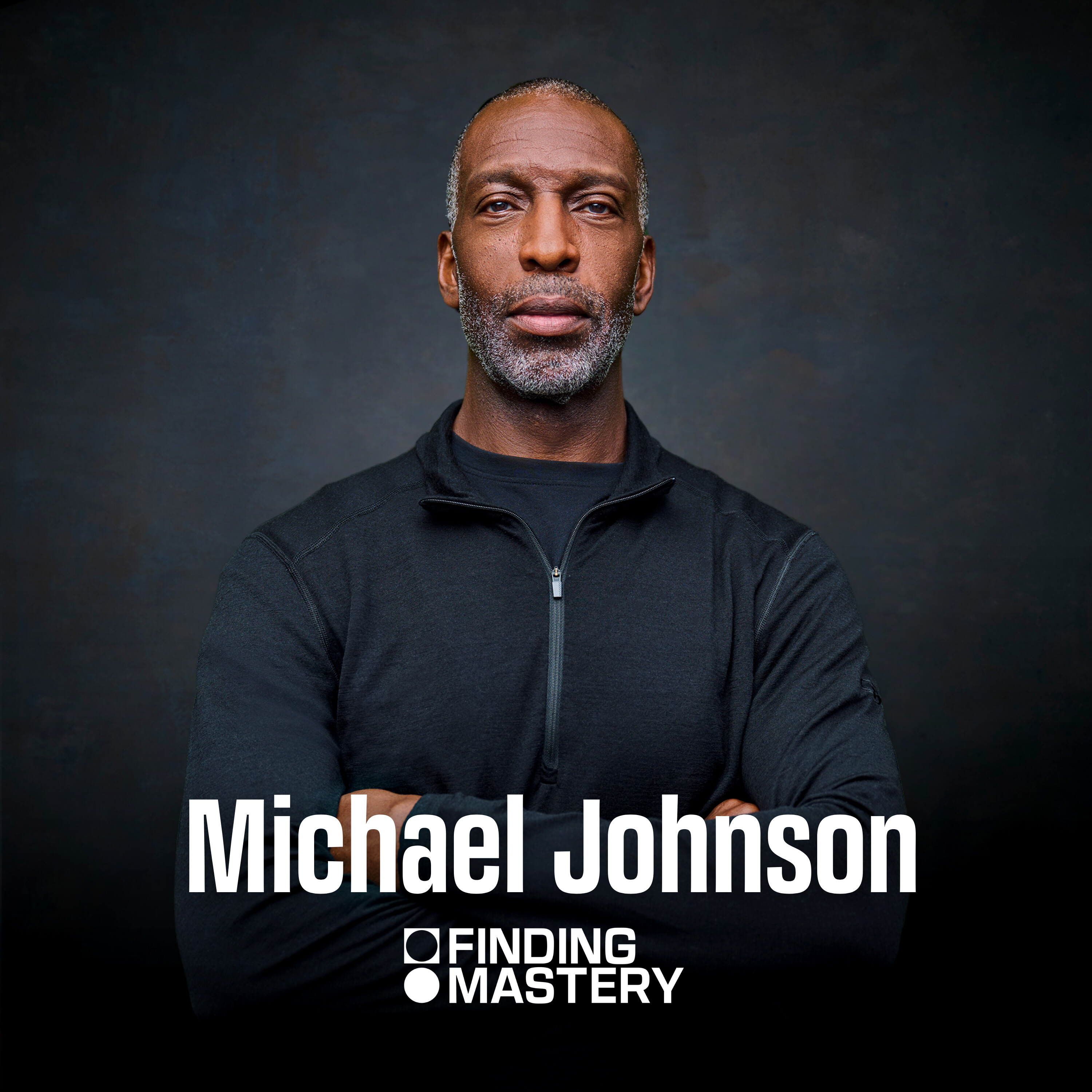
Loading summary
Transcript195 lines
- [00:00]
Michael Johnson
Michael Johnson one way and another, and it's a loser. The only thing I miss about track is that nervousness. I learned how to control the nerves. And so because I could control it, I loved it.
- [00:11]
Dr. Michael Gervais
What happens in the moments just before the race? Noise, the pressure, when everything that you've worked for is about to be tested?
- [00:18]
Michael Johnson
I know I can win. I don't know if I'm going to win. But we're about to find out.
- [00:23]
Dr. Michael Gervais
Welcome back or welcome to the Finding Mastery podcast. I'm your host, Dr. Michael Gervais. A high performance psychologist named Michael Gervais, who Pete Carroll brought to work with
- [00:33]
Michael Johnson
the Seahawks, famous for his work with
- [00:35]
Dr. Michael Gervais
Felix Baumgartner when he jumped out of space in the Stratos project. Olympic athletes depend on something more than just training and talent. They have to stay mentally tough. Today's conversation is with the legendary American sprinter Michael Johnson, four time Olympic gold medalist, nine time world champion, and the former world record holder in both the 200 and 400 meters. Michael takes us inside the call room, the gathering space just before the race.
- [00:59]
Michael Johnson
A lot of races are won and lost in that room.
- [01:01]
Dr. Michael Gervais
Tell me more.
- [01:02]
Michael Johnson
In that moment, it is understanding what you can control, what you can't control, and understanding that I'm at my best when I am so focused on what I'm about to do that I can get to a point where nothing is going to distract me.
- [01:17]
Dr. Michael Gervais
How much imagery would you do the month leading up to a race?
- [01:21]
Michael Johnson
Countless. It was at a point during my career where if I had an idle moment, there'd just be an automatic gun just went off. I'm running a race.
- [01:29]
Dr. Michael Gervais
And later in the conversation, he shares how a life threatening health scare reshaped how he thinks about control.
- [01:35]
Michael Johnson
I had to learn how to walk again. Everything in that moment, our wife said somebody said something about why did this happen to us? And we both were like, why not us? We've been so lucky with that.
- [01:43]
Dr. Michael Gervais
Let's jump into this week's conversation with the legend Michael Johnson.
- [01:53]
Michael Johnson
Okay.
- [01:54]
Dr. Michael Gervais
Four time gold medalists in the Olympics and two world titles. Is that right?
- [02:03]
Michael Johnson
Nine. Nine.
- [02:07]
Dr. Michael Gervais
You have. No, you don't have nine.
- [02:09]
Michael Johnson
Nine. Nine. World championship gold for Olympic gold. Wanna do it over?
- [02:15]
Dr. Michael Gervais
No. No. That is remarkable. Yeah, I mean, in my mind you're in this special zone of like achievement and accomplishment and obviously speed. But look, I've been wanting to sit down with you for a long time. Our paths have crossed over the years multiple times. I've always enjoyed the hellos, the, you know, how you doing those conversations. But you and I haven't had the chance to really dive into your psychology and how you've become extraordinary in your life, both what you did early, what you've been doing of late. And so I really do want to divide this conversation up into mastery of craft, call it part one and then mastery of self, part two. What does it take? And this is a broad question. I'm more curious about where you go than the actual answer at some point. But what does it take take to be your very best?
- [03:09]
Michael Johnson
I've had a lot of time to think about my athletic career and my post athletic career as a television commentator, as an entrepreneur. And if I think about what's the one single most impactful thing on any of the success I've had in any of those areas, it's been understanding who I am as an individual at a very deep level that at this point I'm still discovering things. And so it's knowing, but also the desire to know more. So like, why do I react this way to certain things when I'm in this situation? Why do I feel anxious? Why does this particular thing scare me? So like when I was an athlete early in my career, when I started to really show potential after college, now I'm a professional, I'm a pro track athlete, I'm ranked number one in the world and I'm still getting a little bit scared before a race. And I was like, why am I scared? Because I was able to understand the difference between being nervous and being scared. And every now and then, most of the time I was nervous. I was nervous before every race till the end.
- [04:28]
Dr. Michael Gervais
And describe your nervousness.
- [04:30]
Michael Johnson
Well, I'll describe it, but I'll tell you, people ask me now a lot and since I retired. Do you miss it? The only thing I miss about track is that nervousness. I miss that because I was able to control it. I learned how to control the nerves. And so because I could control it, I loved it. I loved that feeling of all right, Olympic final, world championship final, of which I went nine. Well done. I had to, I had fell out.
- [05:03]
Dr. Michael Gervais
Okay, yeah, fair.
- [05:06]
Michael Johnson
But knowing that I can win this race, I know I can win. I don't know if I'm going to win, but we're about to find out.
- [05:15]
Dr. Michael Gervais
That was your self talk.
- [05:18]
Michael Johnson
That was the truth. Yeah, that was the honest truth. I knew that I can win. I'm the best. I'm ranked number one in the world for a reason. I can win, but I have lost. And before I was the best, someone else was And I beat them. They did lose. You could lose on any given day, you could blow it, or someone could just have the race of their life or both of those things could happen. You can lose. I mean, so that's not just self talk. That was the truth. But what's also true is that that's why we have the race and we're going to find out. And I think I'm going to come out on top. But I got to put the work in. I have to execute. And. But it was always that nervous, like, you know, I want this. And I. So the discovery for me early on, when every now and then in the first couple of years of my professional career where I find myself in a situation where I'm not just nervous, now I'm scared. I was like, what's that about? You know, why am I. Why am I scared? And what I discovered was it was when I felt like I was underprepared. And I knew it right under prepared for what I was about to face. Because certain races take more preparation than others. And sometimes I felt like I'm ready, you know, I prepared, I'm ready for this because I was always physically ready to go. There was never a time where I was physically unprepared, but sometimes I was mentally unprepared. So if the competition was at. And it was when the competition was at a extremely high level, there was more at stake, more on the line. Olympic trials was one of the first ones. And then I felt like I may be a little bit underprepared here. So from that I was able to learn how I need to prepare for those races so that I'm not scared. So I don't feel under prepared. So I feel like, yeah, I'm absolutely ready to go. And I can be just as confident in my ability to execute in this race as I was in the other.
- [07:16]
Dr. Michael Gervais
What I hear in there is you've separated scared from nervousness. I do want to understand the line between those or the difference between those for you and. Because they're on the same continuum, you know. Right. Like, nervousness typically is on the continuum of fear. But what you're talking about, scared. I want to understand the difference and I also want to understand the way that you've separated physical and mental readiness or preparation. And so can you maybe start on the first one, which is like, what did nervousness feel like for you? When did it start and how did you work with it and then get to scared? Like, what's the difference between those two?
- [07:53]
Michael Johnson
Yeah. So for Me, they're very different because I learned how to control the nerves. For me, the nerves came from knowing that I really, really want this. I really want to win, I really want to win. And if you're not careful, the nerves start to control you and it becomes about more than just I really want to win. And you start focusing on because what's the other side of that? I might lose. Right. If you're not careful, you'll start spending too much time thinking about why you might lose. Right. So in that moment before a race, all eight finalists are. You finish your warmup and you're gathered in a very small, confined space, the call room, right. And it's underneath the stadium. You come from the warm up track, you move into it and they call everyone over and then you end up, you know, going through all your checks with the officials and then they take you into this little small room and it's just the eight finalists in there.
- [08:55]
Dr. Michael Gervais
And the other seven are alpha competitive, the fastest, most intense, especially in the sprint, fast switched, you know, like just. Absolutely, yeah. Cheetah's ready to go.
- [09:07]
Michael Johnson
Yeah. So a lot of races are won and lost in that room.
- [09:10]
Dr. Michael Gervais
Tell me more.
- [09:11]
Michael Johnson
Right, so you're sitting there in this confined space moments before you're going to go out and race. Everybody in that room wants to win. Only one's going to win, right. So, you know, yeah, and there's always somebody who's, you know, just going or, you know, screaming and yelling and banging the wall, getting themselves ready and trying to intimidate, you know, everyone else. And in that moment, you could very easily get wrapped up into why that guy might win or why that person might be ready today or why that's their day or why you might lose if you're not careful in that moment. If you understand yourself, you can start to understand how to navigate that particular time of the process because it's important, right in this moment, there's no more practice, there's no more training. The only thing that's left now is this is the transition between warmup, training's done, practice is done, you're at the meet, you do your warmup. Now this is the moment between finishing the warmup, which is, that occupies your mind. You got to do your warmup, you got to do all your, and that's an hour plus process, right? Working with your coach to get ready
- [10:24]
Dr. Michael Gervais
and everything from opening your hips up,
- [10:27]
Michael Johnson
stretching, stretching, stretching, striding, doing some practice starts, you know, working on a couple of the technical things, just get really, really sharp.
- [10:36]
Dr. Michael Gervais
That's right.
- [10:37]
Michael Johnson
But then the only thing after that is that's the transition between now, when the race starts, when the gun goes off. You know, look, I know it looks like, you know, when the gun goes off in track, you know, in sprinting, the gun goes off, everybody just runs and, you know, the first person to the finish line wins. You know, just, you know, it looks very, very simple. It is from a spectator standpoint, which makes it great. But there's a lot that goes on in the race. You've got to know in a 19 second, 200 meter race, you have to know where you are on the track and you have an internal clock that says, I need to be here at this particular time, and if I'm 2, 10 of a second off, I need to know that. So you're constantly assessing where you are, if you're hitting the right times, whether you make adjustments. You're able to make adjustments in the race. Even in a 19 second race, in a 9 second, 100 meter race, guys are making adjustments.
- [11:23]
Dr. Michael Gervais
Wait, you're not, you're not flat out sprinting as fast as you can go until a certain mark?
- [11:28]
Michael Johnson
Well, even if you're flat out in terms of speed, there is different intensities to which you do that.
- [11:35]
Dr. Michael Gervais
That's cool. Yeah.
- [11:36]
Michael Johnson
Right. So, you know, just there is no speed up and slow down necessarily, especially over 100 meters and 200 meters. Yeah, there's no speeding up and slow down. But in order to be flat out the whole way, there's more intensity at some points and less at some points. Right. So it's just like if you are driving your car and you press down on the accelerator to get to 60 miles per hour, you're pressing on the accelerator at one point. You don't have to keep pressing on the accelerator to keep going 60. You just hold it. Right. I understand, but you got to be very efficient to do that. The more work you do, the more gas it takes out of the tank. Right. So anyway, in there you want to understand how you get the best of yourself in that situation and how you are, how you mentally and emotionally prepare yourself for that moment. Right. And so I was able to understand early on that, you know, in that moment what I need to be focused on, what my process needs to be in order for me to not get distracted and start thinking about why I might lose the race. It's not going to do me any good in this moment. The only thing that's gonna help me in that moment is to be visualizing myself running that race. I wanna keep practicing.
- [12:49]
Dr. Michael Gervais
So that's what you're saying. Like during practice, your mind is occupied, you're doing things right. And then when you go into the call room and you are, this is the final touches for readiness.
- [12:58]
Michael Johnson
You are physically, you just sat there, you're not doing anything.
- [13:02]
Dr. Michael Gervais
And so you're not looking around. You are in your internal zone and you are seeing yourself come off the blocks with speed.
- [13:11]
Michael Johnson
I'm visualizing myself running the race so that I can go through all of the different scenarios of how this race might unfold and how I'm going to react to those different things in the race so that when the race actually starts and one of those scenarios unfolds, I've already run it in my mind and I can make the decision quickly. Because you don't have time. You have to make decisions and adjustments in the race. But it's a 19 second race. You don't have time to really think about it too much. You just got to make the decision and hope it's the right one.
- [13:38]
Dr. Michael Gervais
So let's stay on imagery for a minute. How much imagery would you do the month leading up to a race?
- [13:44]
Michael Johnson
Countless. It was at a point during my career where if I had an idle moment where I wasn't doing something or watching a movie or something else wasn't occupying my mind, I'd probably just. There'd just be an automatic gun just went off. I'm running a race.
- [14:03]
Dr. Michael Gervais
Would you close your eyes to do your imagery?
- [14:05]
Michael Johnson
Not necessarily.
- [14:06]
Dr. Michael Gervais
Sometimes it's open. Yeah. And how long would your imagery sessions last? This is a mental training tool.
- [14:13]
Michael Johnson
It varies because like I said, it got to a point for me where it was so automatic that I may just run one race and then I'm off doing something else. Because that moment was only, you know, a minute or second, 19 seconds, you know, or a minute or it may be, you know, I'm just sitting here, you know, I'm doing nothing. And now I'm really consciously just thinking about racing. So I'm running different scenarios over the period of 30 minutes or so. So it would vary. The key point there is that for me, it was such a part of what I was doing at the time that I wouldn't even be conscious of it and even just think about it, you know, before I just would just. The next thing I know, a gun is sounding in my head and I'm off to the races.
- [15:02]
Dr. Michael Gervais
So you didn't schedule time, like, okay, at 8pm I'm going to settle down and I'm going to do five minutes of mental imagery or 15 minutes of mental imagery. It was more fluid in the rhythm of your day.
- [15:13]
Michael Johnson
But again, there probably wasn't a day that went by where I wasn't running races in my head. At some point during the day, could
- [15:20]
Dr. Michael Gervais
you see it and feel it and smell it? Could you get smell involved?
- [15:25]
Michael Johnson
Not smell necessarily, I don't think. But when I think back to it, certainly see it, feel it. Absolutely. Because a lot of racing is feel. Yeah, it's feel. Reason why hearing it after the gun probably isn't very much, because even in a real race with a crowd going wild, when that silence happens, when the starter says, runners, take your mark, when you. You're so focused on reacting to the gun, you have to hear it, but you're not really listening for it. You're reacting to it. And once you hear it and you react, there's just silence in the race until you cross the finish line. That's the level of focus. So I don't hear anything.
- [16:08]
Dr. Michael Gervais
Can you hear. If you play it back, even right now, can you hear your breathing and the cadence of your breathing?
- [16:13]
Michael Johnson
No.
- [16:14]
Dr. Michael Gervais
No. You can't hear like the wind ripping across your jersey or.
- [16:18]
Michael Johnson
No, If I could, that means I wasn't focused on the execution of the race. This is all, all about the feel of the race, how my body is feeling from an endurance standpoint, a speed, endurance, me holding that speed, which is all related to technique. You only have so much focus. You have a finite about ability to focus, right? And it takes so much to understand and have this internal clock and understand where I. Where I am on the track and at what time am I, you know, in terms of the splits and intervals, the feel, in terms of how much energy am I executing and how much do I have left? Am I exerting too much at this point of the race? Am I not? While all of those things are going on, you're also having to try to maintain proper racing technique. So you're focused on that, your body symmetry, what this arm is doing, relaxing different parts of your body to get more effort out of other parts of your body. All of those things are going on at the same time as you're still in a race with seven other people. So you still have to keep your eye on them to make sure you know what they're doing, to determine whether or not you make any adjustments to them. So the level of focus that it takes to do that, I've never experienced that in anything else. And so it's funny. So like if you say, do you hear the wind? Or if I did, that means I'm not focused on this enough.
- [17:44]
Dr. Michael Gervais
There you go. Finding Mastery is brought to you by fatty 15. Healthy aging is not about chasing the newest trends and fads for us at Finding Mastery, it's about taking care of the fundamentals consistently. And one of the most important fundamentals is cellular health. That's why I continue to be excited about Fatty 15. It's a daily supplement that's based on C15. This is the first essential fatty acid discovered in more than 90 years. Fatty 15 co founder, Dr. Stephanie Van Watson, she's a previous guest on the podcast and it's an amazing conversation. By the way, she discovered the benefits of C15 while working with the US Navy. Based on over 100 studies, we now know that C15 strengthens our cells and is a foundational healthy aging nutrient. What it does is it helps slow aging at the cellular level. When our cells don't have enough C15, they become fragile and age faster. And when our cells age, our bodies age as well. Fatty 15 is on a mission to optimize your C15 levels to help support your long term health and wellness, especially as you age. You can get an additional 15% off their 90 day subscription starter kit by going to fatty15gilty15.com finding mastery and use the code Finding Mastery at checkout. What Stephanie and the team at fatty 15 are doing is something I'm really excited about. I really hope you'll check them out. And who was your near peer at that time? Who was your closest competitor?
- [19:05]
Michael Johnson
Every year was somebody different. Every there were in my 11 years competing as a professional over three different Olympics, five different World Championships over that time, and then all the races in between. Every couple of years there was someone new. So when I first started it was Carl Lewis. Carl was established in his career. Then Frankie Fredericks, Namibian sprinter, silver in a 100 and 200 meters in 1992 and 1996. Doesn't get enough credit for that, but he pushed me harder than most. Butch Reynolds over the 400 meters, world record holder in the 400. Quincy Watts, the 92 Olympic champion in the 400 meters. There was a lot of folks over my career that came in and out
- [19:52]
Dr. Michael Gervais
and when Carl Lewis was on your heels or your shoulder to shoulder and maybe he took one stride ahead of you and you've still got half the race to go. What is happening for you there? Because this is applicable to I think all of us. When we have somebody that we feel like we're competing against. And I want to compete with myself. I love doing it around other people, but I really want to compete with myself to be my best. And when I get somebody close to me, I'm like, I know. It does something to me, though. And so I don't really want it to be that way, but it does. And so what did it do for you?
- [20:32]
Michael Johnson
That's the interesting thing about track and as a metaphor for competition and a lot of other areas of life, is that it's probably the one sport, or at least one of the sports, where you're constantly having to sort of blend the two, where you're competing not necessarily against yourself, but your best chance for success and winning is making sure that your execution is as good as it can possibly be, because there's not really anything you can do about the other person.
- [21:05]
Dr. Michael Gervais
You gotta run your.
- [21:06]
Michael Johnson
Run your race. You're in your lane. So you have to be constantly aware of making sure. So when that athlete is, you know, Carl Lewis is on my shoulder, I have to make sure that if I'm already running the race that I plan to execute, that I have to make a decision at that point. And it's a fine line at that point. Do I make any adjustments in my race based on what he's doing? If I'm already doing what I need to do? But also, there's a point in the race where it's like, okay, now I can just race. Right. But it usually comes towards the end of the race and the 200 meters. And again, one of the things that makes me unique is that the 200 and 400 are so different. Like, if at the end of the race, I'm shoulder to shoulder, there's a point if it's within the last 30 meters or so, I can just race.
- [21:55]
Dr. Michael Gervais
Because you got the 400, I can just underneath you.
- [21:59]
Michael Johnson
Yeah, I can just race.
- [22:00]
Dr. Michael Gervais
Is that the difference between boxing and fighting? Like, some guys are fighters and some guys are boxers.
- [22:06]
Michael Johnson
I think it's the same. I think it's the same. I think there's some points in a boxing match where. But it's rare where you can just fight.
- [22:13]
Dr. Michael Gervais
Yeah.
- [22:14]
Michael Johnson
But most points in that match, if you start fighting, you're getting knocked out.
- [22:18]
Dr. Michael Gervais
Yeah. You need to be a technician.
- [22:19]
Michael Johnson
Same thing with track. If you just start racing.
- [22:22]
Dr. Michael Gervais
Yeah, there you go.
- [22:23]
Michael Johnson
And you don't have. You're not executing the strategy and you don't understand what race strategy is going to lead you to your fastest time, because it's still all about the fastest time. Right. Is going to win, then that's probably going to lose you to race.
- [22:35]
Dr. Michael Gervais
If you just start racing, what makes a great competitor?
- [22:38]
Michael Johnson
I think somebody who knows how to get the best from themselves in that competitive scenario. So you know, it's all about getting the absolute, absolute best performance. So in track, a lot of times what you will find is, you know, you'll have 20 races in the season, but one of them is the Olympic final. You'll have an athlete who runs fast times all year long and then Olympic final didn't come anywhere close to that time and finished outside of the medals.
- [23:06]
Dr. Michael Gervais
How did you continually, time and time and time again put yourself in a position psychologically to be great in what other people would consider the brightest lights, the highest stakes competitive environment in track and field.
- [23:20]
Michael Johnson
Figuring out, learning early how to get the best from myself, how to get myself in the. So first and foremost, training. Understanding how to train physical training with my coach. Understanding how to train to get the best from myself physically. What do we need to do in terms of our training program on a daily, weekly, monthly basis to be ready for the season, to have optimized speed, optimized strength, optimized power, to be able to go and run the fastest times that I'm capable of running. That's one. Then figuring out how to get myself into the right emotional and mental state, going into this pressure cooked environment and being able to not get distracted, being able to manage the nerves and the pressure and go in and still execute the best race that I'm capable of racing. And thank you all here, athletes. I just heard an athlete the other day who didn't do well in the Winter Olympics say before that race, I'm going to go, I'm going to treat it like any other race. It's not any other race. And you can't fool yourself into believing that this is any other race. And so if your preparation the whole time is, I'm going to treat this like any other race, any other race. And then you get to the race and it is far from any other race. The entire environment is different. The competition is different. The entire situation is different. The lights are brighter, the sounds and the distractions are greater. Everything is bigger. You're not going to be prepared.
- [25:10]
Dr. Michael Gervais
It's interesting because I've seen it work both ways, successfully and unsuccessfully. This is just another race and this is the biggest show on earth. I am biased towards an assessment that once you're on the track, it's just like every other race. And that circus though there are lots of differences. There's more people watching, there's more cameras. And it's not an environment that's designed for high performance. It's a media environment. And all of those factors need to be accounted for. But the race itself is still the 19 point, whatever seconds. And so I'm biased to lean. I think you and I, our approach would be different. I am biased to lean on the other side, which is like, no, we gotta keep this thing as normal as we can. The way we're thinking about it, this is not the final race. If you lose this race, for the most part, nobody is taking you hostage. I know there has been wild cases in the Olympics of bizarre consequences of losing, but your job is to go be you at your very best. And that's something we can train on Tuesday and Thursday and whatever, you know, semifinals and finals. And I've been fortunate to be across four Olympic Games, summer games in different sports. And there are differences amongst the sports. What I like to do is align at the beginning of the quad, beginning of the four years, with the team and the athletes, like, which way do you want to go about this? And then call out the pitfalls for both sides and then train according to that philosophy. So if it's the biggest show, to your point, then we better create some distractions in practice three years before, three months before. We better create some things for you to really experience that level of intensity and scrutiny well before, so you're practiced with it, which is hard to do. Actually. I want to go back to how you prepare yourself psychologically and emotionally to be your best in a highly competitive environment. What are the actual things that you do to help yourself be more calm and more focused?
- [27:15]
Michael Johnson
Expect the unexpected. Control what you can control and realize that these are the things that I can control. These are the things that I can't control. So I don't spend any time. And we're talking again in that moment after training and practice has all been done. And. And look, just back to. I will go back to that point for just a second. Training, same way I've always trained, whether it's Olympic year or not Olympic year, the weeks before the Olympic final, same training as before any other race. Right. Because that works. Execution of the race. Same execution of the race.
- [27:52]
Dr. Michael Gervais
Right.
- [27:53]
Michael Johnson
But that moment, and we've talked a lot about this because for me, it is the critical moment.
- [28:00]
Dr. Michael Gervais
Are we talking the ready room?
- [28:01]
Michael Johnson
Yes, the call room. The call room. That moment is the critical moment. And that's where it has to be an acknowledgement of the Reality of the situation is, is that this is different. I want it more. The nerves may be more. I need to have even more control.
- [28:22]
Dr. Michael Gervais
Right.
- [28:22]
Michael Johnson
In this moment of your thoughts and your. Exactly. Okay. So in that moment, I think it is, you know, an understanding of the reality of the situation. It is understanding what you can control, what you can't control, and you need to be. For me, it was understanding that I'm at my best when in that moment I am so focused on what I'm about to do that I can get to a point where nothing is going to distract me. There aren't going to be any distractions because I've already gotten myself into that sort of state. And that's where I perform at my best when I'm in that situation.
- [29:11]
Dr. Michael Gervais
Now, this is called an ideal competitive mindset. You just gave, and I think I felt it. Did you just tap into it a little bit when you're speaking?
- [29:18]
Michael Johnson
Yeah.
- [29:18]
Dr. Michael Gervais
You did? Yeah, I just felt that. I was like, oh, shit, here it is.
- [29:23]
Michael Johnson
That's me. So Usain Bolt is who broke my 200 meter world record. He was the big name track athlete after I retired, and I remember talking to him once early in his career and I said, you know, everybody's seen him out there before and he's the greatest entertainer. You know, he's the greatest runner ever and the greatest entertainer, which made him so fascinating to watch, Right. As a track athlete myself, you know, I just watch him like, this is. I just be into it, right? You know, it's like because he's such an entertainer and it looks like, you know, when he's out there, he's just playing around to the camera and doing all of these things before the biggest moment of his life. And I said, what are you thinking about in that moment? And he said to me, he said, when I was younger and I watched you and you were really serious and focused and I tried to do that and it made me so nervous that I would run tight. And he realized, and he learned that to get the best out of himself, he needed to play around. Not, you know, and he needed to find and create distractions and learn to do that. And that was his routine. And if you watch him, he's out there kind of smiling at the cameras and doing all of these things, you know, right behind the blocks before the Olympic final. And when the starter says, runners, take your mark, then it is completely different. Now he's focused, but if he gets focused too early, he gets really tight and runs tight. And he learned that about himself. Early I learned about myself early, that I need to be absolutely focused, no distractions, not thinking about anything else.
- [31:03]
Dr. Michael Gervais
What a cool insight. Because we all have our ideal competitive mindset. Loose and focused versus, like, intense. Some are super chill, like nothing matters. But whatever that approach is, there's still an intensity that is. Is required to be able to do the thing well, the deep focus and intensity. So your mechanism was on deep focus so that you could get into that rock solid place that nothing pulls you your focus, no matter what somebody else is doing in the call room. Do you have a moment where you were a disaster in the call room that I could learn from?
- [31:37]
Michael Johnson
Yes, absolutely. Olympic year 1992. This was my first Olympics. Frankie Fredericks, who I mentioned earlier, he's my number one rival. And we were at a race probably beginning of the season, probably three months before the Olympics, maybe four. And he's never beaten me before. I've been undefeated against him for two solid years. And we're in the call room and everybody's kind of quiet. He said something, and I don't even remember what it was, what he said that he said. And he was just being nice and it was just something about something that was going on. And I remember acknowledging that and being nice back and just not focused on what I needed to be. And I lost that race by two hundredths of a second.
- [32:32]
Dr. Michael Gervais
And you credit it to not being all in on your focus.
- [32:36]
Michael Johnson
It's convenient for me to credit it to that. It could have been anything else, could have been, you know, But I realized at that point that's not who I want to be. That's not what I want to be in that moment. What I want to be in that moment is absolutely focused. And so there were times after that where I had one competitor in the 400 who would want to get everyone, all of us around to pray before the 400 meters. And I'm a nice person. I don't want to offend anyone. And it took everything in me to. To just go, that's not happening with me. Even if everybody else does it. It's just, I'm going to sit over here by myself and. Which I did, you know, because in this moment, that's just not where I want to be. That's not where I need to be in order for me to be at my best. And regardless of whether that means that everybody around here thinks that I'm an asshole or whatever that makes them think about me, I don't care. And that was where I wanted to be to where in that moment, I don't care about anything else. Cell phones came in the latter part of my career, not the beginning. I never had my cell phone with me in that moment because I don't want to hear about anything. I don't want to get a call from anyone. I don't want to, you know, and we wonder what that call was about or whether that's something I should have taken or not. I don't want to be in that position.
- [34:04]
Dr. Michael Gervais
Finding mastery is brought to you by momentous. We tend to think about creatine as something for athletes, for power, for muscle, for strength. But what often gets missed here is that our brains rely on creatine just like our body does. Your brain burns about 20% of your body's total energy, means every thought, every decision, every late night brainstorming. It depends on that same cellular energy system that powers our muscles. And over the last several years, there's been a lot of research around creatine and in particular, its cognitive effects. And a bunch of those studies, they've shown that supplementing with creatine can improve working memory and processing speed, even during periods of sleep loss or high cognitive demand. And I know we all know this, but we do need to fuel our brain. And for me, I trust momentous. They take the long road here. Years of testing, rigorous research. There's no shortcuts for them. Their new creatine chews are built to the momentous standard. That means it's clean. It's NSF certified for sport and scientifically validated. Always talk to your doctor, Always talk to your nutritionist. But for me, creatine is a performance tool. It supports the energy our brain needs to stay sharp under stress, to think clearly, and maybe most importantly, to recover faster from long days and deep work. How you care for your brain. It matters. Head to livemomentous.com and use the code findingmastery for 35% off your first subscription. Again, that's livemomentous. L I V E M O M E N T o u s livemomentous.com and then use the code findingmastery. For those who are in it for the long game. What you're describing is with the, you know, the prayer bit is that there's a pressure to conform that many of us do feel. And what sits underneath of that is this deep, ancient desire to want to belong, to be accepted, to not be rejected. And the fear of other people's opinions is such a strong fear that we will do a lot of things that are maybe not in our best interest. But it's more convenient at the time to go along with the crowd, to go along with the influence of another person. For folks that struggle with fopo fear of people's opinions, what guidance would you give them?
- [36:28]
Michael Johnson
Think about the number of stupid people out there in the world. There are a lot of really stupid people out there. Caring what they think makes you pretty stupid. I mean, because I do care about what people think. It's one of the things I have to constantly remind myself of. And you guys asked me to write on the wall. That's what I wrote.
- [36:52]
Dr. Michael Gervais
Oh, you did?
- [36:53]
Michael Johnson
Yep.
- [36:54]
Dr. Michael Gervais
Yeah, because the listener. We've got a. We've got a wall of all of the true masters that come through here and. And just to share a pearl of wisdom or a philosophy of life. And you shared about that something about staying true to yourself.
- [37:08]
Michael Johnson
Stop caring about what stupid people think.
- [37:10]
Dr. Michael Gervais
Oh, you did say that.
- [37:11]
Michael Johnson
Because that's my problem that I constantly deal with.
- [37:15]
Dr. Michael Gervais
Yeah.
- [37:16]
Michael Johnson
Trying to make sure that I don't. I mean, there are people that, you know, I mean, I care what people think, but I care what people think too much sometimes. And that's something that I struggle with.
- [37:26]
Dr. Michael Gervais
So for me as well. And I draw the line between worrying and caring. And so we need to care about each other and we need to care about the other person's experience around us. But this excessive worry, like am I okay in the eyes of others? Is something that is very debilitating. And so that's what you're pointing to.
- [37:47]
Michael Johnson
Yeah. And I think that the other difference is who are the people that you're worrying about or caring about what they think? I mean, the people that are close to me and I have to constantly. When you're in the public eye, you can quickly get wrapped up into what people think about you or say about you when you don't even know those people and they're not even, you know, part of your life and they're a troll on social media and which makes them probably a stupid person if they're trolling people on social media. I'll have to admit that sometimes I will think about and care about what they think. And I have to try to just, you know, that does not matter. Right.
- [38:23]
Dr. Michael Gervais
This is probably why you are so committed to self discovery, to really know yourself. And I'm wondering if that's one of the ways that you've sustained mastery for so long is I wonder if one of the insights in plain view or the quote unquote secrets. I don't Think they're secrets, period. But the thing that's in plain view is your commitment to self discovery, to really know yourself. Would you say that's one of the reasons you sustained.
- [38:49]
Michael Johnson
Absolutely, absolutely. And being vulnerable about it as well, and being true about the things that you struggle with or that you, you know, don't understand about yourself. Yeah. That continued discovery of self and spending a lot of time, a lot of introspection, you know, is probably, again, as I said at the very beginning, that's one of the things that I think, you know, has been paramount in any of my success.
- [39:16]
Dr. Michael Gervais
Do you have somebody you do it with or do you have a process that's repeatable for somebody else to learn from?
- [39:22]
Michael Johnson
It's a lot of time with myself. When I was young, I was pretty shy. So it's born out of that. Always thinking about, you know, myself and thinking about, you know, what I'm doing. But also that's when that. What does everybody else think of me, you know?
- [39:39]
Dr. Michael Gervais
Right, that anxiety.
- [39:40]
Michael Johnson
Yeah, exactly. So that's the balance. Right. So it's been good for me on the one hand, but it's also something that I've had to. That I've struggled with as well. But then I have really good friends who've known me forever that are helpful and, you know, that I talk to my wife. I spent a lot of time talking to my wife. We both are kind of similar in that sense of, you know, wanting to understand ourselves better, you know, keeps you grounded, keeps you sane. You know, I found that it's just an extremely useful tool for navigating life, you know, when you don't know what's going to happen next and, you know, shit gets thrown at you, you know, the better you understand yourself, the better you are able to deal with it.
- [40:20]
Dr. Michael Gervais
I think there's two main buckets in psychology. If psychology is the study of yourself, then the figuring you out. Right. Self discovery. And then there's a whole host of psychological skills. You've mentioned many of them in the conversation. They've just been kind of sitting right on the surface, which is, I call it master the controllables. You're saying control the controllables. Same thing. We should probably identify what some of those are for you. You know, like what are the things that are most important? You did talk about self talk. You talked about mental imagery. You talked about working well with emotions. And those are all skills. And the more you know yourself, it's like you get the big rocks in the container, and once you really, really, really know Yourself, nobody can ever take that away from you. So it's really hard to move those folks around. Whether you're in a ready room or call room and someone's screaming and yelling, hooting and hollering, and you're like, no, I know myself. And that's their thing. My thing is coming in and just feeling that spark in me, you know, that when I'm running it at easy speed and it's amazing and whatever they're doing is not my. It's not my thing. And then when you come up from that, I can imagine you are absolute force to be reckoned with. Like there was no one moving you off the block. Right, right, right. And you had all of the requisite behind you physical and technical mastery that when you dialed in that psychological deep focus, you had a full package.
- [41:40]
Michael Johnson
Yeah, that's exactly what it is. The way you. You describe it better than I do.
- [41:44]
Dr. Michael Gervais
No, I think we both spent a lot of time thinking about this, but
- [41:48]
Michael Johnson
no, that's exactly it. And it comes from a place. I think it comes more natural for someone like me because for whatever reason, I'm a bit of a control freak. I feel more comfortable when I'm in control.
- [41:59]
Dr. Michael Gervais
What are you trying to control? What are those things?
- [42:01]
Michael Johnson
I'm trying to control as much of my environment and my destiny as I possibly can.
- [42:07]
Dr. Michael Gervais
How do you do that? Because you can't control the environment you have.
- [42:10]
Michael Johnson
No, I mean, I guess I discovered most of this when I was an athlete. Discovered a little bit more as I've continued on after in my post athletic career. But as an athlete, for example, in the warmup area, the day of a race, there's always, you know, I can go down, I'm in a hotel, lots of other athletes. And then most races, there's a place where we all go to eat and you know, we. It's a ballroom catered and everybody eats in there. Not like the hotel restaurant, but all the only for the athletes. And I would go in there, I got friends in there, you know what not, you know, we sit. Sometimes we sit down, you know, we eat. You know, on race day, I don't want to be around. I want to control my own environment. I want to control the conversations I have. I want to control who I'm talking to. I want to control whether I have to talk to anyone at all. I want to control my environment. On race day, I'm always ordering room service. I see, stay in my room. My coach, my manager, my physical therapist and my strength coach. All of those people Are part of my team. They know that I don't want to get into any small talk on race day when we leave the hotel, I know what time I want to leave. Coach decided, we decided together. My track coach and I are the main ones making all of the decisions. Right. Everyone else on the team sort of coach communicates to them. This is what we're doing. This is a schedule. This is. And you know, we all get in a van together with our driver. He's taking us to the track. No small talk. I don't want to get any small talk.
- [43:45]
Dr. Michael Gervais
Clear boundaries, clear rules.
- [43:47]
Michael Johnson
Yeah, this is how I want to be. And then when I get to the track, chill for a bit. We got a routine and, and I want to control as much of that environment and I don't want anybody coming over to do small talk with me. So my team knows, you know, if somebody's coming over, you know, wants to talk to Michael, they're going to say, hey, you know what? Not right now. Talk to you later.
- [44:08]
Dr. Michael Gervais
One of the Olympic teams I work with, when one of the athletes had one earphone in. Yeah, chit chat's cool, but like, yeah, it'd be kind of quick because I'm getting geared up. No headphones in. No problem.
- [44:20]
Michael Johnson
Yeah.
- [44:20]
Dr. Michael Gervais
Okay. One, just kind of two lights out, like I'm in. You know, and so that was a signal to everybody. And so everyone could help create that little boundary around her which is like, hey, do you mind if I. Let me see. Oh, she got two headphones. No, no. Yeah, but she's got one. Be quick.
- [44:36]
Michael Johnson
Yeah.
- [44:37]
Dr. Michael Gervais
Or there's not. Yeah, yeah, go ahead. Yeah, you know, so like there's.
- [44:40]
Michael Johnson
Okay, so my team knew like, you know, based on the amount of time before call time.
- [44:47]
Dr. Michael Gervais
Right.
- [44:47]
Michael Johnson
You know, 30 minutes before. There's nothing, there's nothing.
- [44:52]
Dr. Michael Gervais
Zero rules.
- [44:53]
Michael Johnson
Yeah.
- [44:54]
Dr. Michael Gervais
So you've been obviously world leading athlete and you are incredibly successful entrepreneur as well. If we knew what you knew about operating in high stress environments, how would we be better in modern life? Which is there's plenty of stress for all of us.
- [45:14]
Michael Johnson
Yeah. If you knew as much about yourself as I know about myself, you'd probably be pretty good. In high stress environment, in times of uncertainty, in pressure packed moments and when you're trying to deliver your best because again, that is to me the single most impactful thing on all of my success is understanding myself in a way that allows me to get the best from Michael in the moment.
- [45:47]
Dr. Michael Gervais
And it sounds to me like when, like you don't have like a structured Program for self discovery. It's something that is constantly running as an operating system. Like, oh, that's interesting that I was nervous there or that I didn't know what to say there, or I was on a glad path. And then it sounds like you're constantly tuning and then figuring out what did I do to put me in that situation, whether it's favorable or unfavorable, useful or unuseful.
- [46:13]
Michael Johnson
Yeah, I'd say I'm pretty hyper aware of my actions, of my environments, of my thoughts.
- [46:20]
Dr. Michael Gervais
Are you more aware of your actions or your inner experience or equally the same?
- [46:24]
Michael Johnson
Equally the same, yeah.
- [46:26]
Dr. Michael Gervais
So awareness is. Awareness is a superpower. I think that you've. We're talking about self discovery, but really you're with awareness, right?
- [46:34]
Michael Johnson
Yes, exactly. You know, I wouldn't say that it's totally unstructured because I'm so interested in the space, but I'm also looking at other people a lot, you know, and sort of, you know, what they get right, what they get wrong. Because I'm very interested in this space and always have. So it's not just me, it's almost a hobby as well.
- [46:54]
Dr. Michael Gervais
You know, talk about curiosity. It feels like you're a really curious
- [46:59]
Michael Johnson
person only about certain things. That's one of the things that I would love to be more curious about, more things, but I'm not naturally. I'm curious about the things that I'm really interested in, and this is one of them. You know, people's journeys to success, how they deal with obstacles, how they deal with stress, how people succeed. It's really interesting to me. I'm very curious about that area, very curious about myself, which sounds weird, but I am, because I always want to be the best I could be. I wanted to be the best athlete I could be. I wanted to be the best father I could be. I want to be the best entrepreneur I can be. I've always been very curious about, you know, myself and my own ability to succeed, to overcome.
- [47:48]
Dr. Michael Gervais
You know, when your coach says to you, michael, I got something, I think it's going to change everything. And I think we're going to squeak out a couple tenths of a second and this is going to be a game changer. But that means that you're going to need to come off the blocks on your opposite foot and we're, we're going to change that. Do you go into curious mindset? Do you go into defensive mindset?
- [48:08]
Michael Johnson
Oh, 1,000% curious, yeah. I mean, for that, I mean like
- [48:14]
Dr. Michael Gervais
that you get excited like Tell me more. Like, what do you mean?
- [48:17]
Michael Johnson
Yeah, I mean, so when I was competing, yeah, I mean, I was obsessive about finding the thousandths of a second because that's what's going to make you better. That's what's gonna win races. I was absolutely obsessed with it. And I craved those moments when, you know, coach would give me criticism. You know, that whole idea of craving criticism, that was absolutely me. I don't need coach to tell me how great I am. I need him to tell me where, you know, that was not great. That's where the improvement comes from. And so, yeah, and like every year, my coach and I would sit down at the beginning of the year and I'd tell him, you know, here's what I want to do this year. This is the big goal this year. Break the world record in the 400 meters or whatever. And he would say, okay, you know, let me think about what that's going to take, what we're going to need to change from a training standpoint. And it was always something, okay, if we're going to do this better, we're going to do more. We're going to essentially run faster. This is what it's going to take. This is a sacrifice you're going to have to make. And I would make the decision at that point, is that sacrifice something I'm willing to do? And that's the other thing. It's commitment. You know, people talk a lot about, you know, committing to. It's easy to commit to the goal that I want to be the world record holder, but when coach lays out all of these things, we're going to have to change, that's where the commitment comes in. You got to commit to that stuff.
- [49:43]
Dr. Michael Gervais
Right.
- [49:43]
Michael Johnson
When I decided I wanted to go for gold medals in the 200 and 400 and make history and become the first person to win gold in the 400 meters and 200 meters at the Olympics. I had to add a whole nother training session every day. And then also we went from five days a week training to six days a week training. And to back that up, I'm going to start doing that now two months earlier than I normally would. So those are the sorts of things like, okay, that's a lot, but that's what you gotta commit to.
- [50:12]
Dr. Michael Gervais
What scares you the most?
- [50:13]
Michael Johnson
Being unprepared.
- [50:14]
Dr. Michael Gervais
How did you prepare for this conversation?
- [50:17]
Michael Johnson
I'm not scared of you. You're. You're such a nice guy. You know, I was like, you know, this will be easy. I do this so much. And I love talking about this.
- [50:26]
Dr. Michael Gervais
Yeah.
- [50:26]
Michael Johnson
That, you know, my preparation for this was minimal. Just driving over, thinking, all right, you know what I think we're gonna talk about? And how can I be helpful to people?
- [50:37]
Dr. Michael Gervais
What role do you want to take in the world now?
- [50:40]
Michael Johnson
I'm trying to get there now where I am helping people with my experience more in my entrepreneurial days. The phase that I started that when I was in my early 30s, right after my track career, that's exactly where I wanted to be and what I wanted to be doing. Now I'd rather be spending less time building things myself and helping others build whatever it is that they're building.
- [51:02]
Dr. Michael Gervais
So that's something that folks that are inspired by the way you're thinking and the knowledge base that you have and the commitment to excellence that you embody, that if they're looking to get something off the ground, you would be a good companion in that. Or they're already kind of, I don't know, three cycles into funding, and they're. Yeah, they've got some real skills.
- [51:21]
Michael Johnson
Yeah. I mean, look. Yeah, I spend a lot of time with entrepreneurs. I spend a lot of time with corporate America as well, doing different, you know, keynote speeches and things like that. But, yeah, just trying to help people cut through the bullshit because there's so much out, you know, I think in this space, which. That. That, you know, is important to me, you know, to help people. Typically, people will look at someone like me and say, well, he's done this at this highest level as an athlete, so anything that he says is probably golden.
- [51:47]
Dr. Michael Gervais
Right.
- [51:48]
Michael Johnson
There's a lot of people who have done it at the highest level, and what they have to say isn't really golden because they only have their one perspective, but they believe that that one perspective can universally be applied to everyone. You have that now with not just athletes, but entrepreneurs. Okay. I, you know, sold my company for, you know, $10 billion. That doesn't mean that you know everything. And your particular way of building your company and how you did it and how you succeeded may not be everyone else's journey. So, like the example I gave when Usain Boltz, the greatest sprinter of all time, you know, you know, he didn't do it the way that I did. He did the exact opposite. Right. But at the core is what we both realize is that we have to figure out what works for us and how we get ourselves in the right mental and emotional state in that moment to be able to deal with the pressure of that moment.
- [52:42]
Dr. Michael Gervais
Can you talk about relationships and how they sit in your life.
- [52:47]
Michael Johnson
Relationships have always been important in my life. I have three sisters and one brother. They're all older than me. I grew up with them. They've always been my best friends. They've always been my closest confidants. I'm the youngest, so I took a lot of crap from them. And so when I was, you know, fastest man in the world, I was still taking crap from them. And I love that. And it's always been really important for me. I know that I can go to them with anything. My coach, who was really the only coach I've ever had, he passed away last year, just back in November. Lived a great life. Was like a second father to me and my dad. I was very close to my dad, and my dad was my role model growing up. And we definitely went through that cycle of, you know, child becomes the parent. The parent becomes the child at the end of his life, and I'm having it, you know, I don't know if you should do that, you know, kind of thing, you know, like, you know, but it was great, you know, throughout. And I always valued that relationship. And, you know, I'm with my coach. Relationships have always been extremely important to me, and they've always been a very valuable part of my life. And probably also one of the reasons why I've been able to be successful, because I've had people that have been so important to me that have also helped me to understand that when everybody just saw me and my identity as a fastest man in the world, those people saw me as, you know, my brother, you know, as my son or my friend.
- [54:13]
Dr. Michael Gervais
Is there a practice that you have found to be valuable to invest in relationships that matter to you?
- [54:20]
Michael Johnson
I've learned because I'm always learning about myself. So eight years ago, I had a stroke.
- [54:26]
Dr. Michael Gervais
Finding Mastery is brought to you by AG1. Spring is. It's just a natural time to reset. You know, the days are getting longer, at least for the northern hemisphere, and there's just an energy in the air that shifts. There's a kind of pull to simplify for me, to recalibrate what's working, what isn't. And one area I come back to regularly is my daily routine. It's not about overhauling it, but it is about scrubbing the material of it to really making sense of why I'm doing what I'm doing. So I look at it all, and I reexamine it. AG1. It's been one of those foundations for me for over a decade. Now I'm still using it. I like what they're doing. What I appreciate most is how much it simplifies the equation. One scoop covers a lot of ground. They've got some multivitamins in there. And more than anything, it's the pre and probiotics that I appreciate that they've done. It's all in one glass of water. So if you're taking a bunch of supplements, you don't have that pill fatigue that so many people talk about. I'm traveling a lot right now for our corporate clients, and that means shifting time zones and schedules. That's when consistency really helps. The AG1 travel packs, they've been a game changer for me. I throw a few in my bag and I don't have to think twice about it. I'm giving my body what it needs to keep showing up for work, for the people I care about, for the long game, really. Visit drink ag1.com finding mastery to get an AG1 flavor sampler and a bottle of vitamin D3 plus K2 free in your welcome kit with your first AG1 subscription. That's a $72 value for free. Again, that's drink ag1.com finding mastery I want to take a second here to tell you about a morning routine that I've been using for years. For me, it's a great way to to switch on my mind to ready myself to take on the day. So before I check my phone, my emails, market updates, or text threads, I choose how to start my morning. That's always in my control. That's always in your control too. This is the same morning mindset routine that some of the world's top performers across sport, business and the arts are using. And the best part, it only takes about 90 seconds to do. So. Just head over to findingmastery.com to download the audio guide for free. Again, head to findingmastery.commorning to get your morning mindset routine
- [56:46]
Michael Johnson
right. Came out of nowhere. I was in great shape. I was working out one day, started getting this weird feeling, weird sensation, finally decided just I know my body, something doesn't feel right. And my wife was like, yeah, let's go to the emergency room. Out of an abundance of caution, thinking it's going to be nothing as a stroke, had to learn how to walk again, everything right. And in that moment I learned I have to depend on people more instead of always having them depend on me. I felt most comfortable when people would depend on me and I didn't have to depend on anyone. Didn't want to have to depend on anyone. And I remember my wife and one of my really good friends, you know, saying, you got to let people do for you and help you. At that point, I'm laying in the hospital, and I can't walk. Like, might as well. Right. And. And I learned in that moment, you know, that I've got to. To be more dependent on people and allow myself to depend on these, you know, relationships that I have and have it a little bit more both ways. And that's been really valuable for me. But I say that. To say that I constantly. I'm. Yeah. Just trying. I mean, I was. That was. I was 50 at that point when I learned to depend on people more in relationships. Right. And that's what the relationship is there for, you know.
- [58:07]
Dr. Michael Gervais
Wow, there's a tenderness when you talk about this.
- [58:11]
Michael Johnson
Yeah, it was. I mean, that. That experience was a really interesting one for me in that, you know, people say, you know, what did you learn from that? You know, did you learn to appreciate, you know, life more? And I was already very appreciative of the life that I have, which is one of the things that got me. I remember we were in the hospital at one point, my wife said, somebody said something about, why did this happen to us? And we both were like, why not us? We've been so lucky, you know, And I said that. And my wife's like, you're the only person that would say something like this in that moment.
- [58:39]
Dr. Michael Gervais
Right.
- [58:40]
Michael Johnson
And she was like, but you're right. You know, we've been so lucky. And, you know, I think it's that sort of perspective, you know, that allows you to. You know, I've been extraordinarily fortunate in my life, so I've never taken that for granted. And I think that that is what allowed me to get through that moment the way that I did. It was a really tough. You know, health is. When we first talked, like, how's everything going, Michael? And you're like, oh, health is good. And, you know, that's one of the most important things in that point. It was. It was definitely in jeopardy for me. I wasn't in control, which is very important to me. And it was one of those situations where, you know, I was able to get through it because of all of the things that I learned, and I was able to really apply what I learned as an athlete to getting back to 100% able to walk again, able to run again and do all of the things and get back my quality of life. If I didn't have that experience as an athlete where I was able to recognize, you know, those tiny, small improvements and things like that. I don't know that I would have been able to fully recover from it.
- [59:38]
Dr. Michael Gervais
Thank you for reminding us of that and the tenderness that you have when you describe that part of your life and how important it is to be vulnerable in relationships because we all want to have meaningful relationships, but if we don't open ourselves up to them, people never really get to know us.
- [59:55]
Michael Johnson
Yeah.
- [59:56]
Dr. Michael Gervais
And so we kind of skim on the surface and it's a hard thing to do. So thank you for that. Just to kind of round out the last questions is that can I just give you a thought stem and you give like one or two word answers to a few things?
- [60:08]
Michael Johnson
Yeah, I'll try.
- [60:09]
Dr. Michael Gervais
It all comes down to execution.
- [60:12]
Michael Johnson
Success is never straightforward.
- [60:16]
Dr. Michael Gervais
Failure is a certainty. A certainty. What does that mean?
- [60:21]
Michael Johnson
You're going to fail at some point.
- [60:23]
Dr. Michael Gervais
Cool. If you could name a boat, what would you name it?
- [60:29]
Michael Johnson
For sale. You never buy a boat. Rent it.
- [60:37]
Dr. Michael Gervais
Well done.
- [60:37]
Michael Johnson
Well done. Money is important, but not everything.
- [60:41]
Dr. Michael Gervais
Relationships are everything I'm most curious about.
- [60:45]
Michael Johnson
Oh, it's going to sound weird myself.
- [60:48]
Dr. Michael Gervais
I do think that that is true for you, but I don't think it's a narcissistic thing. I think it's like, no, this is complicated. And I know that if I can sort it out to be just a little bit better, I'm going to be better for other people.
- [60:59]
Michael Johnson
That's exactly. Yeah.
- [61:00]
Dr. Michael Gervais
Yeah.
- [61:01]
Michael Johnson
Better for other people. Better for it. Better look selfishly better for myself. I want to win. Yeah, I want to win. And if I want to win, I got to figure out. I mean, it's up. If it's up to me. I got to figure out how to get the best for myself.
- [61:12]
Dr. Michael Gervais
What a breath of fresh air. Michael, thank you for capturing how you have been so special across. Definitely track and field, but in business and in life and to put it in words for us and be able to tell it in stories but also get down to, like, the process of how you're getting better and how you have become one of the best in the world across multiple domains. So, Michael, thank you for coming through.
- [61:35]
Michael Johnson
Thanks, man. I appreciate it. I enjoyed it.
- [61:37]
Dr. Michael Gervais
Yeah, it's great.
- [61:37]
Michael Johnson
This is fun.
- [61:39]
Podcast Announcer
Next time on Finding Mastery, we're joined by Dr. Jason Fung, physician, fasting expert, and best selling author of the obesity code. In his latest book, the hunger code, Dr. Fung explains why so many traditional weight loss strategies fail. Not because people lack discipline, but because they're working against their own biology. He breaks down how hunger, hormones and modern eating patterns shape weight gain and what we should actually be doing to improve our metabolic health and lose weight. Join us Wednesday, April 8th at 9am Pacific only on Finding Mastery
- [62:14]
Dr. Michael Gervais
all right, thank you so much for diving into another episode of Finding Mastery with us. Our team loves creating this podcast and sharing these conversations with you. We really appreciate you being part of this community. And if you're enjoying the show, the easiest no cost way to support is to hit the subscribe or Follow button wherever you're listening. Also, if you haven't already, please consider dropping us a review on Apple or Spotify. We are incredibly grateful for the support and feedback. If you're looking for even more insights, we have a newsletter we send out every Wednesday. Hunch over to finding mastery.com no newsletter to sign up. This show wouldn't be possible without our sponsors and we take our recommendations seriously and the team is very thoughtful about making sure we love and endorse every product you hear on the show. If you want to check out any of our sponsor offers you heard about in this episode, you can find those deals@findingmastery.com sponsors and remember, no one does it alone. The door here at Finding Mastery is always open to those looking to explore the edges and the reaches of their potential so that they can help others do the same. So join our community, share your favorite episode with a friend, and let us know how we can continue to show up for you. Lastly, as a quick reminder, information in this podcast and from any material on the Finding Mastery website and social channels is for information purposes only. If you're looking for meaningful support, which we all need, one of the best things you can do is to talk to a licensed professional, so seek assistance from your healthcare providers. Again, a sincere thank you for listening. Until next episode, be well, think well, keep exploring.