Loading summary
Transcript414 lines
- [00:06]
David Farrier
Hey, man. Hi, My little fresh turkey sandwich. How are you?
- [00:10]
Hayden
Yeah, I'm good, thank you.
- [00:12]
David Farrier
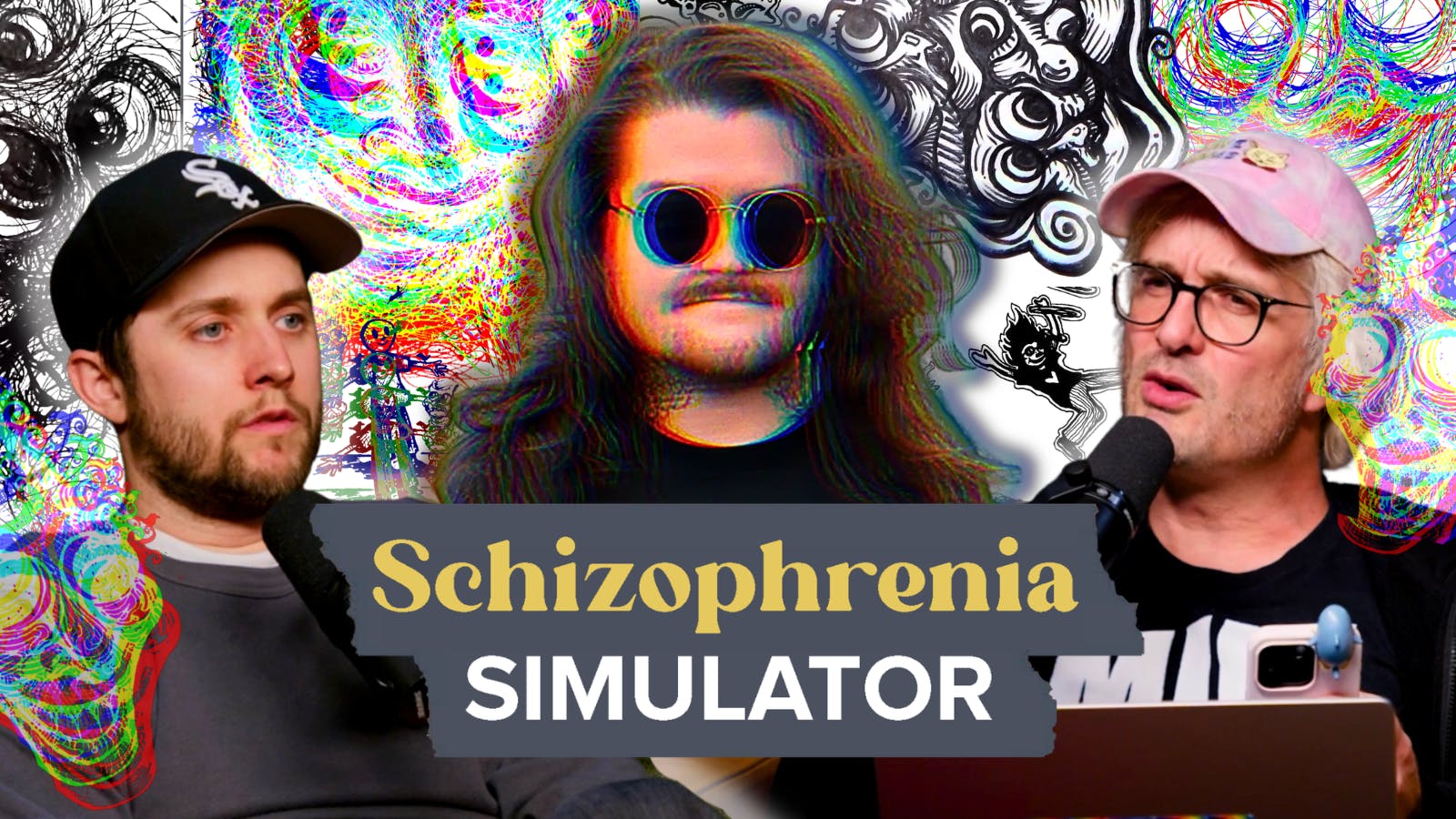
Today's episode is about a man with schizophrenia who's created a kind of schizophrenia simulator so people that aren't schizophrenic can experience what his world is like.
- [00:23]
Hayden
I am interested in schizophrenia simulator. I have not personally had schizophrenia, so I'd be interested. Is it something that we are. We are positive about? Like, this is a good thing that he's doing?
- [00:36]
David Farrier
Yeah, I think it's a really good thing. It's. It's. It's sort of an insight into a mental health condition that I think a lot of us don't understand. So I think it's really great.
- [00:46]
Hayden
Yeah, well, as we've seen recently, there's a whole bunch of mental health conditions that people don't understand. We're speaking just after John Davidson, the man with Tourette's Accidentally. How do you even say it? Said Rachel Slur at the BAFTA Awards, and people like slamming him, which seems like there's a lack of understanding about that. Mental.
- [01:10]
David Farrier
I think there's. If you don't.
- [01:12]
Hayden
It's a funny thing, a. We're all just meat sacks trapped inside our minds, and we can only experience our one brain. And so everyone else is just a locked, unknowable box. And so it's impossible to really empathize it with them and to know exactly what they're feeling. Like, for instance, I have no idea what fucked up stuff is happening inside your ears, you know, between your ears at any moment. And it's such a leap of empathy to sort of see you as a human being. And that's just in my personal life. And I'm sure you feel the same way. And so, like, I think this is a really great thing that he's doing.
- [01:55]
David Farrier
Hey, before you go, I had one other question. Often when I call you every fortnight for this podcast, I try and get you to go somewhere quiet. And last time I called you, you were in some kind of a windstorm. So this time when I texted you to set up this call, I said, you know, let me know in a convenient time today where you'll be somewhere quiet with no massive winds blowing. And you replied immediately, the only wind blowing will be through the empty space between your ears. Yeah. Which I thought was quite confrontational. And then you followed it up with, can you call me in three minutes time? And I just. I've just been thinking, what did you need those three minutes for? Like, to prepare to have a wank. Like, why Three minutes. Why is that?
- [02:39]
Hayden
Why is that what you would think would take three minutes? You're like, what could he be doing in three minutes?
- [02:44]
David Farrier
Three minutes is a solid speed wank time. But why three minutes? Like, what was that three minutes? Like, where were you and why did you need three minutes?
- [02:55]
Hayden
I just thought that because that would take. I was 9:42 when I replied, and 9:45 is a good round number, and I quite like starting on a round number.
- [03:03]
David Farrier
I want you to call it. But no, it's good to know that that three minutes was sort of a rounding situation. Yeah. As opposed to you needing three minutes to do something. Yeah.
- [03:12]
Hayden
Well, and the wink, obviously, but that's one minute.
- [03:17]
David Farrier
I'm David Farrier, a New Zealander accidentally marooned in America, and I want to figure out what makes this country ticket. Now, there's a guy I walk past most days to get my coffee who mumbles to himself under his breath. Without thinking, I tend to walk around him a little bit. I veer off course, putting extra distance between us. There's something inside me that sees he's dangerous. He's unhinged and unsafe. I don't understand him. Now, I assume this has something to do with the social code that says we're not really meant to mutter to ourselves in public. At home, as I pace the house trying to work out an idea, I often talk to myself, but that stops the second I walk out the front door. It also seems that maybe this guy isn't just talking to himself. He's also looking to one side, talking to someone who isn't there. And that's always felt dangerous to me, too. I've been thinking a lot about the way I react to this guy ever since I discovered artist Christopher Grant. Chris has schizophrenia, and the videos he creates are his attempt to let us see the world through the eyes of someone who sees and hears people and entities that aren't there. It's estimated around 3.7 million Americans have experienced schizophrenia at some point in their lives. It's most common in people aged 26 to 44, the age range Rob and I currently exist in. I figured to understand this condition more, I'd talk to Chris about what it's like to have schizophrenia and what it's like to try and explain his condition to other people and what other people make of his videos and of him laying himself so bare. So get ready to hopefully see schizophrenia in a different light, because this is. This is Schizophrenia Simulator episode. Flightless. Flightless. Flightless Bird Touchdown in America. I'm A flightless bird touchdown in America. Hi, Rob. How are you? Good.
- [05:11]
Rob
How are you?
- [05:12]
David Farrier
I'm good. I'm going to crack. I haven't promoted Cutwater in a while. A brand that has nothing to do with the show. But they have a chocolate espresso martini.
- [05:20]
Rob
This is the drinker's is a cut with more water. Right.
- [05:22]
David Farrier
Apparently that's a myth, but I'm just going straight in. I'm going to give it a taste test. Delicious. Coaster is going down.
- [05:30]
Rob
You're learning.
- [05:31]
David Farrier
And quickly. Speaking of sponsorship, Invisalign hasn't reached out at all. I put down my credit card.
- [05:39]
Rob
A few people did reach out offering to break your jaw, though.
- [05:43]
David Farrier
There were a few kind offers of people willing to, like, take me out the back and smack me in the mouth. Yeah. Which is very kind.
- [05:50]
Rob
Which also other housekeeping live shows.
- [05:53]
David Farrier
Yes. We have three coming up.
- [05:54]
Rob
March 29th in Salt Lake City, Salt Lake City, April 2nd in Austin and April 4th in Dallas.
- [06:01]
David Farrier
Yeah. If you go to flightless bird pod.com you can buy tickets there. Or if you're on our Instagram in the links there, we have tickets as well. So we would love to see you there.
- [06:11]
Rob
Or go to the description of this episode. There's so many places to get links as well. Yeah. We put a lot of care into the live shows and have a lot of fun with it.
- [06:20]
David Farrier
So, yeah, they're coming together. I'm starting to get excited. I will say we do have an extra special treat as part of the shows, which I think about in Texas. Oh, my God, I get so excited.
- [06:33]
Rob
Yes. Very special treat. And if you're a taxidermist or know a taxidermist or have animals that are
- [06:40]
David Farrier
dead and stuffed, definitely not alive.
- [06:44]
Rob
Birds mostly.
- [06:45]
David Farrier
We want to dress the set and also we love meeting local taxidermists in town. And so far when we've done these tours, we've kind of been blown away by the people that have come on board with this amazing taxidermy.
- [06:57]
Rob
Or I guess if you're in any of these cities and you just have large weird objects that make sense for
- [07:01]
David Farrier
our show, it's a dangerous prompt. Large weird objects. I'm into it.
- [07:06]
Rob
I think it.
- [07:07]
David Farrier
I'm into it.
- [07:07]
Rob
I mean, if like Chicago we had a giant Frank Thomas bobblehead doll, it's really good. So similar objects, weird things.
- [07:15]
David Farrier
Flightless. Breadchatmail.com. and one more quick plug over on our Patreon. This week we catch up with wat Nick who went to New Zealand. You'll remember him from The Parasocial Listener episode last year. He is now in New Zealand. And so on Patreon, we have a bit of a catch up.
- [07:35]
Rob
That's patreon.com flightless bird.
- [07:38]
David Farrier
And thus completes our housekeeping. Housekeeping. Do you have any housekeeping?
- [07:42]
Rob
No.
- [07:42]
David Farrier
Thanks for bringing me this coffee. You got. It says Enjoy Davey on it, which is slightly annoying.
- [07:48]
Rob
That was for you.
- [07:49]
David Farrier
Now, today's topic is one of these ones that I would say is, you know, it's loosely based around the concept of what the show is. But I guess like the prompt for me was coming across this incredible artist who makes these videos that make you see the world through his perspective. And I texted you about this guy that I see. And we went back and forth trying to figure out whether it's the same guy or not. Because we get coffee at different places, but in the same neighborhood.
- [08:17]
Rob
Yeah, I mean, we live about six blocks away. That's about right.
- [08:21]
David Farrier
And I think it's fair to say in the area that we're in, we live in a really nice area of Los Angeles. I feel very lucky to be here. Which counters with there's a huge unhoused issue and there's a lot of mental health stuff going on. There's a lot of drug stuff going on. Sometimes combined, sometimes not. And so I think in our day to day lives, you do run up against people and you kind of have to do a mental calculation of what to expect and what's going on. And with this guy that's always speaking to himself, I always think he does always feel. I feel scared of him, essentially. And when I spoke to Chris and sort of started talking to him, it just made me see this guy in a very different light. And so I wanted to talk to him more about that.
- [09:05]
Rob
Yeah, I mean, the fact that there were multiple people within a few blocks that we were describing.
- [09:12]
David Farrier
Because we were describing several people.
- [09:13]
Rob
Yes.
- [09:14]
David Farrier
In the end we figured that out eventually.
- [09:15]
Rob
Yeah. And it could have been one of like four that are regulars around the few streets.
- [09:21]
David Farrier
Totally. Before we get into it, a few quick facts. And I'll preface this by saying that I'm definitely not an expert in schizophrenia.
- [09:28]
Rob
No.
- [09:29]
David Farrier
It was coined by a Swiss psychologist, Eugen Buhler, in 1908, very long time ago. And essentially it's a mental disorder characterized by hallucinations, delusions, disorganized thinking or behavior, and sometimes having sort of a flat affect in your voice. So like speaking like very flatly. And symptoms kind of come up during young adulthood, rarely resolve completely. Although there are treatments that can Ease. The symptoms affects males more often. They have earlier onset as well than females. As far as the causes may include some genetic factors, but also environmental factors, including sometimes what your parents consumed during pregnancy. That kind of thing. But there's so many unknowns about it. And like Hayden was saying at the beginning of the episode, it is so interesting. And I think about this sometimes in therapy when I'm trying to get across to my therapist about what I'm trying to talk about. We just don't know how other people perceive the world. We kind of assume people. We have the same, like, reference points.
- [10:37]
Rob
Yeah.
- [10:37]
David Farrier
I don't know how you, like, come at the same stuff that I come at. It's. And I'll never know because we're both in these separate bodies. It's really weird.
- [10:45]
Rob
Until we get those chips.
- [10:46]
David Farrier
Yeah. Until we, like, get uploaded into the cloud with Musk's neuralink and we. I can jump into your body. You can jump into my body. I mean, would it be shocking? Would you be shocked to be inside my brain? Or would you just be like, ah, mostly like my brain, but with some different information followed away? Some things not there.
- [11:03]
Rob
I guess it's fairly similar. Are you. Are you watching the new season of Fallout?
- [11:06]
David Farrier
I haven't started yet.
- [11:07]
Rob
There's some stuff with what you say you want to do.
- [11:10]
David Farrier
Oh, as far as getting my brain up into the cloud.
- [11:12]
Rob
Yeah. And just, like, sustaining your head.
- [11:17]
David Farrier
That is sold. Fallout season two for me, straight away, my obsession with saving the head, and
- [11:23]
Rob
only for, like, 200 years.
- [11:25]
David Farrier
Oh, I love this already. It's also that thing where there was this. I can't remember. It's probably, like, a very common thought exercise. But this idea of you can give any animal the sense of language. What animal would you want to give that gift to so you could talk to them? You know, would you want to talk to a lion? Would you want to talk to a cockroach? You know, would you want to talk to the skunk that's, like, under your house? And there's this kind of idea that even if those animals could talk, you couldn't have a conversation with them because their point of reference for the world would be so wildly different to ours. It would just be. Even if they had English, it would be complete garbage. Yeah.
- [11:59]
Rob
You would have to download, like, culture, healing culture into their brain as well as the ability to just speak.
- [12:05]
David Farrier
Yeah. And also, like, understand. We'd have to somehow understand skunk culture as well or something. But I think about that in the way of being in other People's brains as well. And, like, how doable it would be. I might get into your brain and have a mental breakdown straight away because it's so weird in there. You seem normal to me and very together. I don't know what's going on upstairs.
- [12:25]
Rob
Yeah, I mean, you don't know that I don't know. Same with you.
- [12:28]
David Farrier
Well, that's Hayden's threat to me that
- [12:30]
Rob
I. I just feel like in your brain it would just be taller and just a taller brain, just like a smaller vessel. I don't know. A taller, large. Yeah, just a taller viewpoint is what I imagine.
- [12:43]
David Farrier
Oh, God.
- [12:44]
Rob
With a little more space inside your head.
- [12:47]
David Farrier
Do you want to expand on what that means? A little bit more space in there. Interesting. I also think brains fascinate me because they're so unknown. It's like the ocean. Like, we don't like. People get really excited about space. Ocean is where we, like, know the least. It feels like. And I feel the brain's the same. It's the most important thing in our head, in our body. We have no idea how the hell it's working. It confuses everyone.
- [13:10]
Rob
Are there any statistics you have on how drug use and schizophrenia overlap?
- [13:17]
Chris Grant
It is.
- [13:18]
David Farrier
From what I can tell in my short amount of research, drug use in parents can have great outcomes of schizophrenia in children. So cannabis, other drugs, ingested alcohol, that stuff can influence it as far as drug use in people and whether it brings it on or not. I think it's one of those, like, chicken and egg things where often. And that was the case of the person I talked to when they started getting these. These voices, they turned to drugs to kind of quiet. Quiet. But it ended up making it, like, more so.
- [13:53]
Rob
Yeah.
- [13:53]
David Farrier
And so I think there can be interplays there. But it's not like if you're smoking weed, you're suddenly have schizophrenia.
- [14:00]
Rob
I wasn't. I wasn't thinking it was weed. I was thinking more like meth.
- [14:03]
David Farrier
Oh, those gonna. I don't know. I don't have any stats in front of me about that, whether that factors in or not.
- [14:09]
Rob
Have you ever been worried that you will give yourself schizophrenia?
- [14:15]
David Farrier
In what way? Just expand on that particular prompt.
- [14:22]
Rob
I don't know. Do you have a voice in your head? I'm assuming.
- [14:24]
David Farrier
Oh, no. See, that's. No. That's another really interesting thing. I do have an internal monologue. My friend Eddie does not have a voice in his head at all, which fascinates me. It's just quietness in there. You do or don't I do. You do?
- [14:39]
Chris Grant
Yeah.
- [14:40]
David Farrier
But it's just my. My voice in my head is just me. It's pretty much sounds the same as when I'm talking out loud to you, but it's internal. I don't have different characters. Internally he can be a bit depressed or a bit happy. Like I can be. What's your voice doing? Is it your voice? Is it Rob?
- [14:59]
Rob
Yeah, little Rob. I can't. I mean, I can't hear it, but I'm assuming.
- [15:03]
David Farrier
What do you mean you can't hear it?
- [15:04]
Rob
I don't audibly hear it.
- [15:06]
David Farrier
But in your brain when he's talking to you, when Rob 2 is talking to Rob 1?
- [15:11]
Rob
Yeah.
- [15:11]
Chris Grant
Yeah.
- [15:12]
David Farrier
He sort of has a similar accent and stuff.
- [15:14]
Rob
Sure.
- [15:14]
David Farrier
Yeah.
- [15:15]
Rob
So, yeah.
- [15:16]
David Farrier
But it's one person.
- [15:17]
Rob
Yes.
- [15:18]
David Farrier
Yeah, totally.
- [15:19]
Rob
Yes. I just remember, like, when I first found out about schizophrenia as like a teenager, since I have an inner dialogue, I had like a fear that would go out of control.
- [15:35]
David Farrier
Yeah, totally.
- [15:36]
Rob
And because I'm aware of this thing, I could give myself it.
- [15:40]
David Farrier
No, I think that's. And I talk a bit about Chris. This sort of overlap between. Cause there are forms of like self talk in your brain and ruminations that do kind of start to spin off, not just get schizophrenia, but into this sort of in between territory where it's an unhealthy kind of internal dialogue that can happen.
- [16:01]
Rob
Yeah. And like, not that it has a mind of its own, but it is an internal dialogue.
- [16:08]
David Farrier
Do you feel like sometimes little Rob, inside Big Rob. Big Rob, being you in front of me now, sometimes has a different opinion or you get into a little fight with your internal little guy. Or are you mostly synced up?
- [16:21]
Rob
Mostly synced up.
- [16:23]
David Farrier
Yeah.
- [16:23]
Rob
I haven't had that thought in a long time. I think it was more like teenage years.
- [16:29]
David Farrier
But now it's seated in your mind yet again.
- [16:32]
Rob
Yeah, it's almost like a weird, like OCD tick of like a fear of something. So you keep thinking about it.
- [16:41]
David Farrier
Totally.
- [16:41]
Rob
I completely know that the fear of, like, I'm thinking about this so much that maybe this is going to.
- [16:47]
David Farrier
It's what we talked about. In my childhood. I was a big believer in prayer. And once I realized that I'd be scared I was going to pray the wrong thing and like God would hear it. And then I'd just be like thinking all these like, weird things, like Kill the janitor would come into my head, which makes me sound crazy, would pop up because I was. Oh, no. And I'd be like. I'd pray again. Don't kill the janitor. And then because you're thinking about don't kill the janitor, you're just walking around all day saying, don't kill the janitor. For the record, I didn't kill the janitor and I didn't want the janitor dead. But that was the worry.
- [17:17]
Rob
Well, but, yeah, your brain knows the worst thing that it can say in a situation.
- [17:21]
David Farrier
Yeah.
- [17:21]
Rob
And we're gonna get back to the
- [17:24]
David Farrier
conversation we had recently. Where do you control the brain or does the brain control you?
- [17:29]
Rob
Yeah, Carl. And. And I will say most the time, my brain is not going to like, the worst thing that can be said in a situation.
- [17:40]
David Farrier
No, no, no.
- [17:40]
Rob
But is it now be in social situations where it's like, don't say this. Yeah, don't say this. But when you do that, you're thinking it.
- [17:49]
David Farrier
Which goes back to what Hayden was talking about, which has been this drama at the baftas recently where yelled out a racial slur and there was this
- [17:57]
Rob
debate, like over and over and over again.
- [18:00]
David Farrier
Yeah. It was loud and it wasn't censored, which was quite crazy.
- [18:04]
Rob
Yeah. And they censored another speech.
- [18:06]
David Farrier
Yeah. But there was a certain argument online which was like, no, yeah, sure, this guy had Tourette's, but also, he wouldn't have said that word if he wasn't racist. But of course, the point you made earlier, before we started the show, when you have Tourette's, your brain is thinking of the worst possible thing that's sitting in there to yell at that point. I mean, the main mad thing is that they. It's one situation happened in the room, whatever that is. It's another thing for the BBC to just air it.
- [18:32]
Rob
Yeah, well. And I don't think it was the first disruption during the evening.
- [18:37]
David Farrier
Well, the mad thing is when you look at, I think the censorship for the night there was. What they did decide to censor was someone yelling out about Free Palestine. That got censored. And yet a racial slur. It just was let through.
- [18:49]
Rob
Yeah.
- [18:50]
David Farrier
But then that's. I mean, the BBC is this whole of the topic. Like, they're in such a free fall of chaos at the moment. Used to be such an incredibly respected British newsroom and institution, and now it's just a frigging mess.
- [19:02]
Rob
Similar. Similar paths.
- [19:04]
David Farrier
Yeah. Oh, my God. I mean, different topic. But it's February 25th when we record this. Rob and I were both watching the State of the Nation speech and we both decided you tapped out a little bit before me, but it was very long and we Both ended up just going, not worth watching this.
- [19:22]
Chris Grant
Because it's just.
- [19:23]
David Farrier
It's sort of unwatchable.
- [19:24]
Rob
It was ridiculously divisive.
- [19:26]
David Farrier
Yes.
- [19:27]
Rob
Where it was just like applause after applause, like, but only half the room would stand up and applaud and the other half wouldn't. And they were just, like, taking shots the whole time.
- [19:42]
David Farrier
It was a rough thing to watch in every possible way. It was really hard.
- [19:46]
Rob
And it was the same thing with, like, the Kid Rock super bowl thing where I was curious.
- [19:53]
David Farrier
Yeah.
- [19:53]
Rob
Of like, what the hell is this gonna be? But I. I didn't want to put it on to give viewership to it completely. So I did not watch any of that. I mean, it wasn't really an option for me to watch that over Bad Bunny. But regardless, I didn't want to add to the viewership. And it was the same with the State of the Union, because I know he's looking at how many people watch that.
- [20:21]
David Farrier
Oh, biggest narcissist, biggest fan of television ratings on Earth. So you'll be watching all those views,
- [20:29]
Rob
but a lot of it is, like, people just tuning in to see what chaos is about to ensue.
- [20:33]
David Farrier
But you're right. The main takeaway, it was the most divisive. He was injured. Engineered it to the most divisive thing possible. Yeah. And rough. Really rough. Stay tuned for more Flightless Bird. We'll be right back after a word from our sponsors. Support for Flightless Bird comes from Pesty. Now, Rob, I've heard you've recently been involved in some kind of DIY project. Am I correct?
- [21:00]
Rob
I have been for Vincent's preschool. We've got work days every couple months where we've got to go and do physical labor.
- [21:08]
David Farrier
What do you have to do?
- [21:09]
Rob
I sanded the railings.
- [21:13]
David Farrier
Good job.
- [21:14]
Rob
Which hours of sanding railings was very satisfying.
- [21:19]
David Farrier
I am terrible at diy. I don't do it. The closest I've got to DIY is trying to deal with the cockroaches that get into my apartment. For instance, I created a thing under my door to block off the entrance because I have a suspicion in summer they are coming from outside. Didn't really help. But what has helped? Pesty.
- [21:36]
Rob
I am not a fan of cockroaches, and Natalie's not a fan of cockroaches. We've also been finding black widow spiders our driveway along the side of the house.
- [21:44]
David Farrier
I don't like that.
- [21:45]
Rob
So I definitely need Pesty. It sounds like.
- [21:47]
David Farrier
Yeah, the good thing about it. And I got my pack and was Very glad to get it when I had cockroaches last summer. It is easy, it's effective and it's affordable.
- [21:56]
Chris Grant
Yeah.
- [21:56]
Rob
And it's kid and pet friendly.
- [21:58]
David Farrier
And with Pesti, you can get started at just $35 per treatment with a customized plan based on your location, what bugs you may have and the climate you're in. And with a DIY kit, there are no strangers in your house or appointments to make time for you. Just sort it out yourself. Pesty gets rid of a different types of bugs. That's a lot of bugs from spiders like Rob has a problem with, to ants to roaches and scorpions. Holy scorpions. Oh yeah.
- [22:23]
Rob
Do you guys don't have scorpions in New Zealand?
- [22:25]
David Farrier
We absolutely do not. The kit includes a sprayer, a mixing bag, pesticide gloves and instructions you can complete in less than 10 minutes.
- [22:33]
Rob
So keep the bugs away with Pesti. Go to pesti.combird for an extra 10 off your order.
- [22:38]
David Farrier
That's P-E-S-T-I-E.combird for an extra 10 OFF. Support for Flightless Bird comes from GrowTherapy. Now, have you ever tried to google therapist near me and just ended up way more anxious when you started the whole thing? I do that sometimes with Google Maps. I'll type in a thing and I have typed in therapy before and it's incredibly stressful because you just get a whole lot of dots and you don't even know where to begin.
- [23:04]
Rob
Yeah, there's a lot of decision fatigue that happens when you see all of the different options. Which is why grow therapy is great.
- [23:12]
David Farrier
It makes it way less overwhelming and way more affordable. Because trying to find a therapist shouldn't feel like online dating. With a high deductible growth therapy gets there. They make finding the dream therapist who gets you way easier and way faster.
- [23:25]
Rob
So whether it's your first time in therapy or your 50th, grow makes it easy to find a therapist who fits you, not the other way around. They connect you with thousands of independent licensed therapists across the US offering both virtual and in person sessions, nights and weekends.
- [23:39]
David Farrier
I've already talked about therapy, how I went on a big diatribe about trying to understand what's going on in my brain and my therapist's brain. But to say I find therapy very helpful, I recommend it. If you want to get stuck into sorting out your brain a bit more, give therapy a try.
- [23:53]
Rob
Whatever challenges you're facing, Grow Therapy is here to help. Grow accepts over 100 insurance plans and sessions average about $21 with insurance and some pay as little as $0 depending on their plan.
- [24:05]
David Farrier
Visit growththerapy.com bird today to get started. That's growththerapy.com bird growththerapy.com bird availability and
- [24:14]
Rob
coverage vary by state and insurance plan.
- [24:17]
David Farrier
Toogood and Co Coffee creamers are made with farm fresh cream, real milk and contain 3 grams of sugar per serving. That's 40% less than the 5 grams per serving in leading traditional coffee creamers for a rich, delicious experience. Whether you enjoy your coffee hot, cold, bold or frothy, two good coffee creamers make every sip a good one. Two good coffee creamers Real goodness in every sip. Find them at your local Kroger in the crack. Okay Schizophrenia before we get into this little conversation with Chris, who I really, really like, he's an American, right? Well, we get into that soon. Another very good question. I thought he was American, okay, but as you may know if you listen to this podcast, David Farrier does not always get things 100% correct. He's been known on occasion to get things wrong.
- [25:15]
Rob
But that doesn't change the fact that schizophrenia is a thing in America completely.
- [25:20]
David Farrier
I'm just going to say it's the most common psychotic disorder. Yeah, the frequency of schizophrenia varies across the world, within countries, across geographical locations, and by gender. And finally, schizophrenia caused 17,000 deaths in the US in 2015, just as a stat of how problematic it can be if we don't know how to deal with it and things it leads to undiagnosed. So with that, this is Chris Chapter one who is Christopher Grant?
- [25:53]
Chris Grant
I was super stoked that you followed me. I have really good memories. My brother and I bonded a lot watching Dark Forest. I know a lot of people probably bother you about season two and all that. I'm not one of those people. I'm sure you hear it all the time, but I just wanted to say it was really cool.
- [26:11]
David Farrier
Requests for a second season of a thing that Netflix doesn't want more of are both flattering and annoying. And Christopher Grant knows this. But it's always nice to get an ego boost when you discover people you're a fan of are fans of yours. I wish I wasn't this shallow, but I am. I followed Chris over the last year as he posts on Instagram and TikTok about what it's like to be inside his head. I'm not alone. Millions of other people also watch his videos, and the most shocking thing I immediately learned from Chris is that he's not American. Look, you could probably tell this from the Accent already, but I'm new here. I don't know.
- [26:50]
Chris Grant
A lot of people think I'm from the US but no, I'm from Canada. I'm indigenous. I'm a Mi' Kmaq person, and I live on a reservation in my own house in the woods.
- [27:00]
David Farrier
For anyone out there going Flightless Bird is a podcast about Americans. What the heck are you talking to a Canadian for? Well, I watched that Bad Bunny halftime show in Canada as part of the Americas, so there you go. Plus, it's about time we had a Canadian on this show. As for Chris's part of Canada, he lives in a slightly lesser known province called New Brunswick.
- [27:20]
Chris Grant
My people, in an ancestral way, are very known for being protective and gentle, and mostly, to this day, still primarily do a lot of things like lobster fishing and mild hunting and stuff like that. And the identity that we have here, at least for my part of Canada as an indigenous person, is we're known as the people of the dawn because we see the sunrise first in the morning on our coast. So a lot of our practices have to do with life, death, rebirth. It's a huge part of my perspective that I took onto my experience after being diagnosed almost a decade ago.
- [27:59]
David Farrier
That's what I wanted to talk to him about. His diagnosis. Chris has schizophrenia. And for the last few years, he's been drawing and animating what he sees and hears so others can start to understand what that word schizophrenia means, what it means for him at least. Growing up, Chris didn't deal with any voices, visions, or hallucinations. But he says looking back, he could see he was a bit different to the other kids.
- [28:28]
Chris Grant
Just like anybody looking back through their life, you see that life is no different from a novel. You can see, like, foreshadows, foreshadowing in people you hung out with or experiences you've been through. Sometimes there's very odd, I guess, coincidences that once you're older, it kind of freaks you out because you're like, oh, I didn't see that coming. How could I?
- [28:48]
David Farrier
He says that as a child, he had a lot of issues with authority in teachers. It didn't come from a place of trying to be difficult, rather from a place of curiosity.
- [28:57]
Chris Grant
So it was very frequent that I would have misunderstandings with teachers, principals, other people in an authoritative position because I a question why or what? And it was always taken as like, I'm back talking or being sassy before I went through the psychiatry and figured out that I'm schizophrenic. As I got older I started to realize, I actually think it seemed to parallel more like autism. I was a kid who was very obsessive of a lot of very specific things, to a point that one may argue is borderline psychotic.
- [29:34]
David Farrier
He got incredibly obsessed with parts of history involving disasters. Titanic and Chernobyl were big ones for him.
- [29:41]
Chris Grant
I think it was really off putting to both my parents and teachers around me because I didn't really have a filter. So I would just go to school and be like, did you know that the Chernobyl reactor exploded at this hour and this? And so I was very much a constant info dumper who is very macabre, but joyfully so. I'm very fascinated by the fact that things decay and that people have to deal with darkness and life and all sorts of things.
- [30:07]
David Farrier
No wonder he loved Dark Tourist. It's like I'd made the show just for him. Chapter 2 Growing up, I wanted to talk to Chris about how indigenous people are treated in Canada versus the U.S. as I realize, I have no clue. I think to more fully understand Chris and the way he sees the world, it's important to understand where he comes from. This isn't to say it explains his schizophrenia, rather the way in which he views it.
- [30:36]
Chris Grant
Canada is really good at this in a lot of ways, but I do live in a place where the police pretend that they're okay with everybody. But just this year, like three people have been fatally shot who are from my ancestry. There's other reserves that are kind of in the province I'm in, and on multiple reserves not too far from me. RCMP were sent to do wellness checks, checks on other Mi' Kmaq people, and they were unarmed and they weren't a threat on the body cams, but they still got shot because they were perceived as dangerous and insane.
- [31:09]
David Farrier
A quick Google search confirms all of this. Police killed two Indigenous people in 2020, another in 2024, and another in January of this year. That kind of trauma bleeds into your community and life in a variety of ways.
- [31:24]
Chris Grant
Ever since I was three years old, I've been dealing with really intense trauma and distrust in adults. I don't want to go too to it, but I think you can.
- [31:32]
David Farrier
He trails off. Chris tells me he doesn't want this interview to be derailed by trauma dumping. He doesn't want his work, explaining and destigmatizing schizophrenia to be bogged down in things he describes as dower. At the same time, he says the darker things in his life are important to acknowledge, at least in passing.
- [31:50]
Chris Grant
Ever since I was a little kid. I was described as melancholic but happy at the same time as I wanted to make a lot of friends. I said hello to strangers I talked to like animals and just very excited about life. But every now and then, I would just stare off and I would be very in my own place in my head. And I was one of those kids that even though I would socialize for a long time, I would either go into a bathroom somewhere or I would sit in a corner and I'd have to just reset because there was an overwhelming sadness or an anger or something I had to deal with, but I didn't quite understand yet because I was very young. So I was very used to, like, taking bathroom breaks at school just to sit in a stall and just think and stare and just wonder, what does this all mean? Why am I here? What is this? So there was always a sense of dissociation.
- [32:41]
David Farrier
Added to that was what Chris saw around him as he grew up.
- [32:44]
Chris Grant
Growing up on a reservation, it was very common for me to see the fact that life isn't just things building upon themselves. Sometimes things break down and decay out in the open. I saw people on meth falling into a meth psychosis and spiraling. And you see all the effects of that. And a lot of these people are related to me. There's about a hundred something people in my community on my reserve. They're all related to me in some way. So there's a weird trauma in that, too. I don't want to perpetuate a stereotype or anything, but when the system is pitted against you already, it's very easy to fall into addictions or make poor choices. It just sucks that it's like that sometimes. And so I had to grow up with that as being normalized. Just don't fall into that. I'd walk home from school and there's a car crash in a ditch, and people are tending to somebody. And it's just something that's always on the side of the road, or you're always checking your window, like, who is that outside? And stuff. So peppered throughout my childhood and young adult life, is life being normal. I'm playing video games, I'm watching movies and being a kid. And then every now and then, there's just a very intense reminder of death or decay or instability.
- [33:59]
David Farrier
He says it felt like the polarities in his brain were constantly flipping. And by the time he was 16, he was acutely aware that this was a slightly strange state to be living in. That led to him making an extra effort to fit in even more.
- [34:13]
Chris Grant
I started to act as normal as I could, which is funny, because to me, that meant buying plaid shirts. I don't know why that I was like, if I wear plaid, I'll look like the other miners in the town. There was a mine in my town where a lot of business came from on the outside of the reservation. And so I was like, if I dress like I work in a mine and I'm kind, kind of woodsy, maybe I'll fit in.
- [34:38]
David Farrier
And it fails. It failed very hard.
- [34:41]
Chris Grant
Because you can dress as you like. When someone talks to you and they're like, so, how's your day? And I'm just like, oh, you know, I was chilling down by the river and I was talking to a duck. And I think the duck is very friendly today. It wasn't the other day. It depends where you are in the world and who you talk to. But some people look at you like, okay.
- [35:00]
David Farrier
Chris ended up heading to university to study geology. His obsessiveness had led to an interest in all things rocks, which had dovetailed with his childhood love of nature. But during classes, he found himself doodling and sketching, which led to him swapping to study fine arts. But by his third year of university, he'd started to hallucinate. Chapter three, Seeing things the way Chris remembers it, While he's always experienced the world a bit differently, growing up in his third year of study, there was a big change.
- [35:36]
Chris Grant
So it was a sudden, big shift. I felt like I was an arrow being drawn back my whole adolescence. And then suddenly it was like, here we are. Let go of the arrow. There was a schism in my brain. All of a sudden, my conscious and my subconscious mind, they split, and I could see both of them as clear as each other.
- [35:59]
David Farrier
He said there'd been hints back when he was at home on the reservation that all of this was coming.
- [36:04]
Chris Grant
When I was 16, I was listening to Pink Floyd, the wall a lot, because I related to it, which to me is another sign. Like, I'm young, and for some reason that sticks out. But I remember looking at the ceiling and seeing the ceiling tiles wiggling in my room or seeing little shadowy things moving. And I was just like, oh, I'm just tired, probably. But I always downplayed it, because being Mi', kmaq, even if it's not intensified, there's still an aspect of spirituality. And so growing up, it was just, oh, then you gotta take care of this, that or the other. It's not a big Deal like it's just part of daily life. So anytime anything was happening in my mind, I just went, ah, whatever. I refused to look at it spiritually, scientifically, biologically. I was just like, no, I don't care. I'm too focused on trying to get laid and stuff.
- [36:53]
David Farrier
Chris would see ceiling tiles wiggling and moving when they should have been still. He'd be in the woods and he'd hear a hay behind him. But when he turned around, no one was there. By the time he was studying fine art, all of that had just kept progressing.
- [37:12]
Chris Grant
Where it got really intense. Where I really noticed it was when I woke up in my apartment at university one night, and it was like one or two in the morning and I could hear whispering in the vents of my room. There was a vent above my bookshelf, and it was a whispering, windy voice. And it was asking me to go to a place called Waterfowl park, which was a local marshland walking trail or whatever in that university town. And I actually got up and went there and I was in a weird fugue state. It was odd. And I'm a curious person, so I'm like, well, let's see what this is all about.
- [37:50]
David Farrier
He went to the park that the voices had told him to go to. At 2:00am in the morning, it was completely abandoned. Chris walked back to his dorm and went back to bed, half wondering who told him to go and why. He'd listened for the weeks throughout.
- [38:06]
Chris Grant
Then suddenly, voices were getting stronger. I tried to eat food. And one voice would come out of nowhere and go, eat that. Don't eat that. That, not that one. And I was like, oh, okay. There was a point a couple months later where I looked in the mirror. I was like, okay, I think I have to accept it. I think I am insane. I guess I need help.
- [38:26]
David Farrier
Except he didn't get help. Instead, he entered a manic period and quit school altogether.
- [38:32]
Chris Grant
And I was almost complete university. But I decided, well, if I'm going nuts anyway, I may as well go out burning or whatever. I was hallucinating frequently and then I wouldn't sleep often and I started to be very reckless. So I would sleep around with anybody that would accept it. I was drinking all the time. I started to dabble in psychedelics and smoking weed, and I ended up becoming a heavy drug user, which didn't help that I was already hallucinating. It actually made the hallucinations more vivid.
- [39:07]
David Farrier
The net result of all of this was a period of homelessness, a blur of hitching rides, partying and sleeping under
- [39:14]
Chris Grant
bridges, gripping a knife all night long, alone in the middle of the woods.
- [39:20]
David Farrier
Sometimes Chris would wake up in a ditch, cleaning the spiders off his bag before trying to figure out where to go next. Chapter four Diagnosis. A friend, an ex he'd met on Tinder of all places, ended up being the one who made Chris realize he needed some kind of help. They convinced Chris to go home.
- [39:41]
Chris Grant
I just went from partying and being a more ID or animalistic version of myself to suddenly I'm back in a house where I have to, you know, take garbage out and make sure I'm not like an animal. And it caused a lot of clash between me and my mom. And there was just one night where I had a breakdown where I didn't talk, I didn't do. I just laid on the ground and I just stared up at the ceiling. And so my family at the time took me to my first hospitalization.
- [40:12]
David Farrier
Chris says he was catatonic for what felt like a few days.
- [40:16]
Chris Grant
So the polarities of my perception of reality were hitting into each other at such a fast rate that I couldn't even talk.
- [40:25]
David Farrier
He was given antipsychotics and was eventually evaluated by multiple doctors who informed him they were diagnosing him with a schizoaffective disorder. In other words, Chris's schizophrenia came packaged with a major mood disorder, too. He had bipolar schizophrenia.
- [40:41]
Chris Grant
I speak on the umbrella of schizophrenia because it's not too different. It's just schizophrenia with bipolar mania. Every now and then, if you don't deal with it properly.
- [40:51]
David Farrier
Chris says that a lot of people assume antipsychotics cure you, that suddenly the voices and visions go away. He says that's definitely not the case. He still deals with paranoia, voices and hallucinations. He views his meds like a crutch, a kind of mental wheelchair.
- [41:07]
Chris Grant
Antipsychotics that are really heavy, they might eliminate paranoia or they might tone it down a bit, but you're always going to remember what you've been through. And so sometimes even on antipsychotics, even heavy ones, you still hallucinate or you hear a voice. And if you don't hear a voice, you can feel something nudging at you in your core, almost like it's trying to get out, which is a very weird feeling. You know, when people say, there's bugs in my skin. That thing, to me, I never saw it as bugs. I saw it as some kind of an energy or a undulation that because you're on a certain antipsychotic, you start itching at yourself because there's a part of you that is trying to come out, but it can't. I've already accepted visual hallucinations and voices. They're not the worst part of schizophrenia. If anything, they're like a weird light show. It's hard to explain. But the worst part is paranoia and delusion. So I'm always keeping an eye out for if those things are starting to grow in me.
- [42:08]
David Farrier
He takes a few different medications in unison, which includes antipsychotics and another medication to balance his mood out. It's a combo that's been working well over the last five years.
- [42:19]
Chris Grant
I have voices that can be very dark that I hear, and I have some that can be very light. And then in between, it's almost a spectrum of. I guess the word would be random. Like, I've seen faces that they kind of have a kind quality, but they're a little bit more on the spectrum of looking weirder or shadowy. And then I've seen things that are shadowy, but the voice coming from it is more friendly. And so I guess in a way, it's random, but to me, it seems more like one is dark, one is light, and those are polar, and then in between is the mixture of those. So I see it similar to, like, a color wheel. It's just hard to talk about because to articulate it in English has taken many years. It's very hard to explain to people that a voice is an echo of the subconscious, but that doesn't make it any less characterized and personalized. It's a very odd thing.
- [43:16]
David Farrier
Eventually he found illustrating and animating what he saw as being far more articulate than English. His schizophrenia simulation videos getting hundreds of thousands of views. Chapter 5. Acceptance. At this point, I tell Chris about the guy I sometimes avoid while getting my coffee and how Chris's work has changed the way I view him.
- [43:39]
Chris Grant
That makes me happy because that was the reason I started, was I was tired of people looking at me like that. We all want to be accepted, you know, as much as some edgy people might pretend they don't want to be. We all want to find our tribe. And a lot of people with schizophrenia that I know are very angry. But it comes from a place of there's someone crying in the center of that anger. I understand now why I was angry when I was younger. I wouldn't say I necessarily do what I do because I'm like, I'm gonna help everybody. Because I think that mindset can be dangerous too. You think you're a savior Like I'm schizophrenic, I don't need to have that complex.
- [44:17]
David Farrier
So you know what I mean? So.
- [44:20]
Chris Grant
So I do things purely out of love and hope that it can ripple and make a good mark. If it does, and if it doesn't, then I can't control that. So the best I can do is just create and do what I love. And hopefully maybe by example, you know, it'd be cool if somebody was like, I don't have to hate myself. That's a nice little bonus because I get messages from people, schizophrenia, saying I was angry, but now I'm a little less angry because I know that you're sharing this stuff. And I think it's important that they also see in some of my videos there's people around me, family, I'm grocery shopping. I'm not just a statistic there. I'm a person living and surviving. So I think it's very important that people get that exposure that I am a human. Yes, sometimes I can hear a voice that's dark, but that doesn't necessarily mean I believe it or will ever do anything bad. It's similar to an intrusive thought. It sucks that it has a little bit more of a personalized kind of vibe to it it. But I try to explain there are ways you can observe and not absorb that and you can move through these things.
- [45:24]
David Farrier
He says his work, which aims to break down barriers and help people understand his experience has not all been met with positivity. I go and look on his social media, his TikTok and Instagram and see that there's a range of reactions he gets to his videos.
- [45:39]
Chris Grant
Depending on who you're talking to, you will either get an adverse reaction of fear or an anger at me because I've gotten that a lot, or you get people who are just trying to understand. And I found when I began doing my videos, I was very used to people pushing me into the you're evil category or you're a danger. And also I would look online at other creators doing schizophrenia stuff and I felt like they were doing schizophrenia light, like a light beer almost, where they're not really showing you what it is, but it's just a little tinge of, of it. I'm frustrated because I felt like anywhere I went I'm completely misunderstood even in the schizophrenia community because when I tried to open up about the hyper specific parts of hallucinations that I've noticed, it was either pushed away or I was told it doesn't help the situation. But I disagree. I think understanding what the source of what we're going through is actually a good way to understand yourself and not be so afraid.
- [46:40]
David Farrier
Chapter six, Paradoxical Strength. It sounds sort of simple when he says it. Understanding the source of what we're going through. But this brain stuff is really hard to unpack. It took me years to get my ADHD diagnosis, and a big part of that was just recognizing my own patterns of behaviors in the first place. We're all trapped in our bodies and brains, experiencing the world with very little idea of how it compares to other people's experiences. More recently, I've started looking into other stuff I've never really thought about before. On some days, it takes me a while to leave the house because I have to check. The gas. Stovetops are turned off along with the taps. Then I check again and again and again. And if something feels out of place or a certain task isn't completed, my entire world feels like it's melting. Nothing. I'm crippled on this spiral where everything else in life feels impossible until that one thing is fixed. Intrusive thoughts are so normal I barely notice them, even when it's all I notice. My point is the small amount of picking away at my own brain has felt exhausting. I can only imagine what it's been like for Chris.
- [47:50]
Chris Grant
A lot of people in the neurodivergent community say schizophrenia is spicy autism because it's like autism underneath the processing. But then you have added things like mania, hallucination, hallucinations, and all that. So they call it spicy autism, which I think is really funny. But I think it's necessary to show people that it's no different from intrusive thoughts. And we all deal with the subconscious mind. That's one big thing I'm trying to relate in my videos is, yeah, I'm schizophrenic. But schizophrenia is just a condition that's a lens of the human condition. So it's not just about schizophrenia isolated. It's about being human. Human.
- [48:30]
David Farrier
Chris says that when he opened up about his condition following his 2020 diagnosis, the paranoia and paranoid voices became even more intense. I had eyes on me that were literal. Now, he told me there were sleepless nights and a lot of considerations about whether he wanted to keep creating and sharing his schizophrenia simulations at all. But he found the more he talked about it, the more he articulated his inner mind, that paranoia started to fade and then fade some more.
- [48:59]
Chris Grant
It made me more gentle just in my daily life. It softened my core, but it gave me an Armor on the outside, I believe in being vulnerable is actually the paradoxical strength. So in my vulnerability, I found strength
- [49:16]
David Farrier
along with plenty of DMs telling him he's Satan or possessed or needs Jesus Christ, our Lord and Saviour. He's received plenty of positive messages too. Messages saying he's helped someone understand a partner, a son or a daughter.
- [49:30]
Chris Grant
For many years, I've talked about the importance of meeting people halfway. And when you talk to someone with schizophrenia, it's not about who's right or wrong, it's just about understanding where this is coming from. And then there you can actually find a way to either heal or have a person in your life where you can inspire them to make changes that are better for their mental health. So it's a very delicate thing.
- [49:54]
David Farrier
While you're being talking to me, have you had any voices or presences around or has it been quiet?
- [50:00]
Chris Grant
Of course. I have a blue light in the corner behind my TV there. And it started when I was talking about my more traumatic stuff. It started forming into a little impish face smiling at me. And I just see that as the subconscious is kind of laughing at the fact that I'm talking about my traumas. I'm here. And sometimes I'll see voices that reflect almost the cosmic joke or giggle of the situation. It's not a sardonic or sinister feeling, it's just kind of like, isn't life weird? And I'm like, yep, I agree.
- [50:34]
David Farrier
I thank Chris for his time and for boosting my ego with the dark tourist stuff.
- [50:38]
Chris Grant
Thank you. This has been a lovely conversation. It actually makes me feel like. Like I knew we were going to have this interview, but it actually just re inspired me again because I'm like, oh, this was a great conversation. Like, I feel like doing art now.
- [50:52]
David Farrier
It's art you should take a look at when you get a chance. I'll put it in the show notes. It's work that gives you a direct insight into what it can be like to live with schizophrenia. Before we wrap up the call, I asked Chris if he'd ever get rid of his schizophrenia in another timeline, in another life.
- [51:11]
Chris Grant
At this point, I would not change who I am at all or anything that goes on in my life. I think there's the point, and I think all people deal with this in life. Life, you can be so heartbroken, not by a person, but by reality. Things not really going the way you thought it was going to go, and expectations failing and hopes giving up. And I've been pushed to a brink of that so extreme and technically psychotically that there's nothing to really yearn for. I'm just happy and grateful I'm alive. And so it's given me this new freedom of where I just wake up, I do my art, I'm happy to watch a YouTube video, usually an audiobook. I draw, I hang out with my cats, I feed myself, and to me that's like heaven. So I wouldn't change it for the world.
- [52:12]
David Farrier
Stay tuned for more Flightless Birds Bird. We'll be right back after a word from our sponsors. Support for Flightless Bird comes from Bombus. People are saying to me, what are your 20, 26 resolutions, Dave?
- [52:25]
Rob
Are you reading more? You're hitting the gym? Are you learning how to crochet finally?
- [52:29]
David Farrier
I'm doing none of those things, Rob. My one resolution is to get comfy. Sounds silly, but it's actually very true. And that's where Bombus comes in. They're bringing serious comfort to all my everyday go tos.
- [52:40]
Rob
Your go tos?
- [52:41]
David Farrier
Don't. You're the worst. Yes. Bombus sport socks can fit your toes in there. And they're engineered with sports specific comfort for running, golf, hiking, skiing, snowboarding.
- [52:51]
Rob
I wear them for softball. Very stylish out there and very comfortable.
- [52:55]
David Farrier
You are a stylish man. They also have a new squishy Saturday suede slip on shoe for comfort that's on the go. And they do underwear and T shirts as well. Buttery, smooth, highly recommended. And for every item you purchase from Bombas, an essential clothing item is donated to someone facing housing insecurity. One purchase, one donated. With over 150 million donations and counting,
- [53:16]
Rob
head over to bombas.combird and use code bird for 20% off your first purchase. That's B O M B-A-S.com bird code bird@ checkout.
- [53:31]
David Farrier
Yeah, that was Chris and in the show notes. I know a lot of people listen to podcasts. I feel like no one knows what show notes are. But in your app, if you click there'll be a list of links to his stuff. Stuff. And because his videos are. I've been watching him on Instagram for ages. He's on TikTok as Well, I think YouTube. But it's just, it's really simple. It's just his point of view. But he animates the faces that he sees and with some really tricky audio editing gives the. What he's hearing as well. Yeah, and it's super. Well, there's different feedback like so it's, it's super intense to watch.
- [54:04]
Rob
Yeah. I mean, I found it pretty beautiful how he's learned to embrace it. And insane that he wouldn't change it even if he could.
- [54:14]
David Farrier
No. And it's funny because I've been talking to him this whole time and I've been watching his videos for a year, and I know that he sees stuff, but it was such an obvious question of, like, are you seeing things now while I'm talking to you? Yeah. And in my mind I was thinking maybe they'd settle down while we were talking. But no, they're there the whole time. Faces, voices. And he has to sort through that as he's trying to have a conversation with some weird New Zealander.
- [54:39]
Rob
Well, I mean, it also just speaks so much to how adaptable humans are. And just that, like, yeah, he has learned to live and thrive with this completely condition and.
- [54:54]
David Farrier
Yeah. With these extra voices around.
- [54:56]
Rob
And it's just a part of him.
- [54:57]
David Farrier
This is sort of besides the point, but the fact he's Canadian. There's that one word about a boot. A boot that can. That's the giveaway, right? That's the word. A A. New Zealanders do that a bit as well. They're like, do you want to come round?
- [55:11]
Rob
Eh, Not. Not like Canadians, though.
- [55:13]
David Farrier
It's different. Yeah. Canadians are more like an A. Yeah, yeah, yeah.
- [55:17]
Rob
There's a few just giveaways in language. Did you ever see the movie Bug with Michael Shannon and I think Ashley Judd?
- [55:26]
David Farrier
No. And I love Michael Shannon.
- [55:28]
Rob
It's such an intense movie. They're like, in a motel and he has, like, mental break. They both do. And I think they're on drugs and they think there's bugs under their skin that they're trying to get out.
- [55:46]
David Farrier
Is that a lot of the film or that's like the whole.
- [55:48]
Rob
That's like the whole movie is.
- [55:50]
David Farrier
Right. And are you trying to figure out whether they are. Whether something's real or whether it's all in their minds?
- [55:54]
Chris Grant
Yeah.
- [55:55]
David Farrier
Yes. God, I love Michael Shannon.
- [55:57]
Rob
Yeah. Michael Shannon's incredible.
- [55:58]
David Farrier
That sounds like the most Michael Shannon film you could possibly have.
- [56:01]
Rob
Like, very heavy, like.
- [56:02]
David Farrier
Yeah. Take Shelter is my OG Shannon film. It's about. Have you seen Take Shelter?
- [56:09]
Rob
I think so.
- [56:10]
David Farrier
It's. It's a guy who's obsessed with a coming storm.
- [56:12]
Rob
Yes.
- [56:13]
David Farrier
And he's obsessed with his storm shelter. Yeah. And the big question, much like Bug, it sounds like, is, is this in his head or is this a reality that's actually going to happen?
- [56:20]
Rob
Yeah.
- [56:21]
David Farrier
God, is good. I feel like I'm getting Sidetracked a lot in this episode, but I'm trying to. I'm trying to be honest with what's going on in my. You heard how Hayden abused me a lot at the top of the show. Like when I was trying to set up that call with him. He sort of alluded, there's nothing between your ears. Roosevelt just messaged me as we were recording with a photo of Brian Johnson, that guy that's trying to prolong his life forever, who's insufferable. It's a photo of him sort of slouched on the couch with jeans and a. He just looks sloppy. And Roosevelt just says, has your vibe. This is the kind of abuse I'm getting. Okay, just quick, quickly, as far as schizophrenia goes. Because I think the thing. I suppose my main sort of thought is very easy to misunderstand people who have any kind of mental health conditions. Looking back in history, the first half of the 20th century, schizophrenia was considered to be purely a hereditary defect. So that kind of bled into eugenics in a lot of different countries. And hundreds of thousands of people in the States and abroad, uk, Et cetera, were sterilized without consent. And then you get to Nazi Germany, and many there that were diagnosed with schizophrenia were simply murdered in something called the Action T1 program. I feel like every so much about Nazi Germany. That's horrific. And there's just things. This is the first I'd heard of the T4 program. In October 1939, German psychiatric hospitals were asked to carry out a survey which established that 70,000 patients would qualify by four. The program was known internally as Akjon T4 for short. The patients were killed, found to have schizophrenia, or what was thought to be schizophrenia, killed with carbon monoxide, which they were given in a closed shower room. So that was a big part of the Holocaust. Yeah. Obviously Hitler. Not a big fan of anyone with mental health problems. I just never associated schizophrenia as part of that. But of course, it was from the 1930s to the 1970s and the US they practice frontal lobotomies on people deemed to have schizophrenia. So 1970, not that long ago.
- [58:33]
Rob
Yeah.
- [58:35]
David Farrier
So you can see why today we're still having trouble understanding people with the condition.
- [58:40]
Rob
Yeah, they were doing some wild things that they did not understand.
- [58:44]
David Farrier
Did you ever watch that show? Gonna talk about a show that I barely remember. It was about the early stages of surgery where they're just figuring out. Out how to do different surgeries on people. And it was just so the.
- [58:56]
Rob
Nick the neck.
- [58:57]
David Farrier
God, it was rough. Yeah. Do you just don't think about things we take for granted today. About how not very long ago. Yeah, it was rough. Yeah, yeah. And other completely deranged things like surgery without any kind of anesthesia. Yeah. Okay. Again, show notes. You can see all those videos. Chris is amazing. Also very glad to have our first Canadian ever on flight this morning. Bird.
- [59:20]
Rob
True.
- [59:21]
David Farrier
I don't think I've ever.
- [59:22]
Rob
Tegan and Sarah, Canadian. Yep.
- [59:24]
David Farrier
Damn you and your. Damn you and your fact checking. The third Canadian on the show. Are you ready for some feedback?
- [59:32]
Rob
Let's get some feedback.
- [59:33]
David Farrier
There's a lot. Oh, just actually quickly some feedback that Chris gets for his videos. I went through his social media just to kind of see the stuff. So this is a guy that like paints bare what he sees, what his whole life experience is like. Someone comments. So basically demons, bro. This is downright terrifying. Lying, no match for Jesus. A lot of Jesus stuff, be set free in Jesus's name. A lot of people think that he is possessed with demons. And then there's some really beautiful feedback. Thank you for sharing your experience. And then someone else writes, this is actually pretty similar to mine, which is cool and wild because so far I haven't found anyone else who has an experience I relate to on a molecular level.
- [60:12]
Rob
I had a little curious that followers of Jesus are finding these videos and then deciding they need to proselytize on the comment section. It is pretty weird there. That's like.
- [60:25]
David Farrier
Yeah, how are they?
- [60:26]
Rob
I don't expect to go to our comment section.
- [60:28]
David Farrier
Yeah.
- [60:29]
Rob
And have people telling us to go find Jesus.
- [60:32]
David Farrier
And we are. We don't have that. So it's interesting that they find him.
- [60:37]
Rob
Yeah.
- [60:37]
David Farrier
I wonder why they're watching.
- [60:39]
Rob
Yeah, that's actually a really.
- [60:41]
David Farrier
It's actually a really good question to
- [60:43]
Rob
people saying that he has demons.
- [60:45]
David Farrier
And I would like to see a few more of those comments in our comment section. To be honest, I'd love to see some of those. Do they not care about our souls? Are they not trying to save us? What the hell? Okay. Feedback. A lot of feedback. To me, seeing an orthodontist a couple of weeks ago and then wanting to break my jaw so I get the perfect bite.
- [61:06]
Rob
Mostly the comment on that whole episode.
- [61:09]
David Farrier
I mean, when I think back, it is a sort of a. I mean, I remember how shocked I was when I had a medical professional say, say, look, we can give you Invisalign put recking your jaw. But as an aside, before we do the Invisalign, we can break your jaw.
- [61:24]
Rob
Well, so I did see some Feedback that was about how you could get a thing with the crank that would widen it. And when you're a kid.
- [61:33]
David Farrier
Yeah.
- [61:34]
Rob
Your jaw can adapt more and it's because you're an adult. It needs to be broken. I got that. I had a thing that had the crank that had a key that had to be turned.
- [61:45]
David Farrier
So I don't mean to laugh. I don't mean to laugh.
- [61:48]
Rob
That had a key that needed to be turned that I think would widen when I was younger. And it had like.
- [61:54]
David Farrier
That's so intense.
- [61:55]
Rob
There was like gears inside my cheeks too.
- [62:00]
David Farrier
This is wild. How long did you have it for?
- [62:03]
Rob
Probably only a year or two.
- [62:05]
David Farrier
Who would turn the key?
- [62:06]
Rob
Either my mommy, the orthodontist.
- [62:09]
David Farrier
Probably.
- [62:09]
Rob
Probably. I don't think they're letting you so.
- [62:11]
David Farrier
Intense, isn't it? I mean, I had braces and the most extent I had was rubber bands which would basically pull my jaw forward.
- [62:19]
Rob
Yeah. I hated. I was supposed to get the rubber bands. And I was. And it was high school and I was like, I'm not gonna wear rubber bands.
- [62:26]
David Farrier
The one good thing about them, and I think I did this to Julia Moore, is you could. Once you got used to them, you could flick them with your tongue and fire them out of your mouth at people. And I hit Julia square on the face.
- [62:38]
Rob
I'm sure she loved that.
- [62:39]
David Farrier
But.
- [62:40]
Rob
Yeah.
- [62:40]
David Farrier
She was the one that took my job at Video easy back in the day.
- [62:43]
Rob
Mine was for an overbite too.
- [62:44]
David Farrier
Yeah. We're so similar. We are like. It's quite weird some of our things. But you had this wind up key which. I'm sorry, that's just objectively very funny to imagine. Yep.
- [62:56]
Rob
It was like the roof of my mouth had like a keyhole from some metal little gear that they would turn wild. And then I also had the like.
- [63:06]
David Farrier
It's like full gear in there.
- [63:08]
Rob
It's like a mechanism.
- [63:09]
David Farrier
Yeah.
- [63:10]
Rob
That would. When I would open my mouth, I could open my mouth like super wide. Otherwise it would come off.
- [63:15]
David Farrier
Could you eat okay?
- [63:16]
Rob
Yeah.
- [63:17]
David Farrier
I feel like. I don't mean to. I feel like I'm teasing you now. I'd love to see some photos.
- [63:20]
Rob
I don't think I took photos of it.
- [63:22]
David Farrier
I talked to you.
- [63:23]
Rob
I just looked like a kid with braces.
- [63:25]
David Farrier
This key is blowing my mind.
- [63:27]
Rob
Yeah, but it was in seeing the roof of my mouth. So you wouldn't. You're not gonna see that photo. It's not like opening my mouth.
- [63:33]
David Farrier
And Sam Rhoden. Speaking of Canadians, I'm a birdie in Canada. I Nearly spit out my coffee during this week's episode when David mentioned being offered jaw surgery in his 40s for a perfect bite. I was offered that in the fourth grade and my first consult, my mouth was so overcrowded I had to have six teeth removed before braces could even start. On top of that significant overbite and still growing lower during jaw, the options presented to my parents were break and reset the jaw now, then proceed with braces, or let nature do its thing and keep my braces in forever. Thankfully, mum chose door 2 and simply did not inform 9 year old me that jaw breaking was ever in the equation. Had braces for a few years. I'm eternally grateful. No one wired my jaw shut before middle school. So, yes, David, we could just break your jaw. Has apparently been the orthodontist bolt opener for decades now. Now since I just turned 38 this week, like Rob this year. 88, baby. Love the show. Thanks for all. You both do. All right, Jenna, I was listening to your episode on Child Stars. You spoke about your orthodontics. I got jaw surgery about a year ago to correct some issues with my bite. AKA got her jaw broken. Recovery was gnarly, but I'm very glad I did it. So Jenna comes out on the pro. David should get his jaw broken.
- [64:50]
Rob
What were. Does she explain any of the pros to Dave?
- [64:52]
David Farrier
Just.
- [64:52]
Rob
She's glad.
- [64:53]
David Farrier
No, I just bit a bite, I guess. I mean, obviously some people have more issues than others. I can chew my food fine. Maybe she couldn't chew. Maybe she'd been on liquids her whole life. Turns out, we don't know. She wanted to eat. Break my jaw, I want to chew a burger.
- [65:14]
Rob
I think we.
- [65:15]
David Farrier
Jenna goes on. Turns out one of the best jaw surgeons in the country operates 10 minutes from where I live in Santa Barbara. Barbara. If you want the name, just let me know. So, Gina, thank you for writing in. I'm glad the jaw surgery worked for you. I don't want the number. I mean, I'm not getting my jaw broken. Rob, if we can. I could think of nothing worse in my life than getting my jaw. I'm so. No, I.
- [65:42]
Rob
Like, that's not even going to straighten your teeth either. That's just your bite.
- [65:45]
David Farrier
Yeah, well, that's the thing. It's the break. And then they have to sort the teeth out. Yeah, I do think about this. Like, what if I get to 70 and I'm like, fuck, I should have got it broken. Break it now. That's feeble, old man. And then they break it, then I'll do it when I'm 70. I'm not doing it when I'm not doing it when I'm 43. So just a bit more jaw feedback. Brianna, I just want to say 10 out of 10, do not recommend. I broke my jaw in the eighth grade, which has led to a saga of jaw issues. And I had a total reconstruction in 2018. So this wasn't someone that had it for their teeth. They just got their jaw broken. Had to have it sorted out beyond the fact that they did indeed break both sides, top and bottom, to rearrange things around. I also had to have braces in adult for a year prior to and after surgery and spent three days in an ICU recovering from surgery. Basically, Branagh says, don't get your jaw broken.
- [66:40]
Rob
Yeah.
- [66:41]
David Farrier
I mean, final thing, Wesley, some great names coming up in the feedback this week.
- [66:46]
Rob
Good American names.
- [66:46]
David Farrier
Great American names.
- [66:47]
Rob
You want to do this one with an accent?
- [66:49]
David Farrier
I have a pretty intense severe underbite. Was also suggested by an orthodontist to have surgery which would correct my underbite, but it would require them to break my jaw. This happened when I was 18 and I decided not to go through with it. As far as I know, my life is not being adversely affected by not doing this. But who knows? Maybe I missed out by not having my jaw broke. Thanks, Wesley. Okay. Nikki Rhoden. To correct one of my most embarrassing errors to date, besides getting my age wrong.
- [67:17]
Rob
Oh, this was a good one.
- [67:23]
David Farrier
Corey Feldman and Corey Haim.
- [67:25]
Rob
Same first name, not last name.
- [67:28]
David Farrier
Yeah, I had a lot of confusion in something I rushed over last week. I've been on the impression my entire life. As long as I've been aware of sort of Corey Feldman. I thought he had a brother named Corey called Corey, called Haim.
- [67:43]
Rob
I thought you were talking about the Heim sisters this whole time.
- [67:46]
David Farrier
Yeah, right. All right. They're not brothers. Which I went on a journey of discovery. I mean, everyone listening to this probably already knows that. This. What I got confused with was the two Corey's. That term.
- [67:55]
Rob
I mean, it's the first name.
- [67:57]
David Farrier
Yeah. So just to be. I'm saying this to myself, not to anyone else. There's Corey Feldman, who was born in 71, and a Canadian actor, Corey Haim, who died in 2010. And they're often paired together in New Zealand.
- [68:12]
Rob
Do people in families have the same first name but different last name?
- [68:16]
David Farrier
No, Rob.
- [68:17]
Rob
Okay.
- [68:17]
David Farrier
You don't need to be a shithead.
- [68:21]
Rob
I was just trying to understand you, David.
- [68:23]
David Farrier
You know, a lot of people wrote in about that and I felt pretty dumb. Okay, just be aware when you write in with things I've gotten wrong, be aware that I'm feeling pretty dumb. So just, just couch those emails with some, maybe a few compliments in there. Things I've gotten right, maybe about how good my bite is and my teeth and my jaw symmetry.
- [68:45]
Rob
That one is such a harmless one though, that it was, it was enjoyable.
- [68:49]
David Farrier
You know, it was good. Just funny when you realize like effect in your brain is just so completely wrong forever.
- [68:56]
Rob
Hey, how long have you thought that?
- [68:58]
David Farrier
Always. Always until last week.
- [69:00]
Rob
I haven't done this, but I thought it would be funny to do that when I had kids to just sprinkle in a few weird facts that were obviously not true. That just like in fourth grade comes up.
- [69:14]
David Farrier
That's fun.
- [69:15]
Rob
But I decided against it.
- [69:16]
David Farrier
The director that made the Lobster and Poor Things and all those films, he's got film one of his earlier ones, Dog Tooth. It's about a parent that raises their kids with different beliefs. Yeah. And it's sick and twisted and very fun. Carrie said. I love the Nickelodeon episode and I found it very nostalgic. It shocked me that no one in the comments or in the most recent feedback has mentioned the Nickelodeon doc that came out in 2018 called the Orange Years. Apparently it's just an incredibly good doc. Covers how the network got its start, how it developed programming, interviews with some of the actors. So yeah, apparently the Orange Years, if you want to dig down deeper, it's really, really good. It's on 2B. Jonathan said, I was a huge Nick fan growing up in the 90s and at one point they had something called Smell O Vision.
- [69:58]
Rob
I remember Smell O Vision that you
- [70:00]
David Farrier
could get at Blockbuster Video. It was basically a scratch and sniff bingo card where a number would display during a Nickelodeon show or movie. And then you scratch and sniff that square at the same time to smell the scene on tv. This is amazing. I remember being very excited to try it out when I got to Blockbuster Video. Probably some random Friday night that we're always going. My parents refused to ask the cashier about Smell O Vision because they were too embarrassed. I left brokenhearted. And I've always wondered what Nickelodeon smelled like. Such a good idea.
- [70:34]
Rob
I do remember that being a thing where like same people were like, well, one day you're gonna be able to smell, smell everything what's on TV. There was in those 4D movies.
- [70:44]
David Farrier
Did they ever have Smell? They had smell for 4D films, right? You get shaken around, you get Puffed with smok and water.
- [70:51]
Rob
Yeah. I do remember Alamo. When Heretic came out, they did screenings where they did the Scent of the Pie.
- [71:00]
David Farrier
Oh, that's fun.
- [71:00]
Rob
I like that in the theater.
- [71:01]
David Farrier
Smell o Vision.
- [71:02]
Rob
Yeah, it was a smell of vision.
- [71:03]
David Farrier
I remember there was a thing in New Zealand. I feel like it was on collector's cards where you could scratch and sniff. It was a scratch and sniff thing. Nothing to do with Nickelodeon, but it was a thing.
- [71:12]
Rob
Sniff in general.
- [71:12]
David Farrier
Just in general. Yeah.
- [71:14]
Rob
They were scratch and sniff here, too.
- [71:17]
David Farrier
I'm saying that like it's a revelation. Yeah, but no, I didn't know it was, like, synced up with, like, a scene in Nickelodeon. That's amazing.
- [71:23]
Rob
That's cool. Maybe we should try to do that with some upcoming episodes of Flightless Bird. We'll mail out some scratch and sniff cards to some patrons.
- [71:32]
David Farrier
So sway to bankrupt our show. Start a scratch instead of Empire. Mail them out. It's really good. Oh, my God. There's so much feedback, but it's all really fun. Deirdre noted that Ryan Gosling was in an episode of Are youe Afraid of the Dark?
- [71:46]
Rob
Yes.
- [71:47]
David Farrier
Yes. Heartthrob. Incredible. Other people starred in there. Bobcat Goldwaith. I can never say his name correctly. Gilbert Gottfried was in there. And she also said, you might have told me this already. Rob, do yourself a favor and listen to Polaris. Who did the music for Pete and Pete?
- [72:01]
Rob
Yeah, we didn't mention this either last week, but the older brother from the Adventures of Pete and Pete, your favorite show, was in Home Alone. He was one of the cousins.
- [72:12]
David Farrier
Oh, I love that. When you watch Home Alone, were you like.
- [72:15]
Rob
Yeah, of course.
- [72:16]
David Farrier
Jenny said, when I was in high school, I worked as a beach lifeguard. A fellow child lifeguard at the time got fired for going to Hooters during his lunch break and smacking a waitress's butt, all while wearing his county lifeguard gear. Dumb move on all counts. Yep. Word quickly got back to the beach patrol and he was fired. I found this out after his dad showed up at the beach patrol station with him in his suit asking to talk to the beach patrol chief. It didn't help. Good. You should be fired. Finally. Look, I don't know whether this is particularly significant and accurate, Rob, but I want to kind of get your feedback on this. Sydney seems very. I like an email that's just almost like a bullet point list. There's no hello. There's no like, we love the show. It's just fucking straight in. Sydney says Nickelodeon was For entertainment. Disney. Disney was for feeding the drama llama. Cartoon Network was for sober tripping. Does that make any sense to you? The analysis?
- [73:14]
Rob
Yeah, I can see that.
- [73:16]
David Farrier
Sydney went on to say topic recommendations. Plant parents. Not really. Summer camp. Definitely. I'm trying to get into summer camp. I'm not trying to get into a summer camp. I'm trying to.
- [73:29]
Rob
We touched on that a little bit on the chat pile episode.
- [73:31]
David Farrier
We did this one. I do get behind. I'm going to wrap the episode up on this. Rob in New Zealand. I think it's a great idea someday. I'm working towards it. You know, as we plan these live shows all across America, I'm always thinking, how can I get Rob to New Zealand to do some live shows there?
- [73:46]
Rob
I mean, I'll do it. We just have. We've got to go for like a month. When you go, you go for a month.
- [73:52]
David Farrier
You want to make that 12 hour flight worth it. You don't go in there for a weekend and then fly back. It's expensive as hell to go that far. It's a long trip. You want to get into the time zone. All of it.
- [74:04]
Rob
Yeah. It's like the same with going to New York. I don't go to New York for two, three days. If I'm going to New York, I'm
- [74:09]
David Farrier
going to New York. New Zealand. Minimum, same thing. We have live shows coming up in Salt Lake City, Austin and Denver. Leave that in. It's really good.
- [74:23]
Rob
No, it's Dallas, not Denver.
- [74:26]
David Farrier
If you want, if you want to come see the show notes lightthespreadchatmail.com if you want want to criticize me about anything I got wrong, just be gentle and kind. I'm going through a lot of rough stuff at the moment with my orthodontics, my gum grafts. Yeah, gum grafts.
- [74:46]
Rob
Jaws needing to be broken, braces and.
- [74:50]
David Farrier
We'll see you next week.
- [74:52]
Rob
Yeah. And here is a preview of our parasocial update with Nick.
- [75:02]
David Farrier
Primarily what I wanted to record this week with you was an update on Nick, who was our final episode of last year, Parasocial Listener. If you recall, Nick wrote in to Flightless Bird saying how he, he liked the show. Talked about how he has essentially. Inoperable is not the right word. He's got a type of brain tumor that you can remove it, but it just comes back again. So he's in this position where he realizes he has a certain timeline in front of him. Refocused how he see life. I guess the central thesis was a parasocial relationship doesn't always have to be weird. It can sometimes be quite rewarding for both parties.
- [75:39]
Rob
Yeah. Yeah. We. And we got a lot of great feedback on that episode.
- [75:42]
David Farrier
Yeah. And people obviously identified with it. Like a bunch of listeners have their own health issues they're going through. At the end of the episode with Nick, he talked about how he wanted to go to New Zealand. He'd always wanted to go. And this brain tumor had been motivation to go. Some of these emails that I've been getting, I've just been enjoying them so much from Nick, he said, you probably know this, but I didn't. Apparently US travelers need a visa to go to New Zealand. Oops. And I got this and I was like mortified because I've been emailing back and forth with them, but never mentioned to him the idea of getting a visa.
- [76:15]
Rob
You had to fill out paperwork ahead of time to get a visa or is just like.
- [76:18]
David Farrier
Yeah, usually it's an online form ahead of time.
- [76:20]
Rob
Unless it's just like all baked into the airline stuff at this point.
- [76:25]
David Farrier
It's not baked in. This was Nick's mistake. He thought it was baked in. Yeah. And he walked up to the counter with his surfboard. Very nice attendant explained it to me and in a state of shock, I just about fell over desperately Googling how to apply for one. I clicked the first link that came up and I realized the hard way that there are a lot of scam websites out there that are happy to take your information and issue you a fake visa.
- [76:46]
Rob
Yeah.
- [76:47]
David Farrier
So this is probably the only time I'm going to say this. Like, kudos to an American bank for flagging a suspicious transaction and calling him in real time time just after he had been scammed. And this is a very glass half full typical Nick response. He said, I'm already learning from this experience and it's helping me appreciate the bravery of so many people that deal with so much more serious challenges every single day. I mean, imagine having that mentality.
- [77:13]
Chris Grant
Yeah.
- [77:14]
David Farrier
I'll just be in panic and stressed. And he's like, I've learned something from this, Sam.