Loading summary
Transcript116 lines
- [00:00]
Podcast Host
Foreign. You are listening to an art media podcast.
- [00:09]
Daniil Hartman
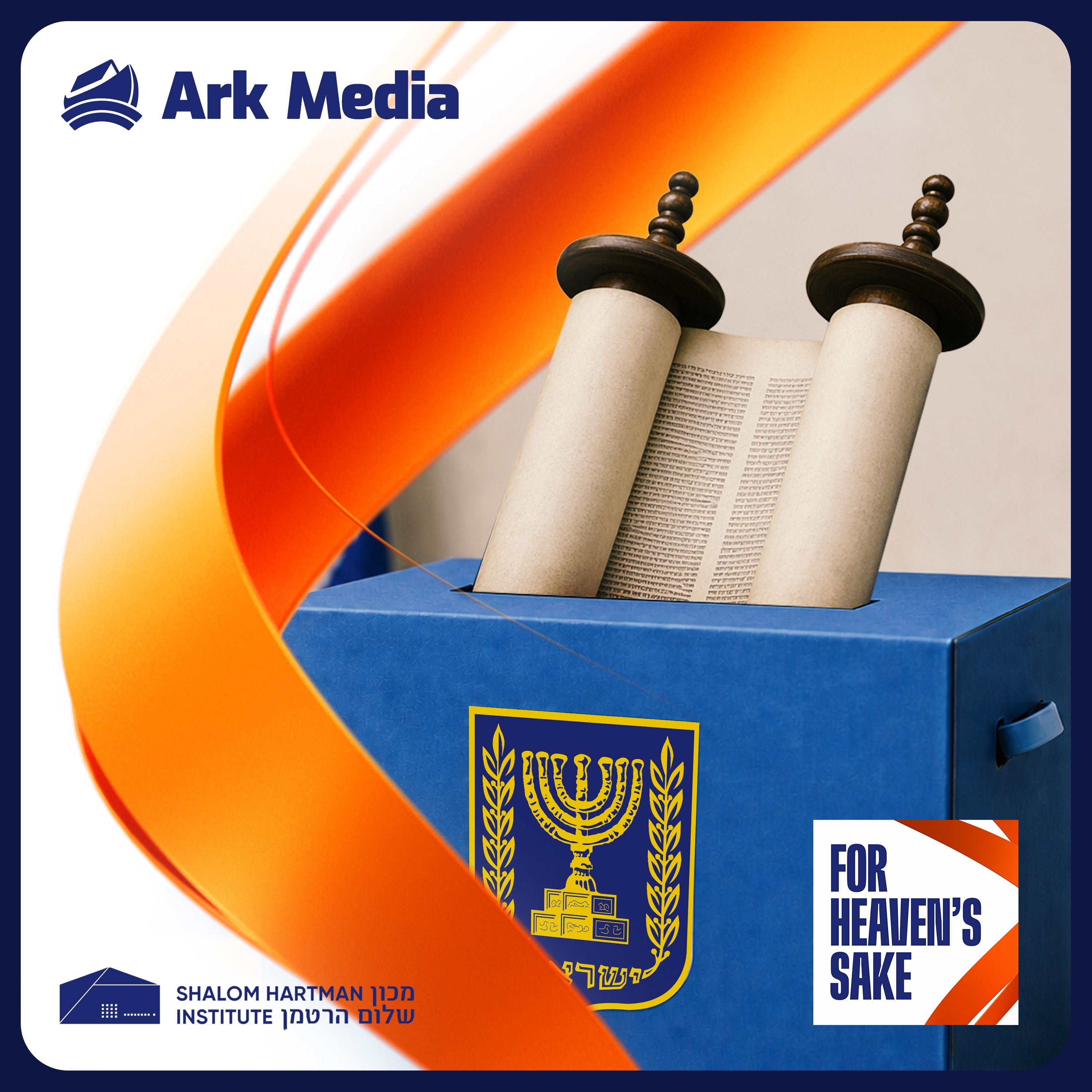
One of the interesting features of this election is that Judaism is on the ballot. See, in Israel, people vote first and foremost on issues of security. But one of the more interesting things that's going to happen is that there's going to be a serious transformation in the whole role of Judaism in the state of Israel.
- [00:27]
Yossi Klein Halevi
In the culture war between the Israelis and the Jews, the Jews won. The question is what kind of Jews this election is going to help define? What is Israeli Judaism? What do we mean by Jewish Israeli identity?
- [00:54]
Daniil Hartman
Hi, friends. This is Daniil Hartman and Yossi Klein Halevi from the Sholem Hartman Institute. And this is our podcast, for heaven's sake, in collaboration with Ark Media. Today is Tuesday, July 28th. In today's episode, we're going to continue to delve into the nuances, complexities and challenges of the upcoming election. One of the interesting features of this election is that Judaism is on the ballot. And that's our theme for today. See, in Israel, the primary issue whenever there is an election is people vote first and foremost on issues of security. Afterwards, they vote on issues of economics. Then you could have a whole slew of other issues, whether it involves environment, health, education. Now, these elections are going to be the same. And recent polls showed that people are indeed voting first and foremost on issues of security and number two on issues of economics. But one of the more interesting byproducts of this election is that the most significant transformation that will occur if, for example, there is a change in government is not going to be in foreign policy. It's actually going to be an internal policy. And it's not just going to be that. You're going to have a government that's now going to be more honest and a government that's going to actually work for the people. Not that these are trivial things, but one of the more interesting things that's going to happen is that there's going to be a serious transformation in the whole role of Judaism in the state of Israel. Because the coalition and the opposition, and we're talking about Likud, the ultra Orthodox parties, the religious Zionist party, as well as all of the opposition parties, principally the Democrats, but not just Bennett, Eisenkot and Lieberman, all have very, very different positions on the role that Judaism should be playing in the State of Israel.
- [02:43]
Yossi Klein Halevi
And it's central to what they're presenting
- [02:45]
Daniil Hartman
to the electors, to their electors, even though they're not. They're speaking about it very clearly. They're calling themselves liberal Jews. They have polit policies, their statements. And so if there's a change in government, it might not just simply be we're moving from right wing to center.
- [03:00]
Yossi Klein Halevi
We're not.
- [03:00]
Daniil Hartman
We're going to move from right to center, right, right, right, or depending on which minister is sitting in which ministry. But the major change is going to be, I believe, on redefining the status quo in Israel. And in this podcast, we want to focus on the four major groupings shaping this issue of religion and state. And that is the Likud, who've been in power for 20 years and more than any other party, have shaped Judaism and the state as we know it today.
- [03:29]
Yossi Klein Halevi
They've been in power almost continuously for 20 years, but actual power for 40 years.
- [03:34]
Daniil Hartman
For 40 years. Very interesting. Two is obviously the ultra Orthodox party who have moved from the fringe to the core of the coalition, and their policies on Judaism are shaping the life of every single Israeli and anybody who has a relationship with Israel. The third are the classic religious party, the Religious Zionist party, and we're going to look the unique features of that. And the fourth are these opposition parties from the Democrats. We're talking about the four principle. It's actually now five parties, and they're made up of religious Zionists, not members of the religious Zionist community, people who are traditional Jews, reformed Jews, as well as secular, who aren't secular Israelis. They see themselves as secular Jews. But for many of you who don't live in Israel, the whole issue of Judaism or religion being on the ballot might seem very, very strange because from a liberal perspect, the default is let's have as least religion as possible, separation of religion from state. But the classic term is not separation of religion from state, it's the separation of church from state. And even in America, you know, religion
- [04:43]
Yossi Klein Halevi
has a place in God we trust, in God we trust.
- [04:46]
Daniil Hartman
But it's far deeper than that. Within that, you're allowed to bring religion. You can't bring a particular vision of what is authentic religion into your state, into your laws, into your education. And it has its own challenges. But we're going to leave that aside for now. The issue is there is this myth that we need smaller religion in Israel. It doesn't work that way. So to frame this conversation, Yossi, let's kick off with how do you even understand this unique story of a country built by secular people in which religion is always an integral part of everything that we do? And now it's going to be so even more in the upcoming elections.
- [05:26]
Yossi Klein Halevi
So, Yossi, so, you know, it's interesting, Daniil, because in the early years of the state, the culture was defined by a culture war between what could be called only half ironically, the Jews versus the Israelis. You had a very strong stream, especially among intellectuals, but within left wing Zionism generally that believed that we're creating a new identity here. Yes, it's linked to ancient Israel, but we were able to circumvent, to leap over 2000 years of diaspora Jewishness. And many Israelis were even squeamish about calling themselves Jews. It's astonishing to think about that. And today it's equally astonishing how we take for granted the fact that Judaism Jewish issues saturate public conversation and the individual identities of Israeli Jews. So in the culture war between the Israelis and the Jews, the Jews won. The question is what kind of Jews? And in a way for us, certainly I think that's the most compelling idea of this election. This election is going to help define what is Israeli Judaism, what do we mean by Jewish Israeli identity. Now, when we think about the place of religion, of Judaism in the public square, we take for granted that there's a component of Shabbat observance in the public square.
- [07:02]
Daniil Hartman
The calendar.
- [07:03]
Yossi Klein Halevi
The calendar. But there's a dark side to that which is the place of religion in politics. And the truth is you can't separate one from the other. And the logic of Judaism demands some component, some expression in the political system. In your introduction you talked about the ability or even the American necessity of separating church from state In Israel we can't separate synagogue from state. And you know who taught me that? Shulami. I'll explain to, I'm sure our young audience, our young audience who may not remember the name. Shulemi was Israel's leading anti clericalist politician. She founded the left wing party Merets. As she once said that she studied Talmud to know the enemy. And she was actually quite a learned opponent of the rabbinic establishment. I once went to interview her when I was working as a journalist and I said to her, well, your model for religion and state in Israel is the American model. I didn't ask her. I said it as I said, well, you know, I'm sure you're model. She said, no, she said, you can't have separation of synagogue and state. Shulemi. I was floored. I said what do you mean? She said, religion is too integral a part of our national identity. You can't artificially separate shoe la Mitaloni. And then she said, can you imagine a Jewish state funding the opera but not mikvaot? Ritual baths. Yeah. And so there you have it. Shulamit Ohlone. When she said that, I realized that the Israeli versus Jewish, they never had a chance.
- [08:57]
Daniil Hartman
They never had a chance. You know, my favorite Shulami Ohlone story on this issue, when she was minister of education, especially from the religious parties were attacking her.
- [09:07]
Yossi Klein Halevi
Oh, they hated her.
- [09:08]
Daniil Hartman
They saw her as the enemy of Judaism. They didn't understand her nuance. And one day the attacks were getting thick. They were personal. And personal attacks is not a 21st century phenomena. This was back in the 1970s and 80s. She got up to respond to her critics as the minister in the Knesset, and they were screaming at her and calling her the most, the worst terms that anti Semite, just the worst. And she was literally shaking. And she says to them, is this the way you talk to somebody who came out of Egypt with you? Isn't that beautiful? I came out of Egypt with you. And then there's a pause in the knist and everybody's quiet. And then she goes, even though it never happened.
- [09:52]
Yossi Klein Halevi
I thought you were going to say, even though some of us built the golden calf.
- [09:56]
Daniel Goodman
No, no.
- [09:57]
Daniil Hartman
She says, so here it is. She got it is. I know Bible. I love my past. This was a Shulami Deloney story, but in many ways it also encapsulates this is the dance. Is it a dance of Judaism as culture? Because we didn't coerce religion on non Jews of Israel ever. The issue and the challenge of religion and state in Israel is that Jews don't agree about their Judaism. But for Shalomi, Oloni, Shiwas and for many Israelis, they were very comfortable with ideas of Jewish culture being. It's just our culture. It's like Supreme Court in Maryland rules that Sunday could be a day of rest because it's not necessarily God's day. It has become a part of the larger culture of America, not something affiliated. But the balance and the challenge of religion and state, which we're really now going to progress into is it's one thing you want to fund culture. The calendar, you need a calendar. The Jewish calendar is a calendar. There are various institutions that the Jewish community always had. And whether someone has to go immerse themselves in a bath or not or how you avail yourself doesn't impinge on privacy. But she was saying this is that in a Jewish state, we care about Jewish things too. But now it went beyond that. It went beyond Shulamit Ohlone's mandate and also the mandate of the founders of the country to a country in which there are very particular policies. There are people who are trying to guide how did Jews do Judaism in the state? And even deeper, I think, as you said, what is our Jewish identity? How do we think Jewishly and principally? The most important one over the last generation has been a party that you would think that's not their mandate. Their mandate was talking about issues of security and economics. But the party that shaped it, from Menachem Begin on, was the Likud Party. Tell us a story about how did they shape and come, particularly today? Because in this election, if they're in power again, what are the cornerstones of their understanding of religion instead?
- [12:01]
Yossi Klein Halevi
So to understand the Likud's relationship to religion and to its constituency, especially Mizrahim Jews from Muslim countries, you have to understand the Labor Party's relationship to Judaism. The Labour Party had a deeply ambivalent relationship to Judaism. On the one hand, they were in an alliance with the religious Zionist party, but they also ceded religion to them. You take care of it. We're building the state. We're dealing with the Jewish people, the defense of Israel, and you can handle religion and we'll allow you to, but it doesn't speak to us. So, for example, when a Labour Party prime minister would win an election after 1967, they wouldn't think of going to the wall to pray, to pray, to thank God. There was no warmth that they showed to Judaism. They gave Judaism its formal place. But they conveyed the very clear message that this is for them, so it's not for us. And Mizrahim, unlike many of the Ashkenazi immigrants who came to Israel who were secular or had been exposed to secular influences in Europe, most Mizrahi immigrants came not just deeply traditional, but that's why they came to Israel. They came because of their religiosity. And the message that was conveyed by labor, especially in the early years, was, you're going to need to change. You're going to need to get rid of some of that primitive baggage if you want to become modern Israelis. And the wound, the patronizing attitude that labor conveyed to Mizrahim is something we're still paying for to this day. When Mizrahim say rak bibi, only bibi, what they're really saying is, we still remember what you did to our grandparents. And never mind that that's not the same Labor Party, and it's certainly not the same Likud anymore. But this sense of the dignity of religion is what the Likud conveyed. Menachem Begin is elected for the first time as prime minister in 1977, what's the first thing he does? He goes to the kota. What does he do the next day? He goes to a settlement and dances with a Torah scroll. And he introduces a new language into the public space, which is Baruch Hashem. Thank God. Bezrat Hashem. With God's help. Now, Mizrahim weren't looking explicitly for a return to observance. They were looking for signs that their culture, who they were, what brought them to Israel was being honored and the genius of the Likhud. And it wasn't the manipulation for Begin and for the leadership, the traditional leadership of the Likud, it was authentic. They were able to naturally convey a love and respect for traditional Judaism. What Begin loved about the Mizrachim is precisely what made labor uncomfortable. He used to call them, you're such warm Jews, Yudim Chamim, you're warm Jews. And labor didn't know how to convey the traditional Jewish warmth, which is what Mizrachen. What they were looking for was an
- [15:39]
Daniil Hartman
embrace, was an embrace of Judaism, which was an embrace of their. So in Menachem Begin, I remember the first time he goes to Washington and he walks from the Blair House to
- [15:49]
Yossi Klein Halevi
the White House on Shabbat.
- [15:50]
Daniil Hartman
On Shabbat. And for the first time the meals are kosher.
- [15:53]
Yossi Klein Halevi
That's right. Which is. It's astonishing to think in the past Israel that an Israeli Prime Minister could go to Washington and he'd shrimp. Publicly. Publicly. So that's the change that Bacon brought. And the Likut to this day is living off of that initial achievement.
- [16:13]
Daniil Hartman
But what that has done, Yossi and you spoke about respect, but there's a certain respect and a closeness to the past. But it also is a double edged sword and especially in the covenant between the Haredim, the Ultra Orthodox and the Likud. Because that respect has created the notion that the religion that we have to respect is whoever is the. It's no longer a Menachem Begin respect for tradition as a vague concept. It's now respect for those who are its official representatives.
- [16:48]
Yossi Klein Halevi
What the transition from was from the old Likud's idea of Judaism as part of the Israeli civic religion to becoming the actual religion as defined by the new caretakers.
- [17:04]
Daniil Hartman
Because in many ways, what the Likud has moved to, this notion of respect has actually become very similar to what I think labor used to do with religion as well. And that is, I don't do it, but you're the authentic one. It's like, if we're going to have religion, we're going to do it the right way. The synagogue I don't go to is Orthodox. See, Menachem Begin went to a synagogue. He wasn't alien a synagogue. The founders, the Labor Zionists, they were alien to the synagogue. He goes to a synagogue. But what has emerged, particularly in their covenant, not with. Because they shifted from coalition partners with the religious Zionists to coalition partners with the ultra Orthodox, is they don't do ultra Orthodox, but you. They're willing to give it over to you. And they're now the protectors of.
- [17:54]
Yossi Klein Halevi
It's really interesting because in a way what you're saying is that Netanyahu is a throwback to the old labor leaders who are not traditional. Netanyahu doesn't have a traditional bone in his body. And so he is farming out Judaism in the same way to the Haredim. The way labor finds out. That's correct. I heard a talk the other day in the Knesset from one of the Likud cabinet ministers. Do the Amsalim, and he's saying to the Haredim, he says, I wish I could learn Torah all. Yeah, really do. The Amsalim wishes he could learn Torah all day. He says, I wish I had the strength that you have to sit and learn Torah. So you're doing it for me.
- [18:38]
Daniil Hartman
For me.
- [18:39]
Yossi Klein Halevi
Who in the Likud would have ever spoken that way?
- [18:42]
Daniil Hartman
Never. And it's part of this process that this group of people, they are traditional, but they're this mixture between people who respect the past, but who are also now pass the respect on to another group of people. So in many ways, the legacy of the Likud, now very different from the legacy of Menachem Begin, is not a legacy of embracing a Jewish culture and a people who love Jewish people, in
- [19:10]
Yossi Klein Halevi
which all parts of the Jewish people
- [19:12]
Daniil Hartman
could find a place, could find a place to becoming the people who respect the masters of religion. Which brings us. And therefore the legacy of the Likud is the handing over of all of religion or Judaism to the ultra Orthodox. That's their legacy.
- [19:32]
Yossi Klein Halevi
That's right.
- [19:32]
Daniil Hartman
And the ultra Orthodox are sitting in this coalition and they're hearing this language of respect. And fundamentally, any legislation on issues of Judaism that the ultra Orthodox party wants, they get, because what they really want. And you can't look at the role of Judaism in the state of the Likud versus the ultra Orthodox as two distinct groups, because the Likud are the ultra Orthodox enablers. That's what they are.
- [20:01]
Yossi Klein Halevi
That's A great way to put it.
- [20:03]
Daniil Hartman
The ultra Orthodox aren't just Orthodox. It's not Orthodox. It goes much deeper than that. It's not that they're trying to put forth an Orthodox agenda for the country and they believe that that's authentic Judaism. You can't understand current ultra Orthodox party policy unless you don't understand. What they want is they want to be the masters of Judaism. They don't just want to be the ones who impact who's on the rabbinate or some particular legislation. What they want is we are Judaism. Here is a group of people who shifted from being on the margins. They always saw themselves as the elite, but they were the minority. History passed them by. History passed them by in Zionism, History passed them by emancipation, History passed them by in North America. They're a small remnant community. And all of a sudden they find themselves as the balance of power for the State of Israel, a state that they rejected. And in the process of their Zionification and their embracing of their leadership role, they said, listen, here is the state for the first time. I'm not just going to be a party in the coalition. I am going to be the master of Judaism for the Jewish people. And all of a sudden they begin to talk about what's appropriate for a Jewish state. You reject the Jewish state? No, I'm the master of it. It's a deep, powerful image.
- [21:32]
Yossi Klein Halevi
I'm the master, not of the state,
- [21:34]
Daniil Hartman
but of the Jewish, of the Jewishness of the state. I am the chief rabbi. And literally they move into an institution that they rejected and they still don't serve it. They don't use the rabbinate, but the rabbinate.
- [21:47]
Yossi Klein Halevi
They have their own rabbis, but they have imposed one of their rabbis, all
- [21:51]
Daniil Hartman
the rabbis throughout the ultra. The rabbinate today is inhabited by all ultra Orthodox rabbis because it's both for jobs, but it's also we are here. It is. There is one Jewish state, we're the masters of it. And what they want to do, the direction that this takes it, it's not one legislation or another. It's basically to say, I have the keys. I have the keys to the kingdom. I'm the one wherever I go, whether it's this rabbi or that rabbi on any issue. So recently, a legislation that most of our audience doesn't even know about was an attempt to change some law in broadcasting, which is a minor. It's not a minor issue, but it doesn't matter. The ultra Orthodox wouldn't support the Likud change in this legislation unless the official broadcasting organization would stop working on Shabbos. It's not appropriate, they would say, for a government institution to work on Shabbos. We're going to tell you now, what's so interesting is that's also how you have to understand the issue of the service in the army, because this started before October 7th. It started in judicial reform, when one of the features of judicial reform is they wanted the Knesset to pass a law in which the value of Torah study was equivalent to the service in the army. And the Likud tried to pass it. They just couldn't for a whole slew of reasons, that the judicial reform didn't work. And a variation of it was recently passed. But what they wanted is, listen, if I'm the master of Judaism, I'm now telling you that Torah study is critical. I want you now to vote and to officially declare me as the King of the Jews. And so this combination of the Haredim and the Likud Party has created a coalition of people who respect Judaism, people who want to be the masters of Judaism and who want to be the ones who shape the way all of Israelis live. You have personal freedom, but anytime it comes to the state, anytime you do Judaism in the public sphere, whether you're getting married, whether you're getting. Getting buried, whether you want to convert, whether you want Shabbos buses on or off, whatever, or who serves or doesn't serve, it's. I am the Pope in that sense. It is my word. And the Likut says yes, precisely because I respect you. You're now the one side.
- [24:20]
Yossi Klein Halevi
I love the insight. And I'd like to point out a few of the fatal contradictions in their new position. The first is that they want to be masters of Judaism and Israel. I think that's exactly right.
- [24:36]
Daniil Hartman
And at the same time, that's their Zionism now.
- [24:39]
Yossi Klein Halevi
Yeah, yeah, that's right. That's right. And they would see it that way.
- [24:43]
Daniil Hartman
Yeah.
- [24:43]
Yossi Klein Halevi
So that's on the one hand. On the other hand, they want us all to leave them alone and let them be a state within a state. They want their state within a state to control the other state.
- [24:56]
Daniil Hartman
So that's a paradox.
- [24:57]
Yossi Klein Halevi
That's tremendous.
- [24:59]
Daniil Hartman
That's a great one. Spell that out, because it's a remarkable paradox.
- [25:02]
Yossi Klein Halevi
So the idea that they can live apart from us and then dictate to us how we should live, it's not just a paradox in itself. It leads to the next fatal paradox, which is that the stronger they get, the more antagonism they rouse against them and the more they undermine their position in Israeli society. So they insist on being separatist. They further insist that we subsidize their separatism. And then on top of that, they turn around and say, not only are we going to separate from you, not only are we not going to participate in any of the burdens that are imposed on you, but we're also going to tell you how you should live. Now. There is no minority in the world. There's no minority in history that could ever get. They don't have the consciousness, no, it's not a minority.
- [25:59]
Daniil Hartman
They're king. No, no, think about like the king.
- [26:01]
Yossi Klein Halevi
The king is above the law. That's part of the fatal paradox exactly, is on the one hand, they have this sense of themselves as a pursued minority, a hated minority. On the other hand, they're in charge.
- [26:13]
Daniil Hartman
They're in charge.
- [26:14]
Yossi Klein Halevi
And then there's one final paradox here, which is, on the one hand, they are a community on the march. They are triumphalist. The future is theirs. Gafni, one of their leading political figures, said recently that his vision for Israel's future is that 50% of the country will serve in the army and presumably pay taxes, et cetera, and the other 50% will be the community of Torah learners. Now, that, of course, is a recipe for the disintegration. There will be no state. But the arrogance not to keep that to yourself, to present that as your vision for the future, on the one hand. On the other hand, they're so terrified of mass defections of their youth that they won't even allow their young men who are not studying, who may be wandering the streets. They won't allow them to go into a much healthier, from a religious perspective, much healthier framework in haredi units in the army, where they really take care of your religious needs, where you study Torah, people come out of those units strengthened in their faith, but they don't have the confidence. And so you can't, on the one hand, believe that you are the future of Israel, and on the other hand, hold on even to your wayward youth, because you're so afraid that you're going to lose them if they go into the army.
- [27:44]
Daniil Hartman
I really appreciate that point of lack of confidence because some of the aggressiveness
- [27:49]
Yossi Klein Halevi
definitely comes from that. Definitely.
- [27:51]
Daniil Hartman
And so you have, between the Likud, who are the enablers, you have the haredim, you have this group of people, huge segment of Israeli society, pushing us in one direction to allow one group to determine for everybody a very stringent, very often extreme, very often not even founded on halacha positions when it comes to the Judaism of the state, very often growing out of issues of insecurity, sometimes just in order to ensure they have their power. But all of this would only be possible if there is a group that should have had a voice, which doesn't have a voice. And that is in this government we have, there are a very strong religious Zionist party, and it's not only a religious Zionist party. A very large number, at least a third of the members of the Likud are members of the religious Zionist community.
- [28:50]
Yossi Klein Halevi
Now, this community, they wear the telltale knitted kippah of the community and their
- [28:54]
Daniil Hartman
settlers and all of the above. They're very similar to Smotrich in that sense, even though not all religious Zionists are part of this party. This only represents, I believe, about a third of the Religious Zionist party.
- [29:05]
Yossi Klein Halevi
You think it's that high?
- [29:06]
Daniil Hartman
I'm in a generous mood right now. So let's say call it a third, why not? Or something like that. But when the state was formed, these were the ones whom Ben Gurion said, okay, you could be the master of Judaism in this state. And one of the interesting features of religious Zionism is that on almost every single issue, they're voting with the Likud to enable the ultra Orthodox to be the masters of issues of Judaism and
- [29:33]
Yossi Klein Halevi
state, issues that they were once in
- [29:34]
Daniil Hartman
control, they were the ones in control of. So the most telling is very recently under the Bennett government, Matan Kahana, a religious Zionist, more on the liberal side, enabled liberal, religiously, not politically, not politically right. He created an innovation in which the kosher certificates aren't just governed by the rabbinate anymore. They're governed also by other alternative Orthodox rabbis, thus giving back authority to religious Zionists, but also rabbis who would ostensibly do this in a more decent way. He created competition. One of the last legislations supported by Smudrich is to remove the authority of religious Zionist rabbis, alternative ones, to also give religious certification and to return it exclusively back to the rabbinate, which is exclusively back to ultra Orthodox parties. So where are. It's like, but you're a religious Zionist, so what is their notion of religion? And when we talk about religion and state in Israel, it's not just issues of ritual and it's not just issues of legislation and practice. It also has to do with larger political agendas. And one of the interesting features of religion on the ballot is that in the Religious Zionist party and many of its Likud supporters, the primary issue of Judaism is not Jewish Law. It's not Jewish values. It is being the master of the land. If the ultra Orthodox want to be the masters of Judaism, religious Zionists want to be masters of the land. And it's not even the holiness of the land. You know, you wrote about this, you know, in your book, like dreamers. It's not just post1967amessianic fervor reconnecting to the sacredness of the land of Israel. Today in the religious Zionist community, it's gone a notch up. Since nobody is talking about territorial compromise. It's not on the issue since the withdrawal from Gaza. The issue is not whether giving up land or not. The issue is whether we are maintaining control over the land. And if Bizal Smotrich, what did he want? He didn't want to be Minister of Religion. What did he want? He wanted to be Deputy Minister of Defense and Minister of Finance so that he could basically be the master of all of Israel's policies in Judea and Samaria. And 150 new settlements or outposts are being built. And the purpose of all of them is not even to increase the amount of people who live in the west bank because there's actually a decrease of people moving. There's a negative growth in the West Bank. You're moving people from one place to the next. He wants as many outposts as possible to present. I am the master. A colleague of mine, Rana Fahum, just traveled from Ramallah to Nablus and she said, as you're traveling on the road, most of the road is Palestinian road. It's area B and area C. Every meter or two is another Israeli flag. What he wants is my Judaism is to be master of the land and also the master of Palestinians. Because under his religious leader, Rabbi Tao, the Messiah will come, God will return to history. When Jewish self confidence reemerges and it re emerges what he calls the spirit of the people. It will re emerge when we exert mastery. We're the masters of now. This is his agenda. He needs to be Minister of Finance to be able to move as much money as he to the settlements. And he's the Deputy Minister of Defense in charge of all civilian Israeli civilians living in Area C. So he could do anything. So his Judaism, he doesn't care about Kashrup. He doesn't care about conversion. He cares about a messianic vision that will emerge when the Jewish people are masters. That is their Judaism. Masters of the world.
- [33:33]
Yossi Klein Halevi
Yeah, I think it's important just to add one caveat which is even though Smutrich is head of a party that calls itself Religious Zionism, that ideology, it doesn't represent the majority of religious Zionists, not at all. And that's why it's a small party.
- [33:48]
Daniil Hartman
It's a small party, barely passing, because most religious Zionists, and we're going to come to them in one moment, and I want to hear your take on it. Why is it that he is supporting various forms of exemption for ultra Orthodox from the army? It violates the essence of his constituency who are serving and dying. Because for him, if the only way that he could be master of the land is to keep together a coalition of Likud and the Alchorzid, I will give you Master of Judaism. I'm master of the Land. And then he, in many ways is stabbing his own constituency, who the vast majority won't vote for him. They've now gone to other parties, including the Likud. So he's making that move.
- [34:35]
Yossi Klein Halevi
I'm still mulling over the really interesting transition that you noted in Religious Zionism from emphasizing the sanctity of the land to mastery of the land. And it is a messianic shift. I mean, this is what's so interesting. But you know, just to take a step back and look at this process historically and try to understand how religious Zionism as a whole went from being the custodians of religion to being custodians of the land. In the early years of the state, before 1967, religious Zionism emphasized the sanctity of the state. And after 1967, they emphasized the sanctity of the land. Now, it's not that they stopped believing in the sanctity of the state, but they put all of their energies into ensuring that we would remain in possession of the land, because that's where the struggle for sanctification, what's taking place. And so even though, you know, you're right that they're not speaking explicitly now about the sanctification of the land, but that shift is what made this moment possible. Correct. And so in some ways, it's the inevitable culmination of that process. What they did, speaking from within their language, they betrayed the sanctity of the state. They ceded the sanctity of the state to that part of Orthodox Judaism that didn't recognize the sanctity of the state, that treats the state as a means, if that in a purely utilitarian way that has no respect for the state, has no respect for the institutions of the state. When you think about the chief rabbis in the early years of the state that religious Zionism produced, these were extraordinary figures. And what was so extraordinary about them was the country recognized them them as great figures, whether you followed their path or not. These were men who radiated love for the state and love for the Jewish people. What we have today are chief rabbis who express love only for Judaism, their understanding. And they're ultra Orthodox, not for the Jewish people as a whole, and certainly not for the state. That's what we lost when religious Zionism forfeited their struggle for the sanctity of the state and began to focus on the sanctity of the land.
- [37:05]
Daniil Hartman
And so the representatives of that is the Religious Zionist party. But there are religious Zionists, there's a whole other group of people. So let's talk about them for a few minutes. They're in the opposition, or they're part of the opposition bloc. They're part of the not Netanyahu, just not Netanyahu community. And in many ways, one of the interesting features of this is that if I go back to your analysis of the Likud, and in many ways they're the Neumannachen begins, they actually have a profound respect.
- [37:34]
Yossi Klein Halevi
Yes, let's look at them.
- [37:36]
Daniil Hartman
We have Avingter, Lieberman, we have Bennett.
- [37:40]
Yossi Klein Halevi
Bennett, who wears a kippah.
- [37:41]
Daniil Hartman
Bennett, who wears a kippah. You have the Misora T Eisenkot, and you even have the traditional. And you even have Yair Golan. Even Yair Golan. Yair Golan explicitly says, I'm not an Israeli, I'm a Jewish. So each one of these in different ways. And you look at.
- [37:58]
Yossi Klein Halevi
But you don't get a sense of religiosity from him.
- [38:04]
Daniil Hartman
Not religiosity, but from his.
- [38:05]
Yossi Klein Halevi
Not contempt. That's not the old contempt, but I don't feel that from him, you see,
- [38:10]
Daniil Hartman
but if you look at his list, you look at the list of people who were voted, almost every one of the people in the top 10, there's Orthodox, there's Kippah wearers, there are Sephardi traditionalists. A Reform rabbi, There's a Reform rabbi.
- [38:25]
Yossi Klein Halevi
I wonder what Shula Mitaloni would make this list.
- [38:29]
Daniil Hartman
Look at this list.
- [38:29]
Yossi Klein Halevi
This party is a successor.
- [38:32]
Daniil Hartman
But if you go also deeper, if you look at Bennett's party, you look
- [38:37]
Yossi Klein Halevi
at Lieberman, it's full of religious Jews.
- [38:40]
Daniil Hartman
But even if they're not whether keep awares, these are people who are Jews, they don't see themselves, they don't talk Israeli, they feel comfortable in tradition. I know that Yair Golan is Not a great synagogue goer. But if you speak to him, and I have spoken to him extensively, he says, of course, this is a Jewish country. He's not Shulami alone. He's not a spectator. He speaks himself. I have a very strong Jewish identity. And in their politics, Jewish values and Jewish ideals and ideas constantly emerge. And so one of the big shifts, and I want your take on this, is that if there is a change in power, you're going to have for the first time in Israel, not people who have a respect for Judaism, who therefore respect an authority on the outside, who they give all the power to. They're not going to be enablers of somebody else's Judaism. You're going to have a coalition of 60, 61, 62 seats of people who are players of Judaism, who live Jewish lives in which Orthodox Jewish law doesn't always define what they do. And if it does, they're tolerant or pluralistic.
- [39:52]
Yossi Klein Halevi
But you see that differently than the Likud today.
- [39:55]
Daniil Hartman
The Likud today are ultra Orthodox enablers.
- [39:59]
Yossi Klein Halevi
They're ultra Orthodox enablers, but they do have a sense of their own Jewishness,
- [40:04]
Daniil Hartman
of their own Jewish. But authentic Judaism is not theirs. See, the respect is not a respect for Judaism, which then means I'm a player, it's a respect for Judaism, which in many ways disempowers them.
- [40:16]
Yossi Klein Halevi
Do you think it's because of Netanyahu?
- [40:18]
Daniil Hartman
I don't know. It could be. It could be because of their covenant with the ultra Orthodox over time. They've just basically, in other words, the
- [40:28]
Yossi Klein Halevi
opposition has no significant religious, political other to who they have to bow down,
- [40:34]
Daniil Hartman
who they have to bow down to. Quite to the contrary, they are like Menachem, they'll respect rabbis. But many of them have alternate visions of what the role of Judaism and state should be. For some of them, like, you know, you have figures who are significantly Orthodox who speak about religious pluralism. You have Bennett who speaks about we have to bring civil marriages. Most of them wanted to shift and break the monopoly of the rabbinate and move religious issues to municipalities where each city, it'll be like a tapestry. Judaism in Israel won't be done on a national level. It'll be done depending on the nature of the city. So if you have a city like Bnei Brak, you don't have buses and your stores will be closed. But in Tel Aviv or.
- [41:16]
Yossi Klein Halevi
I think it's unbelievable that we have to fight for that, really, it's just stunning.
- [41:21]
Daniil Hartman
But that's what happened when you, you
- [41:22]
Yossi Klein Halevi
see, when you Farm it out to
- [41:24]
Daniil Hartman
religious parties of respect.
- [41:26]
Yossi Klein Halevi
The total imposition.
- [41:27]
Podcast Host
Right.
- [41:28]
Yossi Klein Halevi
Blanket across the.
- [41:29]
Daniil Hartman
You see, like the traditional Jew used to have a deep respect, but they respected their own Judaism. They respected the Judaism of their parents. One of my colleagues who's an expert in traditional classic traditional Judaism says traditional msoorti Judaism never judged people on what you don't do it judged on what you do do. So the cup was full. You lived a Jewish life. They weren't setting up clear boundaries, but the farming of this out to this group of people created in alienation. So you have Regev, Mary Regev, who
- [42:02]
Yossi Klein Halevi
calls herself a great transportation.
- [42:05]
Daniil Hartman
You know, she won't allow even strategically significant construction of roads, of bridges because it's the ultra Orthodox. There is this faux respect for somebody else's religion.
- [42:17]
Yossi Klein Halevi
And. Did you say full respect of faux, faux respect? F A U X. F A U X.
- [42:24]
Daniil Hartman
This new group of people, they don't have that. And so you're going to see, it'll be interesting that if Israelis don't see themselves as secular, secular Israelis, but as secular Jews or traditional Jews or liberal Jews, how the games will play. What will happen? What will the Kotel be like? Because this group of people are willing to give the Kotel completely over to the ultra Orthodox. Rabbina will lose some of its control. Different cities will function differently.
- [42:50]
Yossi Klein Halevi
Now, of course this is going to play out in a very ugly way because the parties of today's coalition are going to accuse the new government of being anti Jewish when in fact they're presenting a more expansive idea of Judaism, an idea of Judaism that takes the entire Jewish people into account. And that's going to be the new battleground.
- [43:15]
Daniil Hartman
That'll be the new battleground. It'll be interesting to see how they fill it with something positive. Ministry of Education the only community that doesn't get allocated hours in Israel for Jewish studies are secular Jews. Orthodox schools get 10 to 15 hours. Secular schools, you don't even have an option. The training of teachers, curriculum, it's outrageous. There is a potential for a rewriting of the covenant. I only hope that this will be done slowly because if it's done too quickly, it's going to boomerang is look. And it never is done slowly.
- [43:47]
Yossi Klein Halevi
No, it's never done slowly. And I certainly would understand a new government sense of haste because we finally have a chance to turn things around.
- [43:58]
Daniil Hartman
But the thing that we're going to face is that we have to make sure that we don't get into a cycle of each government repealing the legislation. We need changes that are changes that realign the covenant of the country.
- [44:11]
Yossi Klein Halevi
We should talk about that in some future podcast.
- [44:13]
Daniil Hartman
Just like with the old Orthodox, we're going to draft them and the next group is going to exempt them from draft. It's going to be a yo yo. You know, Bennett wanted to create an area of the Kotel of the Western Wall, which was open to all Jews. So one group's going to open them, then the other group's going to close it. You know, Kashrut is going to go
- [44:31]
Yossi Klein Halevi
one way, the next government's going to reverse it. Yeah.
- [44:34]
Daniil Hartman
So what we have to do is there is an opportunity to rethink. And what the essence is is that there is no master of Judaism anymore. That the idea that the country, as you said, of course Judaism and state are integrated in this country. Of course they are. But there is no master. And that will be in many ways more than foreign policy transformations, one of the most interesting processes that we're going to see unfolding.
- [45:02]
Yossi Klein Halevi
Last Thoughts, Yossi what we're really talking about, Daniil, is the transformation of the framing of the Israeli schism. It's not secular versus religious anymore. It's different ideas of what Judaism is. And that, I think is a much more interesting argument. It's a much more elemental argument. And it also doesn't cede the tremendous power of Judaism to one side. Now that you have the opposition fighting for their idea of Judaism, you're going to see the reaction among the ultra Orthodox feeling that they're cornered and I fear it's going to be very ugly. But on the other hand, it's finally going to start getting real and I look very much forward to this next round.
- [45:56]
Daniil Hartman
So another reason to be excited about the next elections. Yossi, a pleasure being with you.
- [46:00]
Yossi Klein Halevi
Oh, wonderful.
- [46:02]
Podcast Host
Here are some other things that are happening at the Shalom Hartman Institute. The Hartman Institute is at a summer camp near you. Hartman faculty, staff and interns are training over 1,000 camp staffers across North America to bring meaningful conversations about Israel, Jewish peoplehood and values to their camp communities. Many participants are connected to our Wellspring programs in Israel and North America. To learn more about Wellspring, click on the link in the show. Notes
- [46:29]
Daniel Goodman
For Heaven's Sake is a product of the Shalom Hartman Institute and ARC Media. It is produced by me, Daniel Goodman, with help from Miriam Jacobs, Adar Taylor Schechter and Aviva Katmanaur, and studio support from Go Live Media. Our episode was edited by Seth Stein. Natal Friedman is our executive producer and our music was composed by Yuval Samo. Pasta can be found@arcmedia.org where you can explore more of Arc Media's podcasts. You can watch the video versions of our episodes on our YouTube channel. Follow the YouTube link in the Show Notes. Also, to receive updates on new episodes, please follow the link to arcmedia.org and subscribe to Arc Media's weekly newsletter. For more ideas from the Shalom Hartman Institute, visit our website@shalomhartman.org.