Podcast
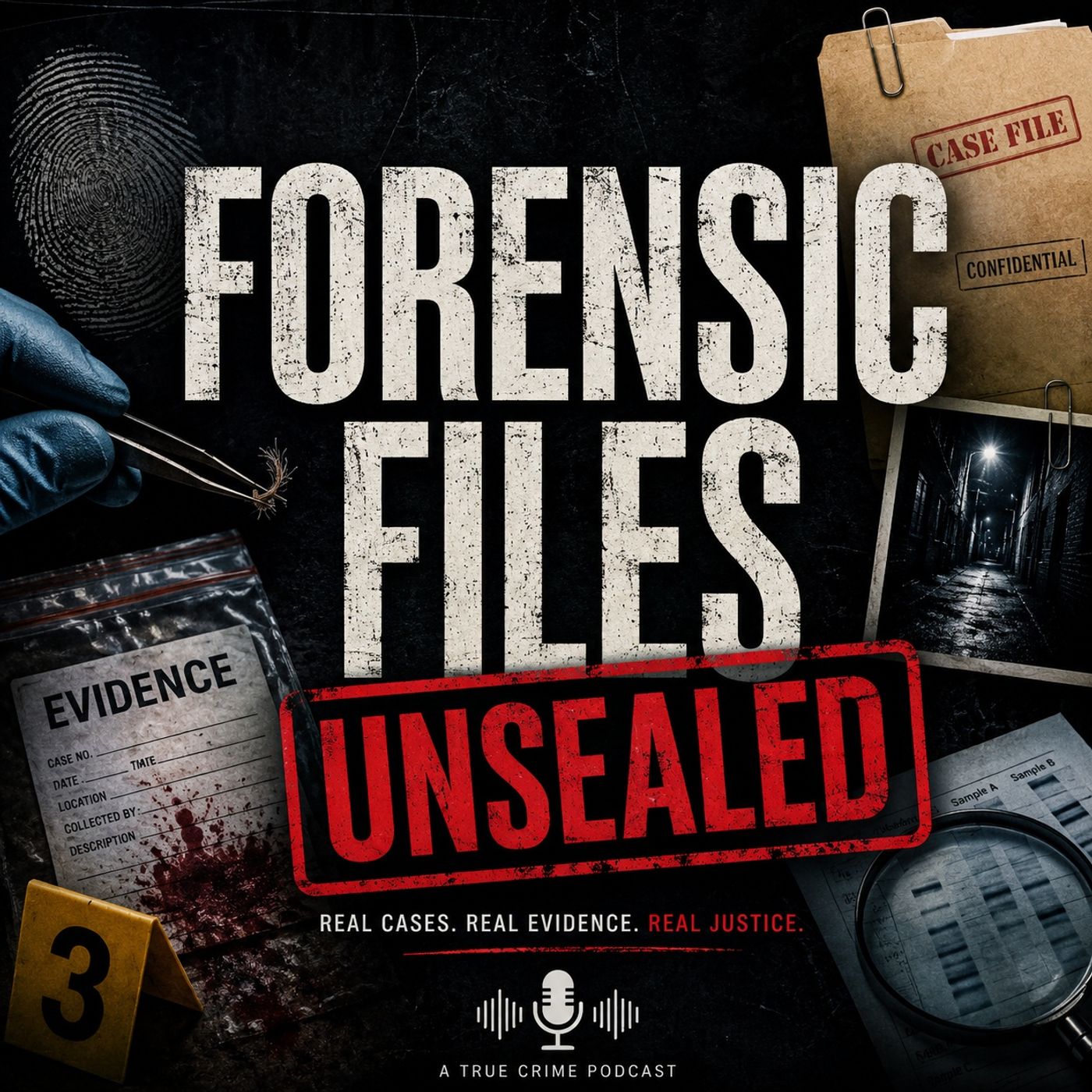
Forensic Files Unsealed
Hosted by AC Wilson · EN
Forensic Files Unsealed takes you beyond the original cases and into the deeper world of forensic investigation, hidden details, and unanswered questions behind real-life crimes. Each episode revisits compelling cases involving forensic science—from DNA breakthroughs and digital evidence to overlooked clues that changed everything. We go beyond the headlines and reenactments to explore what really happened, how investigators pieced together the truth, and what details often go unspoken in public case summaries. Whether it’s cold cases, courtroom revelations, or scientific breakthroughs, this podcast pulls back the curtain on the evidence that solves—or sometimes complicates—the story.
Disclaimer
Forensic Files Unsealed is an independent true crime podcast created for informational and educational purposes only. All cases discussed are based on publicly available records, news reports, court documents, and documented investigative material. This podcast does not claim to provide legal advice, nor does it assert the guilt or innocence of any individuals mentioned. Some interpretations are based on analysis and may include commentary or speculation intended to explore investigative possibilities, not to state definitive fact. All individuals are presumed innocent until proven guilty in a court of law. Listener discretion is advised, as this podcast may contain discussions of violence, death, and sensitive subject matter.
Disclaimer
Forensic Files Unsealed is an independent true crime podcast created for informational and educational purposes only. All cases discussed are based on publicly available records, news reports, court documents, and documented investigative material. This podcast does not claim to provide legal advice, nor does it assert the guilt or innocence of any individuals mentioned. Some interpretations are based on analysis and may include commentary or speculation intended to explore investigative possibilities, not to state definitive fact. All individuals are presumed innocent until proven guilty in a court of law. Listener discretion is advised, as this podcast may contain discussions of violence, death, and sensitive subject matter.
175episodes
Episodes
Newest firstAll episodes
The Forensic Reconstruction of Cheryl Ann Commesso
Today00:36:54Tap to summarizeThis source details the forensic investigation and ultimate resolution of the Cheryl Ann Commesso murder case. After a roadside worker discovered skeletal remains along a Florida highway, a multidisciplinary team of forensic anthropologists and detectives worked to identify the victim, initially known as Jane Doe I275. The investigation shifted from a cold case to a active homicide inquiry after a serial number on a breast implant provided a definitive identification. Evidence eventually linked the crime to Franklin Floyd, a sadistic criminal whose personal photographs and unique thumbprints placed him at the scene of the victim's torture. By using botanical analysis of plant growth on the bones, experts successfully debunked the suspect's alibi regarding the timing of the death. These scientific breakthroughs allowed prosecutors to secure a death penalty conviction, providing long-awaited justice for the victim's family.This episode includes AI-generated content.
Transcribe →The Wolf at the Door - The Murder of Barbara Howe
Today00:42:42Tap to summarizeThis true crime narrative details the brutal murder of 87-year-old Barbara Howe, an active grandmother found dead in the trunk of her car in Ohio. Investigators and medical examiners describe how the killer, former maintenance worker Daniel French, used his knowledge of her retirement community to trick her into opening her door. The victim was violently assaulted and exsanguinated in a hidden crawl space before the perpetrator attempted to destroy forensic evidence using cleaning products and vacuum debris. Detectives initially struggled with a lack of direct evidence until DNA recovered from a crawl space door was linked to French, whose previous repairs at the home had been professionally cleaned, proving his presence on the night of the crime. Despite his attempts to hide and deceive police, French ultimately confessed and received a sentence of life in prison without the possibility of parole. This overview highlights the coordinated efforts of law enforcement and forensic experts to secure justice for a vulnerable victim.This episode includes AI-generated content.
Transcribe →Mr. Handcuffs - The Badge and the Suitcase Killer
Yesterday00:36:51Tap to summarizeThis episode details the investigation and capture of Steven Zelich, a former police officer who murdered two women and hid their remains in suitcases. The victims, Jenny Gomez and Laura Simson, were targeted through bondage websites and killed during violent encounters that Zelich claimed were accidental. Authorities discovered the bodies along a Wisconsin highway, leading to a forensic search that linked DNA evidence from the crime scene to Zelich’s apartment. The narrative highlights how the killer utilized his law enforcement background and "Mr. Handcuffs" persona to manipulate and subdue his victims. Ultimately, the source describes his confession to the gruesome crimes and his subsequent sentencing to multiple consecutive prison terms. Through a combination of surveillance footage and digital trails, investigators successfully removed a sadistic predator from society.This episode includes AI-generated content.
Transcribe →Death in the Tub - The Case of Sylvie Cachay
Yesterday00:40:06Tap to summarizeThis episode recounts the tragic death of Sylvie Cachay, a promising fashion designer found drowned in a bathtub at the exclusive Soho House hotel. Investigators initially weighed theories of an accidental overdose or "rough s" before focusing on her boyfriend, Nicholas Brooks, whose father was a disgraced Oscar-winning composer. The prosecution presented evidence of a toxic relationship and financial theft, arguing that Brooks strangled and drowned Cachay after she threatened to report him to the police. Despite his claims of innocence and a defense centered on her use of prescription medication, the jury ultimately found Brooks guilty of second-degree murder. Today, Cachay’s family honors her memory through a foundation dedicated to supporting victims of domestic violence.This episode includes AI-generated content.
Transcribe →DNA Reveals the Identity of a Teenager Who Died in the Revolutionary War
2d ago00:46:41Tap to summarizeThrough a sophisticated blend of ancient DNA sequencing and forensic genealogy, researchers recently identified the remains of John Pumphrey, a teenage soldier who died during the Revolutionary War. The young private from Maryland perished at the Battle of Camden in 1780 and lay in an anonymous grave for nearly two and a half centuries. Scientists utilized genetic material from a dense skull bone to connect him with 20,000 living relatives, marking a historic milestone in forensic science. This breakthrough transformed a nameless skeleton into a documented individual, illustrating the hardships of boy soldiers who fought for American independence. By reconciling archival military records with modern genetic data, the project restored a name to a casualty of war just in time for the nation's 250th anniversary. The discovery highlights how innovative technology can bridge the gap between historical mythology and the tangible reality of the past.This episode includes AI-generated content.
Transcribe →The Tragic Murder of Rhonda ‘Chantay’ Blankinship
2d ago00:37:46Tap to summarizeIn 2016, a vulnerable 25-year-old woman named Rhonda "Chantay" Blankinship was found brutally murdered in an abandoned cellar in Brown County, Texas. Despite an intensive search and community cooperation, the case eventually went cold due to a lack of forensic matches in existing databases. Investigators eventually utilized DNA phenotyping, a cutting-edge technology that generated a visual composite of the suspect's physical appearance based solely on genetic material. This breakthrough led neighbors to recognize Ryan Riggs, a local man who eventually fled before delivering a public confession at a community church. Riggs admitted to the vicious assault and was sentenced to life in prison without the possibility of parole. This case highlights how advanced forensic science can solve seemingly impossible crimes and provide justice for grieving families.This episode includes AI-generated content.
Transcribe →The Shocking Truth Behind This 1974 Murder
2d ago00:55:34Tap to summarizeThe episode details the harrowing 1974 abduction and murder of Carla Walker, a high school student from Fort Worth, Texas. After her boyfriend was assaulted and she was kidnapped from a bowling alley parking lot, her body was discovered three days later in a culvert. Despite an intense initial investigation that focused on local suspects and a missing Ruger .22 pistol, the case remained unsolved for nearly five decades. Resolution finally arrived in 2020 through the use of genetic genealogy, a revolutionary forensic tool that identified Glenn Samuel McCurley as the killer. This breakthrough led to McCurley's confession and life sentence, providing long-awaited closure to the Walker family. The narrative emphasizes both the power of modern DNA technology and the profound act of forgiveness shown by the victim's brother toward the perpetrator's family.This episode includes AI-generated content.
Transcribe →The 34-Year Secret: DNA Traps a Friendly Killer
2d ago00:41:25Tap to summarizeThis source details the 2025 arrest of Jean Stuller, a 72-year-old man linked to the 1991 cold case murder of Julia Wilbanks through advanced forensic genealogy. Although the brutal stabbing remained unsolved for over three decades, modern technology allowed investigators to match DNA evidence from the crime scene to a discarded straw used by the suspect. During a lengthy interrogation, Stuller remained remarkably calm, claiming no memory of the victim or the event while citing past substance abuse and blackouts. Detectives countered his denials by emphasizing the personal nature of the violence and the statistical certainty of the genetic match. Ultimately, the text illustrates how scientific progress finally provided long-awaited answers for the victim’s family. The case concludes with Stuller facing second-degree murder charges for a crime he continues to deny committing.This episode includes AI-generated content.
Transcribe →How DNA Solved Small-Town Cold Case Murders!
2d ago00:43:01Tap to summarizeThese sources describe the investigation of three historic cold cases in North Dakota and Montana that were eventually solved through innovative forensic technology. The narratives detail the 1981 Swanson Motel murders, the 1956 execution of two teenagers in Great Falls, and the 1973 slaying of a young married couple in Billings. Each account highlights how traditional police work initially failed, leading investigators to rely on criminal profiling and genetic genealogy decades later. By utilizing DNA evidence and family trees, detectives were finally able to identify the culprits, many of whom had already passed away. These stories emphasize the persistence of law enforcement and the power of evolving science to provide closure for families. Overall, the episode illustrates the transition from manual evidence gathering to the modern era of molecular identification.This episode includes AI-generated content.
Transcribe →The DNA That Solved A 12-Year-Old Mystery
3d ago01:01:39Tap to summarizeThis episode details three cold cases where forensic science and persistent investigation finally brought murderers to justice years after their crimes. The first segment focuses on the death of Abby Nebauer, whose brother spent a decade fighting to prove her husband staged a cleaning accident to cover a premeditated shooting. In the second case, a missing woman’s remains were identified twelve years later using advanced mitochondrial DNA testing on a refrigerator that had been kept in police storage. The final narrative explores the brutal murder of Sarah Dean, which was solved when a heating technician discovered stolen evidence hidden in a furnace duct six years after the attack. Each story emphasizes how advancing technology and the dedication of family members or detectives can eventually expose the truth in cases that have long since gone cold. Together, these accounts demonstrate that while criminals may evade capture for a time, physical evidence often provides a permanent record of their actions.This episode includes AI-generated content.
Transcribe →