Podcast
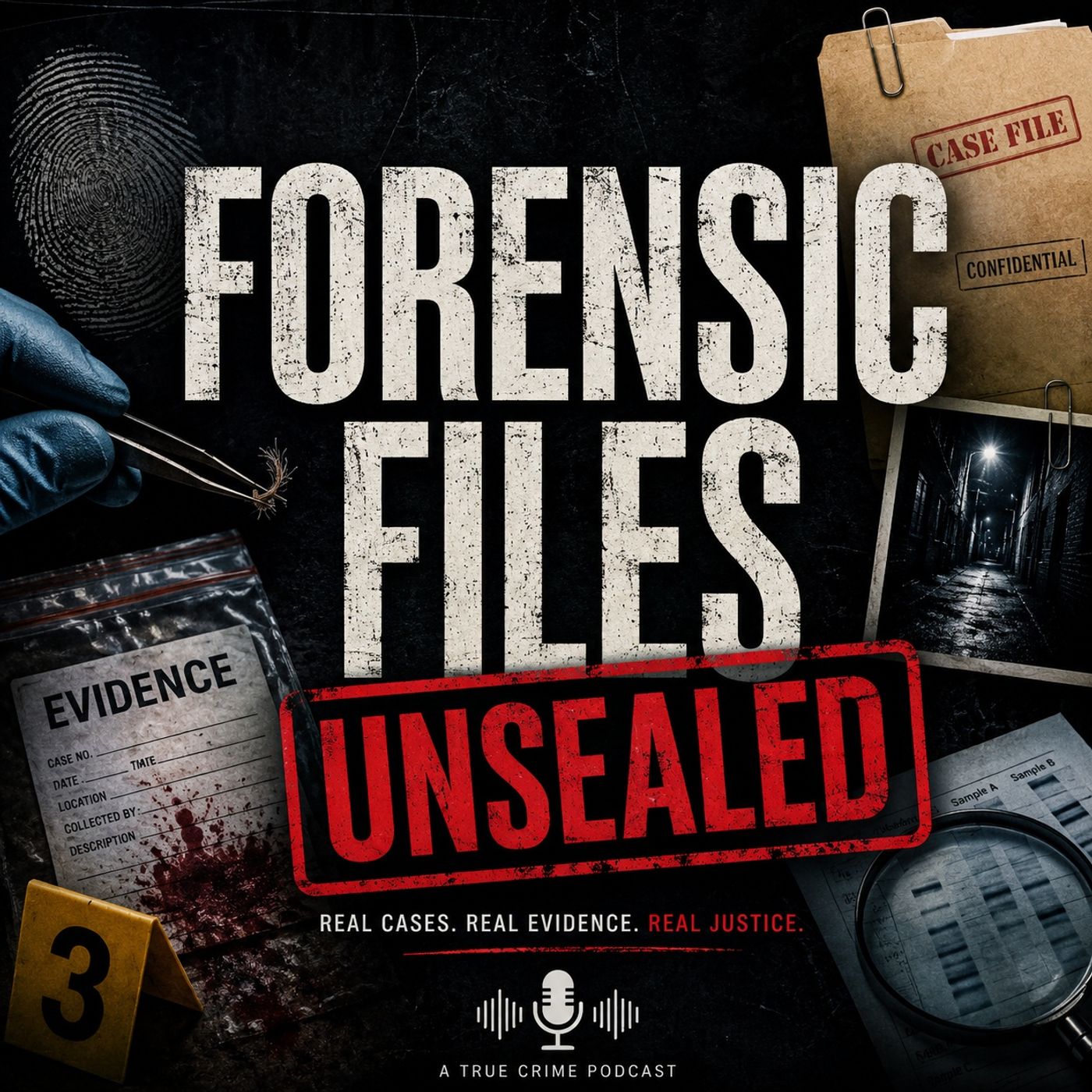
Forensic Files Unsealed
Hosted by AC Wilson · EN
Forensic Files Unsealed takes you beyond the original cases and into the deeper world of forensic investigation, hidden details, and unanswered questions behind real-life crimes. Each episode revisits compelling cases involving forensic science—from DNA breakthroughs and digital evidence to overlooked clues that changed everything. We go beyond the headlines and reenactments to explore what really happened, how investigators pieced together the truth, and what details often go unspoken in public case summaries. Whether it’s cold cases, courtroom revelations, or scientific breakthroughs, this podcast pulls back the curtain on the evidence that solves—or sometimes complicates—the story.
Disclaimer
Forensic Files Unsealed is an independent true crime podcast created for informational and educational purposes only. All cases discussed are based on publicly available records, news reports, court documents, and documented investigative material. This podcast does not claim to provide legal advice, nor does it assert the guilt or innocence of any individuals mentioned. Some interpretations are based on analysis and may include commentary or speculation intended to explore investigative possibilities, not to state definitive fact. All individuals are presumed innocent until proven guilty in a court of law. Listener discretion is advised, as this podcast may contain discussions of violence, death, and sensitive subject matter.
Disclaimer
Forensic Files Unsealed is an independent true crime podcast created for informational and educational purposes only. All cases discussed are based on publicly available records, news reports, court documents, and documented investigative material. This podcast does not claim to provide legal advice, nor does it assert the guilt or innocence of any individuals mentioned. Some interpretations are based on analysis and may include commentary or speculation intended to explore investigative possibilities, not to state definitive fact. All individuals are presumed innocent until proven guilty in a court of law. Listener discretion is advised, as this podcast may contain discussions of violence, death, and sensitive subject matter.
175episodes
Episodes
Newest firstAll episodes
DNA Helps Convict Attacker Nearly Two Decades Later
4d ago00:39:10Tap to summarizeAfter nearly twenty years, authorities in Mills County, Texas, utilized advanced forensic technology to solve a cold case involving a 2005 home invasion and attempted sexual assault. The breakthrough occurred when the Sexual Assault Kit Initiative funded a familial DNA search, which linked a drop of blood from the crime scene to a relative of the suspect in a national database. Law enforcement then used investigative genealogy to identify Jessie Rodriguez, whose DNA was subsequently confirmed to match the original evidence. Following his arrest and confession, Rodriguez received the maximum sentence of 20 years in prison. This resolution highlights the critical role of inter-agency collaboration and the long-term preservation of biological evidence in securing justice for victims. The case serves as a testament to how modern genetic science can overcome the limitations of traditional investigative methods over time.This episode includes AI-generated content.
Transcribe →Ex-Girlfriend’s Obsession Turns Deadly — The Story of Brenda Delgado
5d ago00:53:29Tap to summarizeThese transcripts from the Law&Crime Network recount two separate, high-profile criminal investigations involving obsession and betrayal. The first case details the capital murder of dentist Kendra Hatcher, a crime orchestrated by Brenda Delgado out of extreme jealousy toward her ex-boyfriend’s new partner. Following a period on the FBI’s Ten Most Wanted list and a flight to Mexico, Delgado was eventually captured and sentenced to life in prison. The second narrative explores the tragic disappearance and death of thirteen-year-old Dylan Redwine, who was killed by his father, Mark Redwine, during a court-ordered visit. Investigators linked the boy's death to a violent confrontation over compromising photographs found on the father's computer. Both accounts emphasize the relentless pursuit of justice by law enforcement and the grieving families who refused to let these cold cases remain unsolved.This episode includes AI-generated content.
Transcribe →The Cruise Ship Murder: New Evidence and DNA Twists
5d ago00:41:27Tap to summarizeUnsealed court documents have revealed significant updates in the case of Anna Keaptainner, a teenager found dead under a bed on a Carnival cruise ship. Investigators have charged her 16-year-old stepbrother, Timothy Hudson, with murder and sexual battery following the discovery of his DNA and damning surveillance footage. The video allegedly depicts Hudson blocking his younger brother from their shared cabin and later disposing of the victim's smashed cell phone in a trash bin. Despite the severity of the allegations, a judge has allowed the minor to remain in the custody of relatives while awaiting trial. The defense may leverage a newly identified DNA profile from another individual on the ship to create reasonable doubt. This tragic incident highlights the complexities of federal jurisdiction over crimes committed in international waters involving juveniles.This episode includes AI-generated content.
Transcribe →Forensic DNA Analysis and Facebook Records in Fields Trial
5d ago00:39:02Tap to summarizeThese trial excerpts focus on the presentation of forensic evidence and witness testimony regarding the treatment and death of Gabriel Barrett. A digital forensics expert details Facebook messages between defendants Brad Fields and Candice Diaz, which reveal discussions about the child’s bathroom habits and punitive measures. A DNA expert explains the testing protocols used to identify the victim's biological material on gloves and bedroom walls, linking the defendants to specific pieces of evidence. Finally, a preschool teacher provides a characterization of Gabriel, describing her as a happy and affectionate child who showed no signs of behavioral issues at school. This testimony highlights a visible bruise and neglected hair observed shortly before the child's death.This episode includes AI-generated content.
Transcribe →Drawn to Murder: The Wrongful Conviction of Tim Masters
6d ago00:42:33Tap to summarizeThe episode details the wrongful conviction and eventual exoneration of Tim Masters for the 1987 murder of Peggy Hetrick in Colorado. Investigators originally targeted Masters as a fifteen-year-old suspect based on his proximity to the crime and his collection of graphic, violent drawings, despite a total lack of physical evidence. After spending nearly a decade in prison, Masters was freed when a legal team uncovered withheld evidence and utilized advanced touch DNA testing in the Netherlands. These tests excluded Masters and instead identified the DNA of the victim's ex-boyfriend on her clothing, raising questions about the original investigation's integrity. The narrative highlights the obsessive focus of lead detectives and the tragic consequences of a justice system that ignored an alternate suspect—a local surgeon with a history of voyeuristic crimes. Ultimately, the sources chronicle a ten-year struggle for freedom that concluded with the vacation of Masters' life sentence in 2008.This episode includes AI-generated content.
Transcribe →The Bridge to Justice - The Murder of Shea Briar
6d ago00:46:00Tap to summarizeThis episode recounts the investigation into the premeditated murder of 31-year-old Shea Briar, who was found shot on a rural bridge in Indiana. Authorities discovered that his ex-fiancée, E.J. Stephen, orchestrated the killing to prevent Briar from obtaining custody rights to their young daughter. Assisted by two younger friends, Shelby Hiestand and Hannah Knapke, Stephen lured the victim to his death after a series of failed attempts to poison him. Through interrogations and cellphone records, detectives exposed a cold-blooded plot involving a daycare center and a test-fired rifle. Ultimately, all three women were convicted for their roles in the crime, receiving significant prison sentences for the betrayal.This episode includes AI-generated content.
Transcribe →The Devil’s Twin - The DeWild Murder Trial
6d ago00:47:32Tap to summarizeThis episode details the complex investigation into the 2003 murder of Heather DeWild, a Colorado mother killed during a contentious divorce. Prosecutors initially struggled to secure a conviction because her husband, Daniel DeWild, and his identical twin, David, methodically eliminated forensic evidence after watching crime dramas. The case remained cold for nearly a decade until David broke his silence, confessing to helping his brother lure Heather into a garage to be strangled. This breakthrough revealed that the twins conspired to kill her to avoid child support payments and used their shared DNA to complicate the investigation. Although the first trial resulted in a deadlocked jury, Daniel eventually pleaded guilty to second-degree murder to avoid a life sentence. Ultimately, the source highlights the emotional toll on Heather’s family and the persistence required to solve a crime committed by two people with the same genetic profile.This episode includes AI-generated content.
Transcribe →The Honey Trap Murder on Pito Mesa
6d ago00:47:09Tap to summarizeThis source details the premeditated murder of sixteen-year-old Jesus Quintana, whose body was discovered in a remote area of New Mexico. Investigations revealed a sinister conspiracy involving Mariana Gomez, who acted as a "honey trap" to lure the victim into the desert under the guise of a date. Once there, Quintana was ambushed and shot by two other teenagers, Dominique Marquez and Daniel Medrano, allegedly as retaliation for a previous dispute involving a firearm. The transcript includes police interrogations where the suspects attempted to deflect blame, with Medrano even claiming a mysterious fourth person was the actual shooter. Ultimately, the perpetrators were caught through GPS data and incriminating text messages that proved the killing was planned in advance. While the boys pleaded guilty to murder, Gomez was convicted of kidnapping and tampering with evidence, resulting in nearly two decades of imprisonment for her role in the tragedy.This episode includes AI-generated content.
Transcribe →The Fatal Ultrasound - The Murder of Kaylin Fiengo
6d ago00:42:01Tap to summarizeThis episode details the tragic murder of Kaylin Fiengo, an eighteen-year-old expectant mother found shot to death in her car in Sanford, Florida. Investigators quickly focused on Donovan Faison, the father of her unborn child, who reportedly pressured her to have an abortion to hide the pregnancy from his girlfriend. Although Faison initially provided a false alibi and claimed he had not spoken to the victim for months, incriminating text messages revealed he planned to "crop her out" after receiving an ultrasound photo. Following a lengthy investigation, he was arrested and charged with first-degree premeditated murder for the deaths of both Fiengo and her baby. The legal battle concluded in 2025 with a jury recommending the death penalty, resulting in a capital sentence for his crimes.This episode includes AI-generated content.
Transcribe →The Firefighter's Secret - The Murder of Melissa Lish
1w ago00:46:54Tap to summarizeThis source details the tragic murder of Melissa Lish, a twenty-seven-year-old expectant mother who was killed just two days before her due date in 2020. Investigators identified Matthew Ploy, a firefighter and the child's father, as the primary suspect after he attempted to stage a fatal house fire to conceal the strangulation. The episode outlines the investigation's focus on Ploy’s motive to keep the pregnancy a secret and the forensic evidence, such as DNA and a lack of smoke inhalation, that refuted his claims of an accidental cooking fire. Following a dramatic trial featuring testimony from his own fire chief, Ploy was convicted of first-degree murder, the homicide of an unborn child, and arson. He ultimately received a sentence of life imprisonment without the possibility of parole. The narrative concludes by highlighting the profound grief and resilience of the Lish family as they seek to honor the memories of Melissa and her son, Barrett.This episode includes AI-generated content.
Transcribe →