Podcast
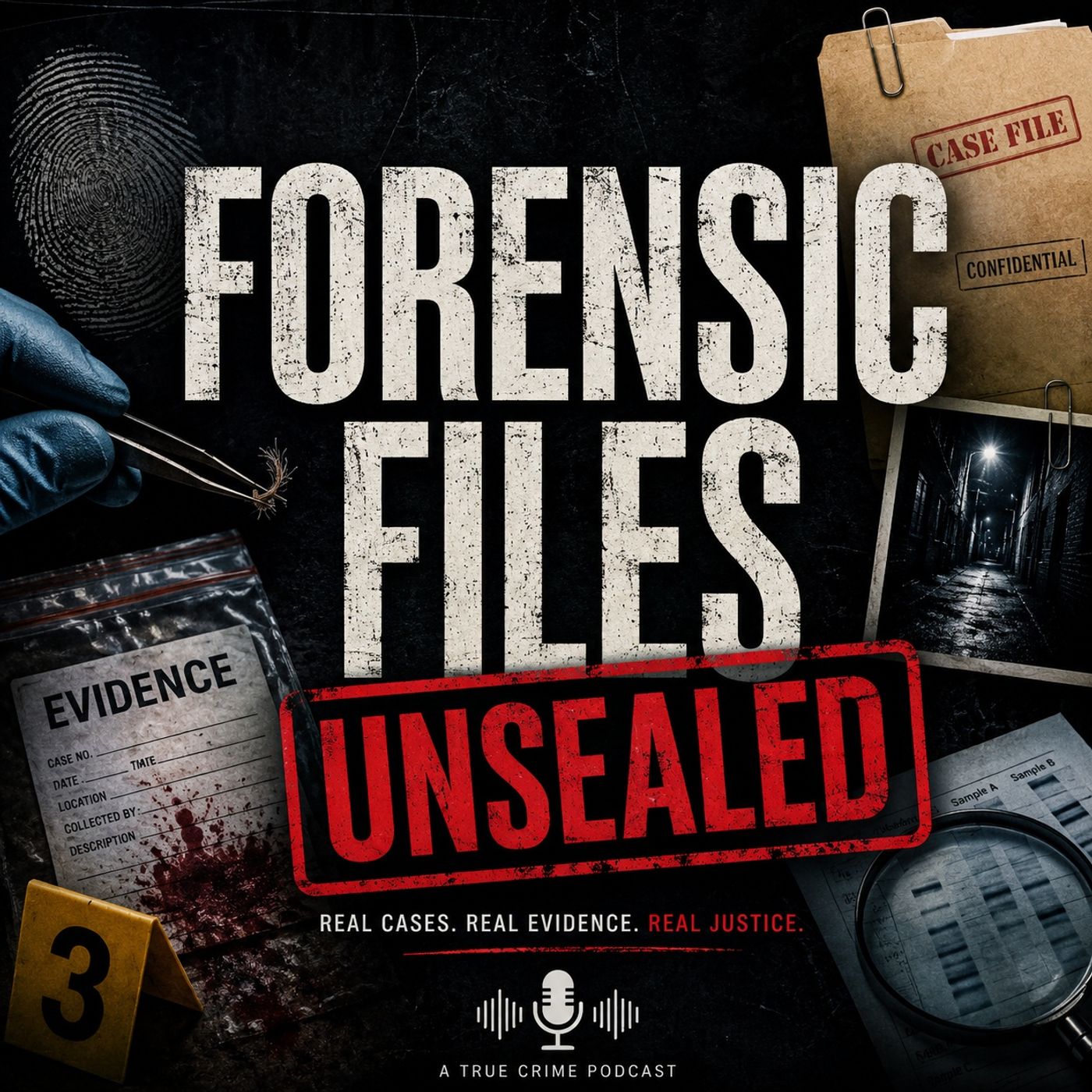
Forensic Files Unsealed
Hosted by AC Wilson · EN
Forensic Files Unsealed takes you beyond the original cases and into the deeper world of forensic investigation, hidden details, and unanswered questions behind real-life crimes. Each episode revisits compelling cases involving forensic science—from DNA breakthroughs and digital evidence to overlooked clues that changed everything. We go beyond the headlines and reenactments to explore what really happened, how investigators pieced together the truth, and what details often go unspoken in public case summaries. Whether it’s cold cases, courtroom revelations, or scientific breakthroughs, this podcast pulls back the curtain on the evidence that solves—or sometimes complicates—the story.
Disclaimer
Forensic Files Unsealed is an independent true crime podcast created for informational and educational purposes only. All cases discussed are based on publicly available records, news reports, court documents, and documented investigative material. This podcast does not claim to provide legal advice, nor does it assert the guilt or innocence of any individuals mentioned. Some interpretations are based on analysis and may include commentary or speculation intended to explore investigative possibilities, not to state definitive fact. All individuals are presumed innocent until proven guilty in a court of law. Listener discretion is advised, as this podcast may contain discussions of violence, death, and sensitive subject matter.
Disclaimer
Forensic Files Unsealed is an independent true crime podcast created for informational and educational purposes only. All cases discussed are based on publicly available records, news reports, court documents, and documented investigative material. This podcast does not claim to provide legal advice, nor does it assert the guilt or innocence of any individuals mentioned. Some interpretations are based on analysis and may include commentary or speculation intended to explore investigative possibilities, not to state definitive fact. All individuals are presumed innocent until proven guilty in a court of law. Listener discretion is advised, as this podcast may contain discussions of violence, death, and sensitive subject matter.
190episodes
Episodes
Newest firstAll episodes
The Pickaxe Massacre - Betrayal of the Ortiz Family
3w ago01:02:49Tap to summarizeThis source details the 2011 triple homicide of the Ortiz family in the small community of El Rancho, New Mexico. The victims, Lloyd, Dixie, and Stephen, were brutally murdered with a pickaxe on Father's Day by Nicholas Ortiz, a teenager they had previously supported and housed. Despite an initial lack of forensic evidence, the case was eventually solved after a witness in prison came forward with information about the killer's plan to rob the family. Following a mistrial, the perpetrator was found guilty of first-degree murder and other related charges. He received a concurrent sentence of 25 years, a decision that left the surviving family members feeling that true justice had not been served.This episode includes AI-generated content.
Transcribe →The Bodies of Dead Climbers on Everest Are Serving as Guidepost
3w ago00:41:10Tap to summarizeThe episode details how the frozen remains of deceased mountaineers on Mount Everest have become permanent navigational landmarks due to the extreme difficulties of high-altitude recovery. Because of the oxygen-depleted environment and immense logistical costs, over 200 bodies remain on the peak, often serving as grim guideposts for those navigating through disorientation or whiteout conditions. Famous cases like "Green Boots" and the area known as "Rainbow Valley" illustrate the intersection of human tragedy and practical mountain travel. These sources also examine the ethical dilemmas surrounding the presence of these bodies, especially as climate change and melting glaciers expose even more remains to the public eye. Ultimately, the episode highlights the perilous reality of the "death zone," where the thin line between success and mortality is marked by those who never returned.This episode includes AI-generated content.
Transcribe →Justice in the DNA: The Darlene Krashoc Case
3w ago00:39:44Tap to summarizeIn 1987, the brutal murder of Darlene Krashoc, a 20-year-old soldier stationed in Colorado, left investigators with a gruesome crime scene and few leads. Despite the preservation of physical evidence, including DNA and cigarette butts, the case remained unsolved for over three decades as the killer’s profile did not match any existing criminal databases. The investigation was eventually revitalized through forensic genetic genealogy, which allowed authorities to build a family tree that identified Michael Whyte as a primary suspect. After matching his DNA from a discarded cup to the 1987 evidence, police arrested the retired soldier at his home in 2019. In 2021, a jury found him guilty of murder, resulting in a life sentence without the possibility of parole. This case highlights how collaborative law enforcement efforts and modern scientific advancements can finally deliver justice for cold cases.This episode includes AI-generated content.
Transcribe →Cops Find Horrific Crime Scene While Investigating Another Murder
3w ago00:45:55Tap to summarizeThis episode chronicles the investigation and trial of Kevin Dean Eastman, who was convicted of murdering Scott Sessions and Heather Frank. The case began when a snowplow driver discovered the charred remains of Sessions, a talented musician, who had been lured to Frank’s apartment and brutally ambushed. Detectives eventually linked Eastman to the crime through surveillance footage and cell phone data, later discovering Frank’s body hidden on a rural property. Prosecutors argued the killings were driven by domestic violence and extreme jealousy, as Eastman sought to eliminate a romantic rival and the sole witness to his crime. Despite the defense's attempt to shift blame onto the victims, a jury found Eastman guilty on all counts. He was ultimately sentenced to life in prison without the possibility of parole for his violent actions.This episode includes AI-generated content.
Transcribe →Nolan Wells' Final Day - The Evidence That Raises New Questions
3w ago00:46:12Tap to summarizeThe episode details the mysterious circumstances surrounding the death of Nolan Wells, a young athlete who disappeared during a Fourth of July beach party on Mississippi’s Horn Island in 2026. While authorities initially suggested an accidental drowning, the narrative is complicated by a distress call from a sinking boat and the recovery of Wells’ cellphone, which appeared suspiciously cleared of recent media. The family, supported by high-profile activists and attorney Ben Crump, has raised concerns over conflicting witness accounts and potential gaps in the official investigation. A private, independent autopsy funded by Colin Kaepernick was unable to determine a definitive cause of death, leaving several questions regarding foul play unanswered. Currently, investigators are seeking additional digital evidence and public testimony to reconcile the discrepancies between the friends' reports and the family’s suspicions. This overview highlights a case defined by unresolved tension between official reports and a grieving family’s search for transparency.This episode includes AI-generated content.
Transcribe →The Pig Farmer Who Butchered 49 Women Like Livestock
3w ago00:53:13Tap to summarizeThis account details the horrific crimes of Robert Pictton, a Canadian pig farmer who murdered dozens of women and disposed of their remains on his property. The episode emphasizes how systemic failures and police negligence allowed Pictton to target vulnerable residents of Vancouver’s Downtown Eastside for years despite numerous warnings. Following a massive forensic investigation, he was convicted of six counts of second-degree murder, though he confessed to killing forty-nine victims. The narrative explores the devastating impact on the families of the victims and the subsequent public inquiries that exposed deep-seated institutional biases. Ultimately, the source reflects on the legacy of the case, which prompted national conversations regarding the safety of indigenous women and led to significant changes in Canadian law enforcement protocols. While Pictton died in prison following an inmate assault in 2024, the text serves as a somber reminder of those forsaken by society.This episode includes AI-generated content.
Transcribe →The Murder of 16-Year-Old Carol Sue Klaber
3w ago00:38:08Tap to summarizeThis episode explores the 1976 cold case murder of sixteen-year-old Carol Sue Klaber in Boone County, Kentucky. After the investigation stalled for over forty years, authorities utilized innovative genetic genealogy and the expertise of Othram Laboratories to analyze a hair sample from the crime scene. This forensic breakthrough identified Thomas Dunaway as the perpetrator, a man with a violent criminal history who had died in 1990. Investigators even exhumed his remains to secure a definitive DNA match and explore his potential links to other unsolved homicides. The narrative highlights how the persistence of law enforcement combined with cutting-edge science can finally provide answers for a victim's family. Ultimately, the source illustrates a significant victory for modern forensics in resolving decades-old violent crimes.This episode includes AI-generated content.
Transcribe →The Digital Trail of a Killer Marine
3w ago00:46:11Tap to summarizeThis source details a criminal interrogation of Willie Ellington, a U.S. Marine accused of murdering Tashe Bennett in Florida. Detectives systematically dismantle Ellington's attempts to protect his military reputation by revealing a massive digital trail, including GPS data, incriminating web searches, and DNA evidence. Despite the suspect's elaborate excuses regarding a Russian Telegram group, investigators present undeniable proof linking him to the victim’s death and the disposal of her body. The narrative highlights how Ellington’s own smartphone and smartwatch recorded his every movement and premeditated thoughts before the crime. Ultimately, the episode illustrates the contrast between the suspect's claims of military honor and the forensic reality that led to his first-degree murder charge. This overview emphasizes that while the suspect refused to confess, the digital evidence and public record laws ensured his actions would be fully exposed.This episode includes AI-generated content.
Transcribe →Family Viciously Murdered in Quiet Iowa Neighborhood
4w ago00:45:38Tap to summarizeThis source details a disturbing triple homicide that occurred in a quiet Iowa neighborhood, focusing on the investigation of the sole survivor, Alexander Jackson. While the young man initially reported a fictional home invasion involving a masked intruder, detectives quickly identified significant logical inconsistencies in his account. Key evidence, including forensic data from his phone and the unique difficulty of reloading the family’s rifle, pointed to a calculated inside attack rather than a random burglary. Authorities eventually concluded that the suspect staged his own injury after fatally shooting his parents and sister. Despite the defense's claims of a rushed investigation, a jury found him guilty on all counts. Ultimately, the case concluded with three consecutive life sentences, though a clear motive for the brutal slaughter of his own family remains a mystery.This episode includes AI-generated content.
Transcribe →D4vd's Tesla Had 11 Air Fresheners, Maggots, When Celeste Was Found
4w ago00:18:51Tap to summarizeThis episode details the harrowing criminal case against singer-songwriter David Anthony Burke, professionally known as D4vd, who is accused of murdering 14-year-old Celeste Rivas Hernandez. After the victim’s dismembered remains were discovered in the "frunk" of his abandoned Tesla, forensic evidence revealed an array of air fresheners and insect activity used to mask the scent of decay. Prosecutors allege the artist killed the minor to prevent her from exposing their illegal sexual relationship, which he feared would destroy his lucrative music career. The episode outlines a chilling timeline involving a premeditated cover-up, including the purchase of power tools and cleaning supplies, as well as the disposal of evidence in remote areas. While the defense challenges the forensic links and investigative procedures, the artist faces severe charges of first-degree murder and sexual abuse. Ultimately, the narrative contrasts the defendant's rise to stardom with the violent death of a young girl whose family continues to seek justice.This episode includes AI-generated content.
Transcribe →