Podcast
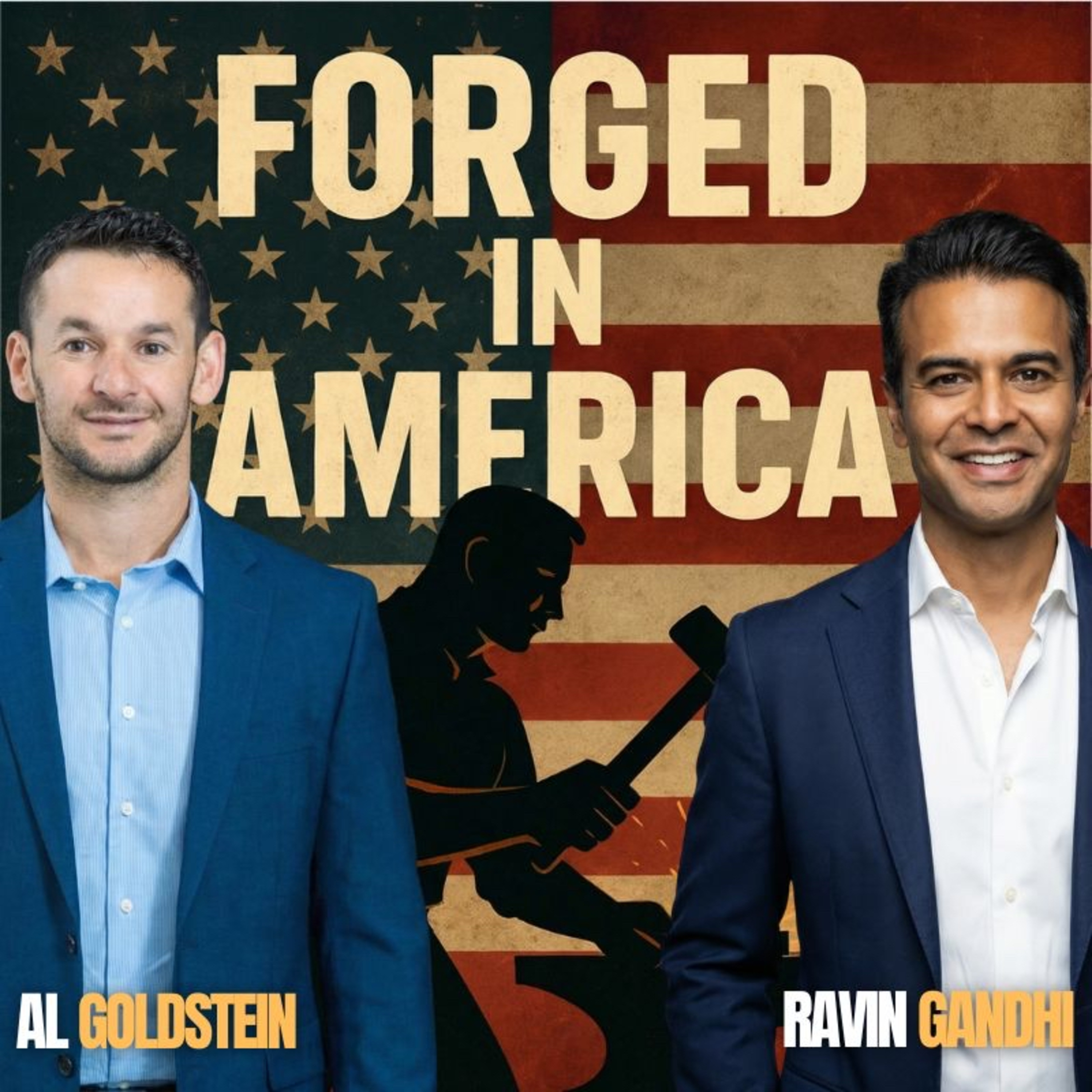
Forged in America
Hosted by Ravin Gandhi and Al Goldstein · EN
Forged in America is a conversation between longtime friends & entrepreneurs Ravin Gandhi (GMM Nonstick Coatings) and Al Goldstein (Avant, Stoic Lane, Pangea) who have founded, built, and exited numerous businesses in addition to investing in dozens of successful startups. This podcast is about how consequential decisions actually get made under pressure—across business, investing, and the institutions shaping the USA. We break down how capital gets allocated, how leaders think in moments of uncertainty, and where smart systems—markets, companies, or political movements—develop blind spots.
28episodes
Episodes
Newest firstAll episodes
E48: Brain Cancer, Alzheimer's, Parkinson's, Addiction, Psychedelics & Future of Medicine
2d ago00:53:07Tap to summarizeIn this episode of Forged in America, Ravin Gandhi and Al Goldstein sit down with Dr. JJ Desai—Stanford-trained physician, entrepreneur, and CEO of Lotus Neuro—to explore one of the most exciting frontiers in medicine: focused ultrasound and the future of brain science.The conversation begins with an emotional story of a Parkinson's patient whose life changed within minutes of treatment before expanding into the future of treating brain cancer, Alzheimer's disease, addiction, depression, and longevity.The discussion also tackles controversial topics including psychedelics, neuroplasticity, meditation, full-body MRI screening, IQ versus EQ, and whether precision medicine will fundamentally reshape healthcare over the next twenty years.How focused ultrasound works—and why it may replace certain brain surgeriesThe breakthrough treatment already helping Parkinson's patientsWhy glioblastoma remains one of medicine's greatest challengesOpening the blood-brain barrier without surgeryThe future of treating Alzheimer's and dementiaHow ultrasound may help fight addiction by interrupting brain circuitryThe latest science behind psychedelics, neuroplasticity, and mental healthMeditation, placebo effects, and emerging research on brain functionWhy "doing hard things" may be one of the best longevity interventionsThe importance of boredom, sleep, and nature for brain healthYamanaka factors and the race to reverse agingVO₂ Max, inflammation, and what actually extends lifespanThe debate over full-body MRI screeningIQ vs. EQ in the age of artificial intelligenceBooks everyone should read on resilience and personal growthThe biggest opportunities—and biggest risks—in the future of healthcareDr. JJ Desai is a Stanford-trained physician, entrepreneur, and CEO of Lotus Neuro. Throughout his career he has founded and led multiple healthcare companies that have collectively raised more than $1 billion in capital. His current work focuses on developing non-invasive focused ultrasound technologies designed to precisely target diseases of the brain without open surgery.Books referenced in this episode:The Comfort Crisis — Michael EasterThe Hard Thing About Hard Things — Ben HorowitzThe Boys in the Boat — Daniel James BrownChanging Your Mind — Michael PollanGrit — Angela DuckworthIf you enjoyed this conversation:Subscribe for new episodes every week.Leave a review—it helps more people discover the show.Share this episode with someone interested in neuroscience, longevity, healthcare, or the future of medicine.Follow Forged in AmericaX: @ForgedAmericaInstagram: @ForgedInAmericaPodcastYouTube: @ForgedInAmericaDisclaimer: The Forged in America podcast features personal stories, experiences, and opinions from hosts Al Goldstein and Ravin Gandhi. This content is for informational and entertainment purposes only and is not investment advice, financial advice, solicitation of investments, or any form of professional recommendation.We strive for accuracy, but mistakes can happen and are unintentional. Nothing discussed should be relied upon for making financial, business, or personal decisions. Always consult qualified professionals before acting on anything you hear.Past performance or results mentioned do not guarantee future outcomes. Listeners are responsible for their own choices.
Transcribe →E47: Dan Crenshaw On His Loss, Iran, Tucker & Misinformation
1w ago01:05:54Tap to summarizeDan Crenshaw is back on Forged In America—and this time, he has nothing to lose.After a stunning primary defeat that will bring his four terms in Congress to an end, the former Navy SEAL joins us for a wide-ranging and candid conversation about what happened, what he learned, and what comes next.Dan opens up about the misinformation and conspiracy theories he believes helped cost him his election, including allegations about his stock trading and personal conduct. We discuss whether politicians should be banned from trading individual stocks, why he surprisingly pushes back on some of the accusations against Nancy Pelosi, and whether serving in Congress is financially worth it.From there, we get into the biggest political and geopolitical questions facing America: the rise of democratic socialism, AOC and the future of the Democratic Party, the filibuster, the SAVE Act and proof-of-citizenship requirements for voting.Dan also weighs in on the changing politics surrounding Israel and antisemitism before giving his assessment of the escalating conflict with Iran. He explains why he believes America should respond disproportionately to Iranian aggression, whether Iran could ever become a functioning democracy, and the circumstances under which he could potentially support American boots on the ground.Then the conversation turns to Tucker Carlson.Dan doesn't hold back about Tucker's relationship with Qatar and Russia, the rise of conspiracy culture on the right, and why he believes the "woke right" and "woke left" are more similar than either side wants to admit.Finally, Dan reflects on losing an election, leaving Congress, making money in the private sector, and the stoic philosophy that allows him to move forward without bitterness.Dan Crenshaw served as a U.S. Navy SEAL before being elected to Congress in 2018, where he represents Texas and serves on committees focused on intelligence, energy and commerce. As his time in Washington approaches its end, this is Dan Crenshaw with fewer political constraints—and plenty to say.Disclaimer: The Forged in America podcast features personal stories, experiences, and opinions from hosts Al Goldstein and Ravin Gandhi. This content is for informational and entertainment purposes only and is not investment advice, financial advice, solicitation of investments, or any form of professional recommendation.We strive for accuracy, but mistakes can happen and are unintentional. Nothing discussed should be relied upon for making financial, business, or personal decisions. Always consult qualified professionals before acting on anything you hear.Past performance or results mentioned do not guarantee future outcomes. Listeners are responsible for their own choices.
Transcribe →E46: Pete Kadens Round 2--USA Debate Continues + Markets Debrief
2w ago01:05:33Tap to summarizePete Kadens is back for Round 2.After his first appearance on Forged in America sparked such a strong response, we brought Pete back to continue the debate—and this time, we go even deeper.Pete lays out his vision for what the Democratic Party should become: builders over bureaucrats, stakeholder capitalism over socialism, children over politics, and expanded opportunity without punishing success. Ravin's response? Pete might actually be a Republican.From there, the conversation gets heated as Ravin, Pete, and Al debate whether socialism is gaining real power inside the Democratic Party, whether MAGA has fundamentally transformed the Republican Party, and whether either side can still claim the moral high ground.They also tackle education, personal responsibility, broken families, policing, criminal justice, media bias, censorship, and why Americans increasingly disagree not just about solutions—but about the basic facts themselves.Then the conversation turns to business and the future: Pete explains why he's still bullish on cannabis, why he believes the stock market could be headed for a prolonged period of pain, and why he fears AI could create a dangerous combination of massive job displacement, abundant idle time, and a shortage of money.Ravin and Al push back, arguing that technological disruption has historically created more prosperity and opportunity—and that AI may prove to be an enhancer of human productivity rather than a replacement for human beings.Pete came back because the first conversation wasn't long enough.This one picks up right where we left off.Disclaimer: The Forged in America podcast features personal stories, experiences, and opinions from hosts Al Goldstein and Ravin Gandhi. This content is for informational and entertainment purposes only and is not investment advice, financial advice, solicitation of investments, or any form of professional recommendation.We strive for accuracy, but mistakes can happen and are unintentional. Nothing discussed should be relied upon for making financial, business, or personal decisions. Always consult qualified professionals before acting on anything you hear.Past performance or results mentioned do not guarantee future outcomes. Listeners are responsible for their own choices.
Transcribe →E45: A Top Surgeon on GLP-1s, Longevity, and Future of Medicine
3w ago00:51:31Tap to summarizeOrthopedic surgeon and entrepreneur Dr. Ben Domb joins Ravin Gandhi and Al Goldstein for a wide-ranging conversation on the future of medicine, AI, longevity, GLP-1s, robotics, healthcare innovation, and the psychology behind healing.The discussion explores where artificial intelligence will—and won't—replace physicians, why personalized medicine may finally become reality, and why one of America's leading surgeons believes the single biggest public health intervention isn't another drug... it's eliminating refined sugar.Along the way, the conversation dives into placebo effects, statins, cancer treatment, parenting, resilience, medical research, and what separates great doctors from merely good ones. Books every physician—and entrepreneur—should read:When Breath Becomes Air by Paul KalanithiThe Emperor of All Maladies by Siddhartha MukherjeeBeing Mortal by Atul GawandeHealing Back Pain by John E. SarnoBad Therapy by Abigail ShrierRange by David EpsteinThe Sports GeneUnbrokenSteve JobsThe 7 Habits of Highly Effective PeopleQuotes:"I'd bet Elon Musk one trillion dollars that robots won't replace surgeons in three years.""The placebo worked. Maybe we should learn how to harness it.""The biggest public health intervention I can imagine? Make refined sugar illegal.""Focus on what's in your power to improve your outcome.""Healthcare is still delivered to individuals—not populations."Dr. Ben Domb is one of the world's leading orthopedic surgeons and the founder of the American Hip Institute. A graduate of Princeton University and Johns Hopkins School of Medicine, he has published more than 500 scientific papers, pioneered advances in hip arthroscopy, and performed the first outpatient robotic hip replacement in the United States. He has treated elite athletes from the NBA, NFL, and around the world while remaining at the forefront of surgical innovation.Disclaimer: The Forged in America podcast features personal stories, experiences, and opinions from hosts Al Goldstein and Ravin Gandhi. This content is for informational and entertainment purposes only and is not investment advice, financial advice, solicitation of investments, or any form of professional recommendation.We strive for accuracy, but mistakes can happen and are unintentional. Nothing discussed should be relied upon for making financial, business, or personal decisions. Always consult qualified professionals before acting on anything you hear.Past performance or results mentioned do not guarantee future outcomes. Listeners are responsible for their own choices.
Transcribe →E44: Pete Kadens created $4B, 7,000 jobs, and wants to fix America
Jul 101:13:34Tap to summarizeEntrepreneur and philanthropist Pete Kadens joins Ravin Gandhi and Al Goldstein for one of the most candid political conversations we've had. A lifelong Democrat, Pete doesn't shy away from criticizing his own party, while also challenging conservatives on issues ranging from democracy and immigration to education, meritocracy, and the future of America.This isn't a shouting match—it's three longtime friends debating difficult issues with honesty, data, and mutual respect.Pete Kadens is a serial entrepreneur, investor, and philanthropist.He co-founded Green Thumb Industries, one of the largest publicly traded cannabis companies in the United States, and previously co-founded SoCore Energy, a leading commercial solar developer.Through Hope Chicago, Pete has helped thousands of students and families pursue higher education by funding college tuition and wraparound support services. The organization has committed more than $100 million toward expanding educational opportunity in Chicago.00:00 Introduction02:00 Is socialism taking over the Democratic Party?08:30 The biggest threats facing American democracy12:00 Personal responsibility vs. victimhood culture18:45 Can education fix America's biggest problems?25:00 What broke public education?33:00 Why college is losing its value41:30 Meritocracy, DEI, and affirmative action49:30 Immigration and America's border debate58:30 The Supreme Court and the future of conservatism1:02:00 Lightning Round1:07:00 Pete predicts the 2028 electionDisclaimer: The Forged in America podcast features personal stories, experiences, and opinions from hosts Al Goldstein and Ravin Gandhi. This content is for informational and entertainment purposes only and is not investment advice, financial advice, solicitation of investments, or any form of professional recommendation.We strive for accuracy, but mistakes can happen and are unintentional. Nothing discussed should be relied upon for making financial, business, or personal decisions. Always consult qualified professionals before acting on anything you hear.Past performance or results mentioned do not guarantee future outcomes. Listeners are responsible for their own choices.
Transcribe →E43: Morning Consult's $1B Founder on Why Entrepreneurship Is So Painful.
Jun 2400:37:24Tap to summarizeMichael Ramlet is the co-founder and CEO of Morning Consult, one of the world's leading decision-intelligence companies. What began with just $30,000 of angel capital has grown into a company generating more than $100 million in annual revenue, serving many of the world's largest corporations, financial institutions, and governments.In this episode of Forged in America, Michael sits down with Ravin Gandhi and Al Goldstein to discuss the realities of entrepreneurship, why most people shouldn't start a company, the future of AI-powered decision making, fundraising, political forecasting, and the lessons he's learned building a billion-dollar business over more than a decade:"The right decision for most people is don't start the business.""You have to have one or two co-founders. It is so exceedingly difficult to go that path alone.""Data doesn't replace leadership.""My biggest stress today is the same stress I had the day I started: Are we moving fast enough?""The success isn't raising the round. The success is what you do with the money."Michael Ramlet is the co-founder and CEO of Morning Consult, a global decision-intelligence company that provides real-time data and insights to major corporations, financial institutions, and governments. Under his leadership, Morning Consult has become one of the most influential data platforms in the world, tracking consumer sentiment, brands, economic trends, and geopolitical developments across dozens of countries.Disclaimer: The Forged in America podcast features personal stories, experiences, and opinions from hosts Al Goldstein and Ravin Gandhi. This content is for informational and entertainment purposes only and is not investment advice, financial advice, solicitation of investments, or any form of professional recommendation.We strive for accuracy, but mistakes can happen and are unintentional. Nothing discussed should be relied upon for making financial, business, or personal decisions. Always consult qualified professionals before acting on anything you hear.Past performance or results mentioned do not guarantee future outcomes. Listeners are responsible for their own choices.
Transcribe →E42: The Financial Guru to Billionaires On What's Coming Next
Jun 1700:47:51Tap to summarizeIn this episode of Forged in America, Ravin Gandhi and Al Goldstein sit down with Rob Skinner, Founder and Managing Partner of IEQ Capital, a wealth management firm overseeing more than $50 billion in assets.Rob has spent decades advising founders, entrepreneurs, and some of the most successful families in America. The conversation ranges from AI and SpaceX to wealth psychology, raising motivated children, and the biggest mistakes people make after a liquidity event. Some quotes from Rob:"Stock prices follow earnings.""Concentration builds wealth. Diversification protects it.""The game changes from offense to defense.""If inheritance accelerates purpose instead of replacing purpose, it can be a tremendous force for good.""You get one chance at being great."Rob Skinner is the Founder and Managing Partner of IEQ Capital, one of the fastest-growing independent wealth management firms in the United States. Prior to founding IEQ, he co-founded Luminous Capital, which was later acquired by First Republic Bank. He has spent his career advising entrepreneurs, founders, executives, and multi-generational families on investing, wealth preservation, tax strategy, and family legacy.NOTE: Rob Skinner, a co-founder of IEQ, appeared as a guest on this podcast, which is hosted by a client of IEQ, giving rise to an inherent conflict of interest by virtue of that client relationship. Neither Mr. Skinner nor IEQ provided or received any compensation or other consideration in connection with the appearance, which was made on a voluntary basis. The views expressed by Mr. Skinner are his own and those of IEQ and do not necessarily reflect those of the podcast host or its affiliates. Nothing in this appearance should be construed as investment, legal, tax, or other professional advice, or as any recommendation, offer, or solicitation.Disclaimer: The Forged in America podcast features personal stories, experiences, and opinions from hosts Al Goldstein and Ravin Gandhi. This content is for informational and entertainment purposes only and is not investment advice, financial advice, solicitation of investments, or any form of professional recommendation.We strive for accuracy, but mistakes can happen and are unintentional. Nothing discussed should be relied upon for making financial, business, or personal decisions. Always consult qualified professionals before acting on anything you hear.Past performance or results mentioned do not guarantee future outcomes. Listeners are responsible for their own choices.
Transcribe →E41: Victor Ciardelli - Angry Kid to $500B Mortgage Empire
Jun 1000:52:31Tap to summarizeIn this episode of Forged in America, Victor Ciardelli tells Ravin and Al didn't grow up looking like a future CEO.He describes himself as an angry kid with a chip on his shoulder, a problem with authority, and an unshakable belief that he was destined for something bigger. That mindset helped him survive near-bankruptcy, the dot-com crash, the 2008 financial crisis, COVID, and every challenge in between.Today, Victor is the founder and CEO of Rate, the third-largest mortgage lender in America. Over the last five years alone, the company has funded more than $500 billion in mortgages while remaining privately held.In this episode, Victor shares the mindset, mistakes, and principles that helped him build one of the largest financial services companies in the country.Disclaimer: The Forged in America podcast features personal stories, experiences, and opinions from hosts Al Goldstein and Ravin Gandhi. This content is for informational and entertainment purposes only and is not investment advice, financial advice, solicitation of investments, or any form of professional recommendation.We strive for accuracy, but mistakes can happen and are unintentional. Nothing discussed should be relied upon for making financial, business, or personal decisions. Always consult qualified professionals before acting on anything you hear.Past performance or results mentioned do not guarantee future outcomes. Listeners are responsible for their own choices.
Transcribe →E40: Mitchell Green's $9B and Why Persistence Beats Intelligence
Jun 300:52:36Tap to summarizeHow does a kid with ADD, average grades, and an obsession with persistence build one of the world's most unique growth equity firms?In Episode 40 of Forged in America, Ravin Gandhi and Al Goldstein sit down with Mitchell Green, founder of Lead Edge Capital, a $9B growth equity firm built on an unconventional idea: world-class entrepreneurs and executives can be more valuable than institutions.Mitchell explains how cold calling 10,000 companies shaped his philosophy, why persistence beats intelligence, why AI may reward EQ more than IQ, and why America still remains the greatest place in the world to build something meaningful.This episode explores entrepreneurship, AI, education, wealth inequality, persistence, investing, and what young people should do if they want to succeed in the next twenty years.00:00 Introduction to Mitchell Green and Lead Edge Capital03:15 Building a $9B firm with entrepreneurs instead of institutions08:45 Why persistence became Lead Edge's superpower14:10 The cold-calling lessons that shaped Mitchell's career19:45 What young people should do if they want to get rich22:00 Why trades, entrepreneurship, and sales skills matter more than ever24:30 Why AI may make EQ more valuable than IQ30:10 Wealth inequality, manufacturing, and why many Americans feel left behind36:20 Politics, opportunity, and preserving the American dream41:00 Lightning round: leverage, founder optimism, AI bubbles, and investing47:30 Why reading still matters in an AI world51:00 Cars, skiing, persistence, and living life fullyPersistence may be the single most underrated competitive advantageAI will likely reward communication, sales, and EQ more than raw intellectBuilding networks creates enormous compounding advantagesEntrepreneurship remains one of the best paths to opportunityMany economic frustrations in America are real—but solutions are complicatedYou do not need the perfect background to build something extraordinaryMitchell Green is the founder and managing partner of Lead Edge Capital, a growth equity firm with over $9 billion under management. Lead Edge has invested across software, internet, fintech, and consumer businesses using a unique network-driven investment model powered by hundreds of executives, founders, and operators.Disclaimer: The Forged in America podcast features personal stories, experiences, and opinions from hosts Al Goldstein and Ravin Gandhi. This content is for informational and entertainment purposes only and is not investment advice, financial advice, solicitation of investments, or any form of professional recommendation.We strive for accuracy, but mistakes can happen and are unintentional. Nothing discussed should be relied upon for making financial, business, or personal decisions. Always consult qualified professionals before acting on anything you hear.Past performance or results mentioned do not guarantee future outcomes. Listeners are responsible for their own choices.
Transcribe →E39: AI, Socialism & Ideas You’re Not Allowed To Question
May 2900:48:45Tap to summarizeThis week Ravin and Al tackle one of the most important—and uncomfortable—concepts shaping modern society: the idea of the Overton Window.Why do certain topics suddenly become impossible to discuss? Why do cultural norms seem to shift overnight? And what happens when institutions stop rewarding curiosity and start rewarding conformity?The conversation spans AI, economics, politics, media, culture, and technological disruption as Ravin and Al debate whether we are living through one of the fastest societal shifts in modern history.Topics include:• Why some AI leaders believe massive white-collar job destruction is coming—and why others think the future is far more optimistic• The OpenAI math breakthrough and what happens when machines start solving problems humans cannot solve themselves• Are companies genuinely replacing workers with AI—or simply blaming AI for overhiring?• Why productivity explosions historically create more opportunity rather than less• The rise of socialism, changing political coalitions, and whether America’s cultural center is moving• Media incentives, institutional trust, and why some stories dominate headlines while others disappear• The debate around “weaponized empathy” and whether good intentions can create bad outcomes• Affirmative action, meritocracy, and why younger generations increasingly disagree on basic facts• Why both hosts remain optimistic despite technological, political, and cultural volatilityDisclaimer: The Forged in America podcast features personal stories, experiences, and opinions from hosts Al Goldstein and Ravin Gandhi. This content is for informational and entertainment purposes only and is not investment advice, financial advice, solicitation of investments, or any form of professional recommendation.We strive for accuracy, but mistakes can happen and are unintentional. Nothing discussed should be relied upon for making financial, business, or personal decisions. Always consult qualified professionals before acting on anything you hear.Past performance or results mentioned do not guarantee future outcomes. Listeners are responsible for their own choices.
Transcribe →