← Free Thinking Through the Fourth Turning with Sasha Stone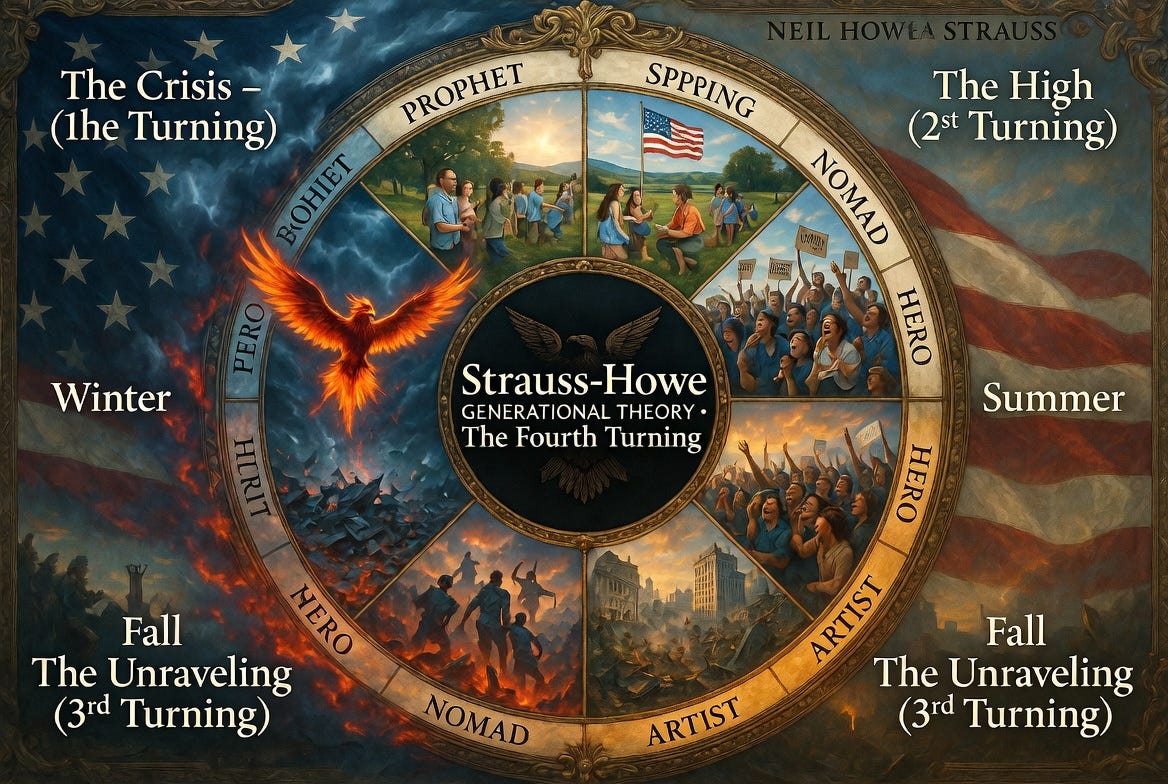
Free Thinking Through the Fourth Turning with Sasha Stone
A Fourth Turning Conversation with Andy Schaalman
01:52:57
Loading summary
Transcript109 lines
- [00:00]
A
Hi everyone. Welcome to the free thinking through the Fourth Turning. My name is Sasha Stone and I'm here with Andy Shaman, who runs the Generation report on YouTube. It's also on Substack and you can find the link in the post of this piece. And we are gathered again to talk about the Fourth Turning because we're living through a fourth Turning, which is why my substack is called the Fourth Turning. We both came to this concept separately in two different worlds. He's in the Millennial generation, which basically the generation that's going to shape American society for the next, or maybe global society for the next 20, 30 years. And I am Gen X. I'm Gen X, the lost generation. But you know, my generation does serve a role in that. We are critical thinkers and we're able to push back a little bit between these two, the boomers and the millennials, which are the main sort of generations that are shaping society. The Fourth Turning is the boomers are on their way out, the millennials are on their way in, and things are supposed to get really, really bad. Now, this is based on a 1997 book called the Fourth Turning by William H. Strauss and Neil Howe. William H. Strauss is no longer with us. Neil Howe is. He has Demography Unplugged podcast and he wrote an update to the Fourth Turning. The Fourth Turning is here. I do not recommend that one. I only recommend the first one because I think there were more clear eyed. They weren't listening to as much NPR and they didn't feel the need to sort of rewrite history because they don't like Donald Trump anyway. So we have a lot to talk about. We're going to talk about the shooting last or the almost shooting last night. The war in Iran is Trump the great champion. But first we're going to kick it off with Andy explaining both how he came to the Force turning and sort of the Cliff Notes version of it, the theory of it, and for new subscribers who might not know anything about it and why I call my site this and what it means. So. Hello, Hello, Andy. Go for it.
- [02:07]
B
All right, all right, I'll take it away again. So the, the, the nuts and bolts of it is that the Fourth Turning is a term. It's not just the title of a book. It's also a term associated with an idea. And that idea is basically history is cyclical and generational change has marked much of it and has much to do with why history changes the basic way that it does. So my, my first encounter with William Strauss and Neil Howe's ideas came, as many things do in life, by accident. When I was about 28, I was going through an interesting and transitory time in my life at the time. And I just happened to be stumbling upon a lot of content about how different generations were doing in the economy and how my generation in particular was, was struggling so conspicuously in the post Great Recession economy. And I stumbled onto a blog post about their ideas and I initially went, well, that just seems like a, like a very convenient way to retrofit history into one single idea and explaining generational differences a certain way and who's. Who's to say anyway, was kind of my initial reaction. But there were just a few things that they said at the outset that intrigued me enough to actually buy their, their book or to buy the Fourth Turning. And I eventually did. And when I did, and I read their explanation of how and why my generation, the Millennials, came into being and why we're so different from both Gen Xers, just older than us and our boomer parents, I immediately was hooked because I just said this is something that I've sensed since I was probably 7 years old. I went through environments as a kid where older kids being around and sort of dominating, certainly the main after school environment, where I went for a number of years where they were the norm. I come from a family with a lot of extra cousins, not nearly as many millennial cousins, and I always sense this difference and their explanation just made perfect sense to me. And so for those who may listening, wondering, this is not just true of millennials, of course it's true of all generations. Millennials are not simply a demographic block born over a span of 16 years that is assigned its place in history by certain technologies or certain events. We're actually an archetype of people that started being born at a very specific point in time and was born over a certain duration. And that's something we've actually talked about in the past. But that's how I came into the set of ideas. I ultimately decided to start producing a podcast, a video series podcast about the ideas and essentially updating the mostly theoretical framework of ideas to current events starting in 2019. And now here we are.
- [05:08]
A
Here we are. So if you could give. So what he means by the archetypes is that according to the Fourth Turning, as we move through time, it's cyclical, like the seasons, right?
- [05:21]
B
Yes.
- [05:21]
A
And so it depends on which generation is born into what specific era and whether or not they're able to meet the challenge of that era wouldn't you say yes.
- [05:31]
B
And it's also, I think this is very important for people to know. I think if they're Gen X as you are. One thing that's always driven me crazy about the way Generation X is talked about and also the silent generation, is that your two generations, because you're sort of the less endlessly profiled generations in recent memory. Very much unlike my generation and unlike boomers and unlike the World War II generation, is they talk about Gen Xers in the silent as though they're frozen in time. Like time was carbonite and they just stayed there. And people either in that after a certain point of time, you guys essentially stop being a generation with your, like, aged peers, because it's not the early 1990s anymore.
- [06:20]
A
Right?
- [06:21]
B
That's. That. That's been a conversation that's gone on or that's been a thread that's, I think, existed around Generation X for a long time. And I think it's just. It just paints a wildly inaccurate portrait of your life story. Like Barack Obama. Nobody knew who Barack Obama was outside of certain circles in Chicago and maybe in Cambridge, Massachusetts, in the early 90s, but he's the first Gen X president. And in the same way that Joe Biden was the one president from the silent generation, he didn't become president until 2021, you know, 70 years after people were talking about his generation being silent. So we had one boomer president, and
- [07:01]
A
that was Clinton, right?
- [07:03]
B
Oh, we've actually. We've actually had three boomer presidents. In 1946, we actually had three boomer presidents born within the space about 10 weeks of each other. Bill Clinton, George W. Bush, and Donald Trump.
- [07:16]
A
That's so funny. God, yeah.
- [07:19]
B
All after the vets came home from the war. So if you think demography and generational differences don't matter. Oh, they do.
- [07:26]
A
Yeah. Because you think of it like rough time. You know, that creates strong men, that thing. But, like, rough times creates parents who are invested in their children, the boomers. The 90s was kind of a despairing, rough, unraveling time, and it created the millennials, because parents like me decided to do better with our generation. But you need to move through these things, these generations, before you can get to the point where you're ready to launch the next sort of protected, coddled. Not really coddled so much. Andy and I have talked about how the younger millennials tend to be more coddled by helic. The older millennials weren't, but they were still. They were still given a better life than their, like, the way I grew up was like, no seatbelts, no parenting, you know, nobody really cared about kids. It was rough. And so we all grew up to want to do better with our generation. So we have the. I mean, it's interesting if you, if you read the book and you see how things move through, but Andy and I both thought that it would be interesting to sort of look as we live through the fourth turning, which we're doing now, and things are getting so crazy. And it's like what Neil Howe says In the book 1997 version is, you know, all seasons have to come, all winters, everything must die in winter to be born again. So we're in an everything must die phase. And to be born again, we just. The only. It's a cliffhanger because we don't know which way Western man. We don't know which way this thing's gonna fall. Neil Howe has predicted it falls, in my opinion, in the worst case scenario, although I have to get over that, I suppose, and accept reality. But this would be in the hands of the Barack Obama Zorhan Mamdani AOC version of America. And life is globalist collectivism, you know, near socialism, censorship, culture's dead. Or the Donald Trump version, which is looking less and less likely, like they're going to be able to hold on with so many forces working against them. Would you agree with that?
- [09:41]
B
I would absolutely agree because I've had many conversations with family members about what I think the fatal miscalculation that each side, if you want to distill it to just left versus right, which I know is not as relevant differentiation as it used to be. The mistake that the left makes when it gets in power, this is especially true I think, since the Clinton administration is that they always steer policy way to the left as soon as they get the reins of power. And that naturally brings out not just people on the right, or you might even say the hard right, but everybody who might have even a little bit of discomfort with the way they're governing. They go to the polls just as a natural reaction to the left overextending itself. The, the, the, the right has the opposite problem. The right believes every time they win, they can. First of all, they think they're going to keep winning forever.
- [10:49]
A
Right.
- [10:50]
B
Also think that just by talking sense to people and talking about how crazy the left is or how crazy the left can be, they win by default. And that's never the case. And I'm in my now home state of New Hampshire, I'm seeing all the time, every day, this foreboding sense that there's going to be significant gains by the left in the near future and what do we do about it? And the solution that a lot of people seem to keep coming back to is, well, we'll just try to talk more sense into people. And therefore, you know, they'll vote for the right people or they'll vote for us. And I'm looking at it from the perspective of no hope. That's not your strategy because it's not going to work.
- [11:40]
A
Yeah, and you were telling me how you were showing up and there was nobody at the meetings, nobody was involved, nobody cared. Nobody saw this as the five alarm fire that it is. There are the. And I come from the left, so I know. I know what it's like to be on the left. I know what it's like. They feel like they're fighting a war every single day to defeat the right. And they are serious, as we saw last night from the shooter. This guy who is very. Doesn't seem crazy. He's like Luigi Mangione, seems very sane, like Tyler Robinson. These guys are vigilante assassins who believe in justice against people whose Personas have been shaped by an unreliable narrator. The media. The media has been lying to the public. And this poor guy believed everything. And so he was ready to shoot members of the media because they showed up at a fascist gathering or a pedophile or whatever it is. He bought all their lies, and then he was going to shoot them because they were going to show up and not boycott. It's the saddest thing. And that's why when people saw Barack Obama with Donald Trump in the Oval Office, they were like, how can he sit down with a fascist? You know, sooner or later they were going to pick up a gun, man. And that's what's happening right now. And there's still no culpability on the left. And Andy and I had been talking for about a half hour on this podcast, which I had forgotten to press record. So to us, we're repeating a lot of the stuff we said before. But let me just pivot very quickly to Iran, because we want to make sure we hit the points that we need to hit, which is that for the first time, I think, in American history, two things are happening in war. One, we don't have a government censoring speech to protect the government. That's always the case in war, even 9, 11, and the war in Iraq. It started almost immediately, the censorship, and it was accepted by the public. But this is the first time where, because of Donald Trump and Elon Musk, we have freedom of speech. And we also have an American public, an establishment media, Democratic Party, and a lot of people on the right at war with the President as he's at war with Iran. And that's never happened. And that is terrifying to me because we were talking about how. I was listening to an interview with Neil Howe where he was saying, before World War II, the country was completely divided between the FDR, New Deal Democrats and the Hoover Republicans conservatives. But that the war brought everything together, everyone together, and it united the country. So years ago, I would think, yeah, we're gonna have a war in the Fourth Turning. Cause there's always a war, right? The Civil. The Revolutionary War, the Civil war, World War II. So what's gonna be our war? I always figured it would somehow have something to do with Russia, Iran and China as an alliance. I could never have predicted this, I have to say. So many people at war with the president while he's trying to fight off this enemy.
- [14:48]
B
Yeah, yeah. One thing we were saying before is that it was all our good stuff, that we was our good stuff. I'll do my best to bring it back, which is, you know, earlier I was listening to Franklin Roosevelt's for freedom speech in 1941, which I believe was given a little bit less than a year before Pearl Harbor. And it was amazing to hear him. And of course, as any skilled president and politician, especially of his archetype and history is Want to do, he framed everything in very clear, clarion, moral terms in a way that I'm sure not everybody listening completely agreed with. But nonetheless, it was interesting that it was an interesting way to compare that time or compare, say, Abraham Lincoln's time to the present, where just the fact that Donald Trump exists in the context that he does and is a president and a leader in this context by itself, I think illustrates the difference between this current Fourth Turning era in America and every single similar era in our past. Because there is nothing Donald Trump can say that can. That can frame everything in clear, clarion, moral terms that. That hundreds of millions of people can quickly agree on. Like that. That is just off the table. Now. It was interesting. We were talking about how the world wars in the. In the first half of the 20th century. It's. It's so interesting to think now about how, you know, for the last four years, and I. You see it out in California, I see it in. In New England, you know, there are still people who have a Ukraine flag on on the, the flag posts on the, on their front doorstep. If you go. If you go in certain places, especially in the more. The more liberal enclaves. And to me, that illustrates how there's long been this narrative about the world wars, which is that there was this clear purpose America had to go overseas and defend democracy, both in the abstract and in the tangible. And what the left, I think, fails to realize about itself is that when they're combining that narrative about, well, we have to fight for the great and good things in the abstract and for the great and good things in the real world and protecting people, sooner or later they can slip into just supporting wars or supporting military actions for intangible reasons or intangible causes. Very quickly they can move away from recognizing that the things that they support might actually be creating a lot more harm than good, or they may not have the good versus bad difference in their sights the way other people might necessarily see it. And so, yeah, there's a lot of problems today in the way. There's just a lot of baked in differences in the way people in America see everything now. But it's kind of been building to this for a long time.
- [18:22]
A
Yes. And the thing is that in the past, throughout my whole life, we had one media, we had one news, and we had a news that would work kind of with the government, maybe challenge them every so often. But if there was a war, the media would be on the side of the government. Obviously it was very controversial to go against the war in Iraq. I remember. And now it seems like it's the default to be against them because they're. The truth is, is that the fourth Turning War isn't just an international war, it's a civil war, because we've been fighting a Civil War since 2016. And that is very interesting to me because we're in uncharted territory. We're migrated online. We live in virtual worlds shaped largely by the millennials. That's their contribution to the American society already, is the Internet. And I think that what we built on the left in 2016. I'm sorry, in 2008, when Barack Obama took to Twitter and we began building this utopia online, I think we all thought that this was America. From now on, we're going to set the rules and everybody's going to follow them. They could never have predicted a Donald Trump to come along, master the Internet, blow through all their conventions and their rules, win a shocking election, and they had no choice but to take all their power and go to war on him and his supporters. This, the war, is what America. Will this be? Will this be an America that's aligned with Canada, Germany, France, Sweden, Europe, Right, Ukraine? Or will this be an America that's different? Whatever Donald Trump wants this America to be, people on the right see it differently than people on the left. But their war is against us. Their war is against dissent. Their war is against anything that goes against what they decided is the way America's gonna be. And most of the people that censor within the Biden administration, these crazy people, they're all millennials, right? And they believe. They're terrifying to me because they don't really believe in culture as I believe in it. They don't believe in art, they don't believe in comedy. Everything must be in support of the state. And. And they're fanatics. And the right is not prepared. They're just not prepared.
- [20:45]
B
Even. Even the ones who I've actually done some digging on, on this, like, some people like. Like Jen Psaki and Karine Jean Pierre, even if they're not technically millennials, I think in both cases, they're actually Xers born in the 70s. They're certainly millennials in spirit. I think we can certainly agree there. Which I think speaks to the fact that I think the latter wave of Gen X is the more conventional features, the more conventional people, the credential chasing, aspiring to careers in government, always believe they're on the right side of every issue, even if they just leap on it, like experts today. And when they go to sleep, they're an expert on Iran, they're an expert on China or whatever it is. That's a personality that was emerging even before my esteemed generation came along. You mentioned something about the monoculture, which reminds me of something I saw last week, which made me. Which, in all seriousness, really did make me think of you, which was somebody drummed up the famous, or infamous, depending upon your point of view. Oscar selfie from 2014 that Ellen DeGeneres took with all these movie stars in the background. And somebody made the point that that selfie was the end of the monoculture, which I. Which I did take to be. Oh, that was the end of Sasha's utopia. Yes, 12 years. And I was thinking back to sort of what 2014 was like right before Donald Trump came on the scene politically. And I was like, yeah, this is probably a lot of.
- [22:31]
A
I don't think it ever would have gotten that bad if, like, right around 2012 was when they decided to really go into overdrive with the schools indoctrinating in the Schools, we had Oscars. So white. Everything suddenly became about race and racism. And if you read Jacob Siegel's book, which I've urged you to read, I hope you pick it up. Do you have it?
- [22:52]
B
That one I do. That one I do still need to go.
- [22:55]
A
The information state. It explains it all perfectly and beautifully in a way that everybody should read. And he talks about these crazy millennials. That's. Although he doesn't do it within the Fourth Turning context. But these people he's talking about in his book are millennials. And they're going to reshape society per Barack Obama's dictates to try to tell people what to think, not how to think. And it was in. They called it a whole of society. That was even before Trump. So what Trump picked up on was, wait a second, this isn't. I don't want this to be the America that I. This isn't, you know, so we call. I call Trump and I think Andy does too. The fourth. The great champion of the fourth turning. Every 80 years there is at least one or a couple of great champions who rise up of the generate dominant generation and push back against them and say, not through me, succeed or fail. Trump seems to be that person. Who else would do the crazy things he has done? And we talked early in our last recorded the Lost episode about how only Trump could make the White House Correspondents Dinner and a must see event. And that was even before the shooting. Like, it was just the fact that he was going to go there and dress down the media and everybody wanted to see that. But then who could have figured? I keep getting surprised. Just when I think that I've seen everything on the left, I'm surprised again, all over again. Like how they immediately started saying it was staged and how they immediately started to pivot to their hate of Trump again with their saying, oh, he did this because of the ballroom. It's just bizarre. It's diseased in my mind. It's crazy that they are. They believe that we should all vote them back into power when they're that crazy. And they've taken up arms now, not as a group, but, you know, they don't push back on it too much. They just deny it, pretend it's not happening. They mocked Charlie Kirk AOC had to take time in Congress to called Charlie Kirk a racist, which. Which continues to justify the violence. They're turning Luigi Mangione into a hero. And Hassan Piker's out there celebrating. Is he a millennial or is he. Is he a gen Z. I think
- [25:20]
B
he's Gen Z. I must concede, I have not looked into what generation Hasan Piker belongs to. If I had to bet my life on it, he's a millennial. But I'd have to look at it. Yeah, most people, as soon as they really become famous, I instinctively just kind
- [25:35]
A
of, you know, put them in a category. Gen X, millennial, Boomer.
- [25:40]
B
I Google it. I Google it and I store the. The year they were born in memory, and that's usually the end of it. So, yeah, most. Most of the people we're talking about is the infamous millennials. They. They really are millennials. And their personalities I've recognized for a long time.
- [25:52]
A
Yeah. And the thing about them is on the left, I mean, I say the left, but I don't know how else to describe what it was that we built. I say utopia, but it's a. Whatever this new America, this shining woke Topia on the Hill, whatever they wanted it to be, that Trump disrupted, the fact that he beat them again in 2024, kicked them into a new level of hysteria and madness because they couldn't believe that America would not vote for them and they would vote for him. Where does it go from here? I mean, what a crazy fourth turning. You have a virtual civil war between two sides fighting it really. It's the left trying to destroy the right, basically. I don't know that the right is. Has the sort of unity and sense of collective sense of purpose to fight the left. Maybe they did in 2024.
- [26:42]
B
But, you know, you just brought up a point that. That I've been thinking to myself for a long time, which is one of the ways I believe that this set of ideas could really prove its value if it was understood universally or close to universally, is if people. And maybe I'm just. I'm just speculating here, but if people really understood what a fourth turning actually means and how high the stakes really are. And the entire right had this sense that, oh, if we lose in the next election cycle or two or three, we could lose the country forever.
- [27:28]
A
Forever.
- [27:29]
B
Yeah. I'm trying to remember what movie I'm doing a sort of binding forever. Is it A Christmas Story? I can't remember, but. But, yeah, for all time. You know, we will never have a Constitution. We will never have a constitutional republic in which individuals have, you know, the civil liberties, rights and freedoms spelled out for them in the document over two centuries ago. Everything will be repurposed for political and serving the political class and the Democratic Party and the cultural left and it will. It will just be in place for the rest of everybody's natural life. And we will effectively, effectively be living in a tyranny in America. We will not be a free country anymore. That is. That is what the left is pushing toward.
- [28:17]
A
Absolutely. Where we were almost there during the Biden administration. And the thing is, is what they're seeing with Trump because of the way the media distorts what he's doing, the lies about ICE and the mass deportations, when they call him a fascist, a Nazi, a pedophile, they have gone as far as you can possibly go, dehumanizing him to the point where some people three times have now tried to assassinate him.
- [28:42]
B
That we know about. Three. That we know about.
- [28:44]
A
Three that we know about. There's also. Iran was trying to assassinate him. But because of that, they now believe, and you can hear them say it, that there is no guardrails anymore. There are no guardrails. They're gonna do everything now to take back power. And they. I mean, I will not be shocked if they just start randomly putting people in prison. They'll censor the Internet 100%. They'll probably ban Tucker Carlson, Candace Owens. All these people will get banned off of YouTube because big tech will just chase the administration. They're not beholden to Donald Trump or the right. They are. They want, you know, to. To be friendly with the administration, to get their regulations or whatever it is that they want. But you can bet with AI man for that alone, for who will control AI? The right should be fighting so hard to stop them, because AI is going to take over everything. It already almost has. And I love AI because I'm a crazy early adopter, and I've been having these long AI Claude. AI designed all these different little programs for me for my website. I have these deep conversations with AI about history, and I try. I do all of them. I do the Google one. I do Grok, you know, can you tell me a little bit more about that time Hitler stopped talking about the Jews in his speeches? You know, and I get this lengthy. It's like any question I want, I can get. Who is going to be in control of that? It's not going to be free if it gets in the hands of the Democrats. It's terrifying to me. And as a person who grew up watching movies and loving the greatest American culture had to offer through the 70s, I am so sad that it's all gonna go away because it'll be turned into the same shit that they're putting out now. I Don't know where we go. If they have complete control of the Internet, complete control of AI, they pack the Supreme Court, they add puerto Rico and D.C. as states. Terrifying.
- [30:48]
B
You know, absolutely. That seems to be a good opening to talk about what the, the basics of the turnings are.
- [30:55]
A
Did we not get to that? I forget.
- [30:59]
B
I think it was, I think it was in the pre recorded portion.
- [31:01]
A
I know I can't remember what we said and what we didn't say by
- [31:04]
B
now, but I'll just bust through them quickly. So, so this book that we're talking about, the Fourth Turning 7 version, it's also, it's also a phrase, it's an idea. And, and, and fundamental to that idea is the notion that history is cyclical and that generational change marks that cycle and to a great extent drives it. So the current, long cycle, long era in American history we are presently living through today. It, it began with the demobilization after World War II. And in that particular, at that particular point in time, America was in what these authors, Strauss and how call a first turning. And this is sort of like history's spring, the first of four phases, first of four seasons, 1950s, that's right. And there's a lot of support and consolidation behind established institutions, new, strong institutions, traditions, strong families. There's a lot of conformity in the culture. Outsiders are in various ways ostracized or let know that they're outside the mainstream. And being outside the mainstream during a first turning in history is not only disadvantageous, but it's often dangerous. And essentially the era that America passed through, from the demobilization after World War II through the assassination of President Kennedy, had all the characteristics of what Strauss and how call a first turning, which again, all of these phases in history, they don't come with all positive qualities or all negative ones. They come with a mix. But they're all essentially essential eras for reflecting how societies change and travel the forces that they do. So again, 1946 to 1963, America was in a first turning. America was in a second turning from the beginning of what you might call the American cultural revolution or social revolution of the middle of the 1960s through the early Reagan years. And this was a period when American culture was totally remade from top to bottom right. Our social values, what we think of ourselves, the lifestyles that people live, the way men and women related to one another, everything about our internal life as a country, and the way people and the way individuals and groups express themselves and celebrated their own unique identities separate from the national Identity. This is a characteristic of America's years from the middle 60s through the early 80s, and this is characteristic of many other such eras in America's past and in other societies, which is why Strauss and Howe give them, you know, give them this overarching name, their second turnings. And those are the summers of history. Third turning eras, which is what America passed through from the middle 1980s through about 2007, 2008, are the eras when all of this social and cultural change that happens in second turnings becomes enshrined and then splinters. And so what society essentially becomes during these eras is it's almost like everybody for themselves, which is something that you well remember, Sasha, from your early days, making a living on the Internet, which is something that would have been considered impossible, not just as a practical matter in prior eras like the 1970s or the 1950s, but it was actually. I don't want to put words in your mouth, but I sense from the conversations we had, it was very appealing to the opportunities that you had and what you wanted for yourself at the time. You were. You were making your way in the early days of the Internet, which is true, I think, of a lot of the people who were making their names on the Internet in the early days. It was this kind of fun, new, exciting frontier. It was kind of like the wild, wild west, but it was something where you could make your mark and, you know, plant your flag someplace that you wanted on your own, and nobody else could sort of interfere with the path that you were charting. And that that sort of mindset is very much something that has coursed through similar kinds of eras in America's past, where. Where, again, it is very much individuals staking it out on their own, free of institutional constraints or free of. Of constraints of most kinds, quite frankly. And the one thing that tends to be true of third turning eras in history is this sense born of all this, this combination of chaos and fun, this particular combination of chaos and fundamentals. But hyper individuation is the sense of boundless possibility. I can almost be anything. The sky is the limit. I think back to when I was in high school in the early 2000s, and how many classrooms had the sky is the limit posters on the wall. I don't feel like that's a phrase that's nearly as much in evidence now as it was when I was younger. But the sense of individual possibility being unrestrained or unconstrained is something that also tends to go in hand in hand with the belief that there's really Never going to be a great crisis in the public world again. There's never going to be any insistent demand for collective unity. And so you just go off and do what you want to do on your own. It's everybody for themselves. These are third turnings in history. Problem is that third turnings of history always get to a point where the individuation starts sowing the seeds of worry and often income inequality and social atomization and just it eventually crosses a threshold where it's no longer seen as nearly as cheerful and optimistic. And this is when society crosses into eras that Strauss and Howe call fourth turnings. Yeah, and fourth turnings is what we're living through today.
- [37:11]
A
Just before we get to that, let me just say what was happening at the end of the last millennium and into the early. You had 1999, you had Columbine, 2001, you had 9 11, then the Patriot act and the war, and you're talking about serious unraveling. So that sets us up for the crisis that sparks the fourth turning.
- [37:38]
B
That's right. And I just want to add one quick point on Columbine quickly, which is that I have maintained for years to anybody who would listen that while 911 was just a national tragedy so enormous it's hard to even fathom all these years later, the event that had the bigger influence on my generation specifically was Columbine.
- [38:03]
A
Yeah, people don't talk about it enough. They really don't.
- [38:06]
B
They don't. It's.
- [38:07]
A
It's the beginning of.
- [38:09]
B
Yeah, that that sort of event was considered so impossible before that shooting at Columbine High School happened that if, if you're 30 years old today and you don't remember Columbine, which was, let's face it, today's 30 year olds don't remember it. It's really hard to. It's really hard to relate to how enormous an event that was, but that was just huge. I was in seventh grade at the time and it rocked everybody.
- [38:42]
A
But it also set us up for helicopter parenting. My daughter was only three when they. When 911 happened, she didn't remember Columbine. But these mounting fears taking us into the 2008, the crisis, that's when people like me started keeping our kids indoors and more of them got online. And so as you look your utopias, you know, it's all prepared because people are. The more online people get, the more power the left had. So as all institutions migrated online as they did after, because in 2000 nobody wanted to go on the Internet, I was a Freak. But as I watched it, you know, as the years wore on, every single educational institution, every media outlet, every company, every corporation, everybody had to have an online presence. And you imagine the left controlled all of it. So Barack Obama came exactly at the right place and the right time in 2008. So you continue that. That's. That's the year 2008. That's the year.
- [39:47]
B
Yep, yep. The. And the big thing with how Strauss and Howe described fourth turnings in history that people need to know in the theoretical sense, is that they said 30 years ago that Fourth Turning eras, such as the one we're living in now, are the eras when social trust hits a low ebb and then rebounds into something new. Social institutions break down and then are rebuilt into something new. The whole public face of society is essentially deconstructed and reconstructed and made into something totally new during these eras in history. Because what fourth turnings ultimately represent is the end of the old public order and the. And the seeds being planted of whatever is coming that's new. And this doesn't just take on a domestic social institution or economic or political dimension. It also very much takes on a world dimension because for reasons we don't really need to get into here, but I think people can understand, many of the world's most powerful countries have been aligned in having their fourth turning eras at the same time for centuries now. You can actually go back to at least as far back as the 18th century and. And see that that lines up. But which is. Which is why World War II was a Fourth Turning event. You go back to the 1860s, and, you know, even as a history buff, I must admit that I'm a little bit embarrassed to have only just recently come around to understanding how many countries had a stake in the. In the outcome of the American Civil war in the 1860s, and the same with the American Revolution in the 1770s and 80s. During these eras, the whole public face of everything completely changes. And as part of that, values disagreements that, especially ones that have persisted for a long time prior to such a public crisis, they come to a head and they either have to be resolved by the disagreements being put on the shelf in service to meeting an urgent public need, or there's a clash. And what today we're seeing in America in other countries too, but we're focusing on America here today. We're seeing a clash between what has classically been thought of as the left versus the right, which is now really the establishment versus the people aligned against the establishment right. And it's no guarantee, given everything that's going on. And we'll. We'll get into the, the war in Iran next. It's no guarantee, given everything that's going on, that the establishment will be able to be countered in time to. I believe this. I believe you do. To preserve America as we've known it for the rest of the 21st century. And that's. That's a scary thing. The thing that's so consequential about these conversations that you and I are having, and I hope there are others out there, but I've met, I've encountered very few of them, is that there aren't many people willing to push back against this sense of that Neil Howe has been putting out for a long time that, well, no matter how bad things get during this era, during this fourth turning in America, when it's over, there will be a reset and we'll just start a new. I don't believe that I, to the extent that I ever believed it. I shook it off a long time ago, before I even started my podcast, talking about these ideas. And I believe you have as well. And that's the basis for.
- [43:53]
A
Well, and if you look at, if you look at the end of other fourth turnings, they might have ended a certain thing, but they started a new thing. Like the end of the Civil War would lead to Jim Crow first, you know, and then take us to civil rights. The end of the war, World War II was the Cold War, and that kicked America into a whole new sort of frenzy of paranoia. So it's never that it's all settled, but that's how he puts it. He puts it, the treaties are signed. I think he looks at Lincoln and the end of the Civil War, but it really is just a way to settle an argument, but it doesn't solve all the problems. We are at an existential point right now, a really dangerous moment in history where we have the people who control everything either believing in a mass delusion or pretending to believe it. Right? They just want their power back. And where they're willing to go all the way to Trump as a pedophile after it was Trump is Hitler. Trump is a fascist. Trump is a dictator that they're running. Trump is a king. No kings. So, you know, in my upcoming podcast, Hitler, if Hitler had a podcast, I talk about, like, how Hitler would love this time because he's no longer a fascist, he's no longer a dictator, because what are those words even mean now? So they are in total war mode on the left. Total war and we've talked about exactly what they plan to do. I don't know if we did it in this time or in the last one, but they are, they are emboldened because of how Trump has governed in his second term. They, Trump was feeling the same way. Like, they're not going to stop me. I'm going to do whatever I want. And that has given them permission to do all of the things, all of the terrible things and take complete control. If I was leader of the right, I would be saying, like a general get up and fight. Don't hand your country over to these people. I thought that 2024, it would have snapped them out of it. They would have said, okay, we really screwed up. Now we gotta redo, rethink ourselves and rebuild. That's not what happened. They doubled down on this oppression complex that somehow Trump marched in with his troops and took over the country and is occupying it as opposed to. They just lost an election because they're lame. You work in politics. I don't think that anybody can make an argument that these Democrats that are running are actually visionaries or people other than Mamdani, maybe, or Platner. But in general, it's this, what are we gonna do about Trump? That's consumed the party. And as you point out in your meetings in New Hampshire, the Republicans are just shrugging it off. Not my business. I won't stick my neck out. Americans won't vote for them. Oh, yes, they will, because these people are fanatics. And it, you know, it is scary. But I'm sorry I derailed the conversation.
- [47:01]
B
No, no, that's perfectly fine. I've only had a few opportunities with people who really know me well to, to get into a conversation, however detailed, about the people who, in my estimation, really drove me out of Massachusetts. I'll, I'll speak in generalities here because it's just, you know, it just touches on a lot of, a lot of nerves for me. But, you know, I, when you. The interesting thing about moving to New Hampshire is when you do, you get a lot of, a lot of congratulations and a lot of atta boys from people who are just, hey, you finally seen the light. Hey, great, yeah, live for your D. And the truth is, I'd had my, my eyes on moving to New Hampshire for several years for personal reasons, not political reasons. And I've always thought of the, the area in New Hampshire where I live now is the second home anyway. And so, so coming here now, it's just, is just a fulfillment of that, of that aspiration I had for myself, but in terms of, in terms of the kind of people who have taken over, not just Massachusetts, but you've seen this happen in California. It's happened in so many other places that are, that are hubs of the globalized white collar professional managerial jobs and the institutions of higher education, the most prestigious ones especially, and just in general, the places that are most closely connected to the global economy and to sort of the multicultural, you can't even call it a melting pot, but the multicultural centers of the United States. What all these places have in common is that they, they believe that they've transcended the past. And within all of those pockets in those places, there's a particular element of people that now predominates who are the professional managerial segment that really determines who gets opportunities and who doesn't. And I learned through very aggravating and eye opening set of experiences spanning several years that starting during the first Trump term and spanning into the Joe Biden years, that entire segment of the population in Massachusetts became liberal, became not just left leaning, but intolerant of people with other views.
- [49:33]
A
Oh boy.
- [49:33]
B
And I, I eventually decided in late 2022, I can, I can pinpoint exactly I was, I was having a conversation with, I won't give the person's name, but I'll give their association. We talked about before. Neil HOUSE FORMER BUSINESS PARTNER I was in contact with him about some things that I just, I, I felt like it would be beneficial to him to know who I was and, and that I could help out him and his clients if there was ever an opportunity for us to work together. I could tell we had some political differences. I didn't care about them because I knew we were in the same domain of ideas and he wanted nothing to do with me. But in all fairness, he was the rule, not the exception. And I was having many other such similar exchanges with people where I finally said I'm not having my lot in life and where I want to go and how I want to live and the person I want to be tied to. Whether or not these people recognize, you know, the value of what I've produced and you know, I'm not buying into their, their, their, their veneer of pretense that they're, they're totally open minded about things cultural, political, they're not. That segment of people has become, in my honest, just from things that I've picked up other places, they've become a totally oppressive force, in my opinion, throughout the blue pockets of America. And it's driving People like myself who, you know, I didn't start out what I thought of as the most political person. They. They drove me somewhere else because I just felt like I had no other choice.
- [51:16]
A
Yeah. And I. Even before 2020, when I left the Democratic Party, I was already the target of so many different swarms. I was called a bigot, a white supremacist, a homophobe, a racist, even when I was a Democrat, because I am Gen X. So I say what I think, and I'm honest, but that's not what they want. They want total compliance. They're totalitarians, is what they are, and it's terrifying. And that's why I'm such a Trump supporter, because, yes, I think he's the great champion. Yes, he's standing up to forces that are trying to destroy him every single day. Not even just assassinations, but the press works. They're at war with him every single day. And so, just to go back to the fourth turning, so 2008 is such a weird year because it's what Neil Howe calls the crisis that sparked the Fourth Turning. Because of the Wall street meltdown and subsequent bailout, which led to Occupy Wall street, which led to Bernie Sanders and led to the Tea Party, which led to Trump and maga. That's one way of looking at it. Another way of looking at it is the rise of Barack Obama, the start of Facebook and Twitter and the iPhone, and how everything was about to really change. The Internet, before social media was very different. You didn't have a way of. It wasn't a Panopticon. It wasn't mass surveillance. It wasn't people saying, oh, so and so liked so and so's post or, I saw you posted this. You know, we've built our own Big Brother, our own surveillance state. That's what's so dangerous about the left taking powers, because they do not believe anybody who's not like them even has a right to participate. And when they take back power, which they probably will, they will censor the Internet. They'll do everything. They'll take control of AI anyway, so 2008 is when we have our as what Neil Howe calls, and he's right about this, the crisis that sparks the Fourth Turning. So then what happens? Tell us what happens after that, 2008, because here we are. How many years later? I don't know how Neil Howe and William H. Strauss could have figured out that it would start in 2008, and then they would get pretty close to, like, 2022. Neil Howe has extended it now to 2030, but. Right.
- [53:38]
B
He keeps moving the goalposts. The thing that's so important to emphasize about, about the timing and the way the Strauss now predicted this is, is they, they, they laid this out in, in their, in their collaborations, including in the Fourth Turning, as well as in some other books prior to that. But what, what they essentially said was that by the second half of the 2000s decade, the, the four part cycle, first, second, third, fourth turnings that they talked about, but in particular this phase of history they call the Third Turning that we reviewed a few minutes ago, that sooner or later the forces of individuation were going to reach a point based upon the timing of generational change in the late 2000s that would usher in a Fourth Turning era and a Fourth Turning move. Just as importantly, regardless of what the specific spark was or sparks were, what eventually happened was there was this incredible financial contraction. At the same time this incredibly charismatic new public political figure, even Savior, came on the scene. And it really did completely reframe the country's approach and outlook on politics in a very short period of time. I was graduating from high school. High school, yeah, right. I was from college as Barack Obama was being anointed with savior status. And it was something to behold. It was really amazing. And it's part of the, part of what establishes me as an elder millennial is my first two, three years in college, the political activity on campus was pretty much confined to people in the College Democrats and College Republicans clubs. And if you weren't part of one of those clubs, but you knew somebody who was in the club or you had, you were like two ways removed from somebody who was the club president is you would get besieged by them to join. And in my particular case, I kept saying, no thanks, no thanks. But that was pretty much the extent of the campus political activity my first three years when I was there. And it was becoming more of a, of a, of a presence. But there wasn't the mania that hit by the time the times of Woke Topia hit in the, in the 2010s that we've talked about. But Barack Obama coming on the scene was, in my opinion, I think in the opinions of a lot of people my age, the first big development in making that a part of everybody's life from that point on.
- [56:33]
A
Absolutely. Probably before Trump obviously the most influential figure in global politics and culture, because if you read Jacob Siegel's the Information State, you'll see how he talks about how people in Europe were picking up on things like black lives Matter and all of our causes and they're like minded with the oppressor, oppressed. It's spread throughout the world and that, you know, there's always a war in the fourth turning. There's the Revolutionary War, the Civil War, the World War II, and whatever this one's gonna be. We thought it would be, I thought it would be, I've written about this, that it would be Iran, Russia and China. And after Joe Biden's botched exit from Afghanistan, it showed that America had a weak leadership at the top. So Russia invaded Ukraine, Hamas attacked Israel, and now we've got two wars. So Trump won. And he said, I'm going to make it my mission to stop these wars. And he stopped a bunch of them. He tried to stop the war in Gaza, freed the hostages, but it wasn't stopped because it continued, the terrorism continued. So that's how he got himself embroiled here in this. We talked a lot about Iran in our last one. We're gonna have to try to reconstruct it. But to just start with, this is probably our big war, but I think our civil war, our virtual civil war against the left is the other big fourth turning question mark. How both of these will end up. Trump is in a very difficult situation, as most gray champions are because they stand alone. Gray champions in the fourth turning stand alone. They're always second guessed, they're always hated, they're always. And they guide the ship through the storm. And per Neil Howe, it doesn't mean that they're gonna succeed. Right. The great champion isn't always gonna be the hero of the story, but they take us to this crisis point, they take us to this through the storm. And Trump is saying in an incredible way, like, did he read the fourth attorney? Like, how does he even know that he's this guy?
- [58:47]
B
Well, my personal opinion on that. So many people just assume that he did read it because of Steve Ban. My honest opinion. Well, first of all, he doesn't. Yeah, he's sort of notorious for that. But my honest opinion is that, is that he was probably badgered by Steve Bannon countless times to read the book. And so he just didn't until he fired Bannon and then he was off the National Security Council and it was forgotten.
- [59:13]
A
But Bannon saw early on he was that guy.
- [59:17]
B
Well, Bannon understood that we were, we were heading into dangerous waters and that things were going to get major decisions that were going to shore up the future of the country were going to have to be made and it was going to be difficult for any leader or any administration. One thing I remember we talked about before, I think that's, that's worth mentioning as far as the actions in Iran, which I have some mixed feelings about. I tend to, I tend to believe that what Secretary Rubio in particular said near, near the outset of epic fury about how Iran was getting so close to having its underground enrichment facilities basically being immune from inspection, and that was just a non starter. I was, I was persuaded by his argument in the sense that I thought, well, if you're going to make an argument for why this is an urgent action needed now, he just made it as clear a statement as anybody can, including the president. And so kudos to Secretary Rubio for that. But with respect to Trump specifically because he's the president, because he's also a boomer leader, I was going back through the statements that Strauss and Howe, either the predictions they made in their book or predictions that Neil Howe made after the publishing of the book, or more recently about how boomer leaders would behave in this era in this fourth turning context. And I was struck by one particular quote that he gave in 1997, which was, I'll quote it here, Boomer leaders near the end of their tenure of leadership will be very much inclined to exaggerate problems in order to bring them to final resolution, which I think, I think we can all agree that that's what's what he's done. And what the administration have done in Iran certainly fits that designation so far. The, the trick is they've, they always made the point Strauss and how did that these eras culminate in a total war or in total wars? And, and what I think Strauss and Howe did not account for and this is something that has shown up in a lot of Trump's decision making. A lot of the military steps that have been taken is total war as it was waged in the past is simply not possible now because of the presence of nuclear weapons. And whether Trump has a plan and an exit strategy and a vision of what, of what the world and what the Middle east will look like once his strategic objectives here are obtained, I don't know. I hope those plans were well presented and in place long before these decisions were made. I think we all hope and pray that they were. But the calculus of what a total war would potentially mean for America in the world today is just totally different than it would have been in the past. And that's something that I think Neil Howe, it's one of the many things he continues to sell short about how different things are today.
- [62:42]
A
That's one. And they do say in the Fourth Turning that with every war there's a technological advancement and that we will be dealing with. That's why he says it could be total war, like nuclear annihilation. But the truth is, is that because of the nukes, it's less likely that there will be. But the thing, the key thing about this moment is, in the past, you would have had, like, let's say this is how this could have gone if we didn't weren't fighting a virtual war with the left that wants to take back power. Trump would have gone in, unseated the leaders, and put in a new regime, regime change. And that would have been. That everybody would have been supportive of him. Maybe there would be troops on the ground, maybe there wouldn't be, but that's how it would have gone. And Russia would not have gotten involved, China would not have. They don't care that much about Iran. They care about the oil, maybe, but that's it as far as it goes. And the media would have supported Trump and he would have emerged a hero in a country united. It's not what happened. Because in the interim, because of Barack Obama, because of his sort of support of Islam and his feelings about the, quote, unquote, oppressed classes and how much they sort of resent the white male patriarchy, something you. You have had personal experience with, that sort of hatred of white men. Because of that, in the schools, all throughout Obama's second term, they taught critical race theory, which built this oppressor, oppressed mindset. So, so much so that my daughter, when she was in high school, she knew already about Palestine. And if she had. If she liked Wonder Woman and she liked Gal Gadot, they would say, you know, she's an Israeli. She's bad. So they had already sort of infected and spread that idea, contagion among the young. That's what my daughter's dealing with. That's what that generation thinks. They have this idea that Israel is the oppressor. They do not remember the Holocaust. They do not remember the. That's one of the scary things about this Fourth Turning, is that all that's gone. We grew up with that because we grew up in the shadow of World War II. But that awareness of what the Nazis did to the Jews is gone. That's why they could call Jews Nazis. That's why they can call the war in Gaza genocide. Hitler loves that, by the way, in case you're wondering. Hitler loves the fact that genocide is Now, a. A flexible term, but that, to me is dangerous because you have Trump trying to talk tough with Iran and trying to get them to back down. And at the same time, Iran is looking at America and going, your own people don't even support you. Your media doesn't support you. The Democrats. Tucker Carlson doesn't support you. So why should they? They know they don't have to budge. At the same time, the negative I would say about Trump is that I think he underestimated the Iranians. I think that he didn't realize that these are people who are fine dying and that they're not going to give up, no way. So the only way to have fought them would be regime change, because they're never giving up. So he's in a pickle right now, big time. And his supporters are saying, pull out. If he pulls out of the war, it'll be even worse for him, for the left, they will have won everything because they would consider him a failure and the war a failure and all the money spent on it a failure. They never talk about Ukraine and how they've spent three times as much on Ukraine and how that's not a war, one that's still going on. And we kept funding them and sending them ammunitions and supporting them. It's just bizarre, this moment. It's just totally bizarre. So we're in, according to Neil Howe, it doesn't end until 2030. We're heading to 2028. That election, you know, in many ways, will decide. I don't know. I don't see the Republicans mounting any offense without Donald Trump anymore. Like, they don't realize what they have in him. A guy who can survive anything, including three assassination attempts and still get up and give a speech to the press. Like, he's amazing to me. But they have that gray champion right now, and they are. Half of them are trying to throw it away, which I think is just insane.
- [67:17]
B
Yeah, it's so sad. I know that we feel in a similar way, but it is so sad what has happened to the American right or to the people who now call themselves the American right since Trump became president. Because, of course, we all have our differences and our disagreements and our points of view that are unique to us. But making sure that the left does not swallow up and transform this country exactly in the image and into the framework that they want is so all important, that that should be something that bridges all of. All of this petty infighting. And it's just not happening. No, it's really, it's. It's tragic, I think.
- [68:18]
A
And let me just use this moment to introduce the topic of Israel. Right? So I'm half Jewish. I never was raised Jewish. I didn't really think about Israel at all. I wasn't somebody who went there or cared about. I wasn't. I didn't really even know what the word Zionist meant, which is kind of dumb, considering I'm such a World War II obsessive. But, you know, that's Israel. Was, was found, was, was built or founded or whatever in what, 1948. So right after the last fourth turning, took 80 years for people to forget about Hitler and the Holocaust. And it's now more popular to see the Jewish people in Israel as the most. That's what they think. A lot of people on the right is that Tucker Carlson people like that. What threatens us most is Israel. The global jewelry, they call it, or Nick Fuentes calls it that. And I only know all this because I'm writing that podcast about Hitler. But so I was looking at. I was looking at Israel in terms of the fourth Turning and how shocking it is to have woken up 80 years later and to have this be the status quo on the right in shocking ways. We used to live in a time where if Candace Owens said that Israel killed Charlie Kirk, which she did and does, and a lot of people believe that Tucker Carlson, Russell Brand people are. The fact that people didn't unanimously push back on that and didn't say, what are you talking about? That they were afraid to do that because of clicks and views, because of her popularity, whatever it was. That to me, was chilling because it was the first time that I thought there was a chance that the right taking power was gonna be worse than the left. It was the only time where I thought that, and thank God for Trump and thank God for the majority of his base that they're not like that, because that kicks into something that continues the last fourth Turning. It really does. Because if you put Israel, you put World War II and you put it all together, you start to see where that could go. Right.
- [70:35]
B
Yeah. To build off of that. And I agree with you, it's been a strange turn. And the. Maybe the number one group. I don't want to ignore that there are extremist groups on the right who I plainly deplore and who I disavow totally. And those people do exist. And it's unfortunate and they need to be disavowed that the punditry class, especially the young punditry, the young and independent punditry class on the right has really disgraced itself in this new Trump term. And I wonder how much of it. I know that among political pundits there's this continuous competition for prestige and influence and money and all these things, and it's just a never ending hamster wheel of trying to outdo your competition.
- [71:40]
A
But, yeah,
- [71:43]
B
if, if there, if there was an understanding, and maybe I'm being naive here, but I, I'd like to think if there was a more widespread understanding of just exactly how serious, like DEFCON one level serious everything would be if the left took power again. There would, there would be, the conversation would be more sober anyway, maybe that's the right word, but it's, yeah, it's been. And, and this was happening, I think you would agree. Maybe, maybe I'll leave it to you. So the signs of this were happening even before Charlie Kirk was killed, which is part of what, what to me marks it off as something that is just. There seems to be something related to, to so many people just breathed a big sigh of relief when Trump became president again, that they failed to understand that the first of all, as we were talking about before, the right just persistently underestimates the left because they don't understand them. And too many people, they laugh at them. They laugh at them, say, oh, they're crazy, and they just push them aside. I was actually explaining this to somebody much younger than me a couple of weeks ago. I said, this is the big mistake, Republicans, I was using a proper cup or something. I said, this is a mistake that Republicans make with Democrats is they just push them away and say they're crazy. They think they'll just go away, but they never do. And the person was spellbound. But anyway, yeah, there's a, there's a want to think that, well, now that we have the reins of not just political power, but rising cultural power now, sanity is here to stay. Sanity is not here to stay. Unless if you're locked into this tug of war that we're involved in more than tug of war, unless you actually seek to understand the other side. And that's something I know that both you and I, as former liberals on the left, really want to make clear to people is that, you know that old phrase of Ronald Reagan's, that I didn't leave the Democratic Party, the Democratic Party left me very. That exact phrase, or variations on that phrase, can speak to why so many people who now count themselves on the part of the spectrum where I believe you and I believe ourselves to be are sounding the alarm about what these people want.
- [74:18]
A
Yeah, it's 1984, you know, and one of the terrifying things about living now is that people on the left think they're living 1984. They don't understand the book. Like, how do we even talk to people who don't understand the book? But at the same time, like, if I went and talked to any of my friends right now, my family, and I brought up this shooting at the White House Correspondence center, they would be spewing all the same rhetoric that they get online. It was staged. It was no big deal. Trump just wanted to talk about the ballroom, you know, but they would ignore this guy's messaging, which is, you know, all about anti ice. It's using all the same motivations that some. So Basically, in the 90s, after Columbine, you had this idea of the rise of the celebrity mass shooter. And that has continued through to now, where you have these guys showing up, they are in chat rooms, they love Columbine killers. They want to be like that. That's killing without a purpose. Killing with a purpose is a whole different thing. Killing with a purpose, where you finally take all that energy and you aim it at a guy. Trump, what's the next step after dehumanization? They should learn from Hitler and the Holocaust. Hitler dehumanized and blamed and demonized the Jews for so long, there was only one place it could go. It's the same with Trump. There's only one place it can go. It can only go to killing him or putting him in jail, putting his supporters in jail, getting them out, putting them in gulags. It's basically the utopian view of China and of Russia that's happening on the left. They want and it suits them because they are a party that is ruled by wealthy elites. It's the ruling class. So what the ruling class needs is absolution. And how they get absolution is by elevating minorities. So they need a constant supply of minorities. So if they take power, they're going to either open the border or grant amnesty to all those who crossed over. That's what they want. They want the slave labor the way that I see them being used by the left because of what the left wants to do to the country, how they want to reshape it. They want their country to be about oppressed and oppressors so that they can be the saviors, they can be the elevated elect. You know, I mean, it's just like 1984 or Animal Farm. It's exactly the same thing. Animal farm or 1984 because Orwell had it so right. Criticizing the left. So if it was me, that's what I would do. But I'm starting to give up hope, because I am. I don't want to give up hope, but I'm starting to give up hope. You know that a lot of the people that help to hold the coalition together are fracturing.
- [77:08]
B
Yeah. I propose the idea of the quickest analogy I could make to sort of illustrate my thought process. Here is as one, I'm sure you'll appreciate Independence Day when Jeff Goldblum suddenly has the epiphany of how to plant a virus in the aliens mothership. And he says, he says they used our satellite signal against us. We can use their signal against them. That's kind of how I think of what if there was a will to go counter these no Kings protests by the right to use their Alinsky tactics against them. The level of mirth and humor alone that I think would be generated by people who are actually creative and wanted to go out and protest in a way that would sort of poke fun at some of these no Kings people and the people who are like minded. I think it could work. And maybe I'm over generalizing or being too hopeful on that one front or being naive, but you know, I, I see it near where I live there is just this sense that's, that's. And you get the feeling it's growing, that the no Kings element really is shaping where things are going to go politically.
- [78:43]
A
And you just listen to them, just listen to any of them and you'll hear your plans.
- [78:47]
B
And I don't want to. Now, I should preface this by saying I have boomer parents. I love my boomer parents. I have other, other boomers in my life who have had a great and wonderful influence on me. And I don't want to paint their entire generation with one single broad brush. That's negative. However many, many conversations that I've had around the people who go, who congregate at the no Kings protests is they overwhelmingly tend to fit a certain demographic of age, income, work status, either retired or nearly retired. And you can tell they're just live action role playing their 1960s and early 70s youth.
- [79:40]
A
Right.
- [79:41]
B
And there's, you get no sense from these people that they really are thinking about how they're tear it all down in the name of, you know, moral, the moral clarity on their side of the aisle and what that is going to do to the country that they're leaving their children and grandchildren never mind the economic realities that they're so many of their children and grandchildren are facing, irrespective of, you know, the way that they're protesting in the way they're living. They just seem, they're out of touch. It's a huge demographic of the country that's completely out of touch. And there, there's a chance, if there's a will on our side of things, in my opinion, to be civil, inject some worth and humor into it. But, but with, with conviction and just a refusal to take these people seriously. There's a chance for us to mount something that can confront this mindset and say, we don't take you seriously. We know exactly how you think. Tell me how Donald Trump is a king. You know, you press them with questions like this or you really call them out or call them to the map. They can't stand there and continue to puff themselves up with their sense of moral and intellectual superiority. But right now they're guiding the way the political needle is moving because too many people on our side of things are either too dispirited or too engaged. And that's right.
- [81:28]
A
And if you have somebody, I'm ranting,
- [81:30]
B
but I hope that changes.
- [81:31]
A
No, I do too. But if you look at Marjorie Taylor Greene who says Trump is compromised by Israel so we need to burn it all down, and you look at even Megyn Kelly saying that Trump going to war now has wrecked his chances for winning the midterms and they're making it all about Israel, which to me is the stupidest, craziest, like, you know, punch self in face that the right could ever do. They're such fools. They don't realize that once the left takes power, they're never going to be able to build a coalition on anti Israel that's ever going to go anywhere. They'll be called Nazis and that's that and that'll be the end of it. They have no power. They only have the power that Trump has granted them. The no kings protests, which started out violent, remember when they were burning Teslas and threatening people? It started with violence. It's continued with violence, even though they say it isn't. But what it does is, is it's funded by these wealthy, you know, NGOs and it keeps people mobilized so they'll show up and vote. And they are, because they're winning elections. They're winning elections in a scary way. That should be a wake up call. But how do you do a wake up call when you have all these people on the right acting like, they don't even want them in power anymore. They don't even want the Republicans, the Rhinos. They're not doing enough. What a bunch of fools. I can't even. With these people, I really can't. Like, at this point, I'm ready to just say, okay, well, good luck. Good luck. Enjoy your life in jail.
- [83:04]
B
Yeah. And you mentioned something about the, the NGOs and the big money. That's, that, that's clearly behind so much of the resistance, and not just the no Kings protest, but the resistance part too. I, I wonder the degree to which so much of what we're seeing, and it's a significant part. This is where I think this currently being a fourth turning era in history and a fourth turning era in history that's, that's rapidly ratcheting up and getting more chaotic and scary.
- [83:39]
A
Yeah, it sure is by the day.
- [83:41]
B
Where this comes in is, you know, George Soros is in his 90s and he wasn't. And as I think everyone knows, he wasn't born in the United States, but he had such a searing experience growing up in, was it Hungary or Poland where he, where he grew up as a kid during the Second World War. But at any rate, obviously he was living in Nazi occupied territory when he was, I believe, a teenager near the end of World War II. And he was essentially, I want to get the broad brushstrokes right, so I don't get the details wrong, but he, he was essentially taken under his wing by somebody who was able to successfully hide his, his Jewish heritage and, you know, in the name of, in the name of saving his life, obviously. And he took part under some effort or another, perhaps under this person's stewardship to essentially confiscate property from some of the last concentrations of Jewish populations in Nazi occupied territory that were sent to the concentration camps before the war ended. And he has talked many times about, you know, that experience just left him for life with this sense that nothing mattered and the sense that there, there was no right and was no wrong and that, except that which you felt yourself and that he has essentially lived out his whole life, certainly since he became a very wealthy man, just trying to effect social, economic and political change through just his sheer my might makes right kind of attitude. And I wonder how much of the, of what's being applied today in the name of the left, that the multicultural left, the elite left, the most highly credentialed, the cosmopolitans, the multiculturalists, just, you know, the, the climate crazies. Apparently Al Gore came out and was giving some wacko pronouncement about what's what, climate catastrophe is coming again the other day. He never stops. Is just an extension of a lesson that so many people took from World War II, whether they lived through it or not, that unless you totally lived for yourself and satisfied every desire and impulse and you were making the world better according to the common understanding of that phrase, then life has no meaning. It seems to me that there is. That some lessons that have been imparted from World War II are still working their way into how people are trying to change American society and the west from the inside still today. And I wish Neil Howe would. Would acknowledge that more. Because if you just take the dry recitation of his theory and just look at it as a series of cycles that always repeats and everything always resets at the end, you can never. That will never allow for room for explaining why there seems to be so much rush to deconstruct everything that Western civilization and that America has always been. That's. That's good and decent. They're not willing to just take the tragic aspects of the past, take the tragic lessons from them and try to make the world better. They're just trying to make the world better according to an understanding that it has to be completely unlike the past.
- [87:47]
A
Yeah, that's right. And I don't know if George Soros is a supporter of Israel, but if he is, he should know that he's supporting a party that is not supporting Israel at the moment. But you know, when I hear that, heard that stuff on the right about George Soros and you know, I never really put two and two together because I'm an idiot. I never put two and two together of like this idea of the global conspiracy of bankers and Jewish bankers and George Soros. I never really thought it was true. Like, I thought they were just. People were just saying that about the right. But now I can see it. I can really see it. It does exist. It is a thing. And it is. It will kill the right. That it will just kill them. They have no idea. But there are some bright spots, like Vivek Ramaswamy. I don't know if you've been listening to him at all.
- [88:36]
B
Oh, yeah, yeah.
- [88:37]
A
But I like him. Is he a Gen X or is he millennial?
- [88:40]
B
Oh, he's. He's a millennial. So I could. I could tell a couple of stories about him. But I'll just leave this one anecdotal thing. I actually went and saw him speak in person when he came to New Hampshire about three years ago. That was a. A threshold moment for me for. For a number of reasons, but not the least of which is because he happens to be two days younger than I am. So when. When he became somebody running on the presidential ticket under, you know, as his own person with his own money, that. That. That was a moment when I realized, wow, I'm.
- [89:15]
A
I'm.
- [89:16]
B
I'm not in my early 20s anymore. That was interesting. So I went to see him. He was very impressive. He's very impressive. He is.
- [89:22]
A
And he's one of the few people on the right who is standing up to this madness and speaking in ways that are disturbing the right. But to me, I'm thinking, yeah, that's the guy that. For me, that's where I want to go, is where this guy's going. He is fair, he's honest, he's very wise about what's happening on the left, very visionary about the future. Now, I don't know if a guy named Vivek Ramaswamy can ever be president. Of course, Barack Obama was president. But I have lost faith with a lot of the right. But in Vivek Ramaswamy, I see a path, a potential path to a more positive movement that can be built that is against this bizarre obsession with. You know, James Lindsay talked about the woke, right? And he. He turned out. I thought he was wrong in the beginning, but he turned out to be exactly right. Because just the same as the left was focused on and obsessed with identity, so too, did the right then become focused and obsessed with identity. They just did it by white Christians as opposed to the minorities. You know, and I think that I hear, like, people like Megyn Kelly or whatever when they say that you can't criticize Israel without people calling you anti Semitic. Well, yeah, you can, but the difference is, is that there is no other group except white people, where people feel emboldened to generalize about them as a group, and they feel like it's okay. And it is okay in our society. Jews this, Zionists. That is the same as how they say, white people this, white people that. Well, you can't go around saying black people this, black people that, Asians this, Asians that, Hispanics. You can't say that. But for some reason, with Jews, you can. It's allowed. And so I think it's. You have to look at it a little bit differently, and you have to consider the history. You cannot forget what happened. I'm not saying it would ever happen again. That's not the risk. The risk is in not seeing that Israel is an ally, a strategic ally of the United States, why we need them at all, and what happens if we lose them? And that's really what the. Partly what the. Iraq, Iran. I can never say it right. Iran war is all about. It's not just they're wrong when they say that Israel has captured Trump and that we're fighting Israel's war. It's not just Israel's war, it's our war. Because Israel is an ally since the end of World War II doesn't mean we should send money to them. It doesn't mean we can't talk about not fighting wars on their behalf. There's no reason why we should be doing that necessarily if it isn't in our interest. But to just act like we don't need Israel in the Middle east when they're the only country that is, you know, that we can count as an ally, which helps our power on the global stage, is naive. And so I feel like with where we are right now is the race to sanity. Which side could be more sane? Which side could draw more normie voters? And it's the right's job not to attack itself, but to attack how crazy the left is. And if they can't do that, they won't win. They have to do that. They have to attract the normies to their side. This is. Explain. This is the threat if they take power. And no, it's not just a threat to Andy, because it is. You realize it. I didn't get a chance to ask you about this, but there was a moment in your life, and it's always stuck with me, where you suddenly realized, wow, this isn't a country where a guy like me has a shot anymore.
- [93:03]
B
Well, what happened was, I'll give the extreme short version here, which is, you know, I come from a background of not just people in my family and people who were very, very close and dear friends of mine, but all the social surroundings that I was, that I was a part of when during my growing up years, is I was around highly educated, reasonably successful people basically everywhere I went. And what I, I think, realized because of my own unique life trajectory and the way it differed from a lot of the people, from that of a lot of people who I knew, was that the meritocracy in this country at some point, and I don't think there was one point when it definitely became something that was. That was committed to be exclusionary to people who held certain beliefs. But definitely there was a point in time after the year 2000, and I think, in particular after Donald Trump came on the scene, where if you, as a. Conventionally, a person who aspired to conventional success in that system, betrayed any sense that you believed in anything that Donald Trump or his supporters believed in, you were just unpersoned. And, and I've, I've tried to explain this to a number of people who I know, and at times I think that connects, and at times it doesn't. And I, I don't want to make it strictly a matter of identity or, Although identity does, sadly, in some ways dovetail with it. But it's, it's, that's actually part of what drives me right now in the things I'm doing in the other part of my life, which is to really explain to people that it's not that I want to put every single person who votes Democrat into one basket and say they all believe things that are wrong or crazy or whatever, or that they, they have this, this, this lust for power over people who think differently. It's that if you really listen to the things that, that Democrats, in the particular, you know, crazy element that we're talking about, if you really listen to the things that they say, you can really unpack, if you're paying attention closely, exactly how they think. And only, this is my personal opinion, only if those people are called to the mat for how they think and how many things that they think simply are not true, that that's the only way that our side, at least politically, stands a chance of fighting back. Because if we just stand by and say, oh, they're crazy and people will come to their senses, that simply will not happen. And, and I'm sure, I'm sure not in California, you have, you have your own, your own stories that must dwarf even the things that I've seen up close.
- [96:14]
A
No, and the problem is, is that the left and the Democrats have done a really good job of naming the bad thing, Trump and his supporters, and they've been piling onto him for 10 years. So it's been really easy for them. It's been a He's the golden goose, or the orange goose, as the case may be. But, you know, for them, because their problem has always been motivating people to the polls. Because I know I'm a Democrat. I know what that's been like. I know what it was like. The whole time, all I did was try to urge people to get out and vote. Trump was very good that way because he brought people out to vote on the left and the right, because you're voting for him or you're voting against him, but the right doesn't seem to have any good. Look, Trump closed the border, right? So they don't have that to fight against anymore. And the fact that they've turned it to Israel is so self defeating, it's hard for me to even say it because it's so you can't make your fight. We're against Israel. That doesn't help you beat the left. They're against Israel too, for one thing. It has to be about. Yeah, Elon Musk bought Twitter, so he freed speech. So they can't be about freedom of speech anymore. So those two issues are taken off the table. Abortion, Roe v. Wade was overturned. That's done. Trump is accomplishing things that they wanted him to do. Gender affirming, care, men and women's sports, all of these things were taken care of by Trump. So what would be their uniting? If they don't see it the way you and I see it, which is this existential threat of what this country will be in their hands, what can they unite around that will get them out to the polls, that will motivate them right now? Like what they don't have, you know, the economy's suffering, they don't like the war. You know, they don't have a voting for motivation right now. That's the problem.
- [98:07]
B
Yeah, well, the thing, the thing that I've, I've been studying closely for a while, and this is more coming from the elites than necessarily from the left, although these elites do tend to of course be on the left, is, is that, you know, now we're in the year of our 250th anniversary.
- [98:31]
A
Oh boy.
- [98:32]
B
And I actually, as I, as I sit as, at my workstation here, I've actually got a couple of books that I specifically requested for Christmas last year because I'm going to be using them for writing purposes and perhaps podcast purposes down the road once I really flesh out how I want to use them. But we, we've talked in the past, perhaps on my podcast or perhaps on this one, about how the, the Jon Meacham, Michael Beschloss, Doris Kearns Goodwin element, the Ken Burns is, they've, they've become the only people who are sought out for insight about American history. Anytime, you know, there's, there's an opening in the cable news segment to talk about it. And I really think these people have to be called out for who they are. As I, as I explained or passed along to a friend of mine recently, you should always be aware of the people who talk about history or use history to just set clear moral examples or illustrations of right and wrong. Because what they're actually doing under the guise of talking about moral designations that it seems like everybody can agree on, is they're actually simplifying the whole world and all of its complexities into moral black and white differences that reflect well on them and make them the moral voice about how everything was or how everything should be. And that's that we have an entire class of people now that talks about American history that way. And we're going to be continuing to hear messages like that all through the rest of this year and beyond. But it's going to be particularly intense as we approach the nation's birthday. And I just have a two quick recommendations for people to read in case they want to know where this group of people kind of is at the moment and talking about this stuff. One is a book by my favorite historian and yours, Jon Meacham. It's called American Democracy, Dissent and the Pursuit of a More Perfect Union Is Just More Fair coming from him about mostly matters of race and issues over immigration and gender and all these things that everybody in Meacham's estimation can agree were morally reprehensible at one point in time. And now, you know, if we just come together as a nation and agree that we just need to answer to our better angels, we will resolve all these problems. That's, that's his basic pitch about everything, you know, is, is just listen to our better angels. And the other is, this is by Walter Isaacson. This is another much shorter book I received for Christmas called the Greatest Sentence Ever Written. It's just about a 30 or 40 page treatment that Isaacson gave probably between biography writing gigs, talking about the first sentence of the second paragraph in the Declaration of Independence and what it means to him. And, and I, I recommend people read these books not because I agree with the authors. You know, the whole retweets do not equal endorsements. But if people really want to know how and why American history is being roped into the conversation about our current political situation by our elites and by the left, they should read these two books and books like them so that they understand what's being said, so that they can push back against it, which is what I plan to do.
- [102:28]
A
Well, I'm so amazed that you're going to do that. I feel like if you can't get the New York Times and the legacy media and Ms. Now and people like that and the Democrats and Hollywood and the institutions, if you can't get them to even face the reality of what we just lived through and what we're living through now, what hope do we have? Like, yes, we can tune them out, yes, we can look at the podcasters. But as we've seen in the last few months, the podcasters chasing clicks and views, you know, that's not how you guide people out of a legacy media that is dedicated to one party where they decide what the word democracy means because they lose thought, lost the election. But they're really good at giving people these things to fight for. You know, it's just why a guy picked up a gun, he thought, I'm going to be a hero today. Just like Luigi Mangione thought he was gonna be a hero. And Tyler Robinson, who took out Charlie Kirk, which might actually be the most consequential thing that's happened in the last year, at least on the right that has really done significant harm to maga. The death of Charlie Kirk and you know, people wanted to. It has fractured the movement, so much so that you'd think that the Democrats planned it. You know, they didn't. But I mean, it does come from the left anyway, so we're winding up here because we're probably just going to go till 1:30. We've been doing it for two hours, even though we started half hour earlier, which we did not record. So how bad do you, let's say the Democrats do take all three branches in 2026. They take the House and they take the Senate and then they take the presidency in 2028. How bad do you think it's going to be?
- [104:25]
B
It will make the presidency of Joe Biden look like a cakewalk.
- [104:31]
A
And that was bad enough.
- [104:33]
B
I hesitate to make specific predictions, as you perhaps know, or some of your listeners may know. I've stepped into the prediction making domain at times with things I've said on, on, on my podcast. But I'll, I'll just, I go back sometimes to a very general, very general prediction that I made about this time last year in an episode that I will shamelessly plug here. It's called this Resistance in the truth regime. Which I think is, is my best word. Where I, where I said. Because again, I believe that all, you know, general predictions are the better ones because the more specific.
- [105:21]
A
Yeah.
- [105:24]
B
And the more you, you look like, you know, what if, if things go differently is. I said that I don't know what's coming next, but my basic prediction is that the protests will grow more violent, the grandstanding will grow more farcical, and the projection and lying will reach a level no one has seen in our lifetime. And I don't take much credit for those predictions because, again, those are very general and you don't have to have the, you know, your intelligence or mine to see that that's what was clearly coming. But that, that is, that that's a spiral that I see us as still dealing with.
- [106:15]
A
Yeah.
- [106:16]
B
And it scares me. And until, until it's recognized by people who want to take action, I am concerned about where that's going to lead.
- [106:28]
A
All right. I'll make a specific prediction, which is, I think that the Democrats will take the House and they will impeach Donald Trump. I think the Senate will remove Donald Trump. I think the third impeachment of Donald Trump, the series finale of the Trump show, they will. And the reason they'll remove him is because there will be a flank of Republicans who are prepared to take down their leader now, feeling emboldened by what's happening on the right and wanting to take the party in a different direction, will vote to impeach and remove Donald Trump. JD Vance will become the president. They will use all of this, everything they threw at Trump now that they've won because they've removed him, and they'll lay it all at the feet of Trump and MAGA, and that'll be that. Whoever will win in 2028, probably Kamala Harris, hilariously, but that's that. So everything I love will be gone, which is art, movies, comedy, journalism, truth, freedom of speech, gone. But out of the ashes will eventually come new growth. I have to believe that if somehow the right gets it together, pulls it together and says, no, we're not giving up this Trump fight, then it's a different thing. But the Democrats will impeach Trump a third time, no question. So good luck, Democrats, I mean, good luck, Republicans, because when they take power, everything's coming back. Gender affirming care is coming back. Roe v. Wade's coming back. Everything. They're going to take everything because they're going to remove the filibuster, they're going to pack the Supreme Court and they're just going to say, from now on, it's our way or the highway. And they will prosecute everybody in the Trump administration. They will start prosecuting Trump supporters. The FBI will start banging down their doors and putting them in jail if they think they're radical. It's going to be terrible, just terrible.
- [108:28]
B
Federally instituted dei. Yeah, A whole range of things.
- [108:32]
A
All of it coming back DEI with a vengeance.
- [108:35]
B
Yeah, but you mentioned one point that I actually wanted to dovetail to see if we could end this on a somewhat.
- [108:40]
A
All right. Okay.
- [108:42]
B
Somewhat happier, Tony, if we could. If we could manage JD Vance, however it should happen. And if I'm being honest, I would like to see J.D. vance put his hand in the Bible one day and take the oath. He would be the first millennial president.
- [109:00]
A
Nice.
- [109:01]
B
Vance is a year older than I am. I've become a fan of his. I don't believe I've gone too overzealous with it, but I do think that he was the right choice on the ticket two years ago and for as much of a groundswell as built for Marco Rubio, who I think has really distinguished himself as Secretary of State. Cool to see one of my generational brethren be president and president soon. Although there's a lot of things not via impeachment, but that actually dovetails to something I heard quite a while ago. Forget who who said it, but it was somebody who was not enlightened on the generational distinctions and differences in the way that you and I are or our listeners are, who said that it was in their belief. This is someone about your age who said it was their belief that Gen X would be. If J.D. vance becomes president, that will mean that Gen X will have been completely skipped over, which is not true. Because as we both know, Barack Obama is an X or not a boomer. We've talked about that before. That's not territory we need to revisit here. But that in terms. Makes me think of this every time I see a JPEG or a. Or a GIF or a news clip of some kind. Chart the Gen the American generations in one single visual. It seems like it seems like you guys are getting skipped all the time. Isn't that. Aren't Gen Xers still in charge of these newsrooms? Aren't Gen Xers making these memes of these GIFs? How is it that you guys are skipping over yourself so much?
- [110:56]
A
I don't know, but it's true. It's. It's. We're just. We're always going to be eternal outsiders. That's just what we are. And that is probably why there was an unraveling when we were the generation in charge. Because, you know, we're more adept at observing from the sidelines than we are being sort of lead. To be a leader, you really have to be to believe in yourself. Gen X didn't really believe in themselves, that they're just too cynical for that. We never had a I believe in myself kind of vibe. It just. That's millennials. That's boomers for sure. But it was never Gen X. I like JD Vance, too, and there's no question that MAGA needs new young blood. I would love a Vivek Ramaswamy JD V. That would make me very happy. I like Marco Rubio, too. When I saw. When I thought Trump would win in 2024, I thought, okay, that's it. The fourth turning is over. 20 JD Vance will win in 2028, and that's that. 12 years of these guys, and the left will finally be taught their lesson. But that isn't how it went. So, anyway, it was a pleasure with you, unfortunately. It was a nice conversation and we'll catch up again the next time something crazy happens. You go Visit. Visit Andy's YouTube the Generation Report, which is very good. He's got a sub stack, but he's not really doing it so much.
- [112:20]
B
Yeah. Yeah. Oh, it's. It's the. The project I continually never seem to get going.
- [112:26]
A
That's okay. That's all right.
- [112:28]
B
Well, I. Well, I work on this. This other part of my life that is probably. Probably of. Well, I will do my best to put out more work on it. Let's put it that way. Yeah, I've got another life. I will do my best to put up more on Substack.
- [112:45]
A
That sounds good. And I'll try to get this posted tonight. All right, have a good one. Nice talking with you.
- [112:52]
B
Always great. Sasha, thanks again.
- [112:54]
A
Bye.