← Free Thinking Through the Fourth Turning with Sasha Stone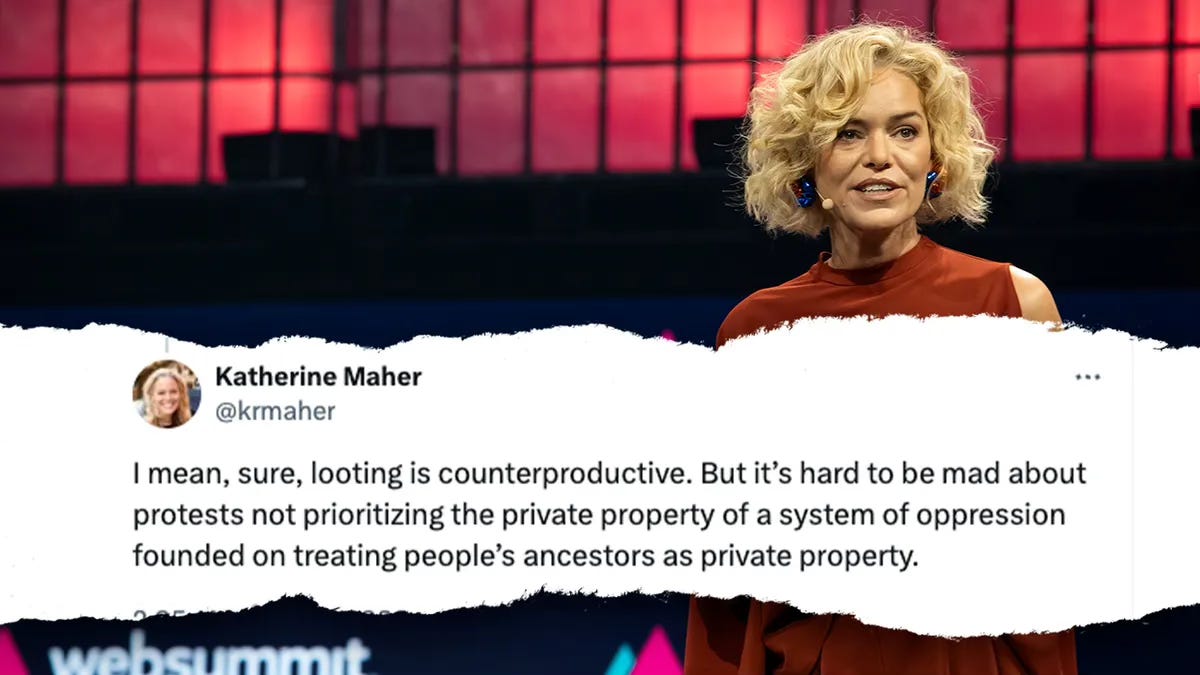
Free Thinking Through the Fourth Turning with Sasha Stone
An Open Letter to the CEO of NPR, Katherine Maher
00:30:22
Loading summary
Transcript103 lines
- [00:00]
Sacha Stone
Hi, this is Free Thinking through the fourth Turning. My name is Sacha Stone. An open letter to Catherine Maher, the CEO of NPR. Dear Ms. Maher, you, don't know me. There's no reason why you should. I'm mostly a nobody. If people know me at all, they know me as a former Oscar blogger whose public support for Trump destroyed by so called career. But really, I'm not all that different from you. Or at least I didn't used to be. I come from your world, more or less. Not that I was ever a tech savvy, globe trotting millennial in charge of National Public Radio, but it would not have been unusual for me to take a picture of myself in a mask in November of 2020 wearing a Joe Biden hat. For podcast listeners, a picture of Catherine Marr wearing a Biden hat and a mask. The best part of Arizona government is my Biden grandpa hat. And tweets from Catherine White silence is complicity if you are white, today is the day to start a conversation in your community. And today, like every single day, is yet another great day to follow more black women as well as all people of color on this here website. And I'm sure looting is counterproductive, but it's hard to be mad about protests, not prioritizing private property, of a system of oppression founded on treating people's ancestors as private property. And lots of jokes about leaving the US And I get it. But as someone with CIS white mobility privilege, I'm thinking I'm staying and investing in ridding ourselves of this specter of tyranny. And yes, the North. Yes, all of us. Yes, America. Yes, our original collective sin and unpaid debt. Yes, reparations. Yes, on this day, I'm so done with late stage capitalism. Also, Donald Trump is a racist. Never underestimate the ability of white people to center ourselves. I do wish Hillary wouldn't use the language of boy and girl. It's a racing language for non binary people. Airline business class demographics are such a pet peeve of mine in the lounge and on the plane. Usually 80% male, usually white. In November of 2020, however, I was already afraid of the Democrats retaking power. Things had gotten weird on the left, Ms. Marr. Really, really weird. And no one would talk about it, least of all NPR or pbs. Then again, they could talk about it because they would be destroyed if they did. Everyone knew that and everyone just went along with it. Especially you. I'm a creature of the Internet and a formerly lifelong liberal who left the party of the movement in 2020, after things had derailed so badly I could not stand to be aligned with them anymore. It was the dehumanization of half the country. It was the corruption within the Democratic Party. It was the dangerous future in store for the nation's young people. It took me a while to finally get kicked out of Woketopia for good. Banished to the virtual gulag, I made a joke about white dudes for Harris, suggesting finally white power was back in style. But one thing about the Woketopians, they have no sense of humor. None. It's been stripped away and replaced with yet more of the suffocating, repellent monoculture that's been shoved down our throats these long 10 years. They all thought I was serious, that I really meant it, that white power was back. Thousands saw the tweet. A close friend of mine would text me to see if I really meant it. I wanted to joke that no self respecting white supremacist would be caught dead praising white dudes for Harris. But I was already in too deep. And that caught the attention of a reporter named Rebecca Keegan. Very much an NPR listener and true believer in the causes of the left. She called me a maga darling in the Hollywood Reporter. A major studio pulled their ads that day. And everything I built over the last 20 years as a woman owned business went up in flames almost overnight. It's quite a story, Ms. Marr, but it's one people like you wouldn't even want to talk about. To you, it isn't cancel culture, it's consequence culture. Well, you might call the defunding of NPR and PBS the same thing. It's consequence culture as a populist movement decides to finally fight back. How it started. You were just 10 years old when I got online, Ms. Marr. The year was 1994. Bill Clinton was still the president. And much like it did last year, my life had fallen apart and I needed a reset. I found the perfect escape on the wild, wild web, where I would live out the rest of the next 30 years of my life. I had a baby in 1998 and as a single mother built a website devoted to the Oscars. In 1999, I also birthed an entire industry and before long, even the New York Times would have an Oscar blogger. I appeared on NPR a few times as an Oscars expert. I would attend film festivals all over the world and hobnob with the rich and famous at fancy parties. I would be invited to cover the Oscars, attending as a guest for almost 10 years. I would make money from movie studios that thought my voice was influential enough to advertise on my site. I could buy a new car. I could support my daughter. I could pay my rent. I would use my website to advocate for a more diverse and inclusive Oscars by promoting women and people of color for the awards. I did this even before Barack Obama won in 2008, which coincided with the rise of Twitter, Facebook and the iPhone. I wouldn't realize it until much later, but all of that coming together at once would allow us to build a necessary inside where we could eventually banish the undesirables to the outside. And we all caught the wave at the same time. We had come out of the 90s era of therapy and psych meds, and now we were ready to build our shining Woketopia on the hill. As society migrated online, it was all under our control. We would ultimately build an empire that represented nearly all of the power in America, cultural, political, educational and institutional. But only a select few would be invited in. My daughter attended all the progressive public schools in Los Angeles. We listened to NPR to and from school. I was a PTA mom, a progressive, active liberal who cared about the climate and racial inequality. I barely noticed around 2014 when my daughter began feeling depressed from what she was learning in school. As a white student whose best friend was black and whose president was black, she was now being told to stand outside the circle and decenter herself from the students of color. She was taught that she was part of an oppressor class and was among the colonizers. And this disease was inside of her. It was her whiteness. I didn't realize then just how deeply indoctrinated our public schools and universities had become. When she graduated high school, only one of her friends wanted to transition to become a boy. Her mother, a conservative, refused to give her puberty blockers and amputate her breasts, though she would finish the job when she turned 18 and is now living as a boy. By the time my daughter graduated from college, two of her roommates were on cross sex hormones changing their sex as a couple. A boy she had a crush on had now fully transitioned and is living life as a transgender woman. And no one in media, not at NPR or pbs, ever warned them they were indoctrinated now too. Covid paranoia and lockdowns only served to heighten the growing anxiety and fear about saying or doing the wrong thing. Wokeness arrived first as a low frequency hum, a reaction to the election of the first black president. As Republicans began to obstruct his agenda? We called them racists. The Tea Party was racist. It had to be. The Freedom Caucus was racist. It had to be. Our president was perfect. And the only reason anyone would object to anything had to be racism. The social justice warriors who came of age online on sites like Tumblr ballooned into a massive army of zealots. None of us saw this coming, and by the time we did, it was too late. The protests at Evergreen College were the first indication that something had gone very wrong. Holding a professor hostage because he went against the doctrine. It should not surprise you, Ms. Maher, that NPR and PBS did not cover that either, although it would have made a compelling episode of Frontline. Fuck you, I fucked police.
- [09:23]
Brett Weinstein
Last month, Evergreen State College in Washington went crazy when a professor of evolutionary biology named Brett Wein Weinstein objected to a day of absence when white students and faculty were asked to voluntarily leave campus. Weinstein branded it a form of racial segregation. A group of student protesters called him a racist. The confrontation incited further protests, debates over free speech and claims of systemic racism on campus. And things haven't calmed down. Tomorrow, Evergreen will hold its graduation at an off campus location 40 miles away.
- [10:02]
Sacha Stone
Would you like to hear the answer?
- [10:06]
Brett Weinstein
This is the video viewed by millions that put Evergreen State and Weinstein in the national spotlight.
- [10:12]
Sacha Stone
This is not a discussion. You have lost that one.
- [10:15]
Brett Weinstein
This is not a discussion.
- [10:16]
George Bridges
You've lost that one.
- [10:18]
Student Protester
Yeah, you've lost that one.
- [10:19]
Brett Weinstein
So what are they doing here if they don't want to talk to you?
- [10:22]
Student Protester
Well, this is part and parcel of their central mode. They're just simply shutting down somebody that they don't want to hear from.
- [10:30]
Sacha Stone
I am not interested in debate. I am interested only in dialectic, which does mean I listen to you and you listen to me.
- [10:39]
Brett Weinstein
Weinstein has taught at Evergreen State for 14 years. He describes himself as deeply progressive, but has been denounced as a racist tool of the alt right by some students and faculty. Weinstein objected to the Day of Absence in a formal protest email to colleagues arguing that, quote, one's right to speak or to be must never be based on skin color. Calls for his resignation followed by virtue.
- [11:07]
Student Protester
Of the way they constructed this. You were making a statement by being on campus that you were not an ally. And I feel like I am an ally to people of color in their attempt to gain equity.
- [11:18]
Brett Weinstein
Do you have any sense at this point of why they want you to resign?
- [11:23]
Student Protester
Well, they think that I'm a racist. Because if you stand up against one of these things because you think it's ill Considered that you will be branded as a racist.
- [11:33]
Sacha Stone
We are here to support the world, dismantle anti blackness campus wine.
- [11:38]
Student Protester
We just wanted to be like, until you're accountable for these actions, you. You don't get to teach students at Evergreen. You don't get to spread this problematic rhetoric and instill it in students.
- [11:48]
Yes, you're disrupting my class.
- [11:50]
So at this point, we would like Brett to be fired, but that isn't happening. The administration is refusing to take action. They're choosing to protect this white CIS male professor over its students.
- [12:00]
Brett Weinstein
Later that day, the students held a raucous meeting at which they presented a list of demands, including the disarming of campus police and mandatory sensitivity training for all faculty.
- [12:10]
Sacha Stone
I'm trying to talk. Okay, we. Trying to listen to.
- [12:12]
Brett Weinstein
It's the one point on which the protesters and Weinstein agree. Evergreen's embattled president, George Bridges, has mishandled the crisis.
- [12:19]
George Bridges
I think their concerns are legitimate. They're articulating ideas that have to do with race, ethnicity, power, privilege, and we're taking a look at them.
- [12:27]
Sacha Stone
That's my problem, George. You keep doing these little hand movements or whatever come through.
- [12:33]
Brett Weinstein
People were criticizing you for using hand gestures.
- [12:35]
George Bridges
Absolutely they were. And you know, that seems crazy to.
- [12:38]
Brett Weinstein
People from the outside of Evergreen.
- [12:39]
George Bridges
It may, but it's noise.
- [12:41]
Brett Weinstein
But the noise has been effective.
- [12:43]
Catherine Maher
No, fuck you, George.
- [12:44]
Sacha Stone
We don't want to hear a goddamn thing you have to say.
- [12:46]
Interviewer
So you don't need to watch that.
- [12:47]
Pamela Moniz
Door, wash all the doors, watch the windows. You need to keep eyes on them. And somebody needs to go in that.
- [12:51]
Sacha Stone
Room real quick to make sure that there's no way in that room for them.
- [12:54]
Brett Weinstein
I mean, essentially sounded like you're being held hostage there. If you were going to go to the bathroom, you had to go with two escorts. Is that true?
- [13:05]
George Bridges
That's what the students felt was true. I was going to go to the bathroom. What do you mean that's what the students felt? Well, that's what they said, if you want to go to the bathroom. I was going to go to the bathroom regardless, and they wanted to escort me. I felt more safe there. Why? What?
- [13:14]
Brett Weinstein
Why did they want to escort you to the bathroom?
- [13:16]
George Bridges
I don't know.
- [13:18]
Brett Weinstein
Did you ask them?
- [13:19]
George Bridges
No, of course not.
- [13:22]
Sacha Stone
Had they come even remotely close to telling the truth throughout this era, maybe things would be different now. And that left it up to independent voices to cover the growing scandal at Evergreen, the transgender contagion, the obsession on race. And that is how evolution left NPR and PBS in the dust. Those looking for truth and common sense had to escape the bubble. I'm guessing you never did, Ms. Maher. The army that took to the streets in 2020 was not peacefully protesting. They were demanding diners raise their fists to Black Lives Matter. They were demanding everyone put a black square on Instagram or else. My niece threatened to cut off all ties if I didn't. I told her she was in a cult. And when I saw this video of Sue's hundred year old mattress store in Kenosha as the city burned because of a false narrative perpetuated by the media. Blake was unarmed and there to break up a fight. I tried to post about it on Facebook. I was shouted down and told I cared more about property than I did about people. You agree with that, don't you, Ms. Marr?
- [14:34]
Reporter
Yeah. That man in his 70s on the road to recovery right now trying to protect this building. Last night here at 22nd and Roosevelt. Just take a look at how the flames leveled the building. Earlier today, we talked with his co workers about how he's doing, and we also heard their emotion.
- [14:52]
Co-worker
I don't know what I expected, but I didn't expect that.
- [14:55]
Reporter
Pamela Moniz is shattered.
- [14:58]
Co-worker
Sorry this is so hard.
- [15:04]
Reporter
Taking deep breaths as she stares where her building once stood.
- [15:07]
Co-worker
It was just the mattress shop, you know, keep it simple.
- [15:11]
Reporter
A simple shop reduced to rubble by these ferocious flames.
- [15:16]
Co-worker
You could see the front of the building fully engulfed and the back door smoke was coming out of that.
- [15:26]
Reporter
The building set ablaze during overnight unrest in Kenosha's uptown.
- [15:31]
Interviewer
We support the protests. We don't support this, though.
- [15:34]
Sacha Stone
There's so many other businesses.
- [15:35]
Reporter
Moniz and her husband, Keith McCoy, watched as the building burned.
- [15:40]
Sacha Stone
Is there words for it?
- [15:42]
Brett Weinstein
I mean, the picture should say it all.
- [15:43]
Reporter
The couple says their co worker attempted to protect the building.
- [15:47]
Co-worker
He was trying to chase them off with a fire extinguisher.
- [15:50]
Sacha Stone
Hey, hey, hey. No.
- [15:53]
Reporter
Moniz says the man in his 70s was assaulted in the process.
- [15:57]
Co-worker
They broke his jaw. Lacerations to his head.
- [16:03]
Sacha Stone
He was trying to defend his building.
- [16:05]
Reporter
The couple says their co worker will recover.
- [16:08]
Co-worker
I can't even wrap my head around what I'm seeing right now.
- [16:11]
Reporter
Just as they plan to do during these times of tension.
- [16:15]
Co-worker
I don't think anyone from Kenosha was responsible for this.
- [16:20]
Sacha Stone
And when Tom Cotton published an op ed in the New York Times reflecting what the majority of Americans believed, that if the protest could not be controlled, we must send in the troops. And then I watched everyone online lose their minds over the truth. Once again, the truth always the truth. By the end of it, James Bennett and Barry Weiss would be out at the New York Times. They would not be the only ones at the Times or other news outlets. Writers and editors would lose their jobs for posting headlines like Buildings matter too, or because some overly fragile staffer felt unsafe and called them out for something like racism. Hundreds and hundreds of cancel culture purges taught everyone the same say nothing or you're next. A glance at your tweets around that time, Ms. Marr, suggests that you were fully on board with all of it too. A true believer in the cause, probably like everyone else who runs a public radio station across America. So when you say their collateral damage, know in a monoculture, everything is the same. If it isn't, you lose your job. That you did not listen to Yuri Berliner's brave testimony in the free press, but rather demonized him for speaking out, should have been enough to force your resignation by the Board of directors. But I'm guessing they're all on the same page as you. Your resignation, however, might look something like this. Posted by Representative Brandon Gill Letter of Resignation to the American people From Catherine Marr July 18, 2025 Resignation I am writing to come clean. The organization I've run since 2024 is nothing but a left wing propaganda outlet. With that, I must resign as CEO of npr, an organization I falsely presented as impartial. In truth, it has served as a vessel for one sided left wing activism. We've abandoned the core mission of journalism to inform, not indoctrinate. Instead, we've promoted ideological narratives, marginalized dissenting views, and allowed activist dogma to masquerade as news. The betrayal of public trust rests with me. To those Americans who expected fair reporting and got filtered ideology instead, you deserve better. I hope my departure marks the beginning of a return to integrity and independence in public media. Lastly, I congratulate the House for passing a rescissions bill to claw back every penny of federal funding for npr. We deserve it. Signed, Catherine Marr, CEO, National Public Radio. You remember him, right? He grilled you pretty hard and you remained poker face throughout gaslighting all of us.
- [19:03]
Interviewer
Ms. Marr, I want to start with you. Just generally, would you say you generally agree or disagree with the following statement? The history of all hitherto existing society is the history of class struggles.
- [19:15]
Catherine Maher
I would not say I agree with that, sir.
- [19:17]
Interviewer
That's good to hear. It's interesting because a lot of your thinking, as expressed by your public statement, is deeply infused with economic and cultural Marxism. Do you believe that America is addicted to white supremacy.
- [19:31]
Catherine Maher
I believe that I tweeted that. And as I've said earlier, I believe much of my thinking has evolved over the last half decade.
- [19:37]
Interviewer
It has evolved. Why did you tweet that?
- [19:40]
Catherine Maher
I don't recall the exact context, sir, so I wouldn't be able to say.
- [19:44]
Interviewer
Okay. Do you believe that America believes in black plunder and white democracy?
- [19:49]
Catherine Maher
I don't believe that, sir.
- [19:52]
Interviewer
You tweeted that in reference to a book you were reading at the time, apparently the Case for Reparations.
- [19:58]
Catherine Maher
I don't think I've ever read that book, sir.
- [20:00]
Interviewer
You tweeted about it. You said you took a day off to fully read the Case for Reparations. You put that on Twitter in January of 2020.
- [20:10]
Catherine Maher
I apologize. I don't recall that. I did. I'd no doubt that your tweet there is correct, but I don't recall that.
- [20:17]
Interviewer
Okay. Do you believe that white people inherently feel superior to other races?
- [20:21]
Catherine Maher
I do not.
- [20:22]
Interviewer
You don't? You tweeted something to that effect. You said, I. I grew up feeling superior. Ha. How wide of me. Why did you tweet that?
- [20:30]
Catherine Maher
I think I was probably reflecting on what it was to be to grow up in an environment where I had lots of advantages.
- [20:38]
Interviewer
It sounds like you're saying that white people feel superior.
- [20:41]
Catherine Maher
I don't believe that anybody feels that way, sir. I was just reflecting on my own experiences.
- [20:45]
Interviewer
You think the white people should pay reparations.
- [20:48]
Catherine Maher
I have never said that, sir.
- [20:50]
Interviewer
Yes, you did. You said it in January of 2020. You tweeted. Yes. The North. Yes. All of us. Yes. America. Yes. Our original collective sin and unpaid debt. Yes. Reparations. Yes. On this day.
- [21:02]
Catherine Maher
I don't believe that was a reference to fiscal reparations, sir.
- [21:05]
Interviewer
What kind of reparations was it a reference to?
- [21:07]
Catherine Maher
I think it was just a reference to the idea that we all owe much to the people who came before us.
- [21:12]
Interviewer
That's a bizarre way to frame what you tweeted.
- [21:16]
Sacha Stone
It's not fascism that canceled Stephen Colbert and defunded public broadcasting. It's democracy. Your side was voted out by the guy you spent 10 years trying to destroy. That alone should send the message that whatever you were doing backfired. For podcast listeners, a headline from npr. Community radio stations are collateral damage as Congress cuts NPR funding. Congress voted to claw back federal funding to public media. Some of those hit hardest include community radio stations in areas that voted for the president. Maybe you'll learn the lesson. Probably not. I can promise you those community radio stations in Trump states don't have any Trump supporters listening to them, and though I do notice some subtle changes in the coverage at NPR after a few casual searches, I'm afraid it's too little, too late. Those local stations are likely to be as woke and indoctrinated as NPR and PBS have become. They have to be, because everything has to be in a monoculture like ours. There is no other option but for all of us to leave it behind. We don't want this indoctrination anymore. Not in our schools, not in Hollywood, not in science, not in culture, and not in our news. Our American story has always been that we shook off the class system that decided our station in life at birth, that anyone could rise, regardless of their status, where they were born, their skin color, or their gender. Obviously we haven't always lived up to that ideal, but it is still our story. The woketopians tell a different story, and it's one you believe in, Ms. Marr. Or @ least you pretend to, because as long as you pay obeisance to the cult, the activists will leave you alone. As I strolled through the farmers market in my very white, very liberal town this morning, I was awash in hedonistic pleasure. The smell of fresh strawberries, bountiful basil, organic olive oil, a whiff of lavender carried by the wind, freshly ground coffee, and someone playing music in the distance. You would fit right in here, Ms. Marr, in a sun hat, with a smile on your face, because this is where you belong, inside utopia. But I also know none of these smiling faces I pass know me. For all of their hybrid cars, the lawn signs, the pleas for kindness, the careful, gentle language so as not to offend all come with an implicit threat. Obey our rules or we will destroy you. Milan Kundera explains what happened to the left as we built our Woketopian empire in the Book of Laughter and Forgetting. Totalitarianism is not only hell but all the dream of paradise, the age old dream of a world where everybody would live in harmony, united by a single common will and faith, without secrets from one another. Andre Breton, too, dreamed of this paradise when he talked about the glass house in which he longed to live. If totalitarianism did not exploit these archetypes which are deep inside us all and rooted deep in all religions, it could never attract so many people, especially during the early phases of his existence. Once the dream of paradise starts to turn into reality, however, here and there people begin to crop up who stand in its way. So the rulers of paradise must build a little gulag on the side of Eden. In the course of time, this gulag grows even bigger and more perfect, while the adjoining paradise gets even smaller and poorer. And to quote one of the greatest films ever made, one Hollywood will never come close to making again. No country for Old men. You can't stop what's coming. It ain't all waitin on you what you got ain't nothing new. This country's hard on people. You can't stop what's coming. They ain't all waiting on you. That's vanity. That's vanity. Nothing will ever be the same when this is all over. Ms. Marr. The good news is that the Empire's collapse will usher in a renaissance, a big bang of brand new culture that is alive, fearless and rooted in truth, not dogma. The best thing you can do is what I did. Escape the bubble now and realize those who don't agree with you aren't your enemy. They are your fellow Americans. Thank you for listening to my podcast, sashastone.substack.com Hope you had a great weekend. And remember to thine own self be true.
- [26:48]
Pamela Moniz
This is where Clement dies.
- [27:03]
Sacha Stone
It Big.
- [27:34]
Pamela Moniz
P Paradise put up a parking lot With a pink hotel, a boutique and a swinging hot spot well don't it always seem to go that you don't know what you got till it's gonna fade paradise put up a fucking light they took all the trees and they put them in a chain museum oh they charge the people a dollar and I have received them now now now don't it always seem to go that you don't know what you got till it's going Paint paradise put up a parking lot La la la la la la la la la la la la Hear me hey farmer farmer put away your dig deep man I don't care about spots or so don't it always seem to go that you don't know what you got till it's gone they paid paradise and put up a parking lot oh they paid paradise Put up a parking lot hey Dan, why not? Well there's a lady that's not a hurdle screamed or sway and a big yellow taxi took my girl way and I said won't it always seem to.
- [29:33]
Sacha Stone
Go.
- [29:36]
Pamela Moniz
That you don't know what you got till it's gone in P Paradise and put up a parking lot.
- [29:44]
Sacha Stone
Don'T.
- [29:44]
Pamela Moniz
It always seem to go? You don't know what you got till it's going Paid paradise put up a foggy life oh yeah they paid paradise and put up a parking lot.
- [29:59]
Sacha Stone
They.
- [29:59]
Pamela Moniz
Paid paradise and put up a parking lot.
- [30:04]
Sacha Stone
Whoa.
- [30:07]
Pamela Moniz
Pay paradise and put up a parking lot.