← Free Thinking Through the Fourth Turning with Sasha Stone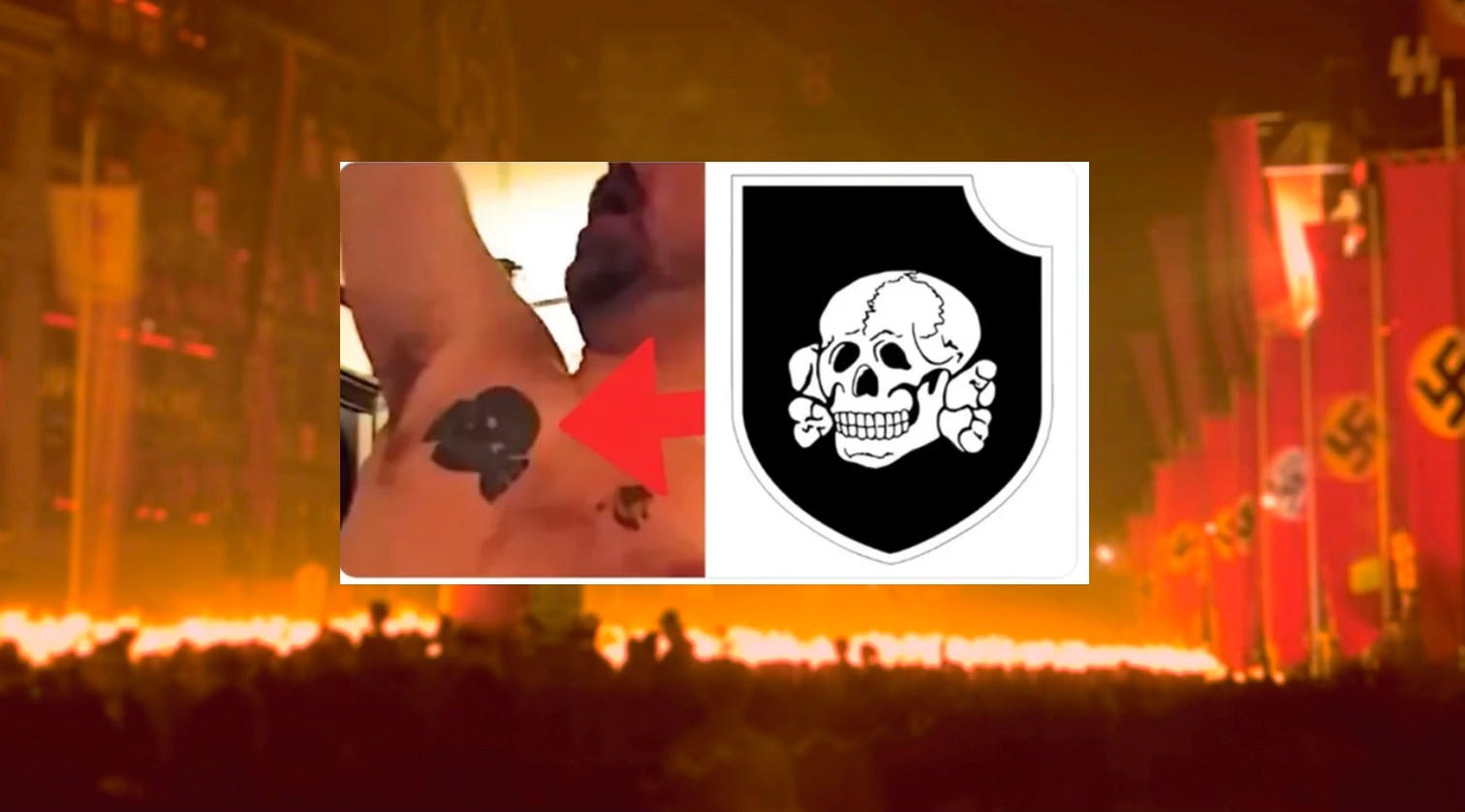
Loading summary
Transcript123 lines
- [00:00]
Sacha Stone
Hi, this is Free thinking through the fourth turning. My name is Sacha Stone. The Democrats have a Nazi problem and it's time to call them out. The Democrats are involved in their own cover up. They're covering up for a Nazi. How could they? All they've done for 10 years is scream about Nazis. Trump was Hitler. I was told and told and told. Leading a brown shirt army, awakening the white nationalists and radicalizing them to rise up and kill black and brown people. I was told the Democrats were the side fighting Nazis. It's okay to punch one. And they're all Nazis. The Democrats told us this is the.
- [00:47]
Political Commentator 1
United States of America, and I don't care what Elon Musk is doing behind a presidential seal in this country. We hate Nazis. Kind of like a foundational defining thing. I still am not rocking with anyone sympathetic to Nazis, and I will do that until I am six feet in the ground. Like, kind of foundational to me as a human being. And so if you're cool and want to defend the Sig Hales and the Nazi salutes, all the. All the, you know, whatever you want to do, that's on you. I'm on the opposite side of that.
- [01:34]
Graham Platner
The other day, General John Kelly, Donald Trump's former chief of staff.
- [01:41]
Donald Trump
Said that.
- [01:42]
Political Commentator 2
Trump told him he wanted his generals.
- [01:45]
Musical Performer
To be like Hitler's generals.
- [01:48]
Political Commentator 2
MAGA is profoundly corrupt, unmistakably anti democracy, and most importantly, MAGA is explicitly a Nazi movement.
- [01:55]
Sacha Stone
You may have replaced a swastika with.
- [01:57]
Political Commentator 2
A red hat, but that is what it is.
- [01:59]
Political Commentator 1
Let's deal with Hitler.
- [02:00]
Political Commentator 2
Okay? I don't think it's hyperbolic to say that. I mean, that is Mussolini.
- [02:04]
Dr. Debunk
Hitler.
- [02:04]
Political Commentator 2
Like language.
- [02:05]
Political Commentator 1
Trump's affinity for Hitler was always covered under an umbrella of his stupidity.
- [02:09]
Political Commentator 2
Echoing Hitler's words.
- [02:12]
Political Commentator 1
Listen to this. Well, Hitler was duly elected.
- [02:15]
Political Commentator 2
Echoing the hateful rhetoric of Adolf Hitler.
- [02:18]
Political Commentator 1
It echoes Hitler. That's the kind of language Hitler used in Mein Kampf.
- [02:23]
Political Commentator 2
Got vermin and Hitler and Mussolini.
- [02:26]
Sacha Stone
That's a horrifying clip.
- [02:27]
Political Commentator 2
That's a fascist clip. Just going full on Hitler from Hitler's Germany.
- [02:31]
Political Commentator 1
We just need to say for the record that the term vermin was really effectively used by Adolf Hitler. Echo dictators like Hitler with language evoking authoritarian figures like Adolf Hitler and Adolf Hitler. Donald Trump parroted the autocratic language of Adolf Hitler.
- [02:50]
Political Commentator 2
Talk about the brilliance of Hitler's generals.
- [02:52]
Sacha Stone
Correct. What do you think of Elon Musk, perhaps the president's most visible advisor, doing two Heil Hitler salutes last night at the president's televised Rally.
- [03:05]
Political Commentator 2
Another Republican National Convention speech ended in controversy as social media users noticed conservative.
- [03:10]
Political Commentator 3
Radio host Laura Ingraham made a gesture that looked similar to the Nazi salute.
- [03:15]
Sacha Stone
God bless you and God bless the.
- [03:18]
Musical Performer
United States of America.
- [03:21]
Political Commentator 3
Ingraham posted a picture on Twitter to.
- [03:23]
Political Commentator 2
Point out that she's not the only.
- [03:24]
Political Commentator 3
One to be photographed in that position.
- [03:26]
Sacha Stone
But this is far from the first.
- [03:28]
Political Commentator 3
Time Donald Trump and his supporters have been criticized for similarities to the Nazi regime of Adolf Hitler.
- [03:35]
Supporter of Graham Platner
He calls those who oppose him vermin.
- [03:41]
Sacha Stone
He talks about the blood of America's.
- [03:43]
Political Commentator 2
Being poisoned, echoing the same exact language.
- [03:49]
Supporter of Graham Platner
Used in Nazi Germany.
- [03:51]
Political Commentator 2
I have talked about the fact that you that the Nazis in Germany in.
- [03:56]
Graham Platner
The 30s tore down a constitutional republic.
- [03:59]
Political Commentator 2
In just 53 days. It does not take much, frankly. And we have a president who seems hell bent on, on doing just that. You know the words that Donald Trump used today? Enemy from within. That's Hitler esque.
- [04:14]
Sacha Stone
Donald Trump and the maga. Republicans represent an extremism that threatens the very foundations of our republic.
- [04:23]
Political Commentator 2
Are they a threat to democracy? Yes. Are they going to take our rights away?
- [04:26]
Political Commentator 3
Yes.
- [04:26]
Political Commentator 2
Are they going to put people's lives in danger?
- [04:28]
Political Commentator 3
Yes.
- [04:28]
Political Commentator 2
Do you think Donald Trump is a fascist?
- [04:30]
Sacha Stone
Yes, I do.
- [04:31]
Political Commentator 2
This is what kicking the out of fascism looks like.
- [04:36]
Political Commentator 1
Comparing the tactics of Donald Trump to Mussolini and Hitler is a very legitimate thing. We have a Timu Hitler in the White House right now.
- [04:47]
Musical Performer
I've been tweeting for over a year.
- [04:48]
Political Commentator 2
Daily reminder. Today's GOP is no longer a political movement. It is a fascist movement that has embraced white nationalism. Donald Trump's rally at Madison Square Garden comes days after his own former chief of staff went on record to describe his former boss as a fascist. But that jamboree happening right now, you see it there on your screen in that place is particularly chilling because in 1939, more than 20,000 supporters of a different fascist leader, Adolf Hitler, packed the Garden for a so called pro America rally. A rally where speakers voiced anti Semitic rhetoric from a stage draped with Nazi banners. When a Jewish protester rushed the stage, the Associated Press reported, quote, instantly a dozen or more stormtroopers set upon him, knocking him down and beating him as he held his head in his arms. Most of his clothing was torn from his body. Later, he was booked for disorderly conduct. Now, against that backdrop of history, Donald Trump, the man who has threatened to use the military against opponents he calls enemies from within, who has threatened to use the troops to quell what he says are lawless cities and to use those troops to carry out Mass deportations of immigrants is once again turning Madison Square Garden into a staging ground for extremism.
- [06:15]
Political Commentator 1
I remember as a young student, you know, trying to figure out, how did people get brought in by Hitler? How did that happen? Shouting and raising their arms. I thought, what's happened to these people? Why did they believe that? You saw the rally in Ohio the other night. Trump is there ranting and raving for more than an hour.
- [06:36]
Political Commentator 3
A speech.
- [06:37]
Political Commentator 1
Rows of young men with their arms raised. I thought, what is going on? So there is rows of men with their.
- [06:48]
Sacha Stone
But there was a Nazi in their midst. A genuine bonafide Nazi. By their own rules, a Nazi. We don't give Graham Platner the benefit of the doubt. That's not how this is supposed to go. It's one strike and you're out, Podcast listeners. A tweet Maine State Press recently surfaced video shows Maine Senate candidate Graham Platner with what appears to be a chest tattoo resembling the SS Totenkopf, a symbol used by Nazi Germany during World War II. We convict him in the court of public opinion because these are your rules, Democrats. This is the bed you made, and I'm afraid you will have to lie in it.
- [07:33]
Graham Platner
Hey, everyone, Grant Platner here. I want to talk to you about something. In 2007, when I was a young infantry sergeant in the Marine Corps, myself and some machine gunners I served in Fallujah, Ramadi with were on our third deployment. We were in a naval vessel and we pulled in for a liberty port in Split, Croatia. We went ashore to do the thing that young Marines do, which tends to be carousing and sometimes getting tattoos. We wanted to get something that represented our jobs, our service, fighting in Fallujah and Ramadi as machine gunners. We went ashore, we found a tattoo parlor after a fair amount of heavy carousing, and we found a tattoo on the wall, a piece of flash that looked like a terrifying skull and crossbones. We thought it looked cool, and so we got it. I have had this tattoo for the last 18 years. I reenlisted into the United States army with this tattoo where I was screened for hate and gang related tattoos. I worked for the State Department as a contractor, where I got a full physical, which included screening my tattoos. I've gone through life with this thing, taking my shirt off, having photographs taken, videos taken. I've been very, very open in my life with the fact I had a skull and crossbones on my chest, because that's what I thought it was. It's come to my Attention that it has a stark resemblance to a symbol that is used by neo Nazis. And I want to say that was not the intent at all. And the idea that I've been going around with something like that utterly horrifies me.
- [09:07]
Political Commentator 2
What is that?
- [09:08]
Graham Platner
This?
- [09:09]
Donald Trump
Yeah.
- [09:09]
Political Commentator 2
What's that?
- [09:09]
Graham Platner
Literally nothing. It's just a. Oh, it's a design.
- [09:11]
Political Commentator 2
Is it like a possum or.
- [09:13]
Graham Platner
No, it's supposed to be like a dog.
- [09:18]
Political Commentator 1
That was Graham Platner. He's a Democratic candidate running for U.S. senate in Maine, debuting the brand new ink that as of today has covered up a previous tattoo that resembled a Nazi symbol.
- [09:31]
Sacha Stone
Why are they having a hard time with calling Platner a Nazi and pushing him out like they all pushed out Al Franken after he was called a rapist? For the same reason they aren't pushing out Jay Jones for his vicious fantasies about killing the children of Republicans. They don't think they have to, and they are right. Here is Bernie Sanders, your candidate.
- [09:57]
Political Commentator 3
In Maine running for Senate, Graham Platner.
- [09:59]
Political Commentator 2
Has been subject to a lot of fire and fury. Stories of old posts, crude comments about black diners, about rural white people.
- [10:08]
Political Commentator 3
You said yesterday you are still supporting him.
- [10:10]
Political Commentator 2
Why?
- [10:11]
Supporter of Graham Platner
I am not overly impressed by a squad of media running around saying, what do you think about the tattoo on Gran Plotner's chest? Between you and me, there might be one or two more important issues, but let me go there. I'm not Graham's best friend. I met him several times. We did a rally in Portland Main, a great rally. I am impressed by the guy. This is a guy who will tell you who has served four tours of duty with the United States military. He was in the middle of some heavy duty combat. He was a machine gunner. That's what you do. You mow down people. He went through some very difficult experiences in the military as a machine gunner. Seeing his friends killed came out of the military. He will acknowledge. I'm not telling you what he doesn't say. He had ptsd. He went to the VA and by the way, but he says they rebuilt his life. He went into a dark period in his life. I suspect that Graham Platner is not the only American to have gone through a dark period. But what he did was he expressed his darkness on the Internet. Probably not a brilliant thing to do. All right. And he said things that are stupid, things that were hurtful. He has apologized for them and what he says now. And the guy that I saw up on the stage in Portland, Maine, rather a brilliant guy. I mean, really A strong fighter for the working class, very articulate, very smart. And what he said is, yeah, I went through a dark period. I said stupid things. I am not the person today that I was back then. And I think as a nation, especially given the fact that we have a president who is convicted of 34 felonies, maybe we have to do a little bit of forgiveness.
- [12:04]
Sacha Stone
They have the legacy media on their side, and to them, only those on the right can ever be called a Nazi and have it stick. Political violence only matters if someone on the right does it. Joe Biden told us that the people we have to fear most are the radical MAGA extremists. Platner will slither on through because that's how the game is played. Here is Mark Halperin, Sean Spicer, and Dan Turrentine on two way.
- [12:30]
Political Commentator 3
Because I contain multitudes, I'm about to court trouble for this program or at least for myself as I introduce this topic. Okay, yeah, we're going to talk about Hitler. So item, the New York Times this morning has a story about how the Trump administration tolerates intolerance and gives jobs to people and says nice things about people who have said things that are offensive to many and objectively offensive. And they include in the story, in their kind of laundry list of, look at all the horrible people associated with Trump, they literally include a picture and then a sentence about Elon Musk, salute. So they're back to saying, even though we can provide a thousand photos of a thousand Democrats doing this, they're about to do that. Okay, number one.
- [13:16]
Political Commentator 2
Number two, by the way, Mark, you just got clipped.
- [13:18]
Political Commentator 3
Someone's going to say that I did it off camera. Number two, when that story occurred, I came up with one of the greatest headlines ever in my newsletter as far as I'm concerned, okay? Because like, like the great Mel Brooks, I think joking about Nazis is perfectly acceptable. I just do. Mel Brooks did it. The producers go watch it. Here's my headline. There's all this controversy over the allegation that Musk had done a Nazi salute. I called it Fur Fuhrer, okay? Best headline I've ever wrote. Hilarious. But a joke about Nazis, okay, now here's this guy, Paul Lagrazia, who, who in a chat, a chat thing with a bunch of people who warned him up here, if the chat, if the things are real, who warned him and said, you don't want to be writing stuff like this. He made, he made joke about, about, made jokes about Nazis, as, as did these young Republicans a few days ago. That story and that. And now you have Mr. Platner, Democratic Senate candidate in Maine with a tattoo, which is widely described as also being a Nazi thing. So on the one hand, Dan, we should all be denouncing the Nazis least controversial statement possible. On the other hand, people joke about stuff. People do stuff. People say and do all sorts of things. And does that mean they should be. Not run for the Senate or lose their job, whatever. How do you, how do you feel about this, Stew? Of, of, of a debate about intolerance, tolerance, cancellation? How do you feel about all this?
- [14:52]
Sacha Stone
I.
- [14:52]
Political Commentator 2
Look, I think the marketplace should make the determination if, if people. Look, I think one of the things now about everyone's going to have a digital footprint. You know, people text both in their personal lives and professionally. You know, it used to be be careful what you put in an email. Now it's be careful what you put on Instagram or a direct message or X or your text messages. Someone could screenshot it. The marketplace will make a judgment if, if they think it's inappropriate. It's, you know, it's like with Trump. I mean, when he speaks and does stuff, some people are horrified and offended and say, this is not what a leader should be. And other people say, I don't have a problem with this in a leader.
- [15:35]
Sacha Stone
The problem is they like him. They want him to stay in their party because they need macho, macho, macho men, and he's a macho Nazi. He sounds like a real man, not like a Democrat. They'll have to convince the ladies of the view, however, because they're not on board. Somehow they realize that if they give Platner a pass, it essentially renders all of their accusations against the right for 10 years null and void.
- [16:06]
Political Commentator 1
P Hustle. That's what he was known as. His handle posted over 1800 times between 2009 and 2021. That, to me, is seriously a red flag when we talk about people being radicalized online. If you've spent that much time on a Reddit site, that's my first concern, too. Although everyone has a past, not everyone can whip up an anti Semitic or racist tattoo that they accidentally got on spring break. They were drinking. You know, like, the level of what you're bringing up is not just a whoopsie, it was a repeated offender. And so this is where I say, there are just so many fish in the sea. In fact, there are 1.5 million people in Maine. I'm sure there's someone else that they could get now.
- [16:47]
Sacha Stone
But there are.
- [16:47]
Political Commentator 1
There are 340 million people in this country, they can't find one without a Nazi tattoo. Yeah, right. I mean, that's the thing. I understand that some Democrats. Thank you. I understand some Democrats are still, I think, because he's running against Susan Collins and people want her to be gone and done because of some of her voting history. But you can't say, oops, 18 years ago I was in Croatia drunk and I got an anti Semitic tattoo. And when you get to the point where you're denying on a podcast that you're a Nazi, I think it's over, you know, and so it's just over.
- [17:24]
Musical Performer
Well done.
- [17:26]
Political Commentator 1
I appreciate that we've had this conversation when it's folks on the right and we've said whether you were on that GOP group chat, whether you were this gentleman we didn't end up talking about in the show, but who ended up having his nomination withdrawal with John Paul and Gracia because he had some neo Nazi history. Both sides. There has to be a standard of behavior in this country for elected officials. There was a time when there was almost. You wanted a moral superiority in your leaders. So if you're a Nazi adjacent on the right or the left, you have no business being in public life. Step aside for someone else who could run for that.
- [17:56]
Musical Performer
Seems.
- [17:58]
Sacha Stone
Podcast listeners, a tweet from Bad Will hunting Nazi tats not being a deal breaker for a huge swath of the left wing is just going to normalize Nazis in the culture at large. I could not believe how effing dumb and short sighted and vile this is. Every Republican Nazi text is now totally fine in context, you effing idiots. These are their rules. They set the no tolerance for Nazis policy and anyone they deem a Nazi is in fact a Nazi. So by their own rules, we must conclude Graham Platner is a Nazi. There is no presumption of innocence allowed. There is no benefit of the doubt. There is certainly no tolerance, redemption or forgiveness allowed. It's once accused forever guilty. That is their most powerful weapon against the right. Everyone is a Nazi who voted for Trump. Elon is a Nazi for waving to the crowd. The media far and wide reported that story as an actual fact. And the utopians inside the doomsday cult not only believed it, but still do. Just ask them. Trump is a Nazi because Trump is Hitler. Ivanka is a Nazi because she is Hitler's daughter. Melania is a Nazi because she wore an outfit one time that the left decided looked like a Nazi outfit. For podcast listeners, media headlines about Melania's Clothes, comparing them to Nazis. The utopians inside the doomsday cult not only believed it about Melania in 2020, but still do. Then again, is there anything they wouldn't believe right now? They're rolling around in agony yet again because Trump is demolishing the East Wing to build a ballro. Sounds like a great idea. Trump is a builder, so why not?
- [19:52]
Donald Trump
Well, certain areas are being left. Certain areas are being left. We determined that after really a tremendous amount of study with some of the best architects in the world, we determined that. Really knocking it down, trying to use a little section, you know, the East Wing was not much. There was not much left from the original. It was. Over the course of hundred years, it was changed, the columns were removed, and it was a much different building. Then a story was added on. In 1948, 1949, there was a story added on which was not particularly nice. And the building was very, very much changed from what it was originally. It was never thought of as being much. It was a very small building. And rather than allowing that to hurt, a very expensive, beautiful building. Building that frankly, they've been after for years. You have that. I brought these along so people could see. But it's about $300 million. It's set to do many, many things, including meetings of foreign leaders, including the honoring of foreign leaders. You can see this. This is a plan. If it's got tables so that you honor a foreign leader. We have a proper space right now. We have a space that, with tables, hold about 79 people. And this is a proper kind of a thing. Now, what the White House was doing, as you know, is they were putting tents out on the lawn. This is an interior shot of the ballroom. I think there will be nothing like it. And it's being paid for 100% by me and some friends of mine, donors to it. The government is paying absolutely nothing. We're also working with the military on it because they want to make sure everything. Everything is perfect. And the military is very much involved in this. They want to make sure everything is absolutely beautiful. You can see the kind of interiors that we're talking about. That's an interior of the ballroom, and it's the highest level. And you see, it goes beautifully with the White House. I mean, the mix is beautiful.
- [21:58]
Sacha Stone
If Obama were building the ballroom, they would hail it as a profound moment in history where America's white supremacist past was finally confronted. They would be more honest about how they really feel about the founding Fathers who built this country on the backs of slaves and the White House's representative of our colonizing 1692 white male patriarchal past. Obama would be hailed as a hero and celebrated on the pages of the New York Times for tearing down that past and building anew. But since it's Trump, it's a desecration because he's a Nazi, racist, fascist, dictator, criminal, felon, rapist, and most recently pedophile. Here are some TikTokers.
- [22:43]
Political Commentator 1
$250 million ballroom. I'm watching news.
- [22:48]
Sacha Stone
I should not. Maga maga maga. 250 million dollar ballroom.
- [22:57]
Political Commentator 1
Is that the optics you're into? Is that what you had in mind?
- [23:02]
Sacha Stone
Is all your country songs?
- [23:04]
Political Commentator 1
And you know President Trump, so it's.
- [23:07]
Sacha Stone
Really in his heart he's a country boy.
- [23:10]
Political Commentator 1
250 million dollar ballroom. Shame you do not build a ballroom for a house you plan on leaving. Donald Trump is saying you by building.
- [23:22]
Dr. Debunk
A ballroom when everybody did the no Kings Day protest.
- [23:26]
Jennifer Welch
Why?
- [23:27]
Political Commentator 1
Because the only place that has a ballroom is a palace. And what lives in a fucking palace, ladies and gentlemen?
- [23:33]
Dr. Debunk
A king.
- [23:34]
Political Commentator 1
Unfortunately, he's a piece of shit. And if he's building a ballroom, that dirty bitch is never leaving.
- [23:39]
Political Commentator 2
I don't give a what Obama did. The current president is literally destroying the White House.
- [23:47]
Political Commentator 1
You take that bullshit somewhere else.
- [23:49]
Political Commentator 3
That's all you guys got?
- [23:50]
Sacha Stone
Every time someone brings up something bad about him. Oh, Obama, Biden did this.
- [23:54]
Political Commentator 1
Trump is over here. Just money laundering our tax dollars to enrich himself and his family. And we're all just like, cool.
- [24:04]
Sacha Stone
Everyone has to be a Nazi because as the ruling class, they are the oppressed side. Their otherwise pristine lives were disrupted when the other half of the country, the less powerful half, decided they wanted to participate in our democracy, but also couldn't stand living under the suffocating totalitarian goodness of the Lahnsine people. You've heard of the good Germans, now meet the good liberals. Here is a list of what you can't say, eat, drive or wear. Everything you did in your past is subject to our judgment. We will decide your character and convict you of whatever we damn well please. We will call you racist, and everyone will go along with it, and your life will be destroyed over it. What did you once wear on Halloween that could now come back to haunt you? Once marked by them, your whole life was ruined. Now that American society had been sucked into the utopian cult of the left, you were marked. And that meant you were to be banished, shunned, disappeared as a bad thing. A Nazi, which kind of sounds like actual Nazis. Doesn't it? The word Nazi is to them a casual adjective. The sky is blue, that flower is pink, that person in a red hat is a Nazi. They don't think twice about it and have emboldened themselves to say it all the time. Here are some tiktokers.
- [25:33]
Jennifer Welch
So this one's for the Nazi MAGA people.
- [25:37]
Dr. Debunk
How does it feel being the bad guy? Like I'm assuming you watch movies, read books.
- [25:46]
Jennifer Welch
The stuff you're doing is not stuff good guys do. So how does it feel being the villain?
- [25:51]
Political Commentator 2
The world is witnessing the death of America not from an outside force, but from a low level con man, a pathological liar, a convicted felon, an injury adjudicated rapist that also inherited $400 million at birth and still managed to go bankrupt six times. Yet he's convinced millions of Americans that he's their savior, that he's this great deal maker, that he's this great leader. It's almost if it was a movie we would go see it and we would think it was completely unrealistic. We would think enough people would rise up to stop him. Just as we believed the Germans would do that before Hitler seized control of the country and murdered 6 million Jews. You guys, this is happening right now and we are running out of time fast.
- [26:50]
Sacha Stone
On January 6th, remember to me the indelible image of that day, of many images that day is the crazy looking guy in the parking lot on his cell phone wearing a Camp Auschwitz T shirt. And this is what I say to my Republican friends. Let me be clear with you. I am out of grace for all of this.
- [27:11]
Political Commentator 3
The world watched in horror as Hitler's Nazi regime plunged humanity into the darkness of the Holocaust. We vowed never again. Yet history has an unsettling way of echoing today, uncomfortable parallels emerge between the Nazi party's rise and and the fervent MAGA movement in the United States. It's a comparison not to be made lightly, but one we ignore at our peril.
- [27:33]
Political Commentator 2
This isn't about calling anyone a Nazi.
- [27:36]
Political Commentator 3
It's about recognizing dangerous patterns and understanding how they can erode democratic values.
- [27:41]
Political Commentator 2
The parallels are not exact, of course.
- [27:43]
Political Commentator 3
Historical comparisons rarely are. But the similarities in rhetoric, tactics and impact are striking and deeply concerning.
- [27:55]
Dr. Debunk
Hey there folks, hope you're doing well today. Dr. Debunk here again with YA Today I wanted to explore some ideas of how we could try to unbrainwash maga. And I think a great way to look at that is to see how they did that in Germany after World War II. And you have to think about it, right? Germany was in ruins physically, morally and fashion wise. The world asked, how do you fix a country full of people who cheered for genocide, wore armbands to brunch and thought Hitler was a strong leader with quirky boundaries? It wasn't easy, but they tried and it worked. A literal Nazis. Maybe, just maybe, we could try it on our uncle who thinks QAnon is real and the IRS is run by lizard people. So we gotta remember MAGA is built on grievance at its core. MAGA's not a political ideology. It's a trauma group for people who think other people existing is oppression. They're not protesting government overreach, they're protesting the idea. They're not the default setting of humanity. Post war Germans were forced to confront the horrors they supported. MAGA supporters call any confrontation a witch hunt. In Germany, being called a Nazi was a mark of shame. In MAGA land, it's a T shirt slogan, but like ironically bro, it's a joke. And then I think this other thing is worth exploring that MAGA is an identity, not a belief. In 1945, Germans were trying to figure out what they were without the Reichstag. MAGA already knows they are the Reich, but you know, with better branding and.
- [29:47]
Sacha Stone
More bumper stickers, podcast listeners, a montage of tweets calling MAGA Nazis. They have also screamed it, chanted it, and even used it to justify violence. Charlie Kirk's assassin believed he was fighting fascism, which is another word for Nazi, because none of these people really know their history. These words are stand ins for their own helpless hatred and rage against people who don't agree with them on their totalitarian worldview. When the Epstein story failed to take down Trump, the Democrats decided pedophile was now their favorite word and all Republicans were guilty of it. They scream it wild eyed with spittles spraying out of their mouths. They say it on TikTok to any Trump supporter because you know, Nazi was played out. Can you imagine Nazi being played out now? It's pedophile. This is on billboards, on the no King sign. They say it casually, frequently as they use the only weapons they have in our virtual civil war.
- [30:55]
Political Commentator 3
Words.
- [30:56]
Sacha Stone
Words to them are harm and they are violence. So they fire them at will. Freaky virtue signaling podcast host Jennifer Welch, who has almost single handedly alienated all heterosexual men from the left, loves to point her bony finger at her fellow Americans accused, lest ye be accused. Here she is calling Stephen Miller and other Trump supporters Nazis.
- [31:25]
Jennifer Welch
You know, I mean, like Stephen Miller is a white Supremacist. I mean, he is. And he's basically running the White House. They keep Trump busy with his decorating projects. He's got building the arch now. He's got his Oval Office design. And then you have these real sociopaths that are real anti Semites, true white supremacists like Stephen Miller. And even though he's Jewish, he's like a Nazi Jew. Stephen Miller is a Nazi and he is a sociopath. And he is the one that actually is not lazy about breaking the law and pushing all of this shit through because he is a little insecure white supremacist who I believe even his own parents must have hated him, because what he sends out into the earth is pure hate and pure destruction of this country and pure projection. The way he speaks about normal, everyday Americans is how he feels about himself. He accuses normal, everyday Americans of being terrorists, of being all of the hating and America. And I think at the end of the day, the guy that's trying to dismantle the Constitution is the guy that in fact hates America, because this guy was bullied in high school and he's unattractive and he's 4 foot 10 and nobody likes him. Donald Trump's top advisor, Laura Loomer, who is the one who came up with that Haitian immigrants were eating dogs and cats and all of this insane conspiracy theory stuff. She keeps showing her true colors. And here she is on Twitter with this post, Alligator Lives Matter. The good news is alligators are guaranteed at least 65 million mills if we get started. Now, to use this type of language about exterminating 65 million people is so Hitler Nazi. So everybody on the left that has said, oh, you guys are being hyperbolic. You guys shouldn't do Nazi comparisons.
- [33:26]
Sacha Stone
Q.
- [33:26]
Jennifer Welch
That's exactly what she's doing. And coincidentally, do you want to know the total of Latinos in the United States of America? 65 million. Every time somebody leaks from within the MAGA administration, on the other side of that leak is unapologetic, unrepentant, racist and Nazi rhetoric. Embattled Trump nominee Paul and Gracia told Republicans that Martin Luther King Jr. Holiday should be, quote, tossed into the seventh circle of hell and that he has, quote, a Nazi streak. Paul belongs in the Hitler Youth with Uber group and Steve Bannon. And Paul says, I do have a Nazi streak in me from time to time. I will admit it. And then he goes on to say, MLK Jr. Was the 1960s George Floyd and his holiday should be ended and tossed into the Seventh circle of hell where it belongs. This is what's in the MAGA movement, and they want to constantly say, oh, no, we're not racist. Y' all are race hustlers. But at the epicenter of all of the movement is this type of leak, and it is representative in their policies. When you have kanks talking about allowing white South Africans in, but not black South Africans in, and wanting to have an immigration system that's more favorable to people with white skin than those that may have black or brown skin, it's.
- [34:48]
Sacha Stone
Obvious what this whole ugly affair has exposed is that they never meant any of it. It was all politics. They just didn't want to share this country or hand it over to people they deemed beneath them. It was all lies. For 10 years, they destroyed people based on those lies, and they never thought twice about it. People have actually died and been viciously assaulted. Most of us were victims of a long con. They never believed it. They just wanted to win. Which is why it's funny to hear Democrats like Jamie Harrison pretend they aren't the side that has been throwing their fellow Americans away like human garbage for a decade, all because they couldn't beat Trump. For podcast listeners, a tweet from Jamie Harrison says the people of Maine will make their choice, and our opinions and thoughts on this specific Senate race won't change that. But let this be a reminder. Vet research, everybody. The margin for error is zero. I get it. We have to stop these purity tests because Lord knows none of us are perfect and will never be. In the eyes of some folks, growth and forgiveness are essential principles, as is the condemnation of bigotry and hate. But this also isn't about blind trust or wishful thinking. The GOP won't give a damn about growth or forgiveness if it means losing a seat and ending Trump's grip on complete power. They will use anything they can, even if they have to make it up to stay in control. So let's not help them. Bottom line, trust but verify every time. So, yes, the Democrats have a Nazi problem. And it's high time that the Republicans gave them a taste of their own medicine by saying so at every opportunity. Who knows, maybe it will make the good people of the left think twice the next time they point their finger and scream Nazi. Thank you for listening to my podcast, sashastone.com if you like my work, please think about becoming a paid subscriber. There is also a link for a tip jar on the main page. And remember to thine own self be true.
- [37:49]
Musical Performer
The congregation sang. We knelt and prayed as we stood before God on that beautiful day Church bells rang and a champagne flowed as our friends gather round following photo but here we are barely five years old and our heart's falling apart I don't want our kids to suffer can we talk to one another? I was once your wife, your lover it's falling Demons are and the whispers But I know you're movie With a prison ourselves Now I feel the chilled wind Of a marriage that failed and our friends are divided they've taken their sides now they'll all sit back and watch the circus unwind I don't stand here trying to focus the flame But I'm hurting deep down inside side all the pain and all the grieving when did we stop believing? Too late now stop the bleeding it's so watch the sense of pointing fingers who's the sav, who's the sinner There ain't going to be a winner Cuz it's so no idea what happened to us Tell me where did it all go wrong? All the tears, all the crying why do we keep denying it so all the time I thought I knew that don't forget our children's future I will do whatever's suture it's all, it's all it's all about Pretend you know the song.