← Free Thinking Through the Fourth Turning with Sasha Stone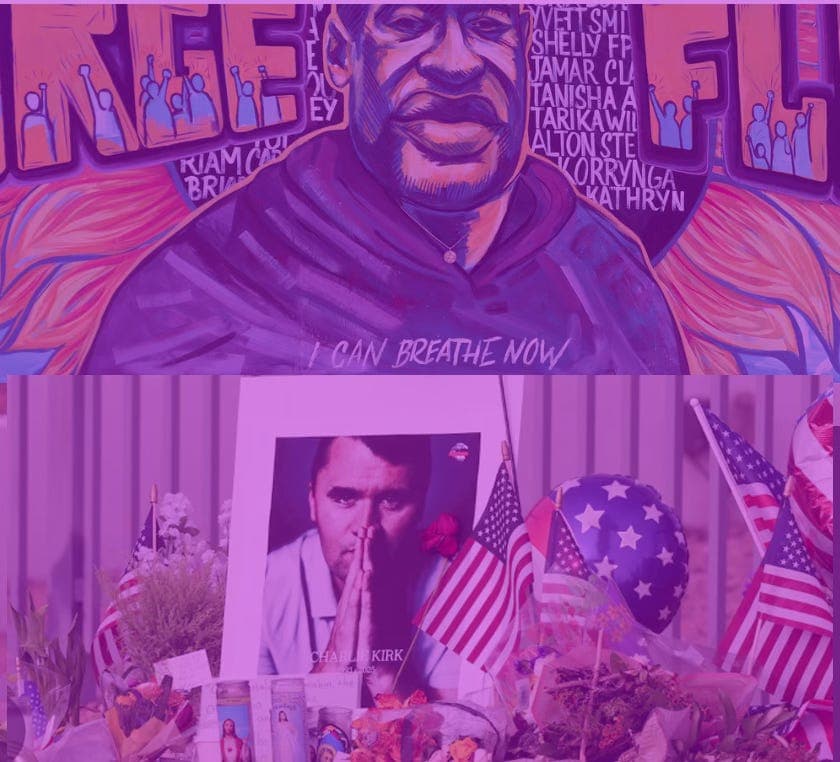
Free Thinking Through the Fourth Turning with Sasha Stone
The Only Thing Charlie Kirk and George Floyd Shared Was a Birthday
00:45:11
Loading summary
Transcript64 lines
- [00:00]
Sacha Stone
This is free thinking through the fourth turning. My name is Sacha Stone. The only thing Charlie Kirk and George Floyd shared was a birthday. No one transformed Charlie Kirk into a hero. He did it all on his own. George Floyd was born on October 14, 1973. Charlie Kirk was born 30 years later on October 14, 1993. That is an odd coincidence, a cosmic joke upon us. We have two paths forward for America, and how we honor these men in death will decide our country's fate. We all remember what happened on Memorial day, weekend of 2020. We all saw the video. It was horrific to watch a man die while begging to be freed and calling out for his mother. The video showed an unconcerned Derek Chauvin calmly placing his knee on the suspect to subdue him. And then we saw the life drained from George Floyd. Almost overnight, he was transformed from a career criminal trying to pass a $20 counterfeit bill to score drugs into a martyr for systemic racism of America's police and a racist America that elected Donald Trump.
- [01:21]
News Reporter
Hands up.
- [01:21]
Ta Nehisi Coates
Don't shoot. Hands up. Don't shoot. Hands up.
- [01:32]
Sacha Stone
Overnight, he was transformed from a career criminal trying to pass a $20 counterfeit bill to score drugs into a martyr for the systemic racism of America's police and a racist America that elected Donald Trump. Millions poured into the streets, breaking lockdowns. Defund the police, they chanted. A photo circulated online of a fake Derek Chauvin with a Make America White Again hat. If you worried about the riots, the looting and the violence, or sympathized with any who were brutalized that summer, like sue and her 100-year-old mattress store, you too were a racist. I'm sorry, sir. I'm very sorry about that man.
- [02:17]
News Reporter
Armed with nothing but a fire extinguisher, 70 year old Robert Cobb tried to defend his friend Sue's shop from a group of arsonists and looters Monday night.
- [02:26]
Megyn Kelly
They just threw a bottle at this guy.
- [02:28]
News Reporter
The whole thing was caught on camera. We want to warn our viewers it's difficult to watch. Fresh from a double bypass surgery, Robert was standing guard until someone punched him so hard in the face. No. That he collapsed to the sidewalk. I can't. I can't. And I can't even think about.
- [02:52]
Ta Nehisi Coates
How.
- [02:53]
News Reporter
Bad it could have been. I mean, it's bad enough they broke his jaw. Robert playfully dodged our cameras most of the day because he said he wants the story to be about how much the Kenosha community loves his friends friend Sue. It's funny because sue said the story is about Robert's bravery. Either way, their reunion was beautiful. Robert's jaw was broken in two places and he went in for surgery this afternoon. Even though their shop is rubble, we will rebuild. These owners say they found a silver lining in the violence and destruction that's ravaged their community. And that break in the clouds is a lifelong friend.
- [03:36]
Sacha Stone
When I showed the video of sue, my friends shouted, how can you care more about property than people? And as buildings burned, as chaos reigned, whatever mass hysteria had taken hold four years earlier, when Donald Trump had won, had now reached its pinnacle. It felt like war. But against what? Police brutality? White America, Donald Trump. In reality, it was a way to reclaim not just the White House, but what Mark Halperin calls cultural hegemony, where they get to decide what we can and can't say and think. They decide what books and movies are racist or phobic of one kind or another. After that summer, there would be no debate about any of it. That America was systemically racist was the default. Anything you said could convict you in the court of public opinion as a racist. All it took was one accusation against you. A massive industry of anti racism ballooned as wealthy whites poured millions into their desperately sought after absolution. It was laughable and grotesque, but it set the tone for what American society would become in the future. There was a disease in America that needed to be eradicated, the disease of whiteness. This was and still is being taught in public schools and universities. It's so bad that young people see transitioning or becoming non binary as a way of being accepted. Now you start to see why Charlie Kirk was and is such a problem for them. He challenged those ideas. He challenged the mandated doctrine. He criticized affirmative action and dei, not to mention trans rights and sex outside of marriage, and that abortion is murder. And all of that went, went straight to the heart of the empire. But let's not get it twisted. The reaction to George Floyd's death was to transform America into a fascist like Woketopia, with nearly every major institution on board, and handed more power to those at the top who could destroy anyone for breaking the strict rules. That has meant the left is free to dehumanize the right in any way they want, as long as they tag their target with the mortal sin of racism which they have attempted to do to Charlie to distort his message and silence his voice. In those days and weeks after Floyd's death, no one on the right celebrated. Trump did not do what Barack Obama did, make a public statement of condolences before launching into an attack. Here is a video from Ben Shapiro.
- [06:37]
Ben Shapiro
So here's the thing. When, when Barack Obama does this, remember, this ties back into that FCC discussion we were having earlier. This right here is the narrative the left wants to retail. The narrative the left wants to retail is that Charlie Crook's shooting is not about Charlie Crook shooting. And it's not about the left. It's not about the left ties with political violence. It is not about the groups that support those political acts of violence. It is not about that. It's about the backlash to free speech. So that is one of the reasons I'm objecting to muddying the waters with the kinds of stuff that we are seeing with regard to the fcc. Just going to note that by way of explaining, here's President Obama continuing.
- [07:15]
Ta Nehisi Coates
Obviously I didn't know Charlie Kirk. I was generally aware of some of his ideas. I think those ideas were wrong. But that doesn't negate the fact that what happened was a tragedy and that I mourn for him and his family. He's a young man with two small children and a wife who obviously and a huge number of friends and supporters who cared about him. And so we have to extend grace to people during their period of mourning and shock. We can also at the same time say that I disagree with the idea that the Civil Rights act of 1964 was a mistake.
- [08:15]
Ben Shapiro
Okay, so he's extending grace to Charlie. Charlie gets shot and he's not talking about the left wing ideologue who shot him. He's not talking about the movement that created the impetus for violence. He is extending grace to Charlie. Don't worry. This is captain anti polarization. He's extending his grace to Charlie because Charlie got shot. Well, isn't that nice of him? Isn't that generous of him? What a self centered.
- [08:43]
Ta Nehisi Coates
That's not, that's not me politicizing the issue.
- [08:48]
News Reporter
It's.
- [08:50]
Ta Nehisi Coates
Making an observation about who are we as a country. I can say that I disagree with the suggestion that my wife or Justice Jackson does not have adequate brain processing power. I can.
- [09:21]
Ben Shapiro
Pause it for a second. Okay. If you actually go back to what Charlie said about the quote, unquote, brain processing power, I'm going to read you the direct quote. If we would have said three weeks ago that Joy Reid and Michelle Obama and Sheila Jackson Lee and Katanji Brown Jackson were affirmative action picks, we would have been called racist. But now they're coming out and they're saying it for us. They're coming out and they're saying, I'm only Here because of affirmative action. Yeah, we know you do not have the brain processing power to otherwise be taken really seriously. You had to go steal a white person slot to go be taken somewhat seriously. Okay, so his argument there is if you say that someone required affirmative action, that is a tacit admission the person does not have the processing power that would have let them in just based purely on merit. That was Charlie's argument. But again the the idea that Obama is putting forth here is that Charlie was a racist. That is what he is trying to retail here.
- [10:13]
Sacha Stone
Trump never smeared George Floyd in death, though he did condemn the protests. The high minded media ignored the violence almost completely in 2020 and no one would dare write an investigative piece on the life of George Floyd or look at the case critically. When Bari Weiss and James Bennett were chased out of the New York Times, it was the left eating its own for daring to challenge the mob. Firing Donald McNeil or David Shore did not happen because they questioned the doctrine. It was because they were accused of being racists. That is very different from people being fired for dancing on Charlie Kirk's grave. To pretend in any way that the right has the power to reorder society, to mandate thought and speech, to implement strict doctrine in every institution, corporation, business and social media platform, is to either have amnesia about the last 10 years or to willfully lie. That isn't exactly the sentiment of Thomas Chatterton Williams in this Atlantic story, the Other Martyr MAGA has found its George Floyd. The title is slightly misleading, but since it's behind the paywall, I don't have much to work with, he writes, quote. For many on the left, Floyd's asphyxiation turned a flawed and desperate man into a Christ figure, someone who bore the weight of the world's failings and in doing so cleared a path to fix them. In the feverish weeks since Charlie Kirk's assassination, the MAGA right is undergoing its own religious ferment, animated by a new martyr. Just as the left used Floyd's death to justify and hasten all manner of political ends, the right is invoking Kirk's name to advance illiberal aims and silence opponents. In death, Kirk has become a cudgel. Even if Trump has gone so far as to condemn Jimmy Kimmel and to threaten to silence speech in Charlie's name, there is no comparing that to how our society was transformed in the wake of Floyd's death. These are not now, nor have they ever been two equal sides. The left is feeling a fraction of what all Americans have been forced to endure for 10 long years. Jimmy Kimmel was taken off air for five seconds. The Trump administration wants to know why PBS and NPR were so one sided for so long and why the public airwaves only support one side. But even asking that question is fascist. That's how much power the left has. We see them all rising up to sign letters by the thousands with Jane Fonda daring to pretend to care about free speech on both sides to mock our leaders. Yet she and all of the other high status elites in the aristocracy said not one word as cancel culture purged hundreds for thought crimes for years. I lost much of my income in 2024 for mocking white dudes for Harris and Gina Carano was fired from Disney for a tweet. Tucker Carlson was thrown off the air after Chuck Schumer threatened Rupert Murdoch from the Senate floor. Every time the left cheered. Now they want to pretend like they care about free speech. The truth is that Charlie threatened them because he did what they could never do. He offered to discuss his views with people he disagreed with. He put the ideas to the test. He spoke with respect and kindness. But his ideas were resonating and he was changing minds one debate at a time. So of course they can't afford to see his star keep rising now that their empire is in collapse. That's why all of the big names are coming out to make a statement about Charlie when he's not here to defend himself. No one did this in the wake of Floyd's death, certainly not at the New York Times. Here is Ta Nehisi Coates echoing that sentiment.
- [14:18]
Ta Nehisi Coates
I don't take any joy in saying this, but we sometimes soothe ourselves by pointing out that love, acceptance, warmth, that these are powerful forces. I believe they are. I also believe hate is a powerful force. I believe it's a powerful, powerful unifying force. And I think Charlie Kirk was a hate monger. You know, I really need to say this over and over again. I have a politic that rejects violence, that rejects political violence. I take no joy in. In the killing of anyone, no matter what they said. But if you ask me what the truth of his life was and the truth of his public life, I would have to tell you it's hate. I'd have to tell you it is the usage of hate and the harnessing of hate towards political ends.
- [15:06]
Sacha Stone
But Mark Halperin, who interviewed Charlie many times and who knew him well, was not holding back in his rebuke of the lie that Charlie spread hate.
- [15:16]
Mark Halperin
I'd like to extend the presumption of grace to people. And you know that guy was not speaking on teleprompter. He was speaking off the top of his head. So maybe he regrets saying what he said, but him, because this man was not a hater, just not just manifestly not. And there's so much evidence on the public record, you didn't have to know him personally to know that he wasn't here. Disagree with him. He said. Charlie said some things I didn't disagree with. He said some things I didn't particularly fancy, but he was not a hater. And, and, and he's got a widow and two young kids and so many friends who loved him. And this guy's on the national town square talking about someone he didn't know and saying really hurtful things. And the reason it matters, besides that it reflects that the New York Times will give it a microphone to someone so ignorant is because it. This is, this is what's wrong with the desire for people to make money and get a claim off of saying false negative things about people they don't know. It's a real fundamental problem that's existed throughout human history. But now in the digital age, you can do it and you can, you can reach millions of people. So him.
- [16:33]
Sacha Stone
They don't realize that the more they try to lie about Charlie, to bury him in the past as a racist who spread hate, the more people like Halperin and others will fight to protect his good name. Here is Emily Jasinsky breaking down a New York Times investigation on Charlie Kirk's debating style. Like he's an insect in a jar. That's how threatened they are by Charlie.
- [16:56]
Emily Jasinsky
This is an attempt to deconstruct all of these different videos of Charlie Kirk over the years and try to come up with the individual pieces of the big puzzle and explain to New York Times readers how Charl Kirk did what he did. But you'll soon see why it's. It's worth taking issue with it. The first line. Charlie Kirk may be best remembered for arguing in public. Nothing really wrong with that. But they go on to say by tackling hot button button issues like abortion and trans rights, Mr. Cook created content that became perfect fodder for brand building on social media. Curated clips highlighting his wins, promoted with captions describing him as destroying. Liberals have racked up tens of millions of views on TikTok, YouTube and Instagram since his assassination. Mr. Kirk has been lionized mostly by those on the right, but also by some who do not share his views as a champion of free speech and an interrogator of viewpoints that spanned the political spectrum. And here's where they do a little. A little bit of bragging. The New York Times reviewed more than four dozen of Mr. Kirk's debates stretching back to 2017, and discussed them with four debate coaches and university professors. They say the Times review reveals how Mr. Cook used the debate to deliver a consistent, hardline message while orchestrating highly shareable moments. Now, what they're doing, you're already seeing it in this paragraph, is trying to make this more about style than substance. So they're trying to. It's actually an interesting new cope, I think is probably the best way to put it that we're seeing from some on the left as they react to the legacy that Charlie Kirk leaves behind. Rather than deal with the substance of why Charlie Kirk was so impactful and influential over young Americans and over the conservative movement in the Republican Party, they are going to chalk it up to clever media techniques. And yes, Charlie Kirk was a fairly clever strategist, but I think you're gonna see why this is probably more cope than anything else. So they say. This genre of debate, which Mr. Kirk helped pioneer, is now a template that other social media personalities across the spectrum have increasingly adopted. Here's a look at how Mr. Kirk constructed his viral confrontations and. All right, well, we'll go on. I have more to say about this, but here, you see, they take out an example and their subheading is hyperbole and go to quips. This part is actually really. This part is just funny. It's also kind of weird, but they act as though it's some type of scoopy bit of information that they found four times where he referred to North African lesbian poetry. You guys needed to sit.
- [19:39]
Sacha Stone
That is how desperate they are to hold on to the cultural hegemony and to silence Charlie. Here is Megyn Kelly going to great lengths to debunk the viral lies about Charlie.
- [19:50]
Megyn Kelly
I'm. I'm sick and tired of what they're doing to Charlie Kirk in the aftermath of his assassination. And the talking points that are now circulating about him on the left are vile and unfortunately viral. They're everywhere from the New York Times to the Guardian and beyond. There's a narrative emerging about him, and it must be countered. The truth must be spoken and made plain. And I hope both fans of this show and critics of Charlie's will do themselves the favor of listening to what I have to say. The turning point revolution is in full swing right now. This past Tuesday at Utah State, students proved they will not bow to terrorism. Showing up to hear a collection of conservatives speak in the same venue Charlie was supposed to. Some 6,000 people were there showing the world that the Charlie Kirk effect is real and it's formidable. By the way, if you would like to send your own message that we will not be silenced by the radical left, come see us on our live tour. You can get the tickets@megankelly.com but it is that very force of Charlie's growing power that explains why he is now coming under withering attack. First of all, this is so inappropriate. He is barely in his grave, killed by someone who said he was too hateful to live. And what does the left do? Try to prove the shooter's point. It's disgusting. And it's no different than discussing whether insurance companies are bad immediately after the UnitedHealthcare CEO was shot dead by an unhappy activist. Maybe let's wait until, say, the headstone has been put up before we start debating the merits of the assassin's argument. The most disgusting among the chattering class last week was easily the New York Times contributor Nicole Hannah Jones, along with author Ta Nehisi Coates, both of whom have made a fortune by telling America how racist it is and always will be. We addressed the Coats attack on Charlie last week in episode 1160. Today we get to Nikole Hannah Jones. See, neither Coats nor Jones can afford to have Charlie's pro America, colorblind, anti woke legacy grow. It would kill what's left of their gravy train. Too many kids are creating turning point chapters. Too many Americans showing up at vigils, too many young black men circulating videos like these on X. I think I'm.
- [22:25]
News Reporter
At a point in life where I.
- [22:26]
Ta Nehisi Coates
Can officially say that I'm conservative. Growing up, you know, especially black. All you do is just vote blue, vote Democratic. But my beliefs, my morals? What, like all the lines with being conservative, the old I've gotten and what I've seen, what they push in their agendas and like, they literally just mock the Bible. Charlie Kirk got shot in the neck. That was the last bastion. I can't be a liberal no more. You see the comments? I hope the gun is okay. The same people asking for moral decency. I cannot in good faith align myself with you guys anymore. We not only lost a political. One of the greatest political activists in. In America. History. In American history, but we lost one of the greatest champions for Christ that we've seen in politics. This man's message was pure. It was not a message of hate. It was A message of unity. Now, I'll be the first to admit I didn't agree with every view he held. But there is one thing I cannot deny. Charlie was unashamed of his belief in Jesus Christ. Christ. And in the age where faith is often mocked or silenced, he stood boldly and proclaimed the name above every name. And for that, I honor him.
- [23:42]
Megyn Kelly
So Nicole Hannah Jones pulls a bunch of Charlie quotes removed from their context or any wider look at who Charlie really was to paint him as a racist. She actually calls him a white supremacist in this piece. We shouldn't be surprised. Jones's bread and butter has been race lies in the New York Times. This is the same paper that aided and abetted her earlier race hoax called the 1619 Project, the fiction that America was really born on the date the first African slaves arrived here. An event Jones posits is America's North Star. Now, Jones admits her purpose in writing about Charlie is that his opinions have been widely embraced. And she's downright alarmed about it. Writing quote it. It is clear that Kirk's ideas are no longer considered on the extremist periphery, but are embraced by Republican leadership. She says this demonstrates that espousing open and explicit bigotry no longer relegates one to the fringe. So Charlie was fringe, in her view, part of the lamentable extremist periphery. But now he's gone mainstream and she is terrified of that. Which she should be, because what that means.
- [24:56]
Sacha Stone
Charlie said provocative things because he wanted to shake college kids out of their indoctrination stupor and have them think critically about what they'd been taught to recite by rote. That's what teachers are supposed to do. That is what art, journalism and comedy used to do, and that is what the left sacrificed to demand obedience to the doctrine which way forward, America. Two 19 year olds. One is Violet Affleck, the victim of every awful lesson pushed upon her by extremely progressive schools and parents who can't stand up to her. Here she is at the United nations making a pitch for masks in 2025.
- [25:46]
Violet Affleck
Anyway, distinguished guests, thank you for having me. I feel so humbled to be here. I represent a generation that in many ways already knows how we've been failed. We are no strangers to protesting injustice. This summer alone has seen youth uprisings in Nepal, Angola and Indonesia, to say nothing of ongoing youth mobilization worldwide for free Palestine and wherever we live. We've grown up in the shadow of the climate crisis with the threats, sacrifices and scarcities that will entail looming over us. We know what that means for our lives, in no small part thanks to the people in this room. And we are told by leaders across the board that we are the future. But when it comes to the ongoing pandemic, our present is being stolen right in front of our eyes. For adults, the relentless beat of back to normal, ignoring, downplaying and concealing both the prevalence of airborne transmission and the threat of long Covid manifested in a series of choices. Young people lacked both real choice in the matter and information about what was being chosen for us. Here's what we know about SARS CoV2 it is airborne, floating and lingering in the air. One infection can result in disabling damage to almost every cell in the body, from the brain and heart to the nerves and blood vessels. Every subsequent infection increases the risk of long Covid and places people who already have it in greater danger. Here's what we don't know is what it does to reinfect children over and over and over again, with no end point in sight from the day they are born. We are about to find out. As Dr. Akiko Iwasaki says, at this point, the whole population is the control group. And after only five years, long Covid has surpassed asthma as the most common chronic illness in children. Five years. I am terrified. Terrified for the children who do not or soon will not know a world without debilitating pain and exhaustion, who cannot trust their bodies to play, explore and imagine, and who will not know the potential of their own minds, unfettered by the cognitive damage from a COVID 19 infection. And I am furious on their behalf. It is neglect of the highest order to look children in the eyes and say, we knew how to protect you and we didn't do it. We have access to a technology to prevent airborne disease, something that millions of our ancestors and millions of people around the world today would kill for. And we refuse to use it. And I shudder to think of where we will be in another five years of unmitigated infection and reinfection. But let me say on the topic of generational memory, that while I imagine no one in this room was alive in the time of John Snow or Ignaz Semmelweis, many of you fought the long and hard battle against indoor smoking. My only memory of that era, at almost 20 years old, is being confused as a child about the no smoking signs on planes. Who would do that? That's gross. My hope for this event and my belief in this community rest on the belief that we can and we must do that again. We can recognize filtered air as a human right as intuitively as we do filtered water.
- [28:46]
Sacha Stone
Meanwhile, another 19 year old Berlin Holland is continuing the tradition of Charlie Kirk.
- [28:51]
Megyn Kelly
Kirk's death is leaving many wondering who could fill the void of his conservative youth movement. And some believe our next guest might be that voice. RYLAND Hollihan is 19 years old. His friendship with Kirk started when Hollihan was in the fourth grade, when he actually got to interview Kirk for his podcast. And now Hollihan is launching his own 10 campus tour sponsored by Kirk's organization. He joins us now. Brylan, thank you for being here this morning. And I'm sorry for your loss, the loss of a mentor.
- [29:22]
Ryland Hollihan
Well, good morning, Happy Tuesday, and I appreciate the opportunity to talk to you.
- [29:25]
Megyn Kelly
I want to ask you about this moment. Erica Kirk said at the memorial that Charlie Kirk wanted to save young men just like the one who took his life. How do you interpret that message?
- [29:41]
Ryland Hollihan
Yeah, I think it's a message of hope and positivity in such a dark moment in this country. You know, what man meant for evil, the Lord is now using for evil good. And the coward that assassinated my friend last week attempted to shut our generation up. But if anything, he woke us up. And what's been really clear is that you can kill a man, but you can't kill movements. And that's what we're moving forward. You know, this is a really hard time to continue in this business, but we cannot cower and we cannot be silenced. And that's why I'm going to these 10 college campuses in my first semester of college, because I feel that it's so important to continue Charla's legacy of champion civil discourse. You know, the reason that we got to where we are in the country today is because our generation was raised to believe that faith and politics were taboo topics to talk about. We didn't talk about. We didn't talk about them at the dinner table. We didn't talk about that when we go in public. Therefore, our generation doesn't know how to talk about faith and politics. We just know how to scream at each other. And the more that we sit down across the table from each other and have civil conversation, guess what? If we leave the table still disagreeing, that's a better position than we're in today. And our generation has to learn to make America talk.
- [30:42]
Megyn Kelly
So while you're talking about this and your generation is talking about these issues, you have politicians who are talking about ways to effectively clamp down on certain kinds of free speech and as somebody who's again, trying to have this conversation on college campuses, how do you feel about that? Because we've heard people even like Ted Cruz, right, talk about the Jimmy Kim Kimmel suspension. And do you worry about clamping down on free speech just as you're trying to ramp up?
- [31:17]
Ryland Hollihan
Yeah, well, I agree with Senator Cruz on this. I've spoken to him privately about it. You know, I'm a free speech absolutist. And as much as I disagree with Jimmy Kimmel's opinion, I agree with his opportunity to share said opinion. ABC has the opportunity to pull him off the air if they disagree. But there's no reason that the federal government should get involved in a situation like that. You know, when we go on these campuses, free speech is something we should be championing. And it's not something that you just champion when it supports your side or your cause. And so if we're genuinely going to be free speech warriors, we have to be free speech absolutists across the board. And I think that that helps our argument when we go on these campuses to be able to sit across the aisle from somebody that disagrees with us and be able to look them in the eye and say, I value your right to disagree with me and I value your right to protest me during a speech. Talk to me, have a conversation. Let's sit face to face and not just talk the phone screen. And that's something I want to be really clear. Charlie could have very easily sat in his podcast studio for the rest of his life and talked to our generation through a screen, but he genuinely valued that face to face conversation. Putting down the phone, putting down social media, looking up here in the eye and talking. That's what we have to get back to in this country.
- [32:18]
Sacha Stone
He's not cowering, he's not shrinking back. He's fired up. Because one man led by example. Which way forward America masks helplessness, Celebrating victimhood or something else, Another way forward, a way out, a way to success. Perhaps Charlie was a threat because he sought to rewrite the future for everyone, regardless of their skin color. Maybe his aim was to try something new because the old way wasn't working. The old way led to George Floyd. They don't even want to take the chance that what Charlie was saying was resonating. They're happy he's not here anymore. They're happy he was silenced. They want a sick and crippled America because then they are necessary. Unfortunately for them, Charlie wasn't like George Floyd. He wasn't famous, only in Death. He stood for more than just serving as a religious symbol. If you disagreed with him, he welcomed you in. Debate him, change his mind, and he has left his legacy. Everywhere, YouTube, podcasts, speeches, and interviews. Surely they must realize that every time they lie about Charlie, all it takes is one search to see the truth about who he was. Here is Charlie engaging in a respectful debate about DEI and affirmative action, where people can listen, learn, and form their own opinions.
- [33:45]
Mark Halperin
So, Gigi, what I'm trying to do right now, going to give you a warning, is prove that your own life experience is actually at odds with some of the things you're saying. Is that cool? So here you are at the University of Tennessee. Correct. You're a student.
- [33:57]
News Reporter
Yes.
- [33:58]
Mark Halperin
You have the whole world as your oyster in front of you. You could study hard, you're going to graduate, you're going to do better than most people in probably the community you came from. Just guessing, I don't know your background, but based on how you're talking, how did the legacy of slavery get in your way?
- [34:14]
News Reporter
I will say the legacy of slavery got in my way in the way that I am not a legacy child here. I will say that it got in my way in the way that my parents, my grandparents, were not afforded the same, were not at one point even allowed to be on the property of this school. I think that that is one of the things that has gotten into this.
- [34:34]
Mark Halperin
But you're here. It didn't get in the way. So here's the attitude I want you to adopt, Gigi, and I'll close with this. Instead of just looking at everything in the past that's wrong and bad through a victim lens. Say, you know what?
- [34:44]
News Reporter
It's still going on.
- [34:46]
Mark Halperin
One sec. Say, you know what? I'm an American, and I'm going to use my mental energy to say, despite all of that, I get to succeed and flourish and prosper as a black American at the University of Tennessee. You are a living embodiment, Gigi, that you can still succeed as a black American individual.
- [35:04]
News Reporter
I would. Okay, can. I would just disagree.
- [35:08]
Sacha Stone
The right didn't need to invent a religion or make Charlie a martyr for one. They already have that religion, and they already have that martyr. Charlie was bringing religion back into the minds and hearts of the young to give them something, anything, than hating themselves for the color of their skin. And it was his faith that led so many people to see the left differently in the wake of his death. Be careful what you wish for, Charlie.
- [35:34]
Ta Nehisi Coates
Kirk sent me a direct message, and I'm going to show you what it said. This is almost six years ago exactly. Now, as of this video, I had not spoken to him in person or on social media. He started the conversation. You know what he said? Three words. You are terrific. Now, bear in mind, this is back before I was blessed with the followership I have now. I had fewer than 10,000 followers on Instagram, very small Facebook presence, wasn't even on TikTok at the time. But the fact of the matter is this young man, this leader of Turning Point usa, reached out to me and saw something I had done. And he felt so moved that he reached out to me himself to encourage me. And then he went a step further. He invited me to the BLS, which is the Black Leadership Summit turning point USA was putting on in Washington, D.C. i told him transparently I was in between jobs and didn't have the money to fund my trip. He told me that they had scholarships available and to email him directly and he'd be able to take care of it. I did. And that's the story of how I got to be a part of the Young Black Leadership Summit, which was instrumental in springboarding me to where I am today. Now, I share that story because he didn't have to do that. And if he was a racist person, why would he do that? I'm so tired of people being besmirched by the tired liberal lie that anyone they don't like has to be some sort of racist. And I'm not immune to this. They call me racist myself. Of course it's ridiculous on its face, but this is the nonsensical nature of your average leftist. They really want you to believe deep down, Charlie Kirk hated all black people. He saw the best in everyone. He saw in me, something I didn't even quite see in myself at the time. And he chose to encourage me. That is why I will literally and metaphorically pick up that mic and continue the work that he started. So when I learned about what happened to Charlie Kirk today, it was like a punch in the gut. Because like Charlie, I'm a Christian, I'm a father, I'm a husband. Even though he might not have known it, his movement had a big effect on my life. I've been invited to several of his company Turning Points events over the last several years. And the first time me and my wife went to one of the events, we were blown away because we didn't realize how big the conservative movement was until we went to a Turning Point event and we realized how much we're not alone that there are thousands of people who hold some of the same beliefs that we do that want the best for our guests country the same way we do that want to see God and Christian values be put at the forefront of our country the way we do. This young guy, Charlie Kirk, was at the forefront of this massive movement, this juggernaut of a movement. So when I learned about what happened to him today, it really broke my heart. Y can't believe it, man. We fight so much on this app. We fight so much on this Internet over just frivolous things. That's so unimportant. And there are people out here trying to kill us and we still try.
- [38:13]
News Reporter
To kill each other.
- [38:16]
Ta Nehisi Coates
They just shot this man in front of the whole world. I can't even look at the camera, bro, because I'mma get too emotional about this, bro. But I. We just got to sit together, man. That man is an American hero. If they can do that to him.
- [38:37]
News Reporter
They can do that to anyone.
- [38:40]
Ta Nehisi Coates
Anybody, Especially black people that are saying Charlie Kirk was racist and was not for black people and did not know black people. I am 100% convinced that you have never sat through a full debate of his or watched any of his debates with a sound understanding. Black people are always so quick to want to be the victim of a situation that they can't thrive. And this is one of the things that Charlie Kirk was exposing to black people. We have such a cap on us because we think we're limited, because we're black or because we're women. And because we think our ancestors, whatever they went through, is still impacting us today. But we are not there anymore. Charlie Kirk wasn't saying that we didn't need or black problems didn't matter. He was saying, hey, you're not a slave anymore and there are no more laws that are holding you back saying that you can't do what a white person can do. You should get up and go and try these methods and become somebody. One thing we got to understand is life is hard and we don't need handouts. Handouts is making people weak and sensitive. That's why this man was just killed over mere opinions, having a opinion. This man never said nothing racist or hated, hated or hateful towards black people. I followed this man very closely and watched many of his debates. And I stand in agreement with a lot of the things that he say. And I really, if I disagree with anything, it was so small. I can't even think about nothing I disagree with. And I just hate that we are a people who are so quick to be controlled by the world word racism that just one little clip misrepresenting what somebody said is all we need to throw somebody under the bus.
- [40:26]
Sacha Stone
That Charlie Kirk and George Floyd were born on the same day offers up two paths forward. One path leads to victimhood with no way out in a white supremacist patriarchy. The other path is summed up by Andrew Colvitt, who was busy trying to keep Turning Point alive. Take a job you're not qualified for. Live boldly and courageously. Get married. Have more kids than you can afford. God will bring the provision. Don't waste time. Leave a legacy. Be like Charlie. Oh, how I wish someone had taught me that lesson 30 years ago when Charlie was born. Choose your hero wisely, America. Thank you for listening to my podcast sashastone.com and I hope you had a great weekend. And remember to thine own self be true.
- [41:49]
News Reporter
Too much for the man Too.
- [41:51]
Ta Nehisi Coates
Much for the man he couldn't make.
- [41:54]
News Reporter
It so he's leaving the life he's come to me he said he's going he said he's going back to mine what's left of this world.
- [42:16]
Sacha Stone
The world.
- [42:16]
News Reporter
He left behind not so long ago Been.
- [42:52]
Ta Nehisi Coates
Me I'd rather live in his.
- [42:59]
News Reporter
World Than live without him in mind.
- [43:05]
Ta Nehisi Coates
World is here superstar but he didn't.
- [43:18]
News Reporter
Get far but he so found out the hard way that dreams don't always come true and even strong his own kind of one way Ticking back to the light he once knew oh yes he did he said it would be.
- [44:09]
Ta Nehisi Coates
That.
- [44:23]
News Reporter
I'd better live in his world Than live without him Foreign.