← Free Thinking Through the Fourth Turning with Sasha Stone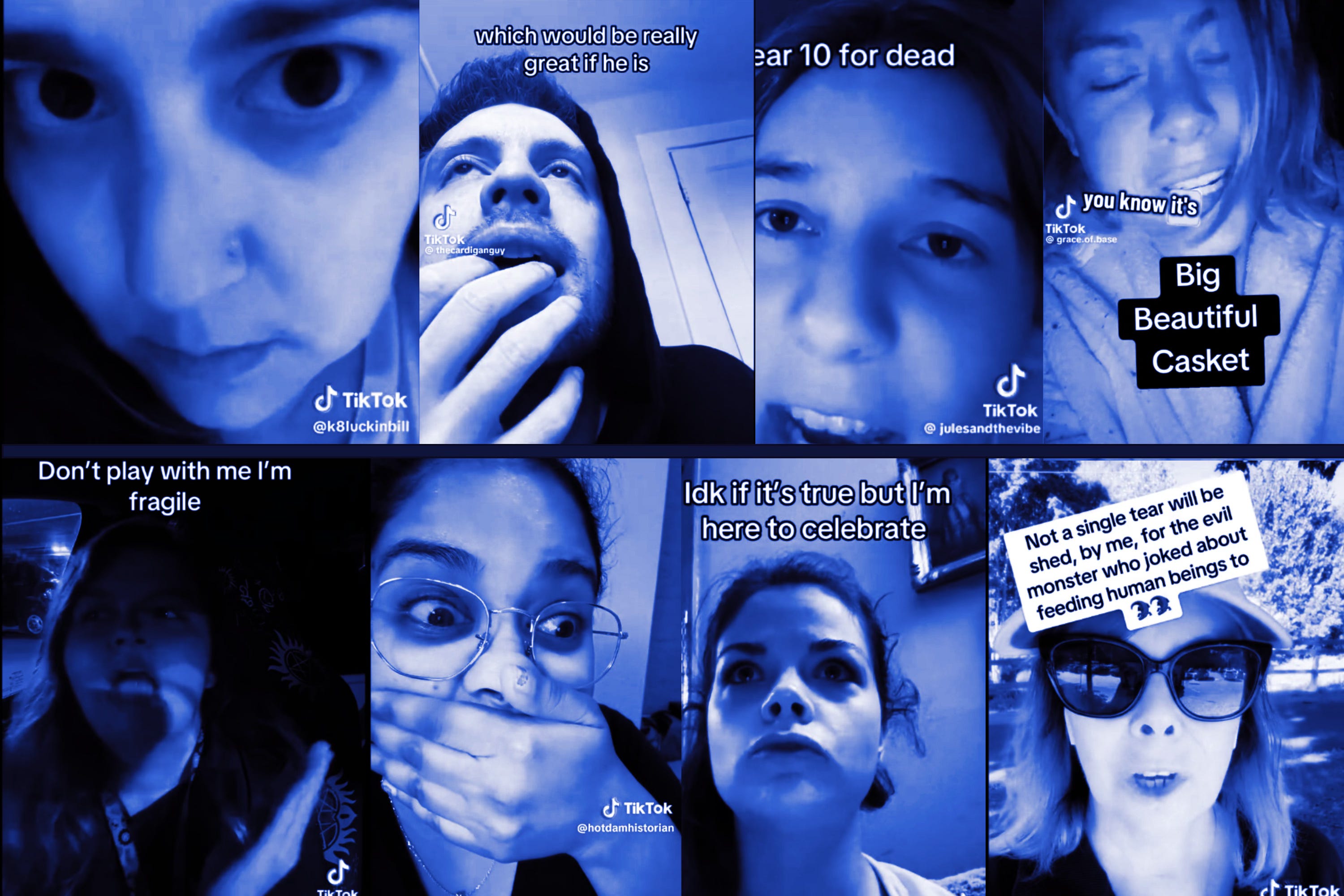
Free Thinking Through the Fourth Turning with Sasha Stone
Trump Derangement Syndrome: The Movie
00:43:28
Loading summary
Transcript1 lines
- [00:00]
A
Hi, this is Freethinking through the Fourth Turning. My name is Sacha Stone. Trump Derangement Syndrome the Movie the Democrats are trapped in a hell of their own making. Part three. I didn't just leave the Democratic Party, I ran screaming from them. On Friday night, I was reminded once again why the news hit X that Trump had died. It wasn't true, of course, but for some reason those who think that the only way to gain back power from Trump is to mess with him or troll him seem to think this was funny. Here are some tiktokers. Is Donald Trump alive right now? Please let the rumors be true. Please let the rumors be true. Please let the rumors be true. Let the gossip be reality. We, we need to remember that there's going to be two types of people out there. There's going to be those of us who are ecstatic that the day we've been waiting for has finally come and we can all just be singing and dancing and celebrating in the streets. Then there's going to be those other awful people who are miserable and angry and their anger is just going to be fueled by the fact that everybody's having such a great time and they don't get to participate. So I think what we need to do is bring back the circa 2010 World cup in South Africa, the most obnoxious noise in the world, the vuvuzela, and just day and night blasting the most obnoxious horn sounds everywhere through the air. So those people just have the most miserable time hating the sound that we're playing, hating that we're having a good time, hating that it happened. And we are all just smiling and enjoying, enjoying the moment. If it happened, I will literally do anything. Holy shit. Could it be? Could it be? Haha. Wouldn't that be a way to celebrate this weekend? Oh my God. What if it is happening? What if it happened? Obviously it didn't happen. Okay, I can't, I can't celebrate yet. Okay, obviously it didn't happen. But now I can't sleep. Wu Sha. I can't sleep. What if it happened? What should we do? If it happened, what should. How should we celebrate? Why would we celebrate? Why would we celebrate? Oh my God. Who are you? We can't wish people dead. We can't wish people dead. Who are you? Who are you? What? This man is responsible for hundreds of thousands of people dying. Okay, then let him just. Yeah, and then celebrate. We should be dancing in the streets. Should I get a drum? What? Obviously it hasn't happened. I'm getting Too excited. We've jinxed it. Like, why the hell would y' all go ahead and make me get my hopes up? Cuz if it's not true, I'm gonna be upset. What does everybody have on their playlist for the occasion? I'm starting out strong with some Noah mourns the wicked, going to some goodbye earliest getting a little pumped up to some unwritten. Of course we got celebration. Dog days are over, Party in the USA karma, a little bit of I don't f with you. Ding dong the witch is dead Celebrate. Pitbull Na na na na na na na na hey, hey, hey, goodbye. Another one bites the dust, highway to hell. And of course, closing out with I got a feeling cuz hell, it is a good night. We could be on the verge of having the best Labor Day weekend of our lives. I'm about to wake my toddler up and we are gonna go drive to the beach and watch sunrise at the beach. God, we need this as a country. We need this as a country. Let it be true. All right, everybody, let me get a show of hands. Who thinks he's dead and who thinks he's not? What's everyone's bets, everybody? Put them in. Now can I hear 10 for dead, 10 for not dead? Let's find out. I'm ready to celebrate. I'm ready to get drunk. I'm ready to smoke a j. I am ready. Y' all better not be lying to me though. I'm gonna be so disappointed. I have my hopes up so bad right now. Stop trying to get everyone's hopes up. You know damn good and well that we are not that lucky. A motorcade and two ambulances along with a helicopter seen arriving at and leaving Mar a Lago. If Trump is dead, I'm gonna start going to the gym tomorrow. If Trump is dead, I'm getting a tattoo. If Trump is dead, I'm getting three new piercings. Yeah, he gone. He's gone. He's gone. He's gone. Why is everyone on X saying that Trump is dead? Why? Why, why, why, why, why, why? They're saying it happened. They're saying it happened. And I believe it. I actually believe it. There's rumors going around that he's dead and no one is debunking them. Guys, what are we doing to celebrate? What are we doing to celebrate? When are we going to get mimosas? When are we going? What should I wear? But as usual, the left can't meme. It wasn't funny. It was chilling because of how obsessed with Trump they've been for the last 10 years, and how their hatred has boiled over into madness for podcast listeners trending topic showing Trump is dead. No one mourns the wicked it became a frenzy, a wild eyed Bacchanalia on TikTok. They were smiling and cackling at the mere thought of it finally happening. Here are some tiktokers if the one thing happens that everybody is talking about this morning and hopeful for, I think I will reconsider this whole religion, religion and God thing. Because he might be looking out for us, you know, even if he's not dead, which would be really great if he is. Even if he's not dead, the sense of community that has been established on the Internet surrounding the hope for his death as terrible news is it didn't happen. One person can't have everything. I can't be this hot and this talented and also get every single thing that I want. The universe is not going to give me everything. But what we did get, what we did get was just like a few hours, just a glimpse into what it might feel like one day when it does happen. And listen, I've seen those hands. I've seen those hands. That day's coming after all. The TikTok trend of when it happens has been flourishing on the app along with somebody just do it for quite some time. They're strung out junkies by now, hunting for that dopamine hit that comes from blurting out whatever shouldn't be said. Looking at their eyes, their crazy, crazy eyes, always makes me think of the Manson followers who had that same look, especially as they skipped through the courthouse while on trial for having slaughtered innocent people who were enjoying a hot August night in 1969 before the creepy crawlers came. I question his huh? Are you sane? Sane? Yes. That's relative. Van Houten claims she originally lied about Manson's role in the murders to protect him during their first trial. The conclusion at the time was that they'd been brainwashed by Charlie. But how he brainwashed them wasn't that different from how the left has brainwashed their followers. He surfed the wave of anti establishment counterculture, finding easy targets to dehumanize and blame. Are you angry? He seemed to say. Take it out on them. They deserve it. The evil was at the top. Cops were pigs. The rich deserved to die. Which is why when Susan Atkins, AKA Sadie, plunged the knife into the pregnant stomach of Sharon Tate, she only felt relief and a kind of euphoria for podcast listeners. An excerpt from a transcript of the trial. What else did Sadie say? She did. She said she was holding Sharon Tate's arms behind her, and that Sharon Tate looked at her and she said she was crying and said to her, please don't kill me. I don't want to die. I just want to have my baby, she said. And I looked Sharon straight in the eye and I said to her, look, bitch, you might as well face it right now. You're going to die. And I don't feel a thing behind it. And in a few minutes, she was dead. The left of today reminds me so much of my childhood growing up as a hippie kid in Topanga. During that time, I was too young to really remember the Manson murders, but I could sense the vibe shift in the wake of them. It was their inability to hold power, how the silent majority rejected them that transformed the make love, not war hippies into violent radicals. I also knew that we all believed religion was too oppressive, which is partly what birthed the counterculture movement in the first place. Sex, drugs and rock and roll only took us so far. I remember that too. I was a child of the narcissistic me generation, where kids were sidelined as adults, chased their bliss and found themselves. The rise of feminism also meant women adopted a false sense of security, and serial killers and rapists began sprouting up like mushrooms all through the 1970s. I remember the gas lines and the malaise. I remember the pendulum shift and how welcome it was when our culture finally became too exhausted of the hippies, especially after the violence, and opted for a different kind of life. Money and success were the fix in the 1980s. Mortgages, marriages, kids, jobs. But even that failed to do the trick. We were still broken and empty inside by the 1990s, just as the self help revolution and therapy culture arose in the wake of the FCC allowing pharma to market directly to consumers, we turned to the brave new world of psychologists and psychiatrists who would fix us, heal us from our trauma and abuse. After a while, though, how we were abused, what made us victims, would eventually become our identity. And for years, every time I met a man or anyone, I would tell my story of abuse. To put it all into context, see me as a victim, Feel sorry for me. In 2008, the Wall street bailout of $700 billion was the crisis that sparked the Fourth Turning, according to Neil Howe, who co authored the book with the late William H. Strauss. But it was an important year for another reason. It was the rise of Barack Obama, the iPhone, Twitter, and Facebook, while the Bailout would awaken the public and eventually birth two populist movements, Occupy Wall street and the Tea Party. The rise of Obama would be the religion we didn't even know we needed. It was a collective sense of purpose where everyone had a seat at the table, but mostly focused on marginalized groups. Everyone but the majority. We colonized the Internet as Obama built his coalition on Twitter, as civilization began to migrate into virtual spaces, and because we were all connected, we could decide the rules of behavior, of language, of status. We remade a new America online to address our collective trauma and abuse and build a better America. A shining Woketopia on the Hill. As wealth and power shifted leftward under Obama's rule, much of America's Rust Belt was abandoned. We didn't realize this as we tinkered with our perfect little world, our insulated bubble. We were so cut off that we almost speciated with an entirely different language from the rest of America. The ruling elites could find absolution by borrowing oppression. They could elevate the marginalized and use use them as a protective layer. As the populace began rising up against the government. The Democrats, as the party of the wealthy, had no need to address their needs or even acknowledge them. Turning the public against them by convicting them as racists in the media and in the court of public opinion served the Democrats well. Now they had an existential crisis because Trump was leading the populace and they were about to shock the world by winning. Trump's win would kick off Trump derangement syndrome, otherwise known as mass psychosis. Maybe it wouldn't have afflicted so many and gone on for so long if the people at the top, the Democrats and the ruling class, cared enough to calm things down. But they didn't. Having a public crippled by mass psychosis served their needs. Here is a video from after school. But what triggers the psychosis of totalitarianism? As was explored in the previous video of this series, the mass psychosis of totalitarianism begins in a society's ruling class. The individuals that make up this class, be it politicians, bureaucrats or crony capitalists, are very prone to delusions that augment their power. And no delusion is more attractive to the power hungry than the delusion that they can and should control and dominate a society. When a ruling elite becomes possessed by a political ideology of this sort, be it communism, fascism or technocracy, the next step is to induce a population into accepting their rule by infecting them with the mass psychosis of totalitarianism. This psychosis has been induced many times throughout history. And as Miralu explains, it is simply a question of reorganizing and manipulating collective feelings in the proper way. The general method by which the members of a ruling elite can accomplish this end is called menticide, with the etymology of this word being a killing of the mind. And as Meerloo further explains, menticide is an old crime against the human mind and spirit, but systematized anew. It is an organized system of psychological intervention and judicial perversion through which a ruling class can imprint their own opportunistic thoughts upon the minds of those they plan to use and destroy. Priming a population for the crime of menticide begins with the sowing of fear. When an individual is flooded with negative emotions such as fear or anxiety, he or she is very susceptible to a descent into the delusions of madness. Threats real, imagined, or fabricated can be used to sow fear, but a particularly effective technique is to use waves of terror. Under this technique, the sowing of fear is staggered with periods of calm. But each of these periods of calm is followed by the manufacturing of an even more intense spell of fear. And on and on the process goes. Or, as Meerloo, each wave of terrorizing creates its effects more easily after a breathing spell than the one that preceded it. Because people are still disturbed by their previous experience, morality becomes lower and lower, and the psychological effects of each new propaganda campaign become stronger. It reaches a public already softened up, while fear primes a population for menticide, the use of propaganda to spread misinformation and to promote confusion with respect to the source of the threats and the nature of the crisis helps to break down the minds of the masses. Government officials and their lackeys in the media can use contradictory reports, nonsensical information, and even blatant lies, as the more they confuse, the less capable will a population be to cope with the crisis and diminish their fear in a rat adaptive manner. Confusion, in other words, heightens the susceptibility of a descent into the delusions of totalitarianism. Or, as Meerloo, logic can be met with logic, while illogic cannot trump derangement syndrome. The movie begins there. It was never about Trump. He was what Alfred Hitchcock would call the MacGuffin in your films, and one of them is a MacGuffin. Can you explain what a MacGuffin is? Yes, a MacGuffin. You see in most films about spies. It is a thing that the spies are after. It's always called the thing that the characters on the screen worry about, but the audience don't care. As they chased their MacGuffin for 10 years, they had no idea that the real story unfolding was what happened to all of them. What happened during COVID during lockdowns? What happened to a group of people who were fed the Russiagate lie? And even now it has never been corrected or debunked. What happened to the people who were told by the New Yorker, the New York Times and the Washington Post that fascism was coming to America? What happened to the young people who absorbed and internalized the unending and relentless focus on the evils of Trump as the media cherry picked the worst things he said and dumped them into the churn? And all for what? To turn out voters when candidates don't drive enthusiasm. They never once thought using fear for that long would ultimately cause a mental health crisis. Crisis in this country, especially among the young. By 2020, I could no longer endure the daily ritual, the two minutes of hate. For one more minute, it felt like poison. I had to know whether it was true or not. Was Trump really all of these things we believed him to be? Or was he the guy we all remembered from the 1980s, the guy in Home Alone? Or was the worst case scenario true, that he was the Goldstein like figure from Orwell's 1984, used only to keep their voters in compliance and full of hate? There's a cancer, an evil tomb, growing, spreading in our midst. Shout propaganda, shout your own. Shout out his name. So I did the hard thing and I decided to find out for myself. I watched Trump's rallies heading into the election, all five a day. I saw his supporters for the first time. They were nothing like as described. They were intersectional, for one thing. All different races, gay people, even trans people. The one thing they had in common was that they did not belong to the ruling class and were not part of the doomsday cult. They were sick of Trump Derangement Syndrome, the movie. They were exhausted by it. They wanted to move on. So did I. For me, finally seeing that none of it was real, that Trump wasn't who I was led to believe he was, that he was the MacGuffin and his supporters were not mouth frothing brown shirts fueled by racism. And that meant for me, there was no going back. It took all the courage I could muster. My Soylent Green is people moment, my to serve man is a cookbook plea to say to them, it's not about race, it's about class. But class had been eliminated out of necessity. If America is a systemically racist country, then Barack and Michelle Obama are still oppressed, which gives them status. But some white guy strung out on fentanyl dying on the streets in Wisconsin is still an oppressor and has no status. Are they surprised the revolution happened to them? The Trump they invented never existed. The story the left has been telling itself is how Shakespeare once described life in the play Macbeth, a tale told by an idiot, full of sound and fury, signifying nothing. Focusing solely on Trump for 10 long years has meant they have never made any progress in solving the problems that put Trump in power in the first place. They've only hurt themselves because there is no version of this movie that comes to anything good. Should they take back power? What's their plan for the rest of the country that voted for Trump? Gulags? Mass deportation? Firing squads? This is my fifth such speech to Congress. And once again, I look at the Democrats in front of me and I realize there is absolutely nothing I can say to make them happy or to make them stand or smile or applaud. Nothing I can do. I could find a cure to the most devastating disease, a disease that would wipe out entire nations or announce the answers to the greatest economy in history or the stoppage of crime to the lowest levels ever recorded. And these people sitting right here will not clap, will not stand, and certainly will not cheer for these astronomical achievements. They won't do it, no matter what. 5. Trump Derangement Syndrome has all but collapsed the empire. With Hollywood barely clinging to life, network television hemorrhaging viewers, and a rising counterculture movement they can't keep up with. Their jokes aren't funny, their movies are unwatchable, their moral superiority is unbearable. Voters are fleeing like rats off a sinking ship. Here is Harry Enton. Democratic Brand right now has about the appeal with the American voter, as the cracker barrel rebrand has with the American consumers. Bad, bad, bad. What are you doing? Oh, my goodness gracious. What are we talking about here in terms of big party registration changes in the key swing states? Let's look at the key four swing states that in fact do keep track of registration by party. Look, the Republican Party is in their best position at this point in the cycle, since at least 2005. And all four of these key battleground states, we go out to the Southwest. Arizona. How about Nevada? Republicans haven't done this well since 2005. Oh, my goodness gracious. At this point in the cycle, North Carolina. I couldn't find a point at which Republicans were doing better. At this point in the cycle, it's at least this century. It probably goes way back in the last century. And Pennsylvania, very similar. Republicans doing better at this point than at any point at any point this century, at least as far as I could find. Now, what types of gains are we talking about here for the Republican Party? Well, let's compare it to this point during the first Trump administration, all the way back in 2017. Look at this. The Republican Party gains in party registration compared to this point back in 2017 during the Trump first administration. In Arizona, you got a Republican gain of three points. Okay, how about Nevada? Up the hill we go even though we're sticking in the Southwest, a gain of six points. How about again, we come to the East Coast, North Carolina, a gain of eight points for the Republicans. And in the Keystone State in the Commonwealth of Pennsylvania, again, we're talking about a gain of eight points. My goodness gracious for Republicans, they are converting old former Democrats to their side of the ledger as well as picking up new voters, registering new voters, and it absolutely paid off for them back in the 2024 election. Now, of course, Donald Trump has been president since January. Are there any bright spots for Democrats? Have they picked up any ground since January 1st in terms of party registration? Not in these key, these key swing states. These four key swing states. What are we talking about? Party registration margin gains since January 1, 2025. Which party's gain in Arizona? The GOP. How about Nevada? The GOP. How about North Carolina? The GOP. How about in Pennsylvania will make it 4 for 4, the GOP. The bottom line is this, Jessica Dean. When it comes to party registration, Republicans have made massive gains compared to eight years ago. They are in their best position in these key four swing states dating back at least 20 years. You have to go back at least 20 years, at least in the case of Nevada, longer in North Carolina and Pennsylvania. So Republicans looking pretty gosh darn good at least when it comes to party registration. And we'll see what happens down the road. But at this point, as I said at the beginning, the Democratic brand is in about as good a position as the cracker barrel rebrand. It is bad, bad, bad for the Democrats. The Democrats themselves have been recorded now as having no faith in the direction of the country down to zero for the first time in history. Here is Kellyanne Conway. Now, you rarely see a poll, Charlie, where The percentage is zero because there's a margin of error of about 3.5%. The Democrats can actually be negative 3.5% miserable. If you look at the cross tabs of this poll. By the way, everybody, this is self reported data. People are being asked, how do you feel? Since 1972, conservatives have consistently said that they are happier, more joyful in their everyday lives and have more stable mental health. These are self reported statistics. And so President Trump's accomplishments, 200 days of winning has just exceeded accelerated that misery for the other side. Folks, there's an old saying, if you can't beat him, join him. And it's about time to get on the right side of 80, 20, 90, 10 issues like crime, like lower taxes, like fewer regulations, like a secure border, peace through strength, the whole list of it. And Charlie, if you look at the cross tabs here, Nate Silver even pointed out this poll suggests that younger people are less happy, that more religious people have more joy, and that the conservative liberal dichotomy was the most distinct difference in the entire poll. More than age, race, gender, socioeconomic status, geography, work status. Think about that. Where you stand on how you feel mentally and in your everyday joy has an awful lot to do with where you sit on the political spectrum. Yeah, it's such a great point. By the way, the University of Chicago has been doing this happiness study for decades and they have found the demographic that's the most happy Are conservative women the least happy demographic? Liberal men, think Al Gore or you can name whoever you want. But I think it's interesting because, you know, why not? I mean, is it that especially now that Trump is elected, as conservatives become happier, they become less happy? And also the reaction to so many just normal things like crime going down, not happy about it. Or even the reaction to the tragedy at the Catholic school in Minneapolis. Such a pessimistic, awful way to look at it, like prayers don't matter. I mean, if prayers don't matter, it's going to be tough to get through life. Unfortunately, there is no snapping out of it anytime soon. They are trapped in a hell of their own making and have arrived at the abyss. Their great white hopes, such as Gavin Newsom and J.B. pritzker, seem to think that fighting back must also mean reflecting the mass psychosis that has distorted their perception of reality. Podcast listeners, a tweet by JB Pritzker. Trump says six people were killed and 24 people were shot in Chicago last weekend. And JB Pritzker, the weak and pathetic governor of Illinois, just said he doesn't need help in preventing crime. He is crazy. He better straighten it out fast or we're coming MAGA President djt And Pritzker says, why don't you send everyone proof of life first in parentheses? Either way, Chicago doesn't want you here. But the truth is, a great leader would be the one to help them out of it, offering rationality and critical thinking. A good leader would welcome Trump's help with crime to save mothers from having to worry about their children. But this is not a party that cares about them. This is a party that only cares about the ruling elite still stuck in the doomsday cult. Here is Nicole Shanahan's Trump Derangement Syndrome video. Are you or your loved ones suffering from illnesses such as tds, also known as Trump Derangement Syndrome? Or do you dismiss or deny the current issues facing our country, such as historic inflation, illegal immigration, corporate corruption, World War III escalations and the chronic disease epidemic? Are you willing to elect someone who was the least popular vice president in modern history and who offers no policy or vision for America simply because your brain keeps telling you anyone but Trump? If so, you might be struggling from TDS Introducing Independence Independence allows you the freedom to finally think independently once again instead of believing everything you hear from the mainstream media. Independence allows for constructive, critical thinking. I used to hear people on the news say things like Donald Trump and the movement he has encouraged are a threat to democracy, and I instantly believed it. With independence, I now realize the media is run by the Democrat elite, who are a corrupt oligarchy that censors free speech, silences political opponents, supports forever wars, and abandons democracy by anointing its candidates. Independence may not be for everyone if you enjoy being lied to about your president's cognitive abilities, support Orwellian totalitarianism, or are excited about communist fiscal policy. Independence may not be right for you. Common side effects of independence may include an awakening of rational thought, successful ethically identifying propaganda, freedom of choice, loss of hatred, anti narcissistic behavior, and love of democracy. I used to blindly hate whoever my party was running against. I didn't care about facts or policy because I was hopelessly indoctrinated with independence. I'm much more interested in policies that uphold democracy and I truly care about the health of our country and its citizens. Ask your doctor if independence is right for you and enjoy your freedoms. Once again, it should not be about Trump 10 years later. What has destroyed the Democrats and the left was never Trump. They could have easily beaten him, they just had to be a little less crazy. But they couldn't even do that. The voters had in Trump someone who could see the working class at all, let alone help them address their problems. But really, most of us voted for Trump as a way out. The Democrats have become so disconnected from reality that they believe it's acceptable to sterilize children and amputate their body parts, among other horrors. We're sterilizing a generation who will not be able to have their own kids. And we're altering their sexual functioning in a way that's going to make it more difficult for them to have loving relationships. Stephanie Nguyen is a licensed marriage and family therapist who is currently treating detransitioners and parents with children questioning their gender. Puberty blockers are not FDA approved for the treatment of a mental health condition. They're being prescribed off label for very young children. And we know for a fact that puberty blockers damage, among other things, brain development, also bone development. There is no such thing as a sane Democrat. Even those who seem semi sane, like Rahm Emanuel, will buckle under the question of gender affirming care. And that made voting For Trump in 2024 one of the easiest things I've ever done. And I was spend the rest of my life reminding every single Democrat that they not only went along with it, but they also fought to preserve it. They own this and every terrible thing that will happen in the next 10 years as children wake up and become adults and realize what has been done to them. That's just one of the reasons I think Trump is the great champion of this fourth turning the one we're living through now. Eight years ago, Neil Howe was asked this question. He wasn't prepared to answer it because Trump's presidency had not yet been tested. Here is Neil Howe. Trump obviously takes us more toward the climax. I mean, everything about the guy is sort of increasing confrontation with the expectation that if it goes well, I'm good, and if I totally break it, I'm good. You know, as we were just discussing, and I think that that kind of the outsider coming in who's willing to take on all outcomes is the kind of leader we're talking about. I would hasten to add that the gray champion figure, you know, when we think of the Abraham Lincolns and the FDRs and so on and these pivotal. Would Churchill have been a great champion? Oh, definitely, yeah. And they're all profit archetypes, meaning they're all born just after the late crisis. They all belong to a generation of sort of that profit archetype. And Trump is obviously a baby boomer if there ever was one. I mean, just everything about the guy, the huge ego and all that. So everything. And these are what great champions typically have, they have enormous ego, enormous self confidence. But the one thing I say is that these leaders are made, not born. It is circumstances which push them into making the right decision. It's not because they're brilliant. From the beginning, people don't forget that FDR was widely considered a lightweight. Coming out of school, coming out of it, with his Ivy League background, no one thought he would do much in his career. Obviously he was born with a silver spoon in his mouth and had a lot of appointments and he could, you know, he'd become governor eventually, but he was, and he was not even the odds on pick in 1932 to become the candidate. Obviously everyone knew that Hoover was toast and you know, Al Smith and all the other guys thought they had first place. So I'm saying there was nothing ordained about fdr. He came in and he ran on a balanced budget platform against Hoover, if you can imagine that. But he grew into it. He had qualities which allowed him in a fourth attorney to go the only place where you could go, given the logic of what was unfolding. And the question is whether Donald Trump may be that kind of person. If he did, we would see some quite extraordinary things. Things, for instance, gaining trust and gaining voter share, as hard as it may be to believe, particularly, and I've often said this, particularly if he gains that among the young. And that's completely unknowable right now. Again, all of these years later, it's hard to see Trump as anything else. Here's a video from Fast Fashion. Could Donald Trump be the Gray Champion of our era? Let's break it down. The term comes from Nathaniel Hawthorne's short story the Gray Champion, where a mysterious elder emerges in times of crisis to inspire and lead. Generational theorists. Strauss and Howe expanded this idea in their Fourth Turning Theory. They described the Gray Champion as a transformative figure who appears during periods of upheaval to guide the nation through existential challenges. In American history, Abraham Lincoln is often seen as a gray champion, leading the country through the Civil War. Franklin D. Roosevelt is another, guiding the nation through the Great Depression and World War II. Both figures arose during major fourth turnings, times when society had to completely rebuild itself. Now, some suggest that Donald Trump may fit this archetype and has even become the main character of this period of American history, especially in light of his stunning return to office in 2025. His rise and presidency also coincided with significant political, cultural and economic disruptions. Supporters say he represents rebellion against a status quo that desperately needed challenging. While critics see him as divisive at best and an existential threat to the nation at worst. But love him or hate him, Trump's leadership reflects the transformative energy described in Fourth Turning Theory. So what do you think? Is Trump the next gray champion, following in the footsteps of Lincoln and fdr? Or is this moment calling for a different type of leadership? Drop your thoughts below. And maybe that's why a death fantasy was their last best hope. Maybe deep down they know this is the end Trump Derangement Syndrome. The movie is nothing less than the rise and fall of a once mighty empire and a disastrous campaign that has all but destroyed the minds of a generation. What the Democrats don't realize or won't accept is that the pendulum wants to swing. So let it. But until they find their way out of mass psychosis, we should do everything we can to keep them as far away from our schools and our government as possible. It brings me no pleasure to watch the empire fall, but I always knew it would. We built an empire of lies. I also knew that sooner or later the truth would cause the whole thing to come crashing down. You can't stop what's coming. It ain't all waitin on you. That's vanity. Thank you for listening to my podcast sashastone.com hopefully I will be doing a fourth turning series coming up soon for paid subscribers. If you are a paid subscriber but you did not pay through substack but through another means like the tip jar which can be found on my site sashastone.com please let me know so that I can mark your email down as paid so that you can can hear it if you are interested. I hope you had a great weekend and remember to thine own self be true. As I walk along I wonder what went wrong with our love Although what I think of the things we've done together oh wow Our hearts over young I'm a walking in the rain Tears are falling and I feel a pain Wishing you were here by me to end this misery and I wonder I wa wa wa wa I wonder why why why why why why she ran away and I wonder where she will stay My little Runway I run run run run away Sa Wishing you were here by me to end this misery I wonder, I wonder why why why why why why she ran away and I wonder where she will stay Sa.